REVIEW: Aida Cuevas with Mariachi Aztlán

8:00 pm • Friday, November 4, 2022 • Hill Auditorium

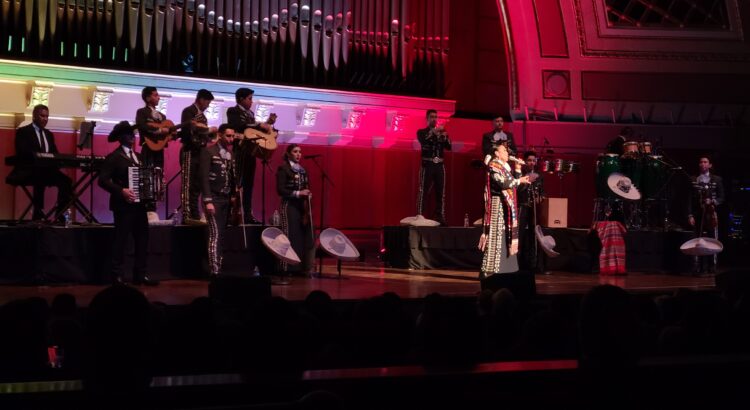
It struck me at some point during Friday’s performance that I was witnessing true mastery of an art form. Aida Cuevas and the musicians of Mariachi Aztlán–and their surprise guest, Valeria Cuevas, Aida’s daughter–demonstrated the kind of personality and confidence onstage that is only achieved by a lifetime of commitment to one’s craft. Aida in particular wowed me with her showmanship. Her banter with the audience felt warmly familiar, almost like they were all in on a little private joke. In a way, they were: conducted almost entirely in Spanish, the performance created a special celebratory bubble of Hispanic language and culture on a predominantly English-speaking, Euro-American campus. In an artistic environment that has historically been exclusive, Aida transformed Hill Auditorium into a space where Hispanics and Latinos were the insiders.

Little moments throughout the evening added to the mood of familiarity and celebration. Before the performance started, El Ballet Folklórico Estudiantil, a dance and mariachi company from Flint, performed a short set in the lower lobby, a space where audience and performers seemed to intermingle at one level, as one community. When I sat down in the auditorium, the couple sitting next to me made small talk for a moment, asking whether I spoke Spanish and suggesting that some 10% of the audience wouldn’t understand a word of the performance, but attended because they love how the music sounds. Later, in a particularly sweet moment, Cuevas wished a young audience member a happy birthday, having chatted with the teen’s mother via Facebook Messenger some time before the event.

The evening’s program took time to spotlight each performer, including the instrumentalists from Mariachi Aztlán. The improvised duet between the company’s pianist and percussionist especially has stayed with me–from my vantage-point on the main floor, I could see their hands flying across their respective instruments, exploring the synergy between their sounds. Near the middle of the performance, after Aida had left the stage to the band for their solos (and so she could complete a total costume change), her daughter, Valeria, entered in her mother’s place. Valeria’s voice balanced dynamically with her mother’s, adding richness to the program, especially their beautiful duet rendition of La Llorona.

Probably my favorite part of the evening was when Aida performed “El Pastor.” Aida’s voice is operatic in quality, and El Pastor exhibits her ability to deftly switch between vocal registers as well as her stunningly regular vibrato. She completed each of these challenging vocal maneuvers with ease; during the instrumental build-up to her vocal entrance, I even noticed as she jauntily tossed her microphone and caught it to reposition it in her hand.

If you didn’t make it to Friday night’s performance, I encourage you to take a look at the video attached below for a small sample of Aida Cuevas’s talent. One thing I know for sure is that should she return to Ann Arbor during my time here, I will be among the first in line for tickets.
 

REVIEW: Czarna owca (Black Sheep)

9:00 pm • Saturday, November 5, 2022 • State Theater • SPOILER ALERT: 3RD PARAGRAPH

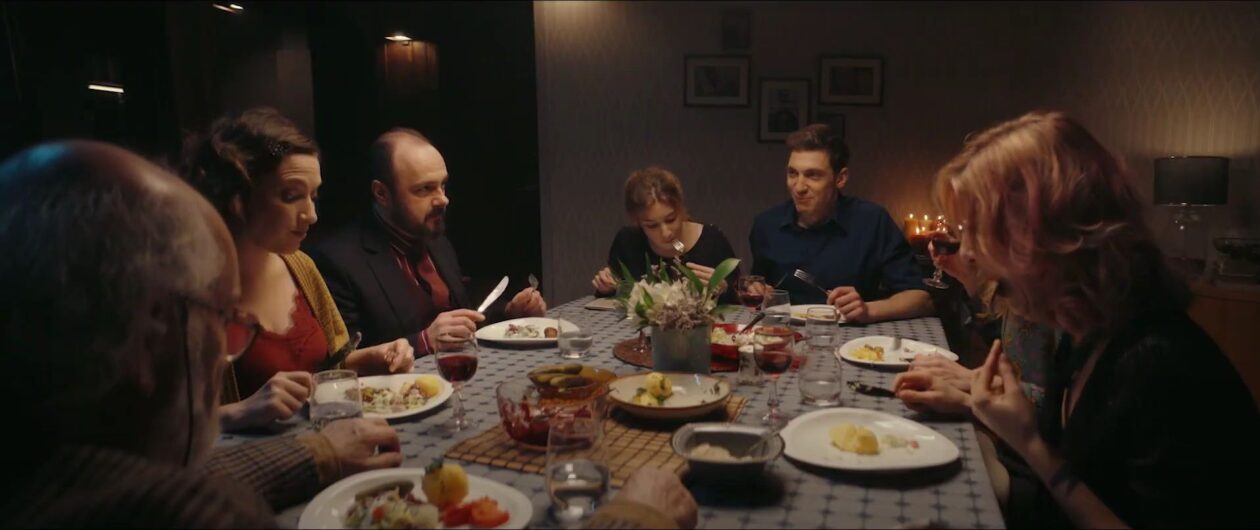
I was pleasantly surprised by the warmth with which Czarna owca (Black Sheep) portrayed its characters. As a family drama and comedy film focusing on the secrets hidden by its characters and how those secrets threaten the destruction of their family, I didn’t expect the characters to be likeable. But even in light of their foibles and poor decisions, moments of humor and kindness help support themes of love and growth throughout the movie.

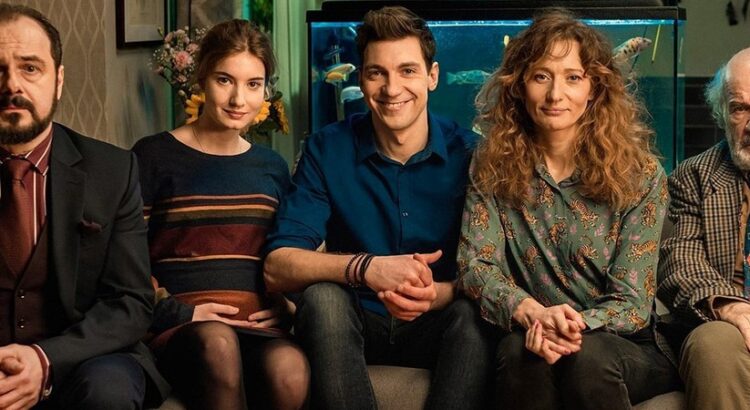
Czarna owca centers on Magda and Arek, a married couple celebrating their 25th anniversary; their son, Tomek (the movie’s narrator), and his girlfriend of five years, Asia; and their grandfather, an elderly man living with dementia. After an extended introduction of the characters and their existing relationships to one another, the plot begins when Magda comes out as lesbian to her family. From there, the family rapidly splits apart, each member coming to terms with their personal truths while finding ways to live apart. However, the movie focuses on how, even in their fractured form, the bonds that make the characters family still exist to support them in during their individual transformations.

While overall the film was a feel-good experience with several good laughs and a happy ending, there were moments of tropishness. I’m mostly thinking of when Tomek was hit by a car. It was so blatantly obvious what was about to happen, and the consequences were so few, I just had to take the scene in stride. It was like a punchline tacked on at the end, once all of the meaningful growth in the movie had already occurred. I also noticed that 90% of the funny moments in the movie were also included in the trailer, so I didn’t feel like I was getting an entirely original experience watching it for the first time. The plot and characters gave the jokes context, which made them more entertaining, but it was a little unfortunate that I already knew what was coming.

Additionally, I wasn’t sure what to make of the MAGA cap which showed up on one of Tomek’s co-YouTubers during the film. To be fair, Tomek’s friends were visiting the United States as tourists, so perhaps they saw the hat as a bit of tourist gear, or he was wearing it out of irony. And while the symbol of the MAGA cap elicits immediate, divisive reactions in the United States, I’m not sure what kind of connotation it would have in Poland. Whether intended positively or negatively, the hat did develop our understanding of Tomek’s character by demonstrating the kind of people he hangs out with. It let us question whether he is one of them, or something different–more mature–connecting closely with the themes of the movie.

Overall, I’m grateful that the Polish Student Organization was able to bring this movie to Ann Arbor for the night. It was a fun addition to my evening, and I appreciated the film’s statement that sometimes growing apart eventually lets your relationships become stronger.


PREVIEW: Czarna owca (Black Sheep)

What: a Polish comedy/drama film, brought to Ann Arbor by this weekend’s annual Polish Film Festival

When: Saturday, November 5, 9:00pm

Where: State Theater

Tickets: available on the State Theater website, $9.25 for students

Czarna owca, or Black Sheep, is a Polish drama and comedy about a family falling apart at the seams. Magda and Arek have had a successful marriage of 25 years, and are now living with their adult son, Tomek, and his girlfriend Asia, while taking care of their aging father. However, a series of secrets and revelations soon cause chaos, prompting each character to confront their own closely-held desires and fears, while finding ways to mend the tears ripping apart their family. At least, that’s as much as I could find out from the few online synopses available for this film in English. Much of the plotline remains a mystery to me, and I look forward to discovering this family’s secrets alongside the characters this Saturday night.

PREVIEW: Simona

What: a Polish documentary film brought to Ann Arbor by this weekend’s annual Polish Film Festival

When: Saturday, November 5, 2:40pm

Where: State Theater

Tickets: free with reservation on the State Theater website [click here]

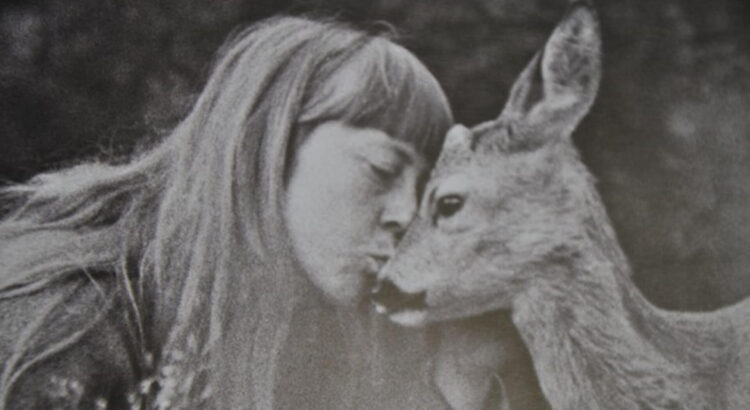
Simona is a documentary about the life of Simona Kossak, a Polish scientist and environmental activist. Based on what little I could discern from Google-translated Polish film reviews, Kossak, who was descended from a long line of famous Polish painters, was rejected by her family and chose to seclude herself in Poland’s primeval Białowieża Forest for the greater part of her life. There, she studied animal behavior and advocated for the preservation of the forest’s natural environment. The film explores Kossak’s eccentric life through the lens of her great niece, Ida Matysek, using photographs taken of Kossak by her life partner, Lech Wilczek. I hope the English subtitles for the film do Kossak’s inspiring story justice, and I look forward to learning about what seems like a magical life spent in one of the world’s oldest–and most threatened–forest environments.


REVIEW: Pressed Against My Own Glass


Entering the exhibit felt like walking into a home. In the doorway, I paused and thought, should I take my shoes off? 

I walked in to look at the first painting, and backed up a little seeing how big it was. Am I allowed to stand on this carpet? I wondered. Knowing the reappropriated furniture had originally come from the artist’s own home, and being used to the etiquette of museums, Pressed Against My Own Glass was refreshing in its way of inviting you in to interact with the art. 

The first painting stares at you with a piercing gaze that scrutinizes you and feels alive. Looking into your soul without so much as a raised eyebrow or any tell of effort being put into making up their expression, makes the gaze all the more powerful and unnerving. So much that I forgot to photograph her. The subject is in an intimate space in the portrait, wearing just a shirt and no pants, sitting in an unmade bed. But I’m the one who feels stripped bare.

This theme of intimacy continued to bear itself through the rest of the room. There are diary entries on the wall on the same side as the door. Right away, you step into exclusive, individual territory. Anyone could have seen the murals, whether they wanted to or not, but those who have come to the exhibit have come by choice. Tatyana rewards and welcomes that. This sets the tone for the rest of the exhibit. 

To put your journal pages, scanned, then blown up on a wall is incredibly brave, I thought.

There were entries about accomplishments, revelations, longings, growing. I shared sentiments with all of them, but the final one I read in the bottom right corner is a moment I feel most women are familiar with. The chastising, the incredulity at our own selves, our own hearts. I’ve had the same feelings over feeling so much about a silly little man, so much that I write about them, and now it’s tucked in the pages here for anyone to read, forever. 

The cracked lampshade, the laminate album of rusted ink photographs; I was really coming into a home. How she could lay down something so personal in a public space, give it up for an exhibition, baffled me. I would want to keep those artifacts close, not letting them leave my bedroom bookshelf. Not even laying the photo album open on a table, only taking it out to indulge myself once a year or so. Tatyana’s courage to lay down so much of herself for others to view inspired me immensely to take more risks in my own art.


Something that especially delighted me was the writing. Since I was expecting pure visual art, I loved the poetry and journal entries and letters. Tatyana collages together a photo, mirror, sketch, earrings, and poetry on the second wall. I love the expression of the girl in the photograph because in its position of covering the poem’s body, her face says, I know you want to read this poem, but hahaha you can’t!

Following right after was the mirror where I fixed my headband. It surprised me to see myself while forgetting my existence, after a few minutes of just perusing through Tatyana’s world.

Just when I thought it couldn’t get more personal, I was brought to tears by Tatyana’s letter to her lifelong (lives long) friend who had passed away. It was while I was reading the letter that I ignored a call from my sister (probably exactly what Tatyana would have discouraged) because I was halfway through and wanted to see it to the end without interruption.

On the fourth wall, was a video projected over a large body of text. The audio included mellow and haunting hummings, the repeated chant of “I made / met peace up in my home,” and a woman in tears singing, “when I think of home, I think of a place where love overflows…”

The clips were calm moving stills. They displayed the motions within a home, like rolling over in bed, humming amidst housework. There were also home videos, facetime clips, a mother getting interviewed with a baby in her lap.

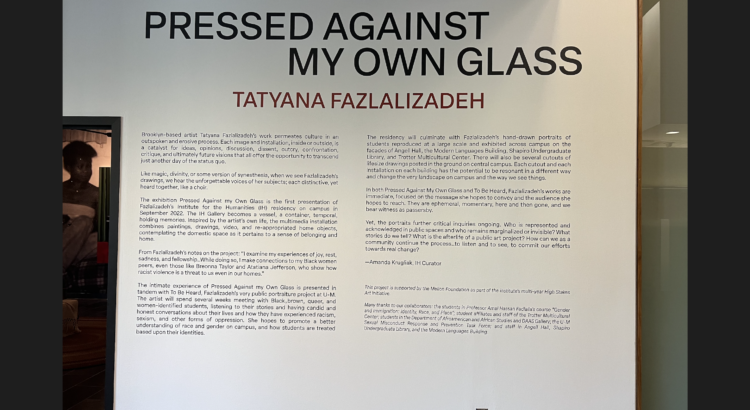
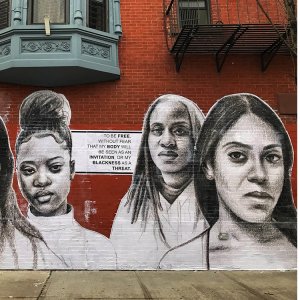
Beneath the projection, the piece reads, “despite the brutal reality of racial apartheid, of domination, one’s homeplace was the one site where one could freely confront the issue of humanization, where one could resist. Black women resisted by making homes where all black people could strive to be subjects, not objects, where we could be affirmed in our minds and hearts despite poverty, hardship, and deprivation, where we could restore to ourselves the dignity denied us on the outside in the public space of the world.” Put in context with the mural project, this exhibit demonstrated exactly that. The murals – all black and white, words bolded and illustrations blown up – were plastered high on buildings, yet, one could pass them without a glance. They resided in the outside world, where the weather’s starting to get colder, people are starting to rush, no time to take their time. The exhibit on the other hand, was lively with personality, colorful, secluded. A distinct sense of home: the oil paintings, personal artifacts, private words and stories. This is how it looks to see the full picture (even if we only uncover a small sense of a part of that person), while I understood the murals as how minorities are often perceived from the outside, paid attention to by onlookers: unsmiling, blunt, general statements, all grouped together. This makes spaces outside of the domestic household hard to feel truly like that of home, a sense of ease and comfort, “a small bit of earth where one rests.” Tatyana addresses this later in the passage: “An effective means of white subjugation of black people globally has been the perpetual construction of economic and social structures that deprive many folks of the means to make a homeplace.” The art was deeply personal and held many sentiments of loneliness, loss, and anguish, and yet, it definitely felt like a place of stillness, of silence, where one could “return for renewal and self-recovery, where we can heal our wounds and become whole.”

PREVIEW: Pressed Against My Own Glass

The last day to see Tatyana Fazlalizadeh’s art exhibition is this Friday, October 21st!

Pressed Against My Own Glass is a multimedia installation on Black womanhood within domestic spaces. “Fazlalizadeh explores her childhood and adulthood within the domestic space and how it connects to the experiences of other Black women and those who had a girlhood… While doing so, she makes connections to her Black women peers, even those like Breonna Taylor and Atatiana Jefferson who show how racist violence is a threat to Black women even in their homes.”

I’ve seen sneak peaks of Tatyana’s exhibit around campus, whether on a building on my way to my class at north quad, or the cardboard cutouts sitting on the grassy patches of the diag. I like the bluntness of her one-liner, accompanying statements with each portrait that point out flaws of the university and of her college experience. Each time I pass them, they feel like reminders to go to the exhibit, which I’ve been meaning to go to. I’m excited to see more of Tatyana’s art in the form of paintings, drawings, video, and reappropriated home objects, and the way she examines “her experiences of joy, rest, sadness, and fellowship in the home” through her art.

The exhibition is located at the Institute for the Humanities Gallery (202 S. Thayer Street). The gallery is open from Monday through Friday from 9am-5pm, and free and open to the public!