PREVIEW: Wendell & Wild

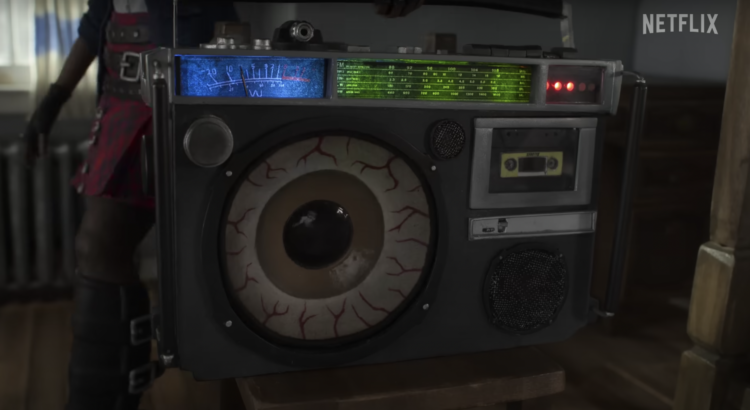
A great movie to get in the Halloween spirit! Director, Henry Selick (The Nightmare Before Christmas and Coraline) and producer Jordan Peele (Nope, Us, Get Out) team up to bring us this new thrilling stop-animation feature, Wendell & Wild.

I haven’t watched a lot of animated movies like this, but the claymation-like style seems to work well in many October-themed movies: Coraline, Wallace and Gromit, The Book of Life, etc. There is just an unsettling, chill-inducing look about them, and Wendell and Wild’s trailer alone gave me goosebumps. 

The main character, Kat, is a Hell Maiden, who needs her school nun’s help to protect her from her demons. Two of which are brothers, who trick this teen girl into bringing them from the underworld into the land of the living; chaos ensues. Although the film seems to be quite under the radar, it’s highly anticipated, and features an all-star cast (including Key and Peele as the demon brothers)!

The horror comedy flick is rated PG-13, and comes out on October 28th, only on Netflix, right in time to embark into spooky season and Halloween weekend!

REVIEW: Journey of Self-Discovery

Journey of Self-Discovery was quite a journey, indeed. I spent a good forty minutes perusing the paintings, scoping out the sculptures.

Upon entering the gallery, I chatted with the facilitator, who told me that two-thirds of the art had already been sold, as Rich’s work at the Dude was for sale through donation, the proceeds of which went directly to support a local grass roots food pantry ministry that serves areas of Ann Arbor.

The whole gallery, every space in it, was filled with a rich arrangement of whimsical paintings and sculptures. (Pun slightly intended.)

Hallucinations made me a little sick to stare at, like an onslaught of auras about to precede a migraine. A dark, whirling enchanted forest; walk through the maze and you’ll get woozy.

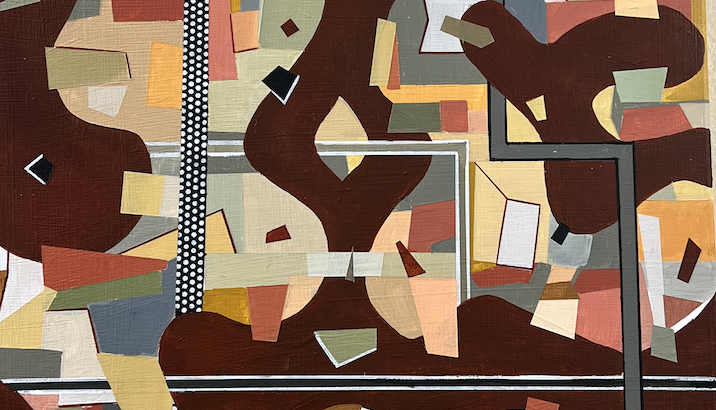
In Ignite, some of the scratched-off paint and its meddled, worn-by-time quality echoed graffiti. “ROM” in the corner made me wonder what other words might be hidden. The piece had the playfulness of a childhood scribble where we’d take our nails to a paper of crayon and get wax curled beneath them, but also the mastery of someone whose paid years of practice.

Spark’s thin, intricate mess of scrapes creates texture and noise. Almost like nails scratching against walls, it feels chaotic yet harmonious. It is quite a feat to achieve a composition of random shapes and colors with no recognizable pattern, that doesn’t border on busy, or unbalanced.

Are you there? haunted me, just from the title. I looked into the abstract and tried to pull something out. It took a few seconds, but I couldn’t help seeing a baby in a womb, floating, unattached to an umbilical cord, living lost in the guts of a mother.

Balancing Act feels like a futuristic, hypertech playground world, or the next version of the board game Chutes and Ladders. 

Future Daze gave off the lonely monotony of a city. I got a glimpse into the banalities of the everyday life of a citygoer. Vibrating with texture and pulse, peering into the painting feels like getting caught in a daunting big place, where you feel like one of millions of others. But the muted palette gives a sense of calmness, dullness, of having gotten used to it, enough to call this bustling place home.

I can’t help seeing some kind of creature in Concentricity, like a silly red panda or raccoon, calling out to me with crossed eyes, just to make me double-take in disbelief.

Junk Drawer Wisdom – a very interesting title. As if claiming it may be messy, but it’s an organized mess, because you know where things are in the clutter.

Suspension feels cakey, creamy; I don’t rly have the words to describe it, but it’s my favorite thus far. Maybe it’s the colors on the left or the texture that I have no idea how Rich achieved, but it feels like a unique ROM texture – a little Jackson Pollock, but more smooth than spattered.

Sitting Meditation was interesting. Especially because the rounded pod-like windows resemble the little apartments in the graphic novel, Apsara Engine. I would think a meditation calm, and maybe this one is, despite the overwhelming cogs-in-machine way about it. Because puzzle pieces are slotting into place, blocks are getting put away into boxes, things getting maneuvered into their rightful place. Thoughts are being stored away, put to rest, so the mind can quiet and not have all these anxieties sitting around, waiting to jump in. The white outline is like the cable in Monsters Inc bringing doors back to their homes.

Blast felt kinda mischievous. There’s a lopsided smiley face at the bottom center and a rounder circle encasing it. It reminded me of those No, David! children’s books because of the one spike on its head, which is so characteristic of a trouble maker (also like Jack Jack from The Incredibles). The black squiggles in the second quadrant are as if he just took to his hair with a pair of safety scissors, and mom is about to come through that yellow door on the right and have a heart attack when she sees him and the mess he’s made.

Tongue in Cheek is a potato cornucopia. A little potato society. There is a potato statuette, like the potato is on top of the world, sailing on a boat.

Got Dopamine? is fun: I couldn’t stop seeing all these silly faces in it. Maybe not all particularly happy or pleased expressions, but they gave me little bursts of dopamine.

Emerge looked like a mouth full of teeth and gums and bacteria, in full sickness. When will you emerge from your room? Pop off your bed? Not today.

I like the way Hanging ‘Round moves as you shift around it. This was just one of the many wood constructions and carvings, which all had so much movement for such a dead thing as the innards of a cut tree.

In Equine Driver, I see a sassy cat and a skirting teacup, like that of Chip from Beauty and the Beast. He is pretending to be a sailboat. Is the cat’s eye slanted at him, or the judgers?

Rhythmic Reverberation felt like it touched directly into my chest. I could hear the soundscape of nostalgic beeps and boops, glowing notes shooting through wires.


Forest For The Trees was fun. I had to wait to have my turn with this one. I witnessed a professor-like observer, an older man with glasses and a tweed coat, humming a sound of playfulness, of delight, humor, at shifting his perspective and seeing how the forest moves, like the whole swath of trees is turned on its side.

If there’s anything I’ve learned from walking around Rich’s gallery, it’s that the aesthetically pleasing – the ones that are easy to look at, that I’d be more inclined to buy or hang up in my house – are not the ones that tell a story, as much as the funky friends, the outcasts.

When I got home, my roommate saw Rich’s card on my desk and burst out in an accusatory smile, because apparently she worked there, at the Dude gallery! She had met Richie, his wife, and his family members who stopped by the exhibit; I had just missed her. I asked what he was like. She said Rich acts like his art. He talks with his hands, and does this thing when he talks, where he moves his head in a looping motion as if he’s drawing infinities with his ears. My roommate delighted in his art because she feels happiest when art, especially her own, is playful. I agree. Journey of Self-Discovery felt like a joyful, eccentric playground that you could dance through, get lost in.

REVIEW: Faculty Recital: Jeremy David Tarrant, Organ

I was first introduced to the haunting melody of the organ through the film Interstellar, directed by Christopher Nolan. Not only did I fall in love with the film itself, but with the resounding brilliance of the organ that shone throughout the soundtrack. If you haven’t seen the film, I would highly recommend it; the soundtrack is very moving.

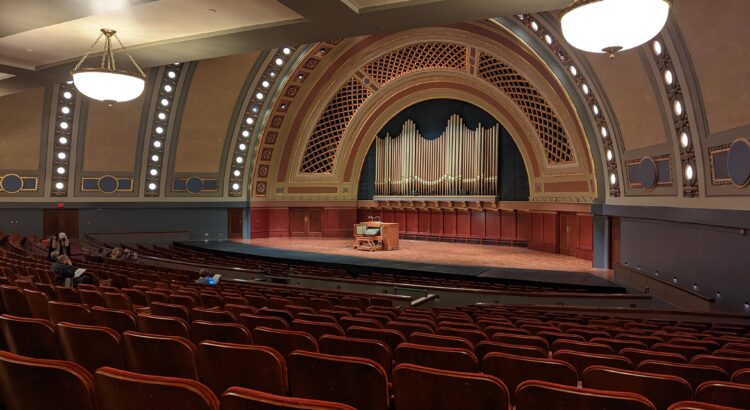
The organ is a fascinating instrument and a very difficult one to master as it requires great precision, technique, and coordination. There are multiple keyboards or “manuals” stacked on top of one another that an organists hands must move gracefully and deftly between. And at the same time, the organists feet are dancing along an array of foot pedals at the bottom of the instrument. I can imagine that playing the organ can be quite a work out. Jeremy David Tarrant, however, made it seem as though playing the organ was as simple as breathing. Of course, I’d expect no less. Tarrant’s resume is an impressive one. He is a Lecturer in Organ at the University of Michigan as well as an active concert organist. Tarrant has performed across the United States as well as abroad and has been featured on several records. It was an absolute joy to watch him perform. I knew the organ was a versatile instrument, but the way that Tarrant played opened my eyes to the countless ways organs can produce sound. There would be moments in the performance when the pipes would breathe so softly over the audience, only to explode in a thunderous wave that vibrated the seats. There would be moments  of whining sound that came close to hurting my ears as well as velvety tones that could put a baby to sleep. The sound was so much more than just loud and quiet, soft or hard. There were even moments where it seemed as though the music was coming from somewhere far beyond the confines of the stage as if in another room. The concert was an amazing experience and the music was superb. But what was also superb was the skills of the page turner that assisted Tarrant as he played. You can see the gentleman in question featured in the picture to the left. I found that he was creating his own performance alongside Tarrant. The gentlemen would wait patiently at Tarrant’s side; a single hand creeping up when he saw his moment approaching and then, with a swift flick of the wrist, the page would be turned, allowing Tarrant to continue his performance unfettered by the constraints of paper. I noticed that the rate of enthusiasm with which the page was turned was equal to the mood of the performance at that time. For example, if the page needed to be turned in the middle of a fast moving, sound swollen section, the gentleman’s whole arm would be involved in the turn of the page. It was a fast, sharp, extended motion. And when the page needed to be turned during a more soft spoken section, his actions would be soft spoken as well. It was a part of the performance that I found unexpectedly fascinating and very appreciative. I admire your talent unnamed page turner gentleman.

REVIEW: Trace Bundy

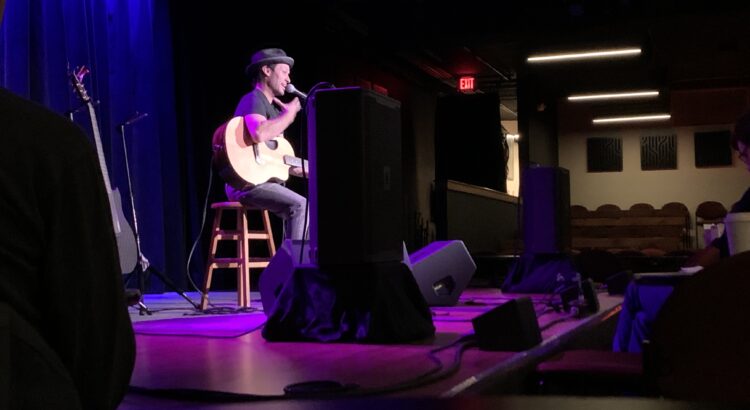
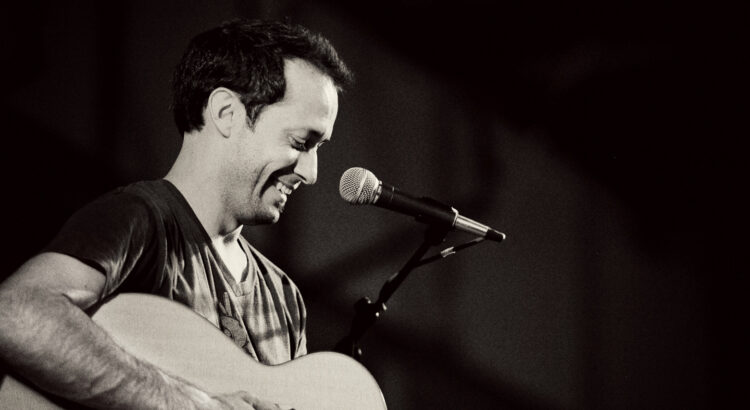
After an exam-dense week, Trace Bundy’s show was a breath of fresh air to end my Friday. On top of his flashy fingerstyle techniques, Bundy’s playful personality shined through. Maintaining a conversational tone throughout the performance, he truly created an environment that felt much like a laid-back living room jam session with friends.

Because it was my first time at The Ark, I did not know what to expect in terms of layout or general audience demographic. The venue seems to be run by volunteers who are all very passionate about sharing great music. I was pleasantly surprised by the casual seating around mini tables scattered across an open floor plan, so my friends and I grabbed a couple of hot chocolates from the stand and settled down in the front.

Bundy opened the show by giving a quick overview of the different fingerstyle techniques he typically incorporates into his compositions, including tapping, percussive thumping, and looping. This really set the stage for an ongoing discussion about the technical elements that were showcased throughout the set list, which was great if you like to geek out over that stuff (like me).

Each of the songs Bundy included in the set seemed to highlight a different concept, which kept the performance engaging and showcased his range. Here were some of my favorite bits:

  • Frankie Valli’s Can’t Take My Eyes Off You. Bundy introduced this as a recent project he took on inspired by the song’s ambiguous chord progressions, which he achieved using a myriad of customized capos (all at the same time, of course). Capos work by clipping to the neck of the guitar and pressing down across all the strings so that the resulting notes you play are shifted up by the same interval. However, by sawing the end off a capo or drilling a tunnel through, Bundy is able to only shift certain strings at a time.
  • Dueling Ninjas. This is one of Bundy’s original compositions from his Adapt album. Played entirely by finger tapping, he explained how each hand represented a ninja with a different personality.
  • Overtime. Bundy demonstrated how he used a delay pedal to create an underlying beat at one tempo and play in between at a slightly different tempo. This created an interesting rhythmical texture and hurt my head trying to grasp how he kept track of the beats.
  • Love Song. My personal favorite! Once again, Bundy brought out a handful of capos and somehow incorporated the procedure of clipping them on/off and sliding them around into the song like a choreographed dance.

I encourage everyone to keep Trace Bundy on their radar! I have a lot of respect for musicians who are not only eager to share their thought processes but are also able to present them in an accessible way to get everyone excited about something like music theory. Speaking to him after the show, I found that he is also just a kind and down-to-earth person. 

REVIEW: Superblue- Kurt Elling with Special Guests Huntertones Horns

What a night.

I can safely say that I’ve never enjoyed jazz music. The few times I’d been exposed to the genre, having stumbled across a jazz tune on Spotify or a video on Youtube, only served to cement my views on the subject: jazz was longwinded, jumbled, and didn’t make much sense. Let me now say that my past self was unequivocally wrong about jazz.

Stepping into the Blue Llama Jazz Club on a Saturday evening was like stepping into an alternate realm. The dark interior was dimly washed in hues of blue and orange light, highlighting the stage. Tiny pinpricks, akin to stars dotted the ceiling and each table had a single candle flickering in a bronze cocoon, beckoning us to our seats…And then the food began.

Right now you’re probably thinking to yourself: “Food? Isn’t this blog  post supposed to be about the jazz show??”

Yes, it is about the jazz show, but that will come in good time, because this show came with a meal, and by meal, I mean a seven course tasting menu sent from heaven. I, having the palette of a five year old child, had never imagined food could have so many flavors or textures. There wasn’t a single dish that wasn’t impeccably plated and served to perfection. As soon as we finished one dish, another would magically appear in front of us. I couldn’t understand half the words the server used to describe the delectable foodstuffs, but I was too focused on trying to keep from salivating to care much. I’ve attached some pictures of the meal for your enjoyment. The frozen grapes featured on the charcuterie board were a particular favorite of mine. We consumed a total of five tasting courses before the show began. At this point, I’d been enjoying the food so much that I couldn’t have believed that the night could become any more magical.

But then the band began to play. And Kurt Elling opened his mouth. And it was beautiful. And it was Jazz. There was this energy that was so potent at times that you could feel it raising the hair on the back of your neck. It wove its way through the crowd and up onto the stage, bouncing off each performer as they gifted their souls away to the river of sound powering into the room. I could feel the beat of the drum in my chest and the whine of the sax shivering down my spine.  You could see that they weren’t performing for us. Yes they were up on stage, yes we’d paid to see them, but they weren’t performing so much as giving in to the passion of the music.

I have never liked jazz music.

But, what a night. How could I not love Jazz music?


PREVIEW: Trace Bundy

Dubbed “Acoustic Ninja” by fans, Bundy crafts intricate guitar arrangements of popular songs and original compositions using harmonics, looping, and multiple capos. His dazzling techniques have taken him across 28 countries and garnered over 45 million views on Youtube. Back for his mini Midwest tour, the seasoned performer will be playing at The Ark this Saturday!

With a nickname like Acoustic Ninja, I felt compelled to dig deeper into his story. Outside of classical music, I love following fingerstyle guitar and the likes of Sungha Jung, Ichika Nito, Tim Henson, and Yvette Young. To my surprise, I found out that a young Sungha Jung had opened several of Bundy’s shows in Korea and toured with him in the US back in 2009 (check out their Billie Jean arrangement!). 

Fingerstyle guitar is not tied to a single genre of music and is mainly distinguished by plucking the strings with all five fingers rather than with a pick. Bundy has a personal bio on his website describing how he discovered a love for music theory and was shaped by the up-and-coming wave of musicians developing this complex playing style. I could definitely relate to the excitement fingerstyle brings, as there is so much space for innovation and experimentation. It has gained even more popularity in recent years, with younger guitarists like Marcin Patrzalek on America’s Got Talent receiving widespread attention. I look forward to seeing what Bundy brings to the table, especially since he once acted as a mentor figure for one of my guitar inspirations.

Join me to see Trace Bundy live at The Ark this Saturday, October 8th @8PM! 

Event info: https://theark.org/event/trace-bundy-221008/