PREVIEW: Oscar nominated shorts – Animation

2022 Oscar-nominated short films are playing at Michigan theater. It’s divided into three categories – live-action, Animation, or Documentary.

This year’s Animation nominations consists of five animations:

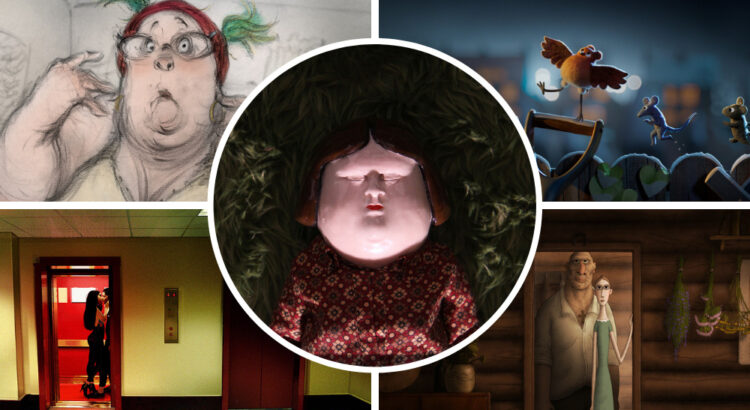
  1. Robin Robin (Dan Ojari and Mikey Please / UK) – A holiday movie featuring Robin
  2. Boxballet(Anton Dyakov / Russia) – a love story of a boxer and a ballerina, not just romantic
  3. Affairs of the Art (Joanna Quinn and Les Mills / UK/Canada) – This is about a factory worker who aspires to be an artist. It has unique drawing styles that has soft but vivid lines, like a pencil or conte
  4. Bestia (Hugo Covarrubias and Teo Diaz / Chile) – This will be a scary one, inspired by a violent secret police agent of Chile’s military dictator
  5. The Windshield Wiper (Alberto Mielgo and Ledo Sanchez / USA/Spain) – According to the director, the central question of this one is  “What is love?”

As can be guessed by the drawing style of each animation (please refer to the featured image if you want to check them out yourself), this combination seems to be different from the pleasant, heart-warming, and dreamy Disney fantasies. After all, this is an animated film rated R. Instead, they look a bit eerie and definitely unique; the LA Times described that they plumb the heart – and the heart of darkness“.

Passport to the Arts offers free student entry until March 22. For more information, please visit the Arts at Michigan Website. (Passport to the Arts – Arts at Michigan (umich.edu))

REVIEW: MENDING


In the quaint, well-lit corner of the Residential College, Jeanne Bieri’s exhibition of quilts, Mending, spends a three month-stay.

There’s something so intimate about quilts – blankets so well-loved, the material extra soft. The two comforters I flew in from home to my dorm are quilts. Most quilts have been personalized, gifted by a grandmother or someone of the sort.

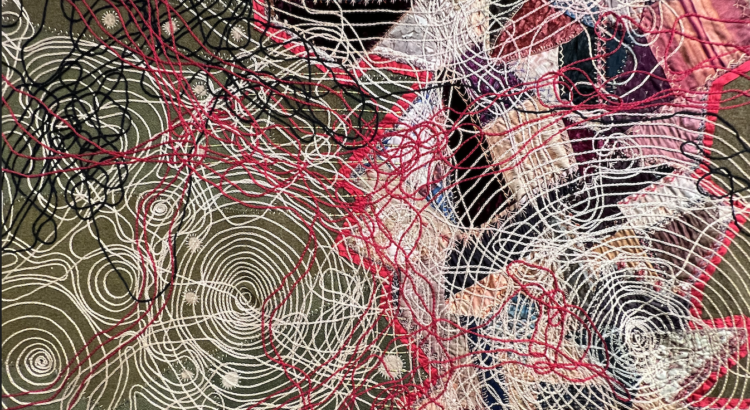
Immediately, the first quilt felt too delicate, too personal to touch. With elegant velvet and iridescent silk thrown over a backdrop of military blankets, the collection is an utter gem. With the help of relatively thick thread, fabric in jewel tones, wool, knit, corduroy, dye, and the occasional stain create patternless collages. Mixing the brightly bold with humble rustic, Jeanne describes how “the layering of quilts with army blankets tapped into my notions of duality, the scratchy army blanket and smooth quilt, one made of love, the other for war.”

I went through the gallery, slowly like this: Scooching close to admire smaller details, the windings and coils of string, then backing up to take in the whole thing, before glancing over to the previous ones I viewed too. I had music playing, and the stories within the quilts were speaking louder.

The movement of the pieces are so fun. Orange Dot has my eyes trailing along its seams, up-down, and like a game or an animation, it moves. Some are so long they fold back and forth in ribbons on the floor – like poured chocolate. The different stitch patterns in Crazy Quilt reminded me of animal tracks, while the larger whole was a map. 


Night Wash contains two twin rivers flowing over a tattered old oil painting, whose ripped edges ripped off to reveal a more colorful culture and history inside.

Tied feels like a landscape, with living organisms and tribes of centipedes snaking between Earth’s crust and plates. The spots and circles resemble bacteria, or eyes. The stitches dotted around the outline of each shape could be wiggly pili or eyelashes.

Orange Drift is funky and fun. This fresh, dress-shaped quilt flaunts colorful seams and embroidered little things like initials and butterflies, flowers, zigzags along the bottom hem, x’s and loops

My music suddenly glitched out – rewinded, went 3x fast, then skipped to a new song with a bubblier beat – a testament to this quilt’s powers.

Properly spooked, I felt struck. Moved. It might sound silly, but these beautiful blankets also gave me the courage to ask the East Quad pianist what song he’d just played, because staring at those quilts while hearing “All I Ask of You” from Phantom of the Opera for the first time was a spiritual experience, man.

I just had to visit them again, the next day. 

I saw scribbles, webs, those circles that looked like viruses blown up through a microscope. Everything was connected, woven together, and somehow this made me think of how the internet has so much info about us, and it’s gross and creepy and dangerous. How traces of someone are always left behind. How even walking in circles can broaden and slowly get you somewhere, out of that hole. How we’re never going nowhere.

I like the spastic squiggling in Clara’s Ribbon and the sneak-ins like the embroidered scene of a bear getting into a barrel of fish, a patch of light-wash pink denim.


Back to Orange Drift – where what looked like closed tulips and Christmas tree lights danced along the silk patches. Then in Barcelona Morals, a subtle appliqued then stitched “margin good” and an innocent bee sat, staring me in the face. If I missed that, what else had I missed?

Upon digesting the fact that there were enough covert details for me to create a damn youtube channel dedicated to relaying all of Mending’s easter eggs with a giant yellow arrow in each thumbnail, I gasped, distraught. Just how long did it take Jeanne to make all of these? I longed to send her a coupon to that masseuse I visited after finals season had seriously fucked my back.


I was especially touched by the story of how textiles connected Jeanne to distant reaches of her family tree. “When I was given one of my Great Aunt’s quilts, I was put in touch with a group of relatives I’d never met.” Her genetic code revealed a shared creative impulse within these women, and in receiving passed-down quilts, she “sensed a tongue in cheek humor within their group.”

I can speak to the great comfort in hand-me-downs. Fabric and garments themselves, I find awe-striking in their painstakingness of stitches. But wearing my family’s old clothes – especially my dad’s or grandma’s (who have both passed) – is a feeling I hold really dear to me. I may not remember their voices ever clearly, but I can flip through an old photo album and say, ha! we’re wearing the same thing.

I never knew that quilts could carry so much personality; I always just loved the homemade, lots-of-thought-and-care aesthetic of them. As someone who hoards scraps of – you name it – fabric, magazines, old letters – with the intention of collaging old materials into something new and deeply personal, I admire Mending and all of its hand-stitched dedication. There’s a whole world waiting to be explored in each of Jeanne’s quilts; I could honestly spend all day looking at them and the hidden surprises they hold.

Read Jeanne’s lovely personal description of Mending here:


REVIEW: The Philadelphia Orchestra – Night 2

After Friday’s phenomenal concert, I was almost worried that Saturday’s concert by the Philadelphia Orchestra could not possibly measure up to the impossibly high standard of the previous evening. However, as I should have expected, the Philadelphia Orchestra did not disappoint! The second evening’s program included Sinfonia (for Orbiting Spheres) by Missy Mazzoli, Violin Concerto No. 1 in g minor, Op. 26 by Max Bruch, and Symphony No. 9 in C Major, D. 944 by Franz Schubert, and was conducted by Nathalie Stutzmann, Principal Guest Conductor of the Philadelphia Orchestra.

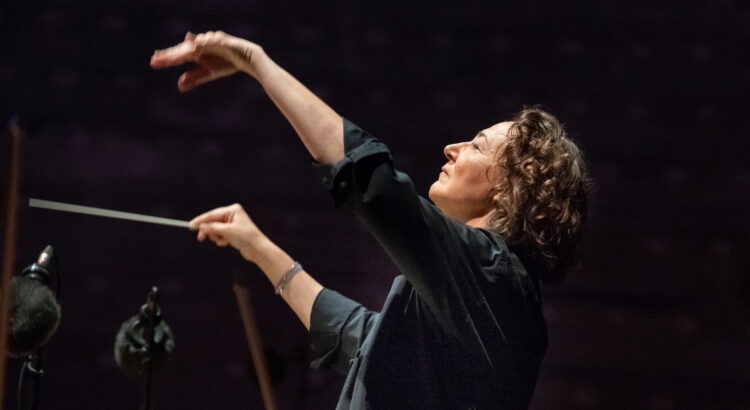
Ms. Stutzmann presided over the orchestra with a joyful and dynamic ease, and I must note how exciting it was to see a professional orchestra concert conducted by a woman – an unfortunately rare occurrence, and something that I had never actually experienced before this concert. Indeed, in addition to her position with the Philadelphia Orchestra, Ms. Stutzmann (who is also an accomplished contralto singer) was recently named the next music director of the Atlanta Symphony (beginning with the 2022-23 season), making her only the second woman ever (and only woman currently) to lead a major orchestra in the United States.

The program was similarly exciting. I was not familiar with contemporary composer Missy Mazzoli, whose ethereal, atmospheric piece Sinfonia (for Orbiting Spheres) opened the concert. Mazzoli aptly describes her composition as being “music in the shape of a solar system, a collection of rococo loops that twist around each other within a larger orbit,” and “a piece that churn and roils, that inches close to the listener only to leap away at breakneck speed.” Threads of music wove in and out, ebbing and flowing in a way that was simultaneously challenging, fascinating, and enjoyable.

Next, the Bruch Violin Concerto No. 1 in g minor, Op. 26 featured violin soloist David Kim, Concertmaster of the Philadelphia Orchestra. His interpretation of the piece, a standard for violinists, highlighted exquisite control, technical proficiency, and expressivity that was a privilege to witness. As I often gravitate toward the slow movements of pieces, I especially enjoyed the concerto’s second movement, the Adagio. The violin sings above the orchestra throughout, and the movement ends superbly peacefully.

Finally, after an intermission, Schubert’s Symphony No. 9 in C Major, D. 944 was a fitting close to an evening of excellent music. As with Friday evening’s program, it showcased the Philadelphia Orchestra’s rich sound, and particularly their world-class string sections, in a way that listening to recordings cannot capture.

The only disappointment about Saturday’s concert by the Philadelphia Orchestra was that, unlike Friday night, it did not include an encore!

REVIEW: Dance Mix 2022: Roaring 20’s

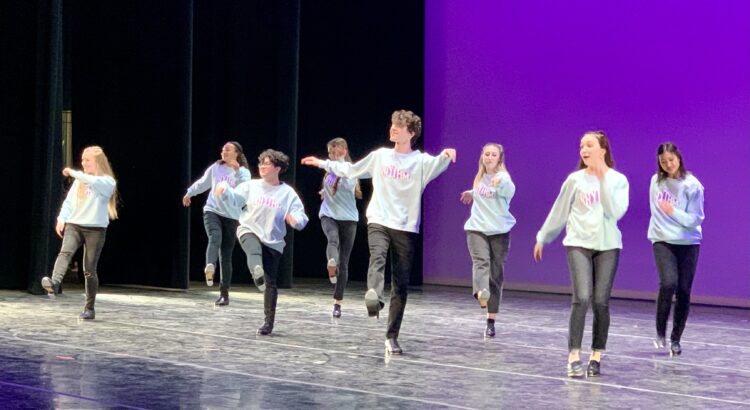
As the audience slowly filed in to the Power Center last Friday, excited chatter and laughter spread throughout the packed room. Anticipation filled the room as introductions were made, along with a touching tribute to previous students who had graduated without a chance to perform at Dance Mix due to the pandemic. The show started off with a series of energetic performances, as EnCore performed their first set and were followed by Revolution, who gave dazzled with their unique yoyo sequences that were choreographed to the music. Although RhythM Tap Ensemble put on three different sets, I would say my favorite was their Mamma Mia set, where they wore costumes resembling those in the movie. The Michigan Ballroom Dance Team also put on quite a performance, with the pairs completing spin after spin. I also loved the enthusiasm brought by the hip-hop groups KGayo3 and Dance2XS, both of which brought the house down with their fast and complex dance moves and popular music choices. 


The audience remained energetic throughout the show, granting each group a tremendous round of cheers and applause. What made the show stand out to me was that groups from so many different styles of dance were able to come together to create a diverse and entertaining performance. It was also incredible to witness students display their artistic talent as they performed self-choreographed routines. The night ended with a lively and humorous performance by the all-male group FunKtion, who then joined the rest of the groups to take their bows, all coming together to celebrate a very successful show.

REVIEW: The Philadelphia Orchestra

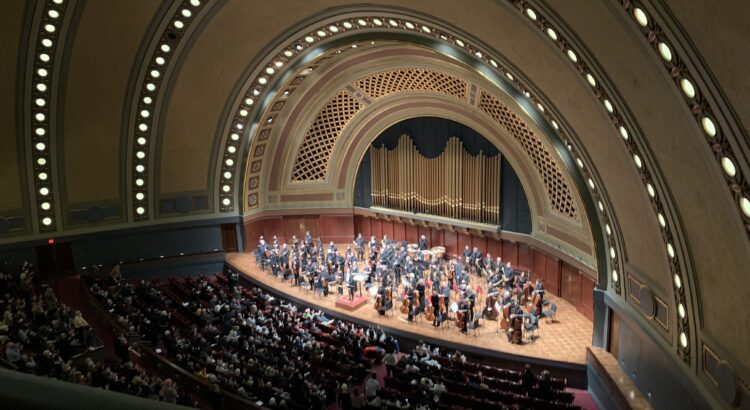
Call me biased, but one of the best parts of being a violinist has to be the concertos. They’re iconic, flashy, and for the musician playing, career-defining. The Bruch Violin Concerto No. 1, in particular, has a special place in my heart, so I was delighted to hear that concertmaster David Kim would be performing it alongside the Philadelphia Orchestra at the Hill Auditorium in concert last Saturday evening. A quintessential staple of violin repertoire, the piece truly comes alive with the many different interpretations by its players.

Opening the concert, however, was a more avant-garde piece by contemporary composer Missy Mazzoli. The Sinfonia (for Orbiting Spheres) sneaks in with a distinctly soft, grainy texture provided by violin and harmonica before expanding to bellowing slides in the lower strings. A mixture of serene and ominous, the composition gives off the impression of irregular, interfering sound waves to convey the vastness of space. Due to its unique instrumentation, they had to take some time to switch out quite a few instruments before the following concerto!

If I were to give one word to describe each movement of the Bruch, I would say intense, longing, and triumphant. However, what makes the concerto so compelling is the complexity of emotion that lies within each category. The violin enters the first movement with a subtle, unassuming G, before erupting into crisp double stops and finger gymnastics. The orchestral passages here, a textbook example of tension-building, are somehow just as attractive as the solo. David Kim’s version had an unmistakably sweet quality, which particularly shined when he got to the slower second movement. From the balcony, I had a great view of his precise bow control which allowed for both a timid, “held back” sound and an unhindered singing voice above the orchestra. In contrast, Kim’s third movement was light, clean, and playful despite the heaviness of all the chords. It was a pleasure to be able to hear in person.

Concluding the concert was Schubert’s Symphony No. 9 in C Major. I had never heard it before, but a particular amusing comment written by Doyle Armbrust of the Spektral Quartet in the program guided my listening: “Franz Schubert wanted to be an opera composer with all the desperation of a hollow-eyed film school grad shopping a script from his garden-level studio in Burbank. My take on him is that he would have been a lot like that one friend — you know, the one who appears to have taken up permanent residence on your couch, but is somehow redeemed by his charisma in conversation?”

The symphony interestingly begins with just horns. A lighthearted melody gets passed around the orchestra like a breath of fresh air—this is later bolstered by bass drum and big, operatic tuttis. Nathalie Stutzmann conducts with an infectious swagger, which I enjoyed watching here. My favorite movement was probably the second one, opening with a plucky oboe solo over a quirky, mysterious, tiptoeing base of strings and interrupted with sudden outbursts of emotion.

Overall, the concert program brought forth a lovely combination of familiar and unfamiliar sounds. As expected, the Philadelphia Orchestra did justice to these works!

REVIEW: Perspectives: An Exhibition of AAPI Expression

I came to the exhibition severely underdressed. Upon entering the gallery, I was greeted with warm lighting, a spaced out selection of art – giving most pieces their own living space to breathe – and a room full of artists and patrons of the arts. Most are dressed well, not to the nines, but in knee-length black dresses or cardigans, getting semi-formal down to a tee. That label was always a bit confusing for me– what constitutes semi, and how much is too formal? Either way, it didn’t matter. What everyone really came here to see was the art.

Placed in each corner of the room, projectors loop videos, rerunning the media art. For the photography, there are display boards that MA:E and the photographers hammered in themselves. Most of the paintings and fine art span the walls, a couple placed in the center of the room.

After the opening remarks and an acknowledgement about the term AAPI and how it generalizes an incredibly diverse community, especially for Pasifika communities, the gallery tour begins. We roam like sheep, tranced by each new work. Everyone cranes their necks to get a better look, arching around one another to see fit. As much as I enjoy how art is in the eye of the beholder, I like hearing directly from each artist. They explain their intentions specific to each piece and the personal meaning behind their art. The distinctness of each artist’s style and voice, and the unique experiences that shape them, are especially apparent.

Some of the pieces that stood out to me:

Riya Aggarwal’s highly-detailed, depthy paintings immediately caught my attention. Each piece flaunts a deliberate to-the-brim intricacy, yet deftly skirts around appearing too busy. I liked how the content of Riya’s paintings were neither black nor white: she specifically explores the cultural tension between “following in the footsteps of my ancestors and creating my own path.” I admired how her artwork elicits feelings of both pride, celebration, and conflict. In True to My Roots, the dark background, body language, and facial expression of the subject evoke a gripping emotionality. 

True to My Roots (2020)

Keri Yang’s paintings pop off the page. I like how even the non-3D elements push the limits of their dimension and create visual allusion. Soulmates plays with border, as the subject encroaches outside of its backdrop.

Soulmates (2021)

Perched high up on the wall, taller than the artist herself, is Michelle Ha’s The Girl with the Iron Fist. With her art, Michelle hopes to “represent Asian American experiences by focusing on representing true narratives rather than focusing on the suffering that prejudices bring.” The lighting in the bathroom of the painting is synonymous to the ballroom’s dim ivory brilliance. “With oil paintings historically being about possession and male pleasure in the western context, I bathed my subject in the light of reclaiming that gaze.” I like how the subject looks half taken off-guard, half-bored yet unwavering. Through peering at the audience, this subject, performing the mundane task of brushing her teeth, confronts “the biases the audience has about East Asian American Women. On another layer, by showing the subject doing an activity anyone may do, I make the experience of being an East Asian American woman more accessible to those that find it hard to find empathy with those different than themselves.”


The Girl with the Iron Fist (2021)

Dorothy’s Masked is striking, from both afar and up close. From across the room, at first I thought the aquamarine on the girl’s face looked like tears. The painting emphasizes the importance of masks, and Dorothy chose her subject, her friend Angela, “because of the increase in racism against Asians at the time since the AAPIA community was being blamed for the virus.”

Masked (2020)

Angeline Tran’s Missing Eye, “an experimental top made of denim, selvage, and buttons sewn together both by machine and hand,” was my personal favorite. The material is sewn “to overlap itself and create the illusion of an eye socket and the buttons are placed in the middle, depicting the pupil.” With one eye lying on the breast, and the other at the belly, the garment represents heart and gut instinct. I loved this piece because of its visual attractiveness, message, and frankly, because it’s just so cool. It was also one of the only 3D, sculptural works in the gallery. I am just starting to take a STAMPS sewing mini-course, and hope to take a garment construction class in the future. As someone who expresses creativity largely through writing, exploring visual mediums has been a therapeutic, refreshing process. Angeline’s inventiveness and utilization of scrap material and selvage inspires me to create with intention and take risks with garment sculpture!

Missing Eye (2021)

Event Program: https://www.yumpu.com/en/document/read/66499721/perspectives-gallery-digital-program