REVIEW: Who Am I? Art Exhibit & Interactive Activity

In between struggling to get words on a Google Doc for that final paper and ordering another cup of cold brew, I found the time to slip away to the Who Am I? Art Exhibit located right outside the Michigan Room in the Union.

Presented by the Center for Campus Involvement, the exhibit showcases the work of fellow UM student artists. With the Union having been recently renovated, there are efforts to fill the walls with art. And what better than art from fellow, talented Wolverines. Students were asked to respond to the prompt, Who Am I? with an art piece. The displayed art takes many creative and unique directions, such as focusing on one’s initials or fashion styles.

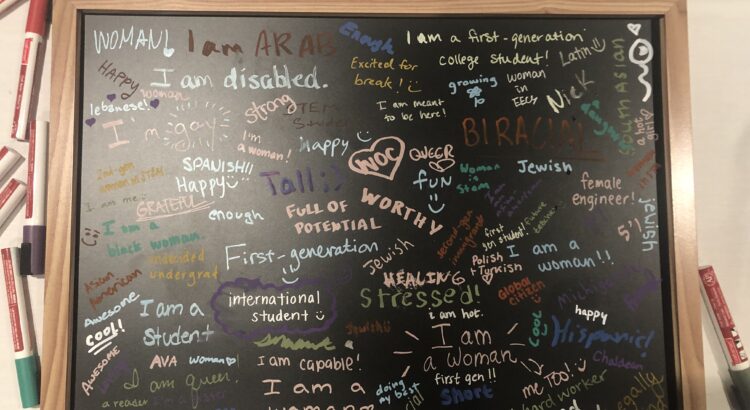
This past Wednesday, Dec 8, there was an opportunity for students to take a moment answer the question themselves. This interactive component consisted of a chalkboard of different students’ answers. Ranging from answers of “first-generation student” to “a leo,” the board is a bright collage of varying handwriting styles and doodles. It’s reflective of our school community and I love its location in the Union, a central part of campus. I look forward to seeing more opportunities to submit artwork and watch the walls fill up with beautiful art.

The question ignited a bit of self-reflection, who am I? Right now, I’m simply studying (more like procrastinating) recorded lectures and notes for this upcoming week of finals. I hope to give the question more attention after one of many 11:59 PM deadlines. But if you are anything like me, you too can slip away from Canvas and take a look at the artwork during building hours up until Dec 17.
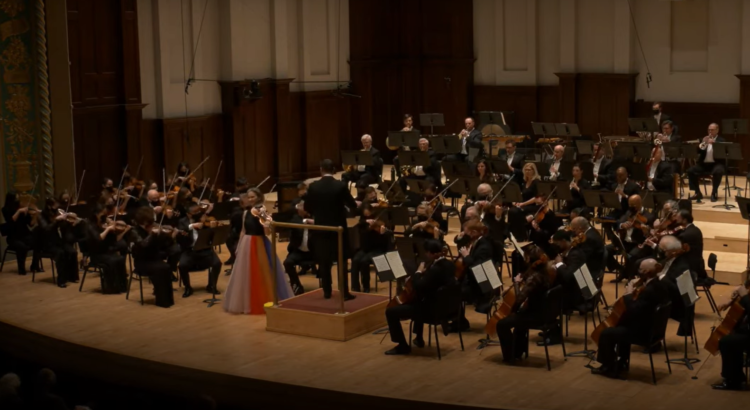
REVIEW: Jader & Hilary Hahn with the Detroit Symphony Orchestra

Home to the fourth oldest orchestra in the United States, Orchestra Hall is truly a magnificent venue. December turned out to be the perfect time to visit, as the holiday-themed pine garlands and twinkling string lights in the lobbies paired beautifully with the red carpets and warm lighting to evoke the Christmas spirit. As a testament to Hilary Hahn’s influence and outreach work, I noticed that the audience had a notably larger proportion of younger attendees than what one would typically find at a symphony concert—including me and my four friends, of course. I found it funny when one friendly usher asked which one of us was “the violin player of the group,” and we all raised our hands. 

The DSO opened the concert with Bedrich Smetana’s Overture to The Bartered Bride, a bright, vivacious piece full of moving notes and striking dynamic changes. Still groggy from the trip from Ann Arbor, I found the piece was a great opener to sit back, build excitement, and appreciate the crisp acoustics of the hall.

Next, Hilary Hahn took to the stage to perform the Dvorak Violin Concerto in A minor. Distinctly contrasting with the previous piece, the concerto featured a dramatic introduction that showcased Hahn’s virtuosity—namely some pitch-perfect runs climbing up the fingerboard and ending with her insanely powerful fourth finger vibrato. I was amazed by how clearly her sound projected over the orchestra to our seats in the balcony. The second movement took on a more somber tone, with a dark-yet-sweet melody echoed by the flutes. Meanwhile, the final movement was clean and bright, playing with a delicate, bell-like motif introduced by the soloist at its beginning. Cue the standing ovation. 

Going off the program, Hahn took some time to say a few heartfelt words about the recent tragedy at Oxford High School and dedicated a solo piece she often plays alone when thinking through things. In this new context, the unaccompanied Bach Sonata for Violin Solo No. 2 in A minor, Andante adopted a whole new depth of emotion. In that hushed room packed with hundreds of people, the longing, sustained melodic line sung over an underlying current of pulses, like a heartbeat. 

After intermission, the DSO performed what is probably Smetana’s well-known piece, The Moldau No. 2 from Má vlast. The piece took the audience on a journey along a great river of the same name running through Czechoslovakia, featuring flowing lines to illustrate the intermingling of hot and cold water over the natural landscape. 

To conclude the concert, the orchestra played Symphony No. 3 in C minor composed by Florence Price, the first African-American woman to be recognized as a symphonic composer. Jader Bignamini, the conductor, noted the importance of playing such underrepresented works that deserve to stand amongst iconic orchestral repertoire. An exhilarating mixture of warm melodies, jazzy-ragtime rhythms, and big brassy sections, the piece was truly refreshing to listen to.  

As expected, Hilary Hahn and the DSO delivered an excellent performance. I look forward to future visits to Orchestra Hall while I’m at UMich!

PREVIEW: Blue Bop Jazz Orchestra Winter Jazz Concert

Are you looking forward to the holidays? Are piles of homework and final exams damping your holiday spirit? Wish your shoebox apartment had a roaring fireplace so you could pretend you live in a cozy cabin in the middle of the forest? (that last one is just me I think)

You probably won’t find a fireplace but you WILL find the ambiance and coziness of one at the Blue Bop Jazz Orchestra’s Winter Concert tomorrow.

The Blue Bop Jazz Orchestra is a swing band run by students at UM! They recently joined a host of other orgs that are part of the University Activities Center (UAC) including the Amazin’ Blue a capella group, MUSKET musical theater org, and Photonix glowsticking group.

Jazz is a music genre that originated from the African American communities of none other than New Orleans, Louisiana (NOLa!). Jazz music is unique in that it uses complex harmonies and blue notes, syncopated rhythms, and heavily emphasizes improv! Today there are many different styles of jazz, from bebop to blues to big band swing. Blue Bop seems to focus on swing – a very danceable style of jazz from the 30s that was named for its emphasis on the off-beats.

Check out a little sample of their playing here: https://www.facebook.com/watch/?v=411437709416552

Come unwind at the end of the day with their jazz and holiday tunes tomorrow December 7th at 8:30 PM in the Michigan League Hussey Room!

REVIEW: Junk: The Golden Age of Debt

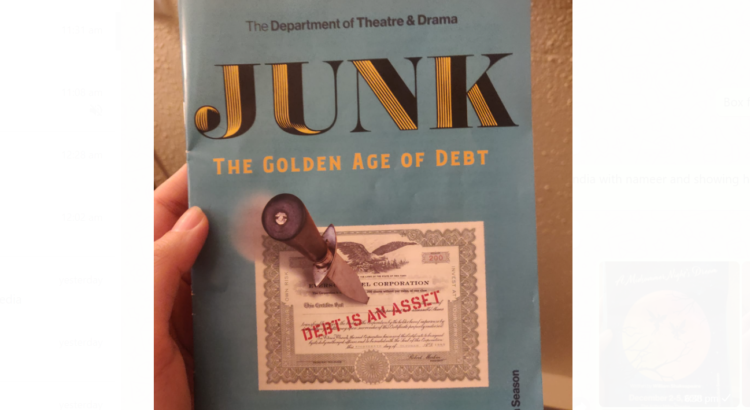
I don’t know where to begin. Junk was a phenomenal show and the team behind it really put effort into every. single. detail.

Let’s begin with the actors. It is hard to think who acted the best because all of them were so good. The plot of this play was quite corporate and the actors carried the theme of the play well.
They spoke dialogues in a believable tone such that I could see real CEOs speaking like that. Their strong delivery also made it stage-worthy. They combined the best of both worlds to up the stakes of the story.

Another star of the show was the set design. I have rarely seen such a well-integrated setup. The set was designed perfectly. It wasn’t meant to be beautiful but to go complement the plot. And complement the plot it did. They had lightboxes that synced up fast-paced music and blinked. It reminded me of stockbroking and the 80s architectural design. The audience also got to see the set being dismantled when a company lost its financing. To see that happen at the very end was just amazing. It reminded me of how important people working behind the scenes of a show are.

The techniques used in the play for phone conversations were nice and brought out the interconnectedness of the characters in the play. The costumes were well designed and fit the 1980s period (the play is set in 1985). Despite the play being set in the 80s, it had a topic as relevant as could be. Its similarities to the 2008 financial crisis and the chaos of the Gamestop situation reminded the audience of the stakes involved when people play around with stocks.

I really liked the ending of the play (I won’t spoil it for you). It highlighted how much money rules everybody. Some accept the cards they’ve been dealt with, some try to hack the system, and so on. The protagonist tries to hack the system and we see how he too gets trapped by it and it’s all a game of numbers. The system speaks in another language and only some can understand it and those who do try to get to the top. Others might have different interpretations of the ending but I think it was about the irrationality of who gets the most money.

The show got a standing ovation from the audience so you know everyone loved it. It showed a lot about the financial world and the power of money without being too dramatic or obvious. It was a great show!

REVIEW: Takács Quartet with Julien Labro

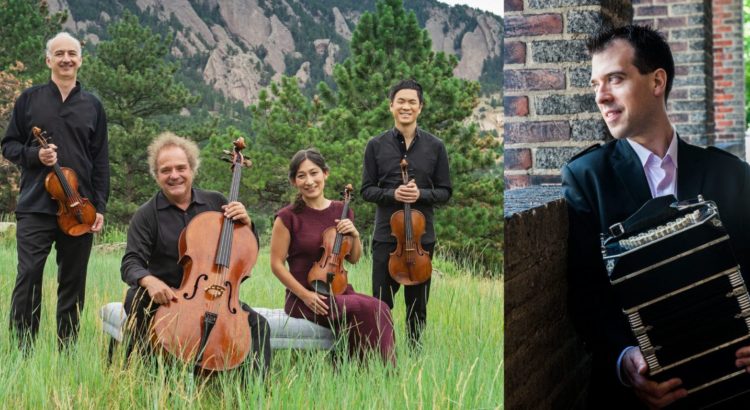
Coming to this performance has reminded me of how remarkably similar listening to new music is to meeting new people. If you come into the interaction without any background knowledge—their origin, their influences, their motive—you might spend the whole time confused, struggling to construct their story from whatever you see at face value, or simply uninterested. It’s the reason why program notes exist, and why I typically like to search for the pieces on Youtube before I hear the performance. Yet, with its mixture of world-premieres, uncommon instrumental combinations, and reimagined pieces, this program definitely challenged typical means of music consumption. 

I was immediately struck by how compact the bandoneon was and how it could achieve such crisp articulation and human-like phrasing. When Labro played, it felt like he was pumping his own breath and soul into the instrument. While the bandoneon is typically associated with tango, Labro also notified us that it was originally intended to play church music in small parishes in Germany. I didn’t quite believe him after he had performed Saluzzi’s Minguito, a groovy, pulsing Argentinian folk music-jazz hybrid incorporating percussive finger tapping against the sides of the instrument. However, his arrangement of Bach’s Wachet auf, ruft uns die Stimme, BMV 645 introduced an entirely new color and tone. In contrast to the previous push and pull of these tangled music lines, Labro’s Bach had a rich, organ-like sustain that put each voice in the four-part harmony on equal footing. 

I was also surprised by how naturally the bandoneon fit in with the quartet. In the first co-commission by UMS and Music Accord, Bryce Dessner’s Circles, the bandoneon set the stage with an oscillating rhythm for the strings to weave between. At some point, the pulsating melodies aligned and transitioned into an icy, polyphonic whistle-like section. Meanwhile, in Labro’s Meditation No. 1, the bandoneon reinforced the ensemble’s warm, syrupy chords and shined in a rich, cadenza-esque solo. In Clarice Assad’s Clash, the second UMS-Music Accord co-commission and concert finale, the bandoneon delivered punching dissonant chords and almost upsetting slides as the strings incorporated various frictional textures and sound effects.

The Takács Quartet was able to show off their refined musicianship in the hauntingly beautiful Ravel String Quartet in F Major. Melding elements of tension and dissonance, the piece had a shiny quality that fit really nicely with the rest of the program while still bringing a whole new flavor of sound. The complex layered plucking of the second movement was truly a marvel—the audience felt compelled to applaud afterward even though it was still between movements.

One of the most experimental pieces was Labro’s Astoración, performed as a solo with a pre-recorded backing track. Described as “an imagined duet and conversation with Nuevo Tango master Astor Piazzolla,” the piece tugged at single notes before expanding into big dissonant chords. Meanwhile, the backing track echoed spoken narrative phrases and introduced a second bandoneon that Labro riffed with. At some point, he also pulled out an accordina—a small, hand-held wind instrument with similar sound qualities to a harmonica— for an added layer on top of the rhythmical background.

All in all, I feel that I had witnessed something remarkable last Friday. My roommate who accompanied me enjoyed it as well, although she admitted that some parts were “a lot”. Such is contemporary music!

REVIEW: Playboi Carti: Narcissist Tour

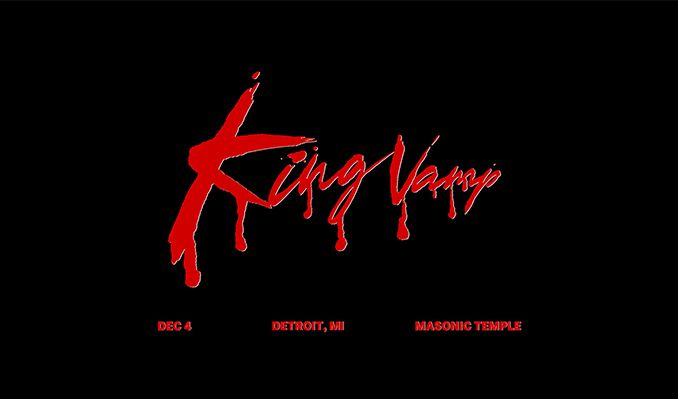
In addition to the actual performance, Playboi Carti live was an amazing experience. Fans wrapped around the block in the brisk 30°F hours before the show even began. Some laughing and hugging to keep warm and others dancing to Carti’s music off their phone. Upon being let into the Masonic Temple, there’s a chilling red scene against the ornate walls of the theater. I will say, the Vamps showed up! Everyone in the bathroom looked absolutely stunning from subversive basics, balaclavas, shiny black latex to detailed, smokey makeup looks. You would’ve thought you were backstage at a Rick Owens fashion show.

The stage welcomed Ken Carson, Rico Nasty, and finally Playboi Carti himself. Each artist brought high energy onto stage which was evident in the audience. I was in awe by Rico Nasty’s vocal range as she performed “Tia Tamera” and “OHFR?” She added her own screams that made the crowd go all the more wild. So much so that articles of clothing were being thrown up high into the air in the mosh pits.

I already lost my voice and Playboi Carti wasn’t even out yet. But when he did finally walk the stage, I couldn’t help but sing along a little louder. The. fog grew thicker and we could barely make out Carti, except for a small silhouette. His voice and the crowd’s roars were all that were needed. Not wanting to sit, many  including myself  stood in the middle of aisles to get as close as possible. There we excitedly sang along to each lyric of “Sky” and cheesing at one another during “Rockstar Made” None of us felt like strangers in that moment, but all happy Vamps.

In between each song, the rich sound of the bass and organ filled the theater. Like Rico, he also added new ad libs in the live performance. The rhythm coursed right through me, to the point where it felt like the sound and I had become one. I could lay my hand on my chest and feel the beat coming straight from me. It was surreal.

Some might say it was insane or dramatic, but that’s Carti. And I loved having the opportunity to see him perform live.