REVIEW: The Alpinist

This amazing documentary followed an extreme alpine climber, Marc-André Leclerc, through several different adventures of climbing as well as his own struggles and personal life. I would say this was one of those films that has you sitting awestruck at least through the credits if not longer. I was blown away by the gorgeous cinematography, the raw honesty of the filmmakers and the subjects of the documentary, and the craft honed by those who do alpine climbing.

First, the cinematography was just gorgeous. I loved that we got both very up close shots of Leclerc climbing and more birds-eye views of the different landscapes he was scaling. A big part of the appeal of the documentary for me was that it was very aesthetically pleasing. They also showed a variety of different climbs, so the audience got to see picturesque mountains from all over the world.

Film Review: The Alpinist – SLUG Magazine

The raw honesty of the filmmakers and subjects definitely drew me in right away to the story. Everyone spoke so highly of Leclerc, and was amazed by his talent, but the filmmakers were not afraid to show some of the difficulties working with him. He did disappear on them for a while, and they had to track him down through other climbers social medias in order to get back in touch with him. I think the fact that they included this in the film made him seem a lot more real, and made me much more interested in him as a person. Further, they chose such interesting people to comment on his talent, with a mix of both older, experienced climbers, people close to him, and some younger, more famous climbers. I think this array really gave viewers a better understanding of how intense and extreme his climbing really was.

The Alpinist' true story: Tragic romance meets 'Free Solo' - Los Angeles Times

Finally, this documentary honestly gave me my first ever exposure to alpine climbing and how it worked. I enjoyed the learning aspect of it, and was glad that the documentarians gave a background of how alpine climbing has progressed in the last century, because it put the talent of Leclerc into perspective for me. Also, I was shocked to actually watch him in action, and see how much faith these climbers really put into their abilities and tools. The amount of knowledge that they have and the bravery of their expeditions really blew me away. The film did a great job of limiting the amount of actual physical climbing shown to the audience, because I think a ton of clips of him just climbing could have been very boring.

I would recommend this film to anyone who likes to watch feats of human talent or anyone who enjoys beautiful landscapes. I thought this documentary was very well done, and kept me engaged and interested the whole time. Finally, I have to mention that the “twist” towards the end of the film came as a total surprise and I think the way the documentary handled it was very well done. Go see this movie!

Tickets at the State Theater: https://michtheater.org/the-alpinist

Where to Watch 'The Alpinist' Movie

REVIEW: Realm of the Dead

This Thursday, I attended Realm of the Dead, an installation at the School of Social Work. Comprised of more than 30 suitcases, Realm of the Dead is a reflection on tragedy, grief, and identity by Rogerio M. Pinto, a professor of Social Work at UofM.

The walk into the building was supplemented by a drumline performance, waking me up and welcoming me into a lobby where videos of the Rio Carnival played. I was handed a small, white, rectangular box with a letter and number denoting where I would be located once we moved downstairs. A suitcase full of wish ribbons lay open: curious, I peeked inside, and an usher offered to help me tie one around my wrist. The ribbons read “Realm of the Dead.”

When the performance was set to begin, the audience descended a set of stairs to the lower floor. The ritualistic feeling of moving down the stairs, down to the Realm of the Dead, accompanied by the drumline’s beat, felt sacred in a way. Hushed, the audience made their way to the suitcases, laid out in a grid. The artist, Rogerio M. Pinto, sat next to a doll in a suitcase casket, holding a rosary, murmuring inaudible words. The drumline came to a halt, the suitcases were opened to reveal insides filled with art, and Pinto began to tell his story.

“Emotional baggage—” Pinto explains. Many people in the world can fit all their belongings into one suitcase. Could you carry everything with you in one bag? How about one small box?

Pinto tells the story, in pieces, of the death of his baby sister Marilia. She was 3 when she was killed in a tragic accident. Pinto unfolds the effect of this tragedy on his family and his identities growing up. Both his words and the suitcases weave a deep exploration of grief in relation to gender, body, ethnicity, immigration, and class. 

Throughout the exhibit, suitcases filled with small items asked each viewer to take the things that reminded them of someone or something they had lost. We would fill out boxes with these things, and at the end, there would be the option to keep it or to leave it in the Realm of the Dead, allowing it to become part of the exhibit. Moving through the exhibit, I felt my box grow slightly more full with the notes and items I had collected, but I also felt myself grow heavy. Listening to Pinto’s story of grief, remembering my own.

We keep the dead with us, in us. My mother passed away 2 years ago, leaving me feeling helpless and crushed. I am still grieving her. While this performance left me remembering this loss with a heavy heart, I found myself comforted by the reminder that a part of her is in me and always will be. I choose to carry her with me. I grieve. “My sweet sister, no longer here, no longer on Earth.” Pinto holds his hands to his chest. She lives on, he says, in him—”Can you see her?” 

This exploration of grief through art and performance was so beautifully touching to me. I am thankful to Pinto for sharing his story, and in this way giving the audience a space to search their own losses. To honor the Realm of the Dead.

REVIEW: University Philharmonic Orchestra

What a night!

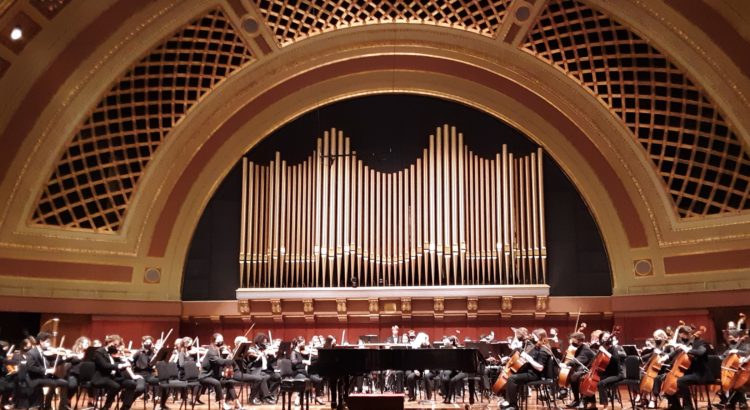
This was my first orchestra concert  experience since coming to the University of Michigan and I’m happy to say that I was not disappointed! Walking into Hill auditorium, I couldn’t help but be amazed at how beautiful the space was; the rows upon rows of red cushioned seats, the decorative work running across the ceiling, and  the massive organ glimmering beneath the lights along the back wall of the stage. I made sure to get to the auditorium early in order to get a good seat and I could tell as soon as I sat down that the acoustics in this space would be amazing. A stifled sneeze from someone on stage would be able to be heard as clear in the nosebleed sections as it would be in the front row.

The concert started out strong, opening with an excitingly fast paced rendition of Chad “Sir Wick” Hughes’  Visions of Renaissance. This piece was a whirlwind of sound from start to finish and Adrian Slywotzky conducted beautifully. But, what truly blew my mind was the second piece of the concert which was  Piano Concerto no. 1 in F-Sharp Minor, op. 1 by Sergei Rachmaninov. The piece was split into three movements and the star of these movements was Pianist, Sua Lee. Lee is a master pianist, having received multiple awards for her incredible talent on the ivory, the most recent being the 2021 Concerto Competition. I’ve never seen fingers move so fast across a piano as hers did that night. Lee shone on that stage while the orchestra provided a supporting role behind her. It was a beautiful call and response relationship that flowed and ebbed with a multitude of emotion. It was clear to  see how involved Lee was in the music. With every intake of breath, every fluid movement of her finger across the keys, the graceful way she leaned into the piano; she was mesmerizing to watch. The emotions she called to the stage ebbed into the audience as well, we were all captivated by her performance. As such, Lee received a standing ovation from the audience.

As wonderful as the concerto was however, I have to say that my favorite piece of the night was Symphony no. 6 in F Major, op. 68 by Beethoven. This was mostly due to the fact that I’m a big fan of the Disney film Fantasia which is a Disney classic and a must watch film if you haven’t seen it. Fantasia is made up of entire stories animated to some of the greatest classical music of all time. And Symphony no. 6 just happens to make up one of my favorite moments of Fantasia. I was able to relive the film live as I listened to the orchestra and I have to say, the orchestra was so superb that if I closed my eyes, I could almost believe I was listening to a recording of a professional group.

It was amazing to be able to witness such a talented orchestra!

PREVIEW: University Philharmonic Orchestra

Being a past music student myself, I couldn’t be more excited to attend an orchestra concert again. The University Philharmonic Orchestra is made up of freshman students looking to expand their ensemble experience, playing some of the most well known works ever created. They’re led by Adrian Slywotzky who is a lecturer of conducting. He’s won multiple competitions for his craft, most recently the 2017 Audite International Conducting Competition in Poland. I’m excited to see how Slywotzky leads his students during this performance.

Another thing that I’m particularly interested in is seeing  the connections between members of the orchestra. Being a violinist for nine years, I’m well aware of how lost someone can become in the emotions of the music being performed. At times, a whole orchestra can be tied together in those emotions. It’s a type of energy that isn’t easy to explain, but even the audience can begin to experience it as the mindscapes of the musicians are transferred into the crowd through each note ringing throughout the auditorium.

The program for this particular performance is made up of three pieces, all from differing eras of music which will be especially intriguing for the audience:

Visions of a Renaissance by Chad  “Sir Wick” Hughs

Piano Concerto No. 1 by Sergei Rachmaninoff

Symphony No. 6 by Ludwig van Beethoven

The concert itself is entirely free and will be held in the Hill Auditorium at 8:00 pm, September 22nd.

REVIEW: Stephanie Dinkins: On Love and Data

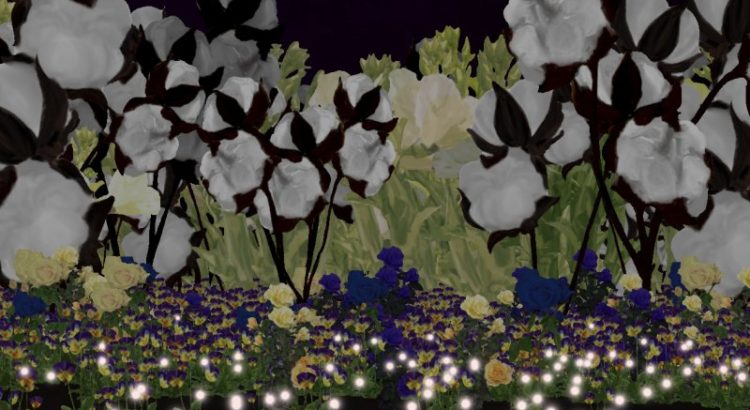
On Love and Data was a truly thought provoking exhibit. The way Dinkins created and showcased her ideas on Afro-now-ism and the way she tackled and exposed  problems of artificial intelligence and digital systems that remain lacking in terms of accessibility and inclusiveness was amazing. Dinkins work is raw with emotion and clearly conveys the strength of her character. Walking alone through the gallery, interacting with her work, there were several times that I felt uncomfortable and on edge. Of course, I’d like to think that’s what some of Dinkins work is meant to do. Dinkins wants her viewers to recognize the issues that are occurring within the digital realm but at the same time, she also wants to show the brilliance of what the digital realm is capable of.

The most striking part of the exhibit for me was a series of videos titled: “Conversations with Bina48”. It’s a series in which Dinkins converses with one of the most advanced social robots of all time. To start, I found the way that the conversations were staged very intriguing. The space between Dinkins and Bina48 is almost uncomfortably close and both individuals are framed in the camera from the shoulders up. It’s almost as if Dinkins was trying to blur the lines between  human and artificial intelligence. Dinkins mannerisms within the videos mirror Bina48 almost perfectly and at times the viewer is confused as to whether both subjects are human or AI. Through their conversations I was shocked to learn that Bina48 considers the human species to be her cousin and that she felt that she had emotions and feelings just as we do.

AI has always been a fascinating subject for everyone. There’s been countless films, books, television series all exploring the concept of the next intelligence, whether that be robots turning on humanity and destroying the world or being helpful non human servants that make our lives a hundred times faster and more efficient. The approach that Dinkins took  with Bina48 was unique. She was looking to create a relationship, she wanted to explore the human condition with something that wasn’t human and it was truly amazing to watch.

I’d recommend taking the time to see this exhibit for yourself. The contribution Dinkins brings to the realm of the digital is something to behold. Though, there was one small hiccup I ran into when going to the event. I wasn’t aware that I had to reserve tickets to enter the exhibit. The exhibit is free of course, but the gallery is taking precautions as to how many people can enter at a time. You can get tickets by scanning the QR code outside the gallery. Don’t miss this event!


REVIEW: Shang-Chi and the Legend of the Ten Rings

I’ve always been a fan of the Marvel Cinematic Universe. With each new film, there’s a sense of familiarity whether it’s the on point wittiness of the script, the Easter eggs through out, or the end credit scenes that everyone knows to wait for by now. You know what you’re getting with a Marvel movie: a decent plot, a decent laugh, and characters that you’ve grown up reading about making it to life on screen. Are the films the most life changing, thought provoking movies of all time? Of course not, but as long as a film makes you feel something, lets you escape into another universe for the better part of two hours, I think that’s worth something.

Shang-Chi and the Legend of the Ten Rings is definitely worth something.

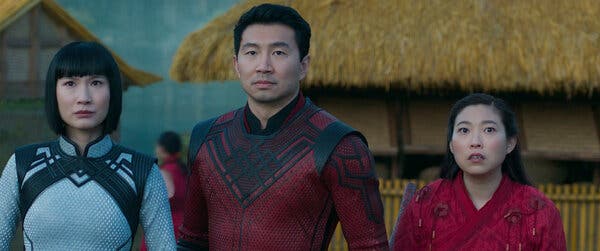
For a start, the fight sequences are beyond extraordinary. I was particularly interested in how the MCU would choreograph those scenes as Shang-Chi is known to be a master of multiple martial arts.  A worry of mine was that in an effort to showcase Shang-Chi’s talents, the fight sequences would turn into drawn out blurs of pointless action that, despite showing an extensive range of the characters talents, would be overly useless to the plot. However, that wasn’t the case at all. Out of all the Marvel movies I’ve seen, Shang-Chi and the Legend of the Ten Rings has the most beautifully poetic fight sequences ever choreographed. It was simply amazing to watch the characters move with such power, fluidity, and grace.  And though the fight sequences were well timed and made complete sense to the plot I would’ve honestly been more than happy  to watch two hours of just those fight sequences.

Another thing I was interested in was the soundtrack of the film. As I’m sure you’re well aware, Marvel has quite the ear for music; choosing soundtracks that bring another  layer of depth to their films. A well known example would be the Guardians of the Galaxy soundtracks. Those classic tracks are blended throughout both films causing feet to bounce and smiles to appear. Shang-Chi also boasts a spectacular soundtrack that fits seamlessly into the film, imbued with the emotion of the characters. Produced by 88rising, Shang-Chi and the Legend of the Ten Rings: The Album is a must listen.

The only element of the film that I was slightly disappointed by was the quality of visual effects for a certain aspect of the film pertaining to the fantastical creatures found in Ta Lo, which is the birth place of Shang-Chi’s mother. These creatures seemed to lack a certain realness that I’ve come to expect from the MCU. I assume that it was a design choice as all other aspects of visual effects throughout the film were on par with what Marvel has shown us so far, but I am curious as to how that came about.

Overall, I would highly recommend watching this film. Even if you aren’t a fan of Marvel, there’s still a lot to appreciate.