REVIEW: A Hidden Life

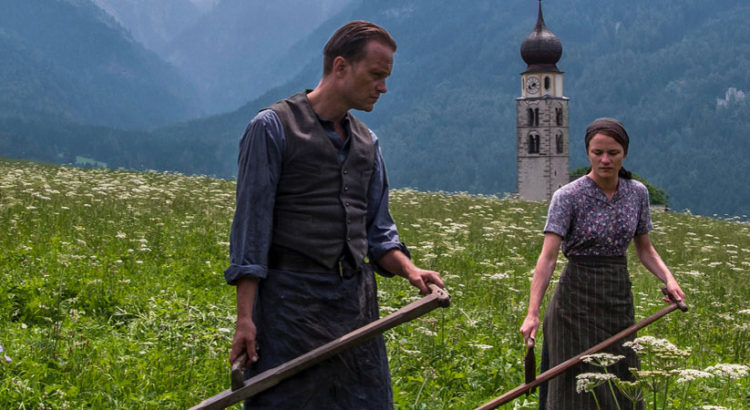
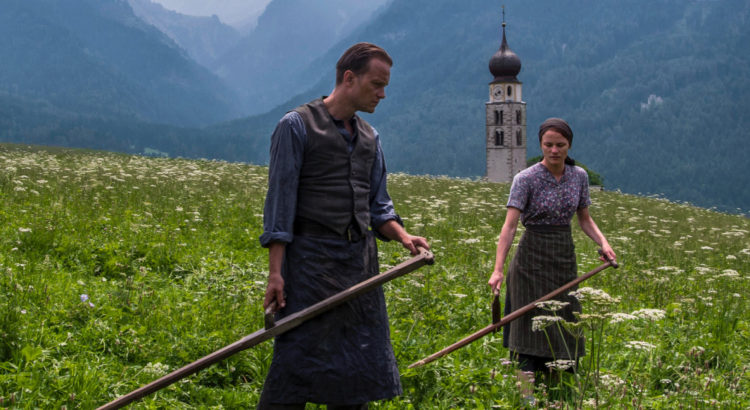
A Hidden Life, at its core, is the story of a man that refuses to swear an oath of service to Hitler. Beyond this guiding plot point, though, this film displays and questions important themes found back then and now. Ideas like the effect of the individual, the meaning of citizenship, and the value of morality are abound in this movie, and I enjoyed the way they were explored: openly and with a steady pace.


A specific aspect of the film that I found interesting was the language choice. The setting changes between Austria and Germany, and both English and German are used throughout the film. Ultimately, to me, it looks like English was just used for contemplative voice overs and when necessary in the plot. This was really intriguing, as you would experience characters speaking both languages. I don’t speak German, so piecing together the German and English-speaking sides of each character added another layer to my closeness to and contextualization of these characters. Another aspect of this language choice was that (outside of plot-essential points), the Nazi figures in the film pretty much just spoke German. It’s definitely a different effect to hear prison guards screaming abuse in German rather than English– this had me thinking about how Americans conceptualize and stereotype the German language. Not to say the director was trying to do anything more than stay historically accurate, but there’s definitely a certain public cultural memory that’s accessed with the German language being used like that.


Terrence Malick’s form of storytelling may not be for everyone, but I find the contemplative and non-linear aspects of his work to be the most compelling. Shots move in thoughtful, visually challenging ways that aren’t afraid to linger and create highly meditative moments. The beautiful Austrian mountains and a gritty Berlin prison offer two central settings that aren’t hard to make visually intriguing. That may be true, but by the end of the film I found myself taken by the sense of place achieved by Malick. When the setting returns to the lush hills of Austria, one feels the heartache of home. When one re-enters the prison setting throughout the film, one feels the tension of the compound. The places created in A Hidden Life are transferred quite vividly to the viewers’ minds, and thus create an intense, seemingly intimate understanding of the aura and symbolic relevance of the place.


I encourage people to see this film, to take the time to let Malick’s world swallow you whole, and to experience the cerebral yet very grounded and real work he has created.
REVIEW: Marriage Story

I didn’t expect this movie’s main plot to follow the legal process of divorce. To be honest, I thought it would follow their falling in love, too. Be warned, there is none of that kind of heartwarming. But the movie still finds a way to feel loving and even a little uplifting to me.

It’s quite a feat, since the movie really is about the technical process of divorce. It shows the difficulty of finding lawyers, the cost (ironically at the expense of the child’s savings), and the frustrating double levels of communicating through lawyers and face to face. I might think a movie about the legal system would be dry or boring. I didn’t.

I read that the director based it off of his own experience with divorce and his child. I can tell! All the examples of when the kid wanted something different than what his parents had planned felt real, because how frustrating is that? One scene shows Driver flying all the way from New York City to L.A. for a little time with his son, but his son doesn’t feel like going with him. But who are the parents to tell the child what he should want, really? All to do in their position is be patient, but I completely sympathized with them in those scenes about how hard that can be.

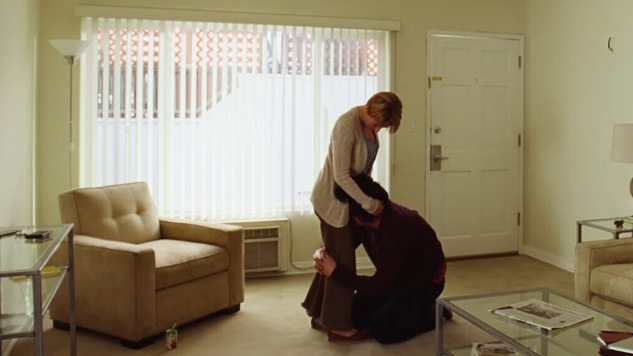
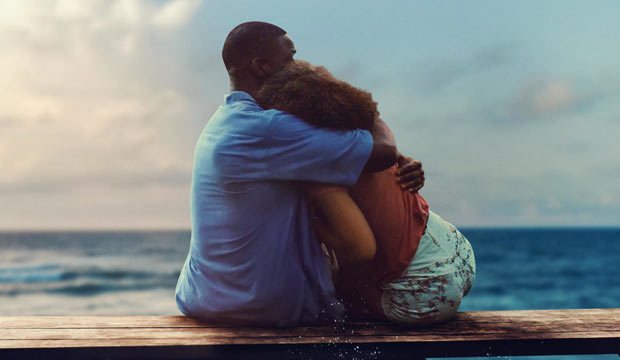
The part that felt the most realistic to me, though, was the scene that a lot of people are talking about. It’s the ugliest, most shocking scene, when Adam Driver and Scarlett Johansson (the parents divorcing) are fighting in his apartment, frustrated with each other about this process they’re going through. Both of them are spitting, tears rolling, noses running, yelling their worst at each other at the top of their lungs. The image at the top, here, is from the end of the scene.

Before Driver collapses at Johansson’s feet, he yells the worst thing imaginable at her: “I wish you were dead.” Without the right lead up about Driver’s character, he’d become a monster. With a disgusted response from Johansson, he’d become a monster. It seems like the hardest needle to thread, avoiding vilifying Driver, but the movie does it. I actually feel closer to Driver’s character when he says it.

How is that possible? The movie succeeds so much at convincing me that both of them love each other, and that makes me think that’s why they’re so thrown for a loop, so out of sorts. Sure, they have a different kind of love than what keeps a family together, but some kind of love, nonetheless. He’s grieving the end of their relationship. Driver immediately regrets what he said, is disgusted with himself, and apologizes; Johansson forgives him without hesitation. She knows how he feels. However oddly, they’re on the same page. And the movie ends with an even stronger sense of their being on the same page, despite how sure they are about divorcing.

My review is, please watch this movie. It feels like an authentic account of parents separating. More than that, it highlights parts that other movies and stories aren’t bold enough to try–the ugliest parts. In a world where divorce happens all the time around children, I think we could stand to be generally better emotionally versed about it for these kids. Even prepared to be these parents, to some extent. I’m writing as one of these kids, but I think there are plenty of other ways to relate to these characters. I say we make more movies like this one, making sense of love in marriage and divorce.

REVIEW: Waves

Waves is a complicated and untraditional work, but at the same time, it left me hoping for more depth. I should say now that this review is riddled with spoilers, so if you haven’t seen it I highly encourage doing so as the film unfolds in a unique and unexpected way.


So the essential plot of this film is that a suburban family copes with the oldest son, Tyler, murdering his pregnant ex-girlfriend, Alexis. There are two halves to this film: the first, detailing Tyler’s downwards spiral that leads him to being sentenced to life in prison, and the second showing the family (namely his sister Emily) coping with the effects of the first half.


To begin with the things I liked about the film, I think it’s very well-made. The camerawork specifically at times pulls off these fluid movements that really accentuate the action of the movie. The cinematography made me personally reflect on the the unique options a lot of films just don’t take a risk on in the way Waves does. The soundtrack to the movie is also used in an interesting, borderline Baby Driver kind of way–however, a few tracks were some of my favorite songs and did take me slightly out of the movie, though I guess that’s a me problem (just an example, I found myself chuckling at the use of “IFHY” by Tyler, The Creator as Tyler punches a hole in his wall out of rage…Tyler, The Creator’s music has such a sense of humor to it for me it just really didn’t match the intended effect). Using contemporary music simultaneously allows for a special kind of relation to this work for audiences and puts a time-stamp on the piece in a meaningful way, so ultimately I place this artistic choice as a net-positive on my experience.


The structure of this film is unique. It is composed of two halves when I didn’t know it would be two halves, thus leaving me waiting after the climax of the first half for the film to end–I thought I was watching a prologue. And it’s clear why I felt the structure to be jarring; these two halves are like two different movies. I couldn’t help thinking as I left that theater that this movie felt like the result of a filmmaker wanting to make a sequel (or even a trilogy) of films, but could only make one. The style of the first is heavily contrasted by the second, and yet overall I do think it could have worked. I understand this choice as the focus and tone of the story really shifts, but in the end it didn’t all come together for me due to a disparity of depth in the two halves.

The first half, to be honest (and a little mean), was like a stylized after-school special. “The popular, handsome star athlete gets an injury that puts him out of his identity-defining sport so he turns to his dad’s painkillers and alcohol and also his girlfriend gets pregnant and wants to keep her baby so they break up and in an alcohol and drug-fueled rage he kills her at a prom-adjacent after-party.” I have no issue at all with this story being told (and honestly, I’m still trying to diagnose how much I oppose this half because he’s a highly masculine athlete). I think adding depth to cliché concepts like this one (as much as it makes me feel like a bad person to say this tragedy is a cliché) is a totally worthwhile effort. The issue here is that I feel like I never really got inside Tyler’s head; there’s nothing especially dynamic going on character-wise. It felt pretty surface level and I found myself feeling very little for him.

Cue the next half of the film, as Emily finds a way to escape the alienation her brother caused and the family as a whole tries to reunite. Again, maybe I just relate more to the quieter Emily, but this half had so much more going on, emotionally. (Which doesn’t make sense due to all that’s happening in Tyler’s story!) I felt like the overall performances were better and the plot took more intriguing turns in this part. (I also have to mention that Lucas Hedges is now exonerated from my previous contempt, between his role in this section of this film and Honey Boy.)


Waves is a good, interesting film. Maybe my issues with it are just a negative interpretation of artistic choices, but at the end of the day I personally felt it was a beautiful but slightly lop-sided film.

PREVIEW: Terrence Malick’s “A Hidden Life”

Coming this Friday to the Michigan Theatre is Terrence Malick’s latest work of cinema, A Hidden Life: 

Based on real events, A Hidden Life is the story of Franz Jägerstätter, an Austrian peasant farmer who refused to fight for the Nazis in World War II and is subsequently faced with charges for treason. His deep faith and his love for family, however, keep his spirit alive in the face of great hardship.

Terrence Malick’s A Hidden Life will be playing at the Michigan Theatre December 20th through December 26th!

Visit michtheatre.org for specific showtimes and additional information!


REVIEW: Wild Lights at the Detroit Zoo

From its “glowing reviews” and advertisements, the Detroit Zoo promised that its annual, 29 day ‘Wild Lights’ show would be nothing short of 5 million LED lights worth of pure holiday exuberance. After attending this past Saturday, I can partially attest to that – the experience of strolling through large-scale LED animal sculptures and holiday-themed decor, supplemented by several regularly operating animal exhibitions, was wholly conducive to the family-oriented ambience the Zoo stresses with most of its events. The Wild Lights show boasted a meticulously illuminated total of 280 sculptures, 230 of which were animal-shaped, positioned for prime group photo opportunities throughout the front half of the zoo.

Upon entering, visitors were greeted with trees brightened by monochrome string lights and an equally eye-catching wildlife sequence played continuously on a large screen. Though blatantly drawing upon your typical holiday motifs, like the giant walk-in holiday ornament and bright green Christmas tree displays, the Zoo also had a couple of outlier light displays. These included a lavender-colored spiderweb, its stiffly perching spider that resembled a taco shell holder, and other refreshing oddities like a sneaky ‘polar bear’ ready to attack a beehive. Though initially underwhelmed by the filler trees’ clashing, garish colors, I was eventually won over by more dynamic displays like the little hummingbird whose wings seemed to flap up and down through an alternating light trick, and branches that seemed to rain light on passerby.

Outside of their Wild Lights event, the Detroit Zoo prides itself upon the 140 pieces that constitute its Fine Art Collection that “…showcase humanity’s relationship to animals and inspire a passion and interest in the natural world”. This and the other artworks I was able to view during the event emphasized the Detroit Zoo’s nationally prominent focus on conservation efforts, animal welfare, and the release/reestablishment of endangered species. Even so, I found it ironic that the statement ‘All Animals Are Important’ was displayed in the North American River Otter Exhibit, within steps of a hot dog stand.

Personally, the most visually stunning bodies of work I encountered were the softly lit, geometric sculptures positioned around the perimeter of other LED lit sculptures. Visitors are invited to gently spin the works, and as they do so, the piece’s inner light seems to shift and refract off of each intricately carved, triangular panel. Each hanging sculpture was similar in overall structure to the next but unique in their repetitive, fractal-like carved patterns; I thought this was the most elegant presentation at the Wild Lights Event.

If you’d like to brighten up your day (or night), make sure to go experience this marvelous walk-through light show, preferably with a warm group of people you find tolerable to maximize the aesthetic photo-taking opportunities. Unless they sell out beforehand, you’ll be able to buy tickets online until January 5, 2020 for the multiple showtimes they have available.


REVIEW: Elf

What a nostalgic favorite! I hadn’t seen this movie since I was a kid, but it still made me laugh and feel good just as much as the first time I saw it. I think this time around, though, I noticed a lot more than I did as a kid, both about the actors, the storyline, and other more subtle aspects.

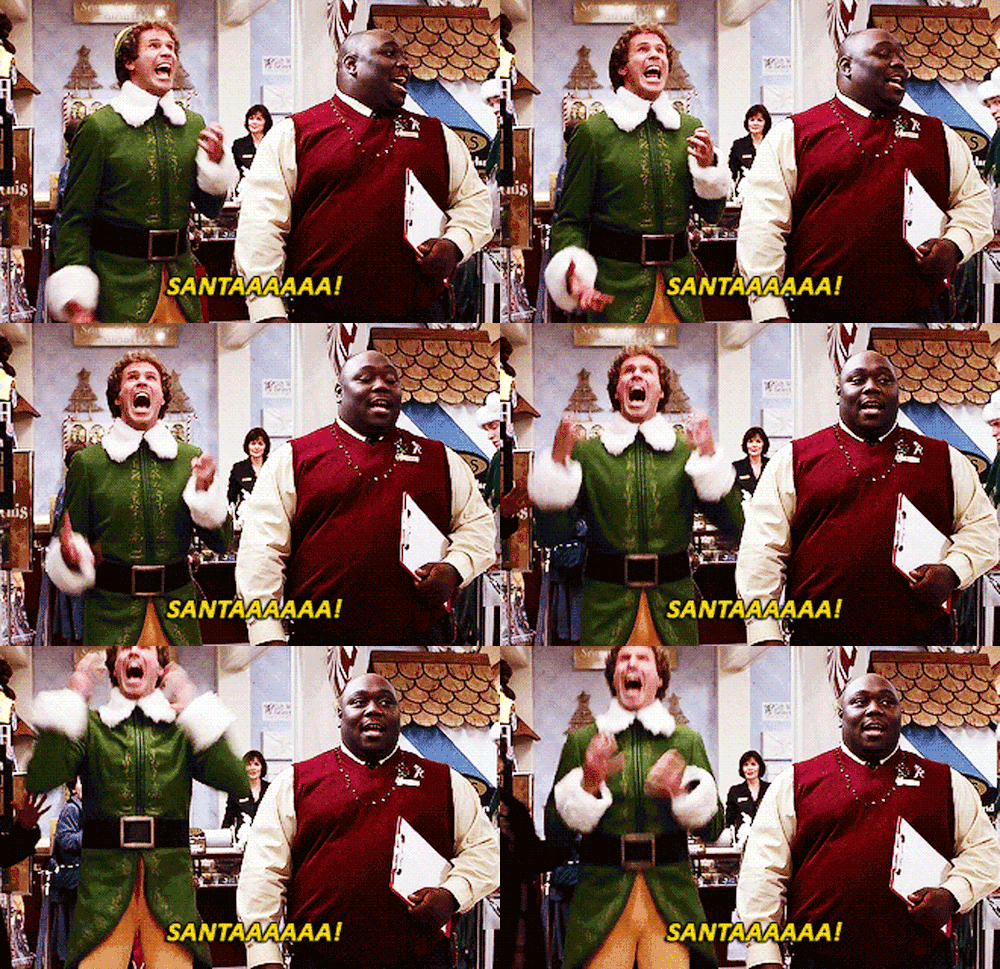
Will Ferrell is still hilarious, as he always is. But this time, I really noticed his acting skills and timing a lot more than I had appreciated it before. He is so good at being awkward in a funny way that just rests on the edge of being unwatchably cringy, which is very impressive. His character is difficult to play, because he is supposed to be a person who is trying only to be nice but manages to insult many people. Ferrell is quite good at saying not very nice things in the nicest way. When he calls Miles Finch, (the writer called into his dad’s office for help) an elf, we can see how insulted he is. But Ferrell makes it absolutely clear that Buddy, his character, does not mean it in an unkind way at all. Ferrell also is good at making his lines sound fresh and original. For example, when he sings (both in his dad’s office and in the store), it absolutely sounds just made up on the spot, despite being an actual part of the movie.

I also love that the focus of the storyline is not actually Christmas itself, but what the holiday season is supposed to represent- feeling loved with your family or chosen family. The movie does end with Santa needing the Christmas spirit to make his sleigh work, but that is not a focus or a main plot line until the very end. The actual point of the movie is to show that love is real and abundant, even if it is not there at first or not obvious. That is a wonderful message to send across.

There were also some things that I definitely did not notice the first time around, like how it is kind of creepy the way Buddy would not leave Jovie alone at first, even though he really did not have malicious intentions. I also did not realize that was Zooey Deschanel with blonde hair! I also noticed this time the cool perspective work they did to make all the elves look so much shorter than Buddy, despite the fact that they were regular-sized people. I was looking closely when someone was standing behind Buddy, patting him on the back, and I could really tell that he must have been far away, because his hand did not look like it reached Buddy at all. However they hid it very well, because that was the first time I had even thought about this idea. Also, when Buddy is sitting on his elf-father’s lap, there must have been a different set of legs directly under him, and the actual actor playing his father was sitting much further back which was a very cool effect! I definitely had not noticed this as a kid at all.

This movie definitely gets my star of approval, for its humor, clever filming, and the overall fuzzy feeling of love it projects. A great movie to curl up on the couch and watch with some hot chocolate and a blanket during the holiday season, for sure.