REVIEW: Mary Poppins Returns

Image result for mary poppins returns

Mary Poppins Returns hit theatres in December 2018, and was received with mixed reviews– some loved the new spectacular addition to the classic Mary Poppins film starring Julie Andrews; others found it exhausting and drab in terms of plot, characters, and music. I find my own opinion lodged somewhere between the two; I didn’t love the movie, but I will defend its integrity and originality. The movie takes place a generation after where the first movie left off. Michael and Jane Banks, the children who Mary Poppins comes to nanny, are all grown up now. Jane is an activist fighting for union workers’ rights, and Michael is an artist and teller with three children who recently lost their mother– and it seems like that they’re all about to lose something else– their house. Amidst this financial turmoil, Mary Poppins materializes to help the Banks children– all of them– go on a magical adventure to revitalize their sense of wonder and joy.

Emily Blunt’s rendition of Mary Poppins is, well, blunt. This new Mary Poppins, reeled in through a kite with not a single hair out of place despite emerging from the eye of a raging storm, with perfectly poised little kitty heels bent at an artful angle, with her curt responses and matter-of-fact commandeering of the Banks children– she’s not as cheery and la-di-da as Julie Andrews’ Mary Poppins. This new one’s feisty. She’s got attitude. She means business. This new Mary Poppins rolls her eyes and bustles around and smiles less but manages to do more. Her magic is controlled and precise, bestowing the children with their own sense of agency rather than spoiling them with her treats. Emily Blunt’s interpretation of Mary Poppins is slightly spicier than it is sweet– and I love it for that. I’ll defend this movie against musical theatre purists that argue that Emily Blunt is not as good as Julie Andrews. They’ve both made the role their own in fun and inventive ways.  

That being said, however, in all honesty, my reaction to this movie was quite ordinary. I didn’t love it; I didn’t hate it. The plot of the Banks children trying to keep their house wasn’t the most engaging, even if Colin Firth was the one playing the evil banker. I didn’t find myself humming the tunes to the new songs as I walked out of the theatre. They just weren’t as catchy or extraordinary as they’d been hyped up to be. And, most importantly, the movie didn’t light up that spark of wonder and joy that Disney movies usually do; the nostalgic, gooey, fuzzy feeling spreading through my stomach– that life can be seen through a rose-colored lens– this movie just didn’t strike that emotional cord for me.

It did have its ups, though. In a song called A Cover Is Not The Book (possibly my favorite part of the whole movie– it’s really fun and whimsical), Jack and Mary Poppins perform with animated characters under the dazzling lights of a circus tent, and in the classic Hamilton style, we get some of Lin Manuel-Miranda’s crisp rhymes and fast-paced rap-style rhythms. There’s a song where the Banks children’s bathtub transports them to an oceanic adventure, swimming with whales and dolphins under an infinite blue sky and tufty white clouds. There’s the subtle romance between Jack and Jane, and though it’s painfully underdeveloped, it’s cute to watch. But still– I can’t really say that any of this adds up to a hugely substantial and magical movie experience. It’s a fun movie, and obviously part of a larger American musical cultural phenomenon, but in isolation, it seems enjoyably ordinary to me.

(Poster from Google Images)

REVIEW: Roma

Roma, a film directed, produced, co-edited and shot by Alfonso Cuarón, is a semi-autobiographical film set in 1970-1971. It follows the life of Cleo, a maid to a middle-class family in Mexico City.

Roma was originally aired– and is currently still being screened– on Netflix, where it got rave reviews. Select theaters, such as the Michigan Theater, showed the film in theaters. As someone who has watched the film both on my laptop screen and on the big screen, I can attest to the fact that one receives a very different film-watching experience depending on which setting it is enjoyed in. While seeing Roma on a smaller screen makes it no less creative or artistic in its story or message, the scope of its beauty and intensity widens, as sound and images envelop the viewer in a more immersive experience.

The film is completely in black-and-white, and in Spanish with English subtitles. Immediately, though there is no actual use of color in it, the film manages to paint a detailed picture of the affections, tensions, and family dynamics that exist within the household that Cleo works in. Life in Mexico City, as presented in the film, is rich with life and sound; I immediately could sense the energetic and animated spirit of the city through the sights and sounds of its people and animals.

From the beginning of the film, Cleo is the character to whom one is immediately drawn to; she is the center of the narrative, and holds a gravitational force over the other characters in the film as caretaker, provider, source of emotional fulfillment– though her quiet presence means that they may not be aware of that dependence. More than the star of the film, Cleo is a very interesting and nuanced character: though she barely speaks above a whisper, never betrays a hint of anger or frustration, yet her quiet gravity and strength are tangible. The martial arts scene, when she is the only person in a field of people who is able to form an intricate balancing pose– though no one takes notice– serves to illustrate the ways in which her restraint actually is a way of showing her restrained power.

Cleo endures many hardships, both before and during the film’s setting occurs; a diasporic past and rocky relationship with her mother is hinted at, and during the extent of the film she loses several other loved ones. Again and again, we see Cleo abandoned and left alone; in most scenes she may be surrounded by those who claim to love and treasure her, but ultimately she is abandoned. In her darkest moments of agony and sorrow, the people she depended on in that moment leave her to her own devices. For instance, in the scene where Fernin abandons her at the cinema to finish the movie on her own, we are given a view of the screen of the film that Cleo herself is watching, and the scene is drawn out so long that we finish the movie with her. In other similar situations, the director chose to extend the scene and stretch it out for an almost uncomfortable amount of time. This particular decision, in my mind, was made to force the readers to sit with Cleo in her silence for a while so that they can temporarily embody the stillness and the waiting that characterizes so much of her life, and to reflect upon the implicit ideas or emotions that these scenes provoke. One of these subtle ideas is the notion of strength and bravery as being traits not only exemplified by showy acts or performative expression, but that can also be found in quiet reservedness. Cleo is the prime example of this; one cannot help but note the tenacious resolve in her impassive, but determinedly expressionless, face as she watches devastation and destruction happen around her in scenes such as in the hospital baby unit and in the forest fire.

As the film continues, the more surreal and abstract images and concepts that are hinted at at its introduction are expanded upon and incorporated into the meat of the film. Scenes of destruction and violence are superimposed on ones that are canonically joyful, such as birthing a child or looking at newborn children in the hospital ward. At first, the surreal elements caught me off guard, as I had assumed that this film would be more documentary-like in its telling. However, once I realized that this film is more on the artistic side, the various images and recurring metaphors– as well as the slightly exaggerated actions and personalities of some characters– began to work together to make the film a lot more interesting.

Before coming to see this film, I had already heard very positive reviews about it. The amount of artistry and creativity in this film was a lot more than I had anticipated, so I was pleasantly surprised when the film made more of an impression of an art film than a documentary. There are so many beautiful images and ideas that are explored throughout the film, and I am glad that several of my friends watched this film so that I can talk to them about specific scenes and metaphors that I cannot do in this post, as I don’t want to spoil any part of the plot for our readers.

If you are able to catch a viewing of Roma on the small or big screen, defiantly take that opportunity. The film is a beautiful exploration of strength and beauty in the seemingly mundane, and a brilliant depiction of the various ways in which human relationships have the capacity to love and to destroy.

REVIEW: Into the Spider-Verse

Image result for into the spider verse

The last animated film I fell in love with was Zootopia from a couple years ago, but there’s no doubt that Into the Spider-Verse has indefinitely exceeded it. The animation is utterly breathtaking and alive, capturing all the inter-dimensionality of the storyline and the true vivacity of New York City. The movie is also written exceptionally well with an engaging and relatable main character, Miles Morales, a Afro-Latino thirteen-year-old growing up in Brooklyn. Overall, the movie is a powerful addition to the Spiderman canon with a positive lead character who is a person of color– and, more than anything, all this in combination with its stunning animation and art style make it one of the best animated movies I’ve ever seen.

Into the Spider-Verse follows the story of Miles Morales, a nerdy, artistic teanager in boarding school in New York City. His African-American father is a cop, his mother Puerto-Rican, though Miles is closest to his Uncle Aaron. On a night when Miles and his uncle are spray-painting a tunnel in the Subways, Miles gets bitten by a radioactive spider, giving him the powers of Spiderman. After witnessing the death of Peter Parker, Miles realizes that there are many other spider-people just like him who have similar powers– and they must all team up to close a dangerous breach in the fabric of their spacetime dimensions.

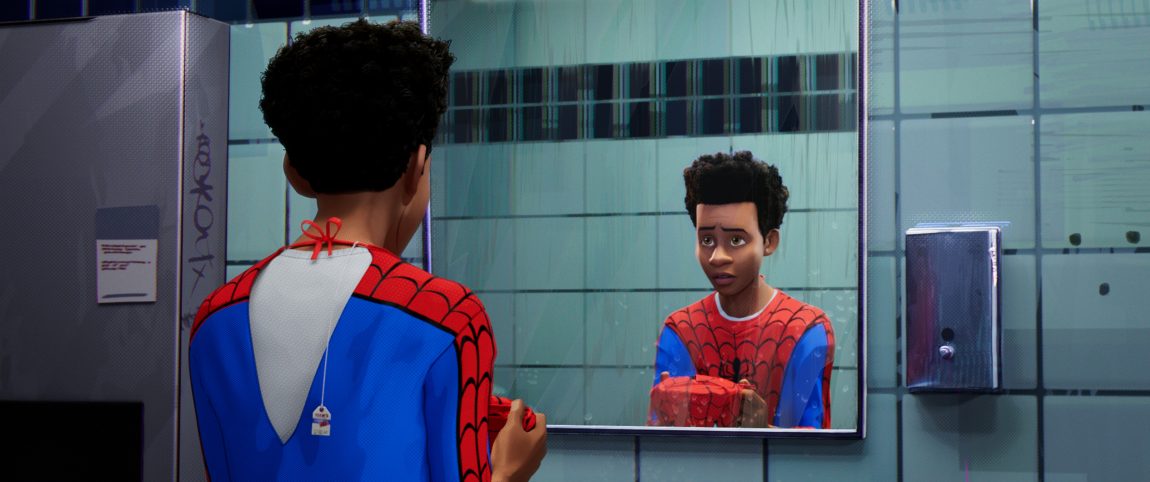
The character for Miles Morales was created in 2011 by writer Brian Michael Bendis and comic artist Sara Pichelli, drawing inspiration from President Barack Obama. What I loved about this movie (and what a lot of people seem to want from Spiderman) is how it added a new personality and perspective to Spiderman. Miles seems like a very authentic and relatable kid going through the ups and downs of growing up, which is all exacerbated by his newfound spider powers. His ascent to heroism is believable and admirable, as he struggles and fights to fit into the burden and responsibility of being a superhero. Miles isn’t a flashy, flaunting superhero– he is genuine, down-to-earth, and, even when he’s out saving the world, the audience knows that the guy behind the mask is just a kid from Brooklyn who loves art and is still finding his place. He seems to be one of the most human superheros in the universe, and I love that. The characters and relationships in this movie are written exceptionally well– it hits a sweet spot between funny, touching, and inspirational. I loved laughing at the jokes as much as I loved watching the conflict escalate.

Image result for miles morales into the spider verse
Miles wears a cheap Spiderman costume because he doesn’t have his own yet.

The best part about the movie, however, the part that still keeps me coming back to it, is the visual spectacle. The movie is bursting with color, liveliness, and utterly perfect animation. The style is quite realistic with a comic twist, almost as if the pages of a comic book had just come to life, dancing with color and movement. The accompanying soundtrack features artists like Nicki Minaj, Lil Wayne, and Post Malone, and it is fresh, original, and fits the movie so well– just like what Miles Morales would listen to. The movie is an absolute feast for the eyes and ears.

If you get the chance, I highly recommend this movie. At the very least, it’s highly entertaining– at the most, you will have come out of the theater with a thrilling visual experience and met the best spiderman yet.

PREVIEW: CMENAS Film Screening: “Rachel”

The first film to kick off a series organized by UMich’s Center for Middle Eastern and North African Studies, “Rachel” is the story of a young American woman who was killed tragically while fighting for peace in the Gaza strip. Her death had little coverage in the time it occurred, and though witnesses claimed it was an intentionally committed murder, American and international investigators brushed it under the rug and soon forgot about it. With the poignancy and engagement of a great storyteller, director Simone Bitton does the work that should have been done during her tragic death, showing the injustice of Rachel’s story and the larger Palestinian narrative in which is takes part. You can watch this film on 4:00pm – 6:00pm in Weiser Hall – Room 555. It is a free screening.

PREVIEW: The Favourite

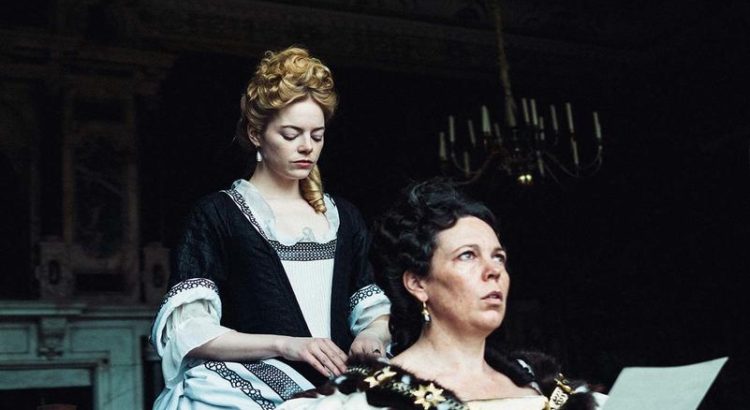
The Favourite has become one of the most talked-about films of late 2018 and early 2019, receiving no less than five nominations at the Golden Globes (including a win for Olivia Colman as Best Actress — Motion Picture Comedy or Musical). Directed by Yorgos Lanthimos, the film stars Emma Stone (Maniac) and Rachel Weisz (My Cousin Rachel) as two cousins competing to be the “favourite” of Queen Anne (Colman) in 18th century Britain. The Favourite is showing this week at the State Theatre as well as at Ann Arbor’s Quality 16.

PREVIEW: If Beale Street Could Talk

If Beale Street Could Talk only hit local theaters recently, but it is already garnering an impressive reputation. An adaptation of the 1974 novel of the same name by James Baldwin, the film has accrued several award nominations, including three at the Golden Globes for Best Motion Picture — Drama, Best Supporting Actress, and Best Screenplay. Directed by Barry Jenkins of Moonlight fame, the film stars KiKi Layne and Stephan James as Tish and Fonny, a young couple whose romance is derailed and tested when Fonny is falsely accused of rape and Tish discovers that she is pregnant. If Beale Street Could Talk is currently playing at the State Theatre, as well as other local Ann Arbor theaters such as the Ann Arbor 20 IMAX and the Quality 16.