REVIEW: Fantastic Beasts: The Crimes of Grindelwald

If I were to summarize my reaction to Fantastic Beasts and Where to Find Them in two words, they would be: disappointing and utterly unmagical (oops, I cheated about the two-word rule… kind of like J.K. Rowling did in writing the movie).

I had pretty high expectations for this movie after the first Fantastic Beasts movie, which was filled with beautiful animations of magical creatures within Newt’s briefcase, exciting romances and unexpected friendships, and an engaging, clear narrative. The first movie was an introduction into the series with fun explorations of the relationship between the magical and non-magical communities when Newt’s magical creatures accidentally get released in New York. None of the magic or excitement holds true for the second movie. It has a horribly meandering plot with an excess of characters who are poorly introduced and developed; the focus of the main characters and their relationships doesn’t continue well from the first movie; and, honestly, the whole movie was confusing, badly plotted, and, above all, kind of boring.

Fantastic Beasts: Crimes of Grindelwald starts off with the escape of Grindelwald. Albus Dumbledore, once a close friend of the rising villain, requests that Newt be the one to find Grindelwald, whose main mission is to bring back power to the magical community and have them overtake non-magical peoples. Newt hesitantly agrees, though many different people have dispatched on a mission to track down Grindelwald: Tina, the aurar and Newt’s love interest from the first movie; Credence, the emotionally troubled and morally ambiguous young boy; and, strangely, a completely random new character, the head of a prominent African magical family. All these people have their own convoluted motivations. Either way, by the end of the movie, Grindelwald does present himself to the patched-up and disorientingly written cast of characters; choices must be made and battle lines drawn.

Though the plot sounds promising in theory, its execution was the worst I’ve ever seen of Rowling’s writing. There were too many characters in this movie– Albus Dumbledore, the African auror I’d mentioned, Credence, his new girlfriend Nagini (where did she come from anyway?– there was absolutely no substantial context given for this), Newt’s brother, Newt’s brother’s fiance (both characters who were abruptly and poorly introduced into the mix), and at some point, even Nicholas Flamel (I can’t even comment on how disorienting his appearance was)– all this, I must add, in addition to our four main characters, Jacob, Tina, Queenie, and Newt. None of the characters were developed in the movie, and their relationships even less so.

The biggest problem to the plot was the sudden introduction of new and seemingly tangential information by the third quarter of the movie. It was inorganic and confusing to the audience. More shocking was how important this sudden information was to the end of the movie. Perhaps Rawling was attempting to set the stage for the next few movies, but the attempt was too ambitious– it was a grossly oversized cast of characters, a confusingly patched-up plot, and an unsatisfactory ending. Rowling, I think, works best in prose and novels, where there is ample space to develop all the narrative aspects to their fullest.

Despite having a distaste for this movie, I can still say that I’m too enchanted by the wizarding world to quit consuming Rowling’s media anytime soon. I hope, at least, that the next movie is much, much better than this one.

REVIEW: Green Book

“Traveling while black,” a guide that outlined restaurants, motels, and other establishments that were accepting of black people traveling in the south during the 1960s. In a time of legal discrimination, “Green Book” was a handbook that blacks used for their mere protection and safety due to the color of their skin. Based on a true story, Green Book is a film that takes the audience on a journey as an Italian-American male and African-American male spend two months time together on the road to the deep south and back. Directed by Peter Farrelly, Green Book embarks the true story of a world-class pianist and his personal identity crisis while co-existing in America during an extremely isolating time.


Dr. Don Shirley, played by Moonlight star Mahershala Ali, has set out to go on a two-month tour, performing world-class compositions for wealthy, white Americans. To aid in this tour, Dr. Shirley hires a chauffeur, but more so a personal bodyguard. Word around town is that Tony Vallelonga (played by Viggo Mortensen) is the best man for this job. Currently a laid-off bouncer at The Copacabana Nightclub, Tony is well-known in his hometown in the Bronx as “Tony Lip.” This reputation is something he is proud of — for he is acknowledged for his cunning way of finessing people with his swift words and persuasion. Tony’s character is highly unadmirable and Farrelly makes us aware of this. It’s clear that Tony is racist, a thief, a liar, he’s violent, and ultimately is an ill-mannered mess (countless scenes of him sloppily eating, smoking, or both simultaneously). Despite these characteristics, the film spins these into the attributes of someone who is laid-back, carefree, obedient by any means necessary, and a humorous family man. Because of this angle, the audience is forced to want to support Tony throughout his adventure with Dr. Shirley. Contrastingly enough, Dr. Shirley is presented as the complete opposite in every way imaginable. He has no family, he’s extremely uptight, and lives in a bougie apartment above Carnegie Hall full of authentic and eclectic design. His vernacular is top-notch, his intellect is unmatched, his poise and mannerisms are highly distinguished, and his patience is extremely thin for someone like Tony.


Considering these dynamics, it’s rather easy to predict the elements of the film. Interestingly enough, the majority of conflicts and emotions came from the interactions between these two characters, rather than the political/racial climate while they were traveling. This makes it difficult to fully identify what one may actually be satisfied with after watching the film. In some ways, there could have been much more emphasis on the actual happenings of discrimination. Furthermore, this inevitably presents a huge obstacle from steering away from the typical white savior perspective. In this regard, it’s hard to ignore Spike Lee’s Do The Right Thing. In many ways, Green Book relates to this film with its Italian-American vs African American conflicts. There is a strong tension led by stereotypes and grossly identified misunderstandings. Another theme that revealed from both of these films was the hierarchy of oppression — both of these races countering each other with respective struggles and biases that they face. However, Green Book introduces the topic of the hierarchical class structure. Tony demands that he’s more black than Dr. Shirley because of his lifetime upbringing in the Bronx, where he is a working-class man for his family and enjoys the typical “black foods,” while frowning upon the luxuries that Dr. Shirley has earned.


Green Book is an emotional journey more than anything. Throughout its bursts of anger, it’s complemented with spouts of joy. Where it may be full of tears, it’s backed by minutes spent laughing hysterically. This film attempts to tackle a challenging topic, so much so that it could have been more aggressive in recognizing that many of these problems still exist as we near the year of 2019. There were scenes of white saviourship orchestrated by Tony as his personal bodyguard but it’s almost unreasonable to have expected anything less. One may leave this film feeling slightly incomplete with the unravelings of Dr. Shirley’s personality and identity crises. Overall, Green Book is a compelling story about friendship and the tenacious mindset that “Genius cannot change people. It takes courage to change people’s hearts.”


REVIEW: The Room

Where do I even begin with this movie?

Image result for i did naht gif

I’d heard it called “the worst movie ever made,” but this fails to capture everything horrible about director (and writer, and producer, and star) Tommy Wiseau’s work. Perhaps some numbers will help: Wiseau spent $6 million to create this disaster, while collecting only $1800 in ticket sales, as it played in a few select theaters in California when it was released in 2003. The man behind this blasphemy is as bizzare as his movie, keeping so quiet about his personal life that no one is sure of his birthplace beyond that it is somewhere in Europe. After he immigrated to the United States, he worked his way up from bus boy to movie star, becoming independently wealthy by unclear means. Since The Room, he has landed a few roles in television and film, not to mention receiving some sort of praise from James Franco’s 2017 movie The Disaster Artist, in which James and his brother play Wiseau and friend/colleague/costar Greg Sistero, telling the story of The Room’s disastrous making.

Image result for disaster artist

Basically, this movie was a meme before modern memes existed. The actors perform expressionlessly, their voices flatly reciting a poorly-written script. Scenes fail to fit together in any continuous, logical manner, creating unrelated and unfinished plotlines. The opening music is somewhere between the background to an old anime, a made-for-tv movie, and a documentary about King Arthur. Where there is dialouge, there is often no background noise at all, creating an unsettling feeling for the viewer. There is so much wrong with the layout and execution of this movie it would be possible to go on about it for several eternities; the whole thing is simply bizarre.

In my eyes, Wiseau is very earnestly aspiring to something that isn’t worth aspiring to; he strives to imitate the worst facet of American film, throwing together a love triangle, a splash of ganster violence, sex scenes, cancer drama, a near-fatal football-related accident, a suprise party, state-of-the-art recording equipment, an ending that is the exact opposite of an unexpected twist…etcetera, etcetera. All of this comes together to form what is for the most part an especially awful Lifetime movie. And yet, I and millions of others around the world somehow love this movie. Given the distorted sense of humor the Internet has cultivated in us all, had The Room been made in 2018, I could see it being quite a success. In fact, it has become more successful since its release, playing periodically in theaters everywhere. Wiseau himself has attended some of these events, given to arriving via limosine and sitting in the front row. His immortal confidence in his work is truly something every artist should aspire to.

Image result for the room

Tommy Wiseau has a website! If you’re interested in purchasing The Room merchandise or some of his self-designed underwear, he’s put almost everything on sale for the holiday season. One of his jackets (with a free copy of The Room and a “dogeee” stuffed animal) would make a great gift for your grandmother, perhaps. And if you haven’t yet seen this work of art, I urge you to find a showing in a theater near you!

REVIEW: Boy Erased.

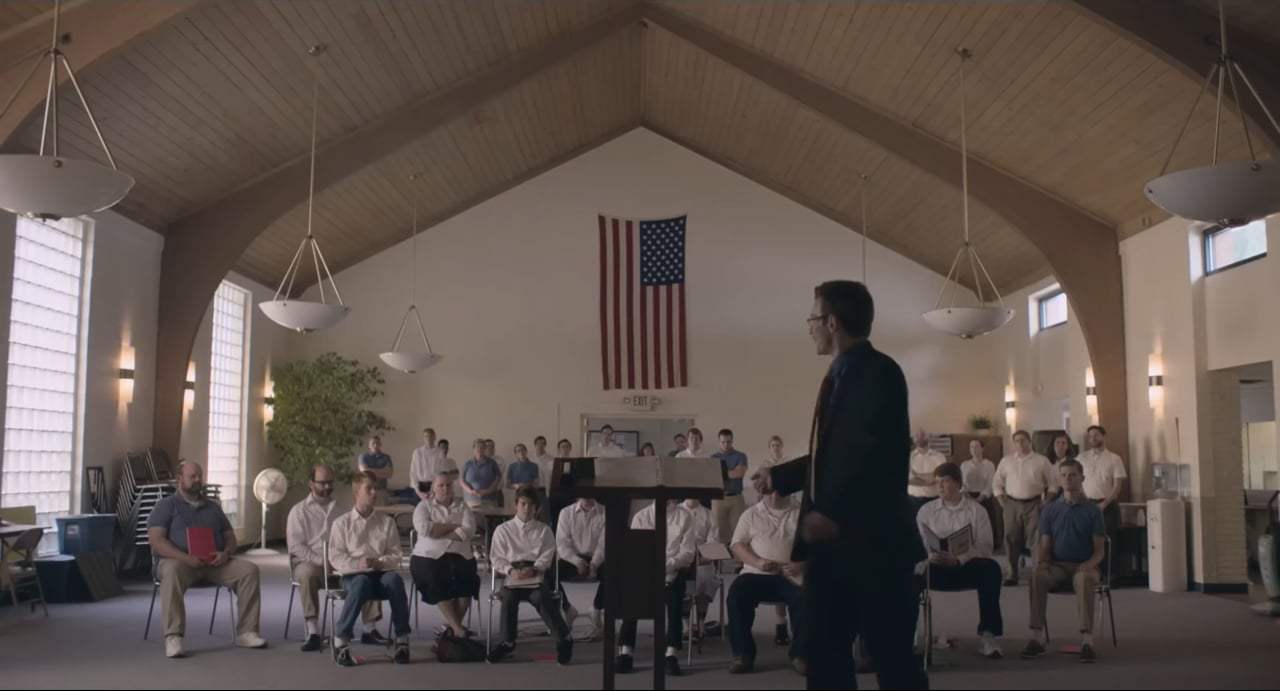
After reviewing Beautiful Boy, Boy Erased seems to follow as another dose of a dysphoric mood. They are films of similar tones, based on memoirs, iterations of the same loneliness growing up and the tremendous struggle of an unfamiliar new world. The films are similarly understated in many ways, often slow and cyclic, but Boy Erased properly gives us significance where it is needed, emotion where it is craved, and a genuineness that is never lost.

An impressionable Jared Eamons (Lucas Hedges) only wants to reconcile his faith and his sexuality, to live in his realm of familiar things despite a lingering discomfort that’s been tucked away. He’s a basketball player, he has a cheerleader girlfriend, works part-time at a car dealership, on his way to college — and now far away from his old life, he begins to occupy another significant space, another world that becomes more corporeal as time passes.

But nothing is certain, and when Jared is unwillingly outed to his parents, he still has an earnest conviction that he is able to shed this sin. He dutifully agrees when his father (Russell Crowe), along with with other higher ministers of church, suggest that he participates in Love in Action, a gay conversion program.

The Miseducation of Cameron Post is a film similar in topic, where the titular character Cameron is characterized by her rebelliousness, skepticism, and an overall faith in herself during her time at conversion camp. But here we differ in that Jared is compliant and eager to please, if not to change. He is a good son, one who sits expressionlessly supportive of his father’s ordainment as a Baptist minister and his vows to eliminate homosexuality. After his first day at Love in Action, he tells his mother he’s excited for the things to come — maybe even believing this sentiment himself.

Boy Erased’s importance comes from Jared’s delicate uncertainty and the fragility of his worlds. His parents are conservative and misinformed, but do ultimately care for him. He believes in his faith, but has a doubt that he cannot shake. The film presents itself in a fairly reserved manner, not explicit in the way it condemns the program staff or his parents. But slowly, we grow to see the way Love in Action is sinisterly manipulative, emotionally taxing, built on the basis of a poorly worded handbook — the same time that Jared also begins to realize the flawed chassis of its goals and who he is.

We go back in time to understand the things written on Jared’s “moral inventory” of past behaviour. In flashbacks, we see that sometimes, he was thrown into a violent confrontation with his sexuality, dangerous and non-consensual, with the collateral aftermath of shame. And other times, it was gentle, soft moments of clarity that changes the way Jared connects his two realms of being at his own pace. The way he consolidates his worth is slow, highlighted by painful moments of realization during his time at Love in Action and, in retrospect, outside of it.

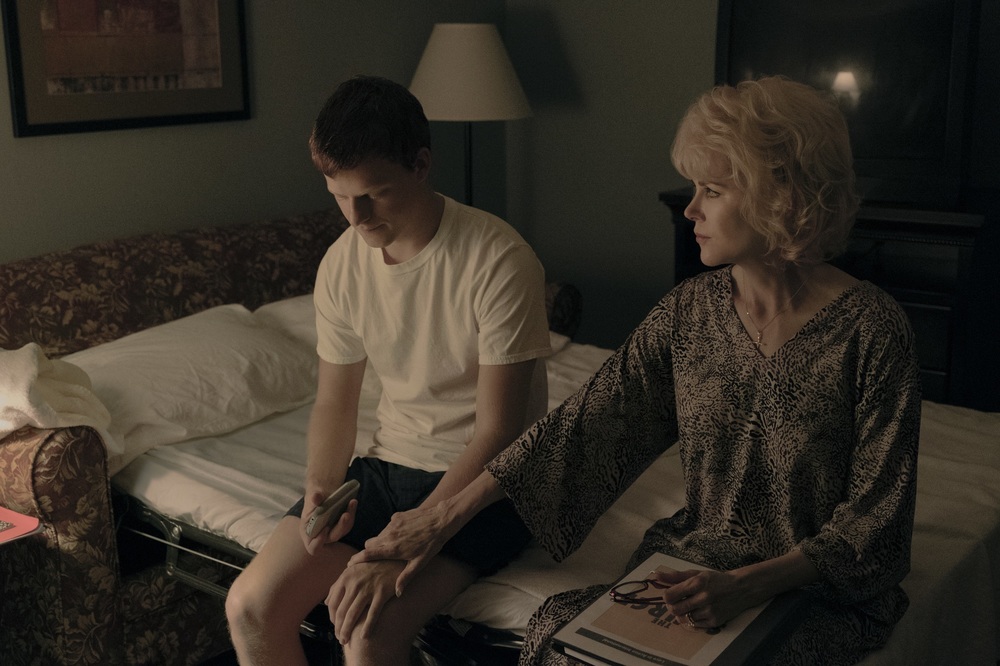
The film climaxes after the abuse of one of the kids at Love in Action, when Jared is called upon to perform an exercise of confessing his sins and channeling his anger, the upsurge resulting from Jared’s gradual development into certainty in his own skin. This resolution is foreshadowed when Jared’s mother, Nancy (Nicole Kidman), tells him the first time she drops him off to call her if he ever needed to. And above her husband, above rule, above God, his mother rushes to Love in Action, puts program leader, Victor Sykes, in his place, and drives off with her son when Jared tearfully calls her. In a very beautiful moment, his mother gives him her love and support as foremost, above all.

Boy Erased is not without its flaws. The secondary characters lacked development; from the astute Gary to the solemn Sarah, we seldom saw more of their inner world, our cinematic gaze fixated on Jared. Even for Jared himself, things were kept subtle, difficult to decipher his exact thoughts —although it often seemed like he didn’t quite know either, filled with conflicting ideas and doubts, a mess of diverging ideals pooling together that clarifies with his growth. Despite its tonal softness, Boy Erased finishes on high hopes, carried by the relationship between Jared and his family as well as the terrific job done by the cast, giving just enough to avoid falling flat.

PREVIEW: The Room

Although described as a cult classic, I have never even heard of this movie. Its description is beyond bizzare, warning that I will “never see a football the same way again,” which is terrifying, and brings me to a very specific memory of this poem I read from a book I picked up for 50 cents at a used book store. Reviews of this movie range from calling it a masterpiece to the worst movie ever made.

Basically, I have no idea what watching The Room will do to me, but I will die from curiousity if I don’t see it.

You should join me in this odd venture into the unknown. It’s showing one night only, Friday, November 30 at 10 PM, in the auditorium of the Michigan Theater.

One last thing: the Michigan Theater website requests that audience members do not bring metal spoons or footballs to the show (???), so be sure to remove the spoons and footballs you normally carry before arriving.

REVIEW – The Other Side of the Wind

I arrived at the Michigan Theater, ready to do my job. It was early so I chose my seat carefully. Not too close or I would be swallowed up by the glowing screen. Not too far or I would strain my eyes trying to see the actors’ faces. Just right. The Goldilocks seat was situated perfectly between the two older men in front of me. I sat, no popcorn, of course. I was being professional. A few minutes later, the lights were dimming, and the screen was displaying the coming attractions. Twenty minutes after that, I was fast asleep.

The film that I had set out to see, the same one that sent me into deep slumber was The Other Side of the Wind. It is both an entirely new creation and a relic from the past. Originally written and directed by the famed Orson Welles, principal photography for the film was completed in 1976. However, the editing process became increasingly complicated as years passed. Welles passed away in 1985, project still uncompleted. Finally, in 2018, the film was completed and released by Netflix in November. Seemingly, after this long and winding journey, I should have been entranced by this film. After all, this was the Orson Welles, the same visionary who created Citizen Kane, hailed to this day for its revolutionary use of the medium of film. This was the last project, a glimpse of fading genius. What kind of film enthusiast, what kind of movie critic was I, if I could not enjoy this film? The kind that falls asleep, apparently.

Thankfully, the Michigan Theater was not my last chance to enjoy this film or yours either. You, too, can watch The Other Side of the Wind on Netflix now. It is a film that is strikingly different from most of the service’s offerings. Not to its detriment, I think. This is something altogether unusual in its form and presentation, not at all what I was expecting. The story is framed as a documentary, archiving the last day of Jake Hannaford’s life. Hannaford (John Huston) is desperate to complete his latest film, intending to comeback from years of controversy with this experimental project. The documentary incorporates scenes of his project intermittently, fully committing to the film-within-a-film-within-a-film premise. It is confusing, jumpy, and quite amusing as Welles links conversations and camera angles. He flows from character to character, scene to scene, requiring the audience to connect the cleverness and create the plot. Once in a while, he even explains things, underlining and highlighting repeatedly, until one wishes he would be less blunt again. For a sleep deprived college student, it was a little bit more whiplash than I could handle. The tone thoroughly distinguishes it from any of the more plot-driven or even character-driven films in theaters today. Welles focuses instead on creating a mood and immersing us in it as we explore the troubled life that Hannaford has created for himself.

So, perhaps, I was not the perfect audience for this film the first time around. But as someone who returned to it the next day, comfortably seated before my computer, it is a great film to revisit. The Other Side of the Wind has much hidden visual depth, even narrative depth at times, but does not quite capture the interest.