REVIEW: Zell Visiting Writers Series: Hieu Minh Nguyen and Nicholson Baker

On Thursday night, I was lucky enough to be able to listen to Hieu Minh Nguyen read several of his poems at the UMMA. Unfortunately, Nicholson Baker was unable to attend the reading due to travel difficulties. However, Hieu commanded the stage so well that I didn’t even realize that the hour had flown by until he announced his second-to-last poem.

This was the third installment of the Zell series that I attended, and it succeeded in blowing me away again. Personally, as a writer myself, I love attending readings because I walk away feeling inspired, buzzing in a way that is indescribable and makes me want to sit down on the curb right outside of the venue and whip out a piece of paper and a pen. Each writer has their own unique energy that touches listeners in different ways.

However, out of all the installments I experienced in the past, this one was notable for the way in which Hieu commanded the stage. He immediately established an easy rapport with the audience, making us laugh with references to astrology and kindergarten-age romance. He was conversational and bold and bright, and after the first half hour I decided that if I would ever be able to choose whatever parallel universe I wished to inhabit, I would choose the one in which I was close friends with Hieu.

Because if there was one theme that made recurring appearances throughout the program, it was the importance of friendship: how much Hieu needs and treasures it. In fact, the person who introduced him with an opening statement was his close friend Franny Choi, an esteemed poet in her own right. Seeing the two of them hug onstage and smile and laugh, I could sense how deep the love for each other is; watching them admittedly made me miss my best friends at home.

Besides friendship, Hieu’s poems also dealt with heavy topics that centered on his experiences as being a queer, Vietnamese American poet. Though the night started out with laughter and lightheartedness, the mood became a bit more somber as he read more of his poems, which delved into the aforementioned darker issues (though none of his poems are trivial or shallow, by any means).

All in all, I enjoyed listening to Hieu Minh Nguyen read some of his works. I intend on reading more of them on my own, as well as attending future Zell events.

Hieu Minh Nguyen has a forthcoming collection of poetry, titled Not Here, released in 2018 by Coffee House Press. I anticipate reading it, and encourage others to, as well!

Image credits: University of Arizona

PREVIEW: Zell Visiting Writers Series: Hieu Minh Nguyen and Nicholson Baker

On Thursday, February 15, come out and attend the next installment of the Zell Visiting Writers Series, featuring Hieu Minh Nguyen and Nicholson Baker. The Zell Visiting Writers Series invites one or two distinguished authors to share their work, and it’s a great way to gain some insight into what the Michigan writing community is all about, as well as to listen to some beautiful works of literature!

Hieu Minh Nguyen is a queer, Vietnamese American poet who is associated with Kundiman and Muzzle Magazine. His first book (This Way to the Sugar) has won the Minnesota Book Award and the Lambda Literary Award, and his other works have been published in places such as the Southern Indiana Review, Guernica, and the Paris-American.

Nicholson Baker has published a total of nine novels and four pieces of nonfiction, as well as various other pieces of work, in places such as The New Yorker, Harper’s, and The New York Review of Books. Baker’s work has won him a National Book Critics Circle Award, House of Holes, and other awards.

The reading will take place in the UMMA from 5:30 – 6:30. Admission is free.

REVIEW: Constellations

It is simply astounding that out of all the possible things that could happen, out of all the ways things could turn out, it is this one way that events align. How astronomically unlikely it is that two people would meet each other, at this time and at this place, and be suited enough to each other that they could form an attachment, remain woven into each other’s timeline; how much more possible that they never meet at all, never become the people they need to be to be suited to each other. In any romance, or even any story involving the meeting of people, or maybe even any accounting of an interaction between two objects, it is a given that the paths of those individuals did cross, and what matters is everything that follows. Constellations accounts for the possibility that nothing follows, that the spacetime continuum doesn’t allow for a story at all. In bringing to the foreground the laws of physics, it reminded me that everything that does happen is wondrous just because it happened, and not something else. Somehow Constellations maintains the inevitability of a single possible outcome and also confirms the existence of infinite potential outcomes.

Time is linear, and yet it must go in parallel lines because so many different end results occurred in the play. And it must be intuitive to understand this at some level because even with the same lines, and cuts forward and backward in time with no cue but lights and tone of voice, those vignettes assembled clearly into cohesive alternate timelines. There are so many ways to say the same words, all of which change the way the characters perceived their timelines if not the timelines themselves. Skillful is the least you need to be to switch from angry to loving, bouncy to pensive, in a split second, and these actors were worlds better than merely skillful. I didn’t expect each vignette to be so short—really just a few lines before it was repeated with a different interpretation—but those little snippets of story were enough to give the show the texture it needed.

It was very full-bodied for a show that was only an hour and ten minutes long. It felt much longer, not longer because it was boring but longer because it was mesmerizing enough that it felt as if there was too much story there to have unfolded in only an hour. I think several lifetimes happened over the course of the play, lifetimes that contained laughter, awkwardness, poignancy, anger, and love all at once.

I realize this isn’t a review so much as it is a reflection. Perhaps that defeats the purpose, but I mention this because any show that makes me think, the way Constellations did, is worth seeing. Had I been asked before tonight, I would have told you that if you had enough numbers, enough variables, and an equation, you could calculate the outcome of the universe. And perhaps I still would. But tonight, string theory seems closer and truer than it ever has before.

PREVIEW: J. Edgar Edwards Reading Series

Interested in exploring the Michigan writing community, listening to beautiful literature, or simply want something to do on Saturday night? On January 27th, the J. Edgar Edwards Reading Series will be presenting works by Elinam Agbo, Augusta Funk, and Rachel Cross, all first-year MFA students of the Helen Zell Writers’ Program. The reading is free and open to the public. Each reading is held on Saturday evenings, but at different locations; the January 27th reading will be held at 605 West Hoover, Apt. 2, at 7:00 PM. Come out and enjoy!

REVIEW: Murder on the Orient Express

As an Agatha Christie fan, I have to discuss this film in two parts: as a standalone work and as an adaptation of the book.

As a standalone film, Murder on the Orient Express was really good. The cinematography was beautiful, crystal clear with lush colors, elegant and enhancing the 1930s feel of the movie. I always appreciate it when a movie is well-lit: while darkness may add to the effect, I do prefer to be able to see what is happening onscreen. The use of light here was impeccable.

The acting was also very good, which is no surprise considering the film boasted quite a lineup of famed names: Judi Dench, Michelle Pfeiffer, Johnny Depp, Leslie Odom Jr. were just a few names among the star-studded cast.

the plot of this film is dependent on each person in the cast making their character a strong one; although it is a mystery starring Poirot, he is not the main character. With Agatha Christie’s style of writing, he never is. What I’ve always liked about her books is that her plots are really not about the murder at all. She gets the murder out of the way at the beginning of the novel, and then spends the rest of her time studying the people who are involved in the murder, slowly unraveling each one of their characters so that really the end result is a deeper understanding of people. So with this film I didn’t really like the way it made Poirot a focal character. On one hand, he was the outsider to this situation, and to have a consistent thread in a plot it helps to have a narrator or protagonist, and so perhaps it couldn’t be helped. But I felt that the characterization of the other people in this movie was somewhat lacking.

I also didn’t care for Branagh’s portrayal of Poirot. It’s a hard character, as Poirot is comic sometimes, and deadly serious at others. My first question was, why couldn’t someone who is actually Belgian (or at least French, although Poirot himself would probably hate that) play the role? I don’t know of any adaptations where Poirot has been played by a native French speaker – even David Suchet, who is probably the most famous Hercule Poirot, is English. That aside, I am not sure Branagh quite decided whether Poirot was to be amusing or dramatic, leading to a result that was an odd mix of both. In dramatic scenes, I personally much prefer if the actors almost whisper their lines instead of shouting them, as I find that far more intimidating. In the books, Poirot, while he can get worked up and raise his voice, is not really the kind of person I would expect to yell about something really serious. I wish Branagh had done that – it would have made the scene seem less like Poirot was flying off the handle, and more like Poirot was just barely keeping his anger on a leash. I will say, though, that his mustache was excellent. If you’re not familiar with Christie’s character, this may not seem like very important a point, but one of Poirot’s identifying attributes is his huge mustache, which David Suchet never really had. Also, Branagh did manage to bring out Poirot’s fastidious nature, which is another essential aspect of his character.

All in all, the movie was a really good one, if you didn’t compare it to the book. For that reason, I was wary of seeing it, but the fact that Judi Dench was in it convinced me otherwise (she, incidentally, does a magnificent job of adding a softer side to her character, the Princess Dragomiroff, than I thought existed in Christie’s portrayal). And there were no really major details changed, as far as I remember, though it has been a while since I last read the book. But if you did compare it to the novel, I think the nuances of Christie’s characters are perhaps explored more fully in the book, though the actors – I’m thinking of Michelle Pfeiffer and Judi Dench here – did a fine job of bringing out those nuances in the limited time they were given to do so.

I think the most perfect part was the opening song in the end credits. Sung by Michelle Pfeiffer, who plays a pivotal role in the cast,  was a beautiful fit, both by style and by lyrics – as such, it was almost haunting. Full of love, loss, and sorrow, it ended the movie on a fittingly melancholy note.

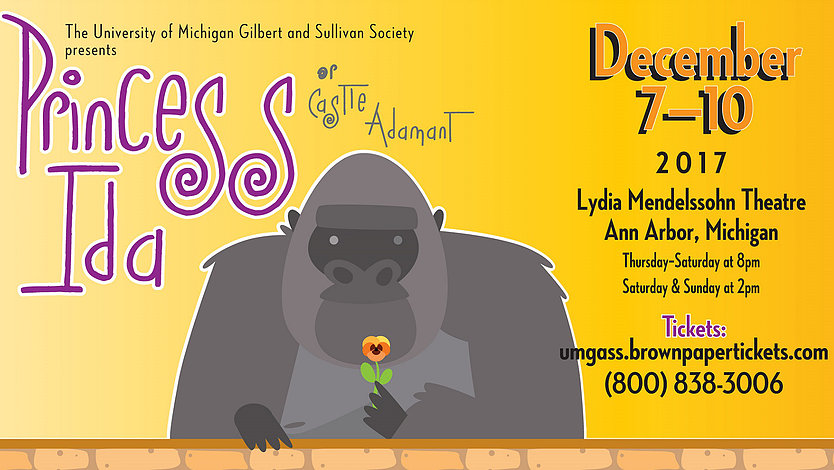
PREVIEW: Princess Ida

The show that the University of Michigan Gilbert and Sullivan Society (UMGASS) is putting on this semester is Princess Ida. If you haven’t heard of Gilbert and Sullivan, they were a duo (a librettist and composer respectively) who wrote comic operas in the late 1800s. While the 1800s were a long time ago, the humor in the operas is as fresh now as it ever was. And it doesn’t hurt that UMGASS does a beautiful job of adding even more exuberance to that humor.

Gilbert and Sullivan operas are so absurd that it’s hard to know where to begin giving a synopsis. In the most general sense, Ida is about women’s education. But for more details, I recommend you come to the show.

Showtimes are Thursday 12/7 – Saturday 12/9 at 8pm, and Saturday 12/9 – Sunday 12/10 at 2pm. Tickets are available at umgass.brownpapertickets.com, at the door, or free with a Passport to the Arts.