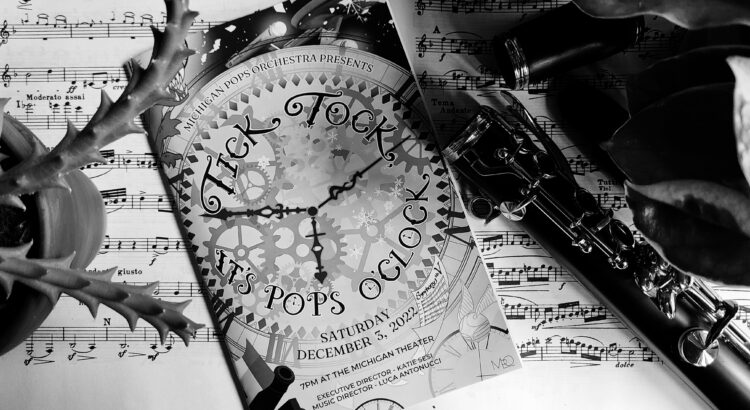
REVIEW: Michigan Pops Orchestra Concert “Tick Tock, It’s Pops O’Clock”

7:00pm • Saturday, December 3, 2022 • Michigan Theater

This was my first experience as an audience-member for the Michigan Pops Orchestra. While I knew beforehand their reputation for wacky, fun performances, I was still surprised and delighted by the personality the musicians brought into their work. Not only did they play with excellence, but musicians were featured in short skits introducing the music, as well as in videos made to accompany the program. I’ve never been to an orchestra performance with so many musician-specific fan bases–Anthony Medei, co-tech director and viola player, seemed particularly popular in his comedic features as Milly Bagic, Doc Brown, and the evening’s gameshow host.

The orchestra took several opportunities during the evening to wish farewell to its current executive director, Katie Sesi, a graduating senior. One of my favorite moments during the performance was during the final few measures of Amilcare Ponchielli’s “Dance of the Hours.” As she played, a little anticipatory smile appeared on Sesi’s face that widened into a full grin as the orchestra struck the final note of the song, a moment which I felt sweetly captured the dedication and love Pops musicians feel for the organization.

One of the pieces I heard Michigan Pops would interpret on Saturday night, and which impelled me to buy tickets, was “Time Warp” from Rocky Horror Picture Show. I am a big RHPS fan, and I was curious about how a glam rock piece could be arranged for orchestra. Coincidentally, during the performance a story was shared about how the executive board had to scour the internet for an orchestra score of the piece, finally locating one used by an obscure orchestra in Germany. Ultimately, although the musicians did an admirable job of bringing the piece to fruition, my final opinion is that orchestra-Time-Warp might have been better left in Germany. Rocky Horror ≠ orchestra music.

Overall, however, I immensely enjoyed the mix of songs chosen by the orchestra, which in another context might seem eclectic, but which was roped together by the theme of “Time” encapsulated in the performance. True to its role as a “Pops” orchestra, the songs were almost all familiar to me. I liked how the program illustrated the versatility of orchestra as a medium, which throughout the evening alternately took center-stage in pieces like Beethoven’s Fifth and shifted gracefully into the background as, for example, a screen showed a student-created speed-run of Harry Potter and the Prizoner of Azkaban. Additionally, I appreciated how many of the songs Pops performs are famous enough that everyone might have heard of them, but not everyone gets the chance to experience them live in concert. Michigan Pops offers an accessible opportunity for audiences to experience iconic music live and an entry point for everyone to get interested in orchestra.

PREVIEW: Michigan Pops Orchestra Concert “Tick Tock, It’s Pops O’Clock”

This semester, the Michigan Pops Orchestra chose ‘Time’ as the concept for their concert, meaning the pieces they’ve selected have some kind of tie-in to that theme. On their instagram @michiganpops they’ve advertised OSTs from Harry Potter, Jurassic Park, and Star Trek, as well as pieces from classical composers like Beethoven and Tchaikovsky. I’m assuming that they chose timeless classics (heh) that everybody has heard alongside other iconic soundtracks, so it’ll be music familiar to the audience. Full orchestral symphonies aren’t as commonly heard though, so it’ll still be a new experience for a crowd not as well-versed in classical music.

The Michigan Pops Orchestra is one of the only (perhaps the only) ensemble on campus that is completely student run. This allows the performers much more artistic freedom, so each one of their concerts is unique. One aspect of Pops that differs the most from other ensembles is their inclusion of skits and films; I’m not sure what the skits will be, but the films they’ve created will be playing during Jurassic Park and Harry Potter!

Everybody is welcome to attend their concert: K-12 students get free entry, Adults pay $9 per ticket, and University students get discounted tickets for $5.

Tickets will be sold in the Posting Wall at Mason Hall from November 28th to December 2nd and at this MUTO link: mutotix.umich.edu/3688

Don’t worry if you missed these dates, though, because tickets are also being sold AT THE DOOR the day of the concert on December 3rd at 7:00pm in the Michigan Theater.

REVIEW: The Music of Studio Ghibli

This past Saturday, the Ann Arbor Symphony Orchestra performed a sold-out show at the Michigan Theater. Led and conducted by Wilbur Lin, the orchestra played arrangements of film scores from Spirited Away, Howl’s Moving Castle, and My Neighbor Totoro. 

The concert was a delight. I have grown up watching Hayao Miyazaki’s Studio Ghibli films, and had been looking forward to this event since the start of the semester. Joe Hisaishi’s scores are particularly successful as not only the main themes are iconic, but each other piece from each film are unique, sweeping, whimsical, full of wonder, and simply beautiful to listen to. 

The Spirited Away arrangement perfectly encapsulated the mystery of the film, as well as the chaos that ensues as the story progresses. It was a treat to watch the orchestra play live, and being able to identify what instruments were playing what. With “Merry-Go-Round” and “Cave of Mind” from Howl’s Moving Castle, I loved hearing the same theme played via different techniques – plucking, or pizzicato, as well as the typical bowing technique I am most familiar with hearing. 

I also appreciated that Maestro Lin spoke between arrangements to discuss themes from the film, noting the differences between the more Hollywood dramatic scores of Spirited Away and Howl’s Moving Castle and the more popular-and-familiar-at-the-time Japanese TV reminiscent score of Totoro. The Totoro Orchestra Stories were particularly joyful as the music is arranged to teach children about the different components to an orchestra – highlighting the woodwinds, strings, percussion, etc. by section before the orchestra as a whole launches into themes from the film. Local music teacher Momo Kajiwara also joined the stage as a narrator in Japanese. 

I had only been to one orchestra performance of a film score prior to this event. At the first event I attended, the symphony orchestra performed the entire score for the third Harry Potter film, with the film playing on a screen above the performers. I often find that when I watch a film or show, I do notice the score, but it is something I have to revisit after watching in order to fully appreciate. Hearing the score isolated from the context of the film with the Ghibli concert allowed me to be completely immersed in the music, and having the films played in the background was not necessary to be engaged and awed. 

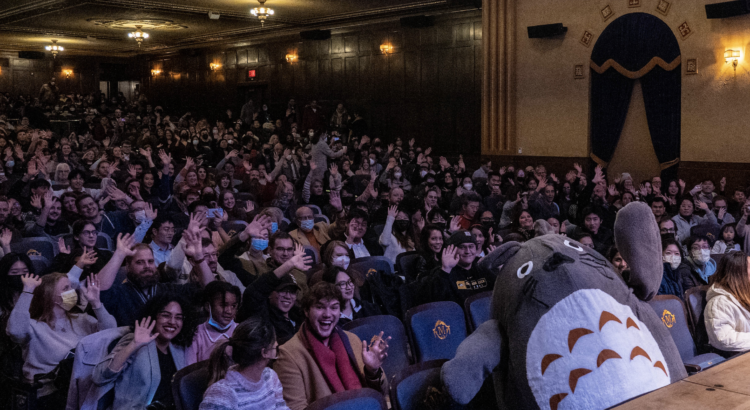
And of course, seeing Totoro in the flesh was a welcome surprise:

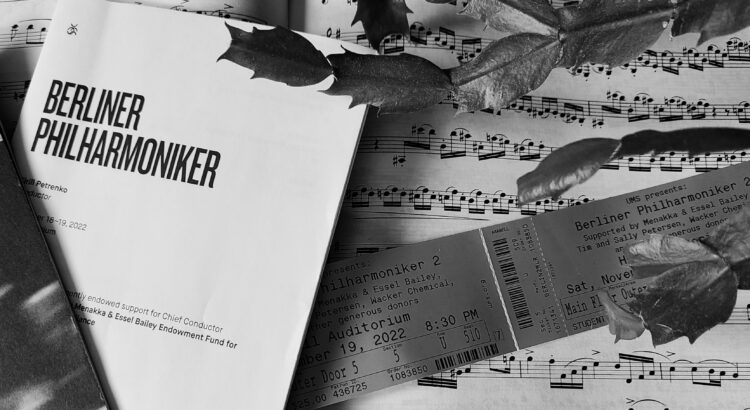
REVIEW: Berliner Philharmoniker (Saturday Program)

8:30pm • Saturday, November 19, 2022 • Hill Auditorium

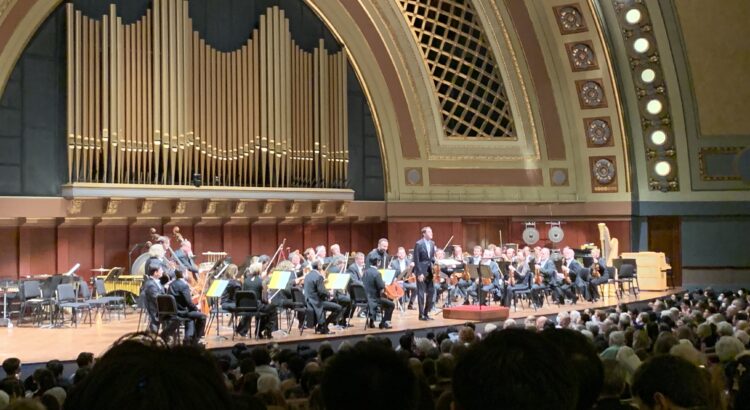
Seeing the Berlin Philharmonic perform Mahler’s Symphony No. 7 on Saturday night was nostalgic for me, despite never having seen them perform previously. Back in early September, I vaguely recognized the name of the orchestra on the UMS season schedule as one of my younger brother’s favorites. He is still in high school, and lives several hours away, but when I texted him that the Berlin Philharmonic was coming to Ann Arbor, he flew into action coordinating travel plans with our parents while I bought us two student tickets. This weekend, he and my parents drove through blizzards down from northern Michigan to see the performance and kick off Thanksgiving break.

On the night of the performance, my brother and I waited anxiously in the crowded lobby of Hill Auditorium for the doors to open, and in our seats we people-watched together, with a particular eye to the eccentric winter gear of some of the older patrons. During the performance, we excitedly nudged one another whenever we heard a flute (his instrument) or clarinet (mine) playing solos, and we both fangirled obsessively over the showy flutter-tonguing of the flute in the fourth movement.

I am not an expert in music, orchestras, arranging, or conducting, but this performance was captivating for me because of the way live music engages my imagination, eases the flow of my thoughts in new directions, and awakens moments from my past to be interpreted in new ways. I have read that Symphony No. 7 seeks to represent the transition from night to day, drawing from nature. There were moments where the music made me think of a slumbering hive of honeybees beginning to stir, or the midnight walk of a lone coyote across moonlit snow. At intervals, I drifted into memories of my childhood, time spent listening to and playing my own music. Listening to the Berlin Philharmonic flow through the symphony’s five movements became a process of listening for the memories evoked by each melody.

Seeing the Berlin Philharmonic perform reminded me of music and artistry as a common thread weaving throughout my life, connecting me with my family and my memories. It also reminded me to be grateful for the advantages afforded my by attending a school like the University of Michigan, and the privilege of being able to share the arts here with my family. The performance helped me reconnect with the joy that comes with experiencing music, and my first evening upon returning home for Thanksgiving break saw me digging my old etude books out from among my mom’s stacks of piano music and brushing the dust off of my clarinet case.

REVIEW: Berliner Philharmoniker (Friday Program)

One thing my childhood piano teacher of twelve years always told me was that a good performance made you feel taken care of. If you feel nervous on stage, so does your audience. If you are comfortable, the natural rise and fall of the music emerges and your listeners can comfortably breathe along each phrase. 

Last Friday, I had the pleasure of seeing the Berlin Philharmonic play at the Hill Auditorium. Pen and notebook in hand, I was reminded of my teacher’s words when the pages stubbornly remained relatively blank. When faced with the golden standard of the orchestral world, I suddenly found it very difficult to come up with any constructive comments. For the concert’s two-hour duration spanning raucous 21st-century sounds to Mozart’s pristine motifs, all I could do was sit back and think: this is so nice.

As the orchestra members made their way to their seats, I was surprised to see the second violins and cellos settle down in each other’s usual sections, with the basses gathered on the left side of the stage behind the cellos. While this seating arrangement made sense for the Mozart concerto later in the program, it was interesting to hear it used for Unstuck, a recent composition by Michigan native Andrew Norman. It is difficult to describe what happens in the piece–eerie, yet beautiful melodies are sandwiched between messy, frantic climaxes. Blurry tutti slides carry the listener from one idea to the next to the point where you forget where the piece even started. I rarely get a good view of the basses when I watch concerts, but this time around I was able to observe how they were constantly employed to add subtle, textural elements–slaps, snaps, dry scrubbing–to the ensemble.

Next up was the Mozart Violin Concerto No. 1 in B-flat Major performed by concertmaster Noah Bendix-Balgley. I don’t typically listen to Mozart over other composers, but Bendix-Balgley’s interpretation felt like a return to the fundamentals and allowed me to appreciate his music. His solo part was impeccably clean and sweet with a bell-like quality. The hardest part of playing Mozart is to make it sound effortless–both the ensemble and soloist mastered this element. The candenzas, written by Bendix-Balgley himself, were complex and brilliant.

Concluding the concert was the Korngold Symphony in F-Sharp Major. There is a lot of discourse surrounding Korngold and his validity as a serious composer due to his career writing music for films–an argument I find silly. The cinematic lushness and bold tuttis give the piece a distinct mood, while the free-spirited clarinet solo at the beginning of the first movement introduces an engaging story of conflict and resolution throughout the work. 

Part of the reason why the Berlin Phil is able to produce such a distinct sound is the combination of intense coordination and soloistic playing. By matching the exact speed and positions of each bow, the strings are able to meld together and mask any sense of bowings. I can only hope that everyone could have the chance to hear them perform live because it is truly a magnificent experience.

REVIEW: Celebrasia

I arrived promptly at 5:15, and through the windows of Mason Hall, I could see the place was already swarmed. The performances wouldn’t start until 6:30, but eager supporters ravaged the food booths, arriving early to secure good seats and snag Asian snacks like scallion pancakes, spam musubi, samosas, onigiri, tea eggs, and dumplings, just to name a few. 

After destroying the best tofu pudding of my life, and a quick fishbowl study sesh (grind never stops), we headed to auditorium A to catch the performances. Only to find an overflow of people out into the hall. There was absolutely no way to get a seat, let alone see past the crowd of heads cramming the walkway. Despite many technical difficulties, and my late arrival to the show, the student groups were a hit. From the doorway of the auditorium, through the screen of a phone filming between two heads (shout out to the dude who was recording), we gasped, bug-eyed at Revolution Yo-yo’s flying tricks and coordinated routine to “Stereotype” by STAYC. When they threw and caught their yo-yos and jumped to the beat of the song, the audience emitted oohs, ahs, and wahs

By the time the intermission hit, we were able to finally find seats and sit down. Pretending we were a part of Seoul Juice, who were all suited up in forest, olive, and dark green (one member even dyed their hair green), we wove through the crowd with ease. With the fairy lights and floral compositions framing the stage, the band resembled Christmas trees, a little grove of them. They absolutely murdered their new setlist, blazing through “Pink + White” by Frank Ocean, “Jealous” by Gummy and Ailee, and “Hype Boy” by NewJeans with character and ease. Suzy’s high notes alone were enough to bring about collective chills. Nods and grimaces of admiration (expressions like that of K-drama characters after downing a smooth shot of soju) between members solidified a sense of not only skill, but group support and dynamic. Their unique color showed when they grooved with one another during instrumental riffs. Like when Darren swooned against the back of the stage when one of the new members sang solo. Or when the mics started beatboxing (more tech issues!) and a few members stalled while the situation was being sorted out. The distraction, in the form of playing around with pleasant, jazzy sounds, made the dim auditorium feel like a street-side restaurant in Italy. Along with roars towards individual members of the band, cheers from the audience (“Slay Juice”) hyped the whole group up.

Seoul Juice performing Pink + White.

As a (mediocre) dancer and dance enthusiast, I especially enjoyed the dance groups’ performances. DB3, in matching schoolboy outfits, had the audience barking, singing along, and screaming fanchants. rXn demonstrated a versatile variety of dances that blended the traditional with trendy. 

rXn during two different dances.

FunKtion’s final pose.

“Hype Boy” came on again during Female Gayo’s performance medley. The K-pop dance group flaunted the strengths they’re known so well for: sharp stage presence, clean coordination, and charming charisma. The choreography caught every eye; mine were glued, dry from forgetting to blink. And I wasn’t the only one. The person sitting in front of me was filming a literal fancam for one of the members.

So when the speakers stopped, mid-song, it was all the more disappointing, for both the audience and the performers. Some members kept dancing, while the other half froze in their positions, mid-step; both moves oozing professionalism. The music was fixed, the song replayed, they got back into formation again. But the technical difficulties were still being difficult; as soon as the song started back up, it grinded to a halt again, at the same time as before. Luckily, third time was a charm, and they were able to finish out the performance both smoothly, and with a bang. 

Female Gayo while waiting for the music to get fixed.

I wasn’t able to see nor write about every group, but I look forward to next year’s Celebrasia, and I’m sure many can say the same!

I left with several shazamed songs in my pocket, a satisfied stomach, and cheeks that hurt from cheesing.