REVIEW: PandemoniUM presented by Amazin’ Blue

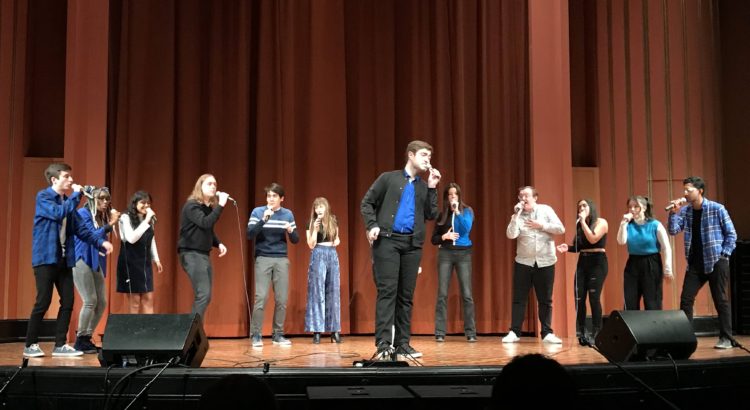
Going to see Amazin’ Blue and State of Fifths rock the (very orange!) Rackham Auditorium was the perfect way to spend a Saturday Night.

If you don’t believe me about the orange part, just take a look:


It’s gorgeous. I wish the world had more monochromatic auditoriums.

ANYWAY, Amazin’ Blue is an award-winning a capella group at UM founded in ’87, and it is the only university-sponsored a capella group on campus. They try to create innovative music!

State of Fifths is an award-winning a capella group at MSU founded in ’08. They arrange all of their own pieces and perform a wide variety of music!

All of the singers and soloists from both groups were phenomenal and had me wishing I could sing because they made it look so easy! And best of all, every single one of them looked like they were having the time of their lives up there. They were grooving and bopping on stage the whole time looking like there was nowhere else they’d rather be. It made it impossible to not have fun down in the audience too.

Every so often in between songs someone from Amazin’ Blue would take the mic to introduce one of the “newbies” who had joined the a capella group recently! They read out fun, teasing bios for each newb and then asked them to mimic a certain sound on the spot. Some of the interesting ones were the sound of a vending machine, ripping off a piece of tape, and a plane taking off. All in all I loved their camaraderie on stage and how they made it clear they really think of Amazin’ Blue as a found family.

At the end they sang their alumni song and invited any Amazin’ Blue alums from the audience to come up and sing it with them. An alum jogged up to the stage and took over the percussion and absolutely DOMINATED it. It’s never too late in life for me to learn how to beatbox right? If I do I’m going to add it to my resume.

Something I didn’t know is that both Amazin’ Blue and State of Fifths release studio albums! You can check them out on Spotify here and here. Support your friendly neighborhood a capella groups!
 

REVIEW: Takács Quartet with Julien Labro

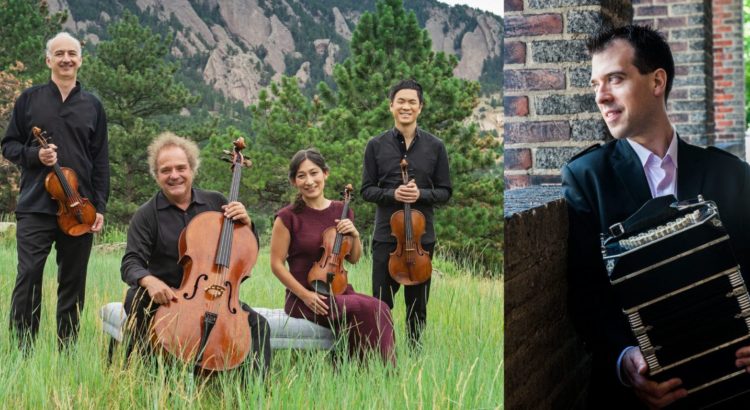
Coming to this performance has reminded me of how remarkably similar listening to new music is to meeting new people. If you come into the interaction without any background knowledge—their origin, their influences, their motive—you might spend the whole time confused, struggling to construct their story from whatever you see at face value, or simply uninterested. It’s the reason why program notes exist, and why I typically like to search for the pieces on Youtube before I hear the performance. Yet, with its mixture of world-premieres, uncommon instrumental combinations, and reimagined pieces, this program definitely challenged typical means of music consumption. 

I was immediately struck by how compact the bandoneon was and how it could achieve such crisp articulation and human-like phrasing. When Labro played, it felt like he was pumping his own breath and soul into the instrument. While the bandoneon is typically associated with tango, Labro also notified us that it was originally intended to play church music in small parishes in Germany. I didn’t quite believe him after he had performed Saluzzi’s Minguito, a groovy, pulsing Argentinian folk music-jazz hybrid incorporating percussive finger tapping against the sides of the instrument. However, his arrangement of Bach’s Wachet auf, ruft uns die Stimme, BMV 645 introduced an entirely new color and tone. In contrast to the previous push and pull of these tangled music lines, Labro’s Bach had a rich, organ-like sustain that put each voice in the four-part harmony on equal footing. 

I was also surprised by how naturally the bandoneon fit in with the quartet. In the first co-commission by UMS and Music Accord, Bryce Dessner’s Circles, the bandoneon set the stage with an oscillating rhythm for the strings to weave between. At some point, the pulsating melodies aligned and transitioned into an icy, polyphonic whistle-like section. Meanwhile, in Labro’s Meditation No. 1, the bandoneon reinforced the ensemble’s warm, syrupy chords and shined in a rich, cadenza-esque solo. In Clarice Assad’s Clash, the second UMS-Music Accord co-commission and concert finale, the bandoneon delivered punching dissonant chords and almost upsetting slides as the strings incorporated various frictional textures and sound effects.

The Takács Quartet was able to show off their refined musicianship in the hauntingly beautiful Ravel String Quartet in F Major. Melding elements of tension and dissonance, the piece had a shiny quality that fit really nicely with the rest of the program while still bringing a whole new flavor of sound. The complex layered plucking of the second movement was truly a marvel—the audience felt compelled to applaud afterward even though it was still between movements.

One of the most experimental pieces was Labro’s Astoración, performed as a solo with a pre-recorded backing track. Described as “an imagined duet and conversation with Nuevo Tango master Astor Piazzolla,” the piece tugged at single notes before expanding into big dissonant chords. Meanwhile, the backing track echoed spoken narrative phrases and introduced a second bandoneon that Labro riffed with. At some point, he also pulled out an accordina—a small, hand-held wind instrument with similar sound qualities to a harmonica— for an added layer on top of the rhythmical background.

All in all, I feel that I had witnessed something remarkable last Friday. My roommate who accompanied me enjoyed it as well, although she admitted that some parts were “a lot”. Such is contemporary music!

REVIEW: Playboi Carti: Narcissist Tour

In addition to the actual performance, Playboi Carti live was an amazing experience. Fans wrapped around the block in the brisk 30°F hours before the show even began. Some laughing and hugging to keep warm and others dancing to Carti’s music off their phone. Upon being let into the Masonic Temple, there’s a chilling red scene against the ornate walls of the theater. I will say, the Vamps showed up! Everyone in the bathroom looked absolutely stunning from subversive basics, balaclavas, shiny black latex to detailed, smokey makeup looks. You would’ve thought you were backstage at a Rick Owens fashion show.

The stage welcomed Ken Carson, Rico Nasty, and finally Playboi Carti himself. Each artist brought high energy onto stage which was evident in the audience. I was in awe by Rico Nasty’s vocal range as she performed “Tia Tamera” and “OHFR?” She added her own screams that made the crowd go all the more wild. So much so that articles of clothing were being thrown up high into the air in the mosh pits.

I already lost my voice and Playboi Carti wasn’t even out yet. But when he did finally walk the stage, I couldn’t help but sing along a little louder. The. fog grew thicker and we could barely make out Carti, except for a small silhouette. His voice and the crowd’s roars were all that were needed. Not wanting to sit, many  including myself  stood in the middle of aisles to get as close as possible. There we excitedly sang along to each lyric of “Sky” and cheesing at one another during “Rockstar Made” None of us felt like strangers in that moment, but all happy Vamps.

In between each song, the rich sound of the bass and organ filled the theater. Like Rico, he also added new ad libs in the live performance. The rhythm coursed right through me, to the point where it felt like the sound and I had become one. I could lay my hand on my chest and feel the beat coming straight from me. It was surreal.

Some might say it was insane or dramatic, but that’s Carti. And I loved having the opportunity to see him perform live.

REVIEW: Sa re ga ma pella

Sa re ga ma pella by Maize Mirchi featured 8 songs, an intermission with Indian snacks, a dance performance by Michigan Taal and a really really excited audience.

The acapella singers did a good job harmonizing and it was nice to know some songs were independently set up by students. The introductions of the new members between songs was one of my favorite parts. The introductions were short, sweet and really funny. We got to know a lot about the companionship shared between the members of Maize Mirchi. The audience consisted of parents and friends of the performers and they were really engaged with the performances and cheering their loved ones on.

A point I would like to highlight is the cultural fusion of this group. They are an acapella group with a touch of Indian culture. I would say their group shows a kaleidoscope of Indian American culture. Less than half of the songs were in an Indian language and some of these were half English half Hindi. The western Indian mix was well carried by the performers. Their coordination really hit the sweet spot!

The soloists showed a very authentic image of Indian American culture and by the excitement of the audience it was obvious their supporters liked it. I think the song selection could have been improved to show more diversity but it was an entertaining show regardless.

The performance after the intermission by Michigan Taal was short and sweet. The size of the stage was very small but they did not let it hinder them. They had an exciting diversity of dances and their energy was infectious.

Being at the acapella concert was like being at an intimate event for family and friends where everyone knew each other and supported performers.

If you like Indian American culture and acapella then Sa Re Ga Ma pella can’t hit it more on the head than anything else!

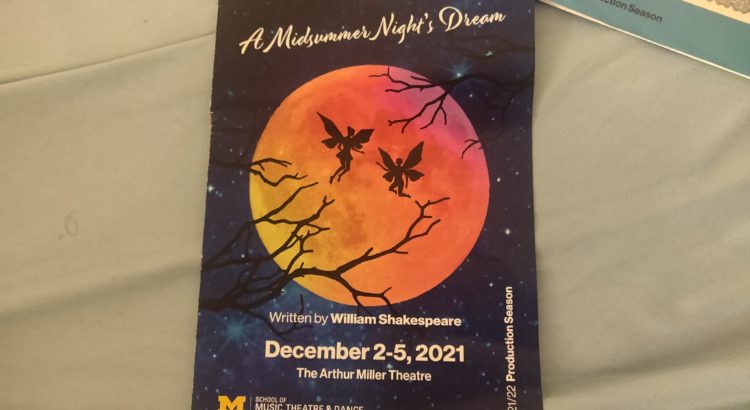
REVIEW: A Midsummer night’s dream

This performance of a midsummer night’s dream was very special. With minimal backdrop and music, the attention was really focused on the acting. The actors really took this opportunity to showcase their range of voice and such. I especially loved the performance of Helena and Oberon (the fairy king). Their performances especially commanded everyone’s attention and their stage presence was powerful.

The outfits of the fairies were very cool. That brings me to the topic of costumes! This play had an interesting fusion of modern costumes in a Shakespearean play. Seeing people in modern school uniforms talk Shakespeare and the human King and queen wearing modern formal outfits like tuxedoes was special. I think it was a good choice and made the show really different from traditional Shakespearean performances. This choice of costumes like t shirts, heels, tartan skirts, Winx Club like outfits on the fairies made the play experimental and I liked how displaced it made the play seem! It was a nice clash of time periods.

The dream-like quality and confusion of the plot suited this clashing outfit choice and put the audience also in an air of amazement and confusion like the characters being played with by the fairy cohort.

The sound effects and lighting added a nice hint of magic and surrealness to the play. The parts involving the fairies singing and magic were probably my favorite parts because of how elusive they were. The play’s highest moment, leaving the audience in shrieks of laughter, was definitely when Helene, Hermia, and their lovers meet after the men have been given love potions. The energy of the characters and the comic timing of the situation was very well suited.

This play was a lovely treat of magic, love, and playfulness. It did not try to be more serious than it should be and the jokes were funny. It was a perfect show to see to have a fun evening!

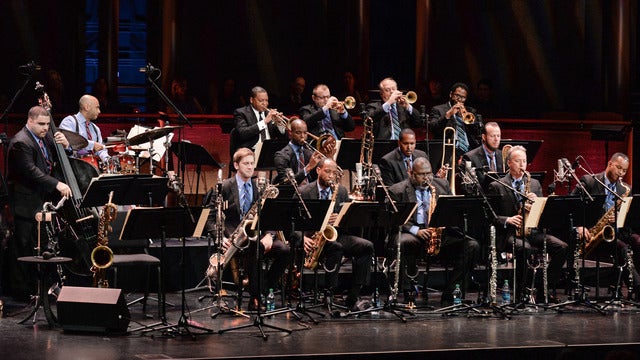
REVIEW: Jazz at Lincoln Center Orchestra with Wynton Marsalis

One of the best parts of living in Ann Arbor is its many performance venues, which draw performers and artists from around the world. I’ve been a fan of the Jazz at Lincoln Center Orchestra since high school when I myself played in jazz bands, and it’s been a treat to be a student with such easy access to concerts such as JLCO’s nearly annual appearances. This Sunday, I took my seat in the packed Hill Auditorium and waited with anticipation for this year’s Jazz at Lincoln Center Orchestra experience.

Holiday music, at least the popularized songs I always heard on the radio as a kid, are rooted in the big band and swing style, evoking a certain kind of nostalgia when hearing familiar tunes. But that’s exactly what jazz happens to be, a musical oral history passed down from those who came before. Trumpet player and co-director Wynton Marsalis embodied this with his in-between-song banter, telling stories of the legendary jazz musicians and the rich histories of the popular songs we often take for granted.

JLCO was joined by jazz vocalist Alita Moses, who dazzled the audience with her smooth, warm vocals and joyful stage presence. Moses led the band in the spiritual “Mary Had a Baby,” showcasing her beautiful, crystal-clear voice and also giving the band a chance to sing some, too. I thoroughly enjoyed a Coltrane-inspired arrangement of “My Favorite Things,” where a saxophone section completely comprised of soprano saxes each took a whirl at solos, and a killer piano solo had me laughing in my seat. Near the end of the performance, a more emotional moment came when the band debuted a new piece composed by co-director Marcus Printup titled “I’m Still Here This Christmas,” written in memory of those we have lost in the past few years in the pandemic.

With true Michigan spirit, Wynton Marsalis opened the performance with talking about the OSU game, and ended it by quoting “The Victors” in a solo during an arrangement of “Go Tell it on the Mountain.” One of the things I love most about jazz is the beautiful spontaneity of it, creating moments like that which carry and twist lines of music like a private joke.

I left feeling happy, warm, and in the holiday spirit, cheered by the energetic, danceable swing of their Big Band Holidays music.