REVIEW: Funkwagon || Sabbatical Bob || Midnight Mercedes

When COVID-19 was at its height, live music was the thing I missed maybe the most. Music, in my belief, has a special way of bringing us all together–whether it’s dancing, congregating at concerts, or just the act of sharing favorite tunes in the car or in living rooms. When live music as we knew it temporarily shut down, I found myself longing for the environments of concert halls and music venues. Listening to online performances kept spirits up, but when I got the chance to walk into the Blind Pig again this weekend, to feel the bass and drums reverberate in my body, something came alive in me again.

Even if you’re not a self-proclaimed fan of funk music, I believe there’s something for everyone to enjoy in the infectious drum beats and groovy bass lines. As my friend who attended with me admitted, “funk is sexy, in a fun way.” Music that invites your body to move, invites you to cheer. Music that commands your attention. Mixed with the transportational qualities of a nighttime neon-lit music club, I truly felt like I was elsewhere, in the space that the music created for us.

This night of funk music opened with Midnight Mercedes, a small Michigan funk band with killer vocals and a tenor saxophonist with an eye-catching light-up neck strap. The vocalist, draped in a rainbow giraffe-print dress, sang with soul and smiles, sending chills down my spine with her strong sustained notes. 

Next, we heard from Funkwagon, a gospel-infused funk band based in Detroit, MI and Burlington, VT. Lead keys giving equal energy to his vocals, splitting into ear-pleasing harmonies with the other instrumentalists. More often than not, I found myself smiling at the pure life radiating from the music on stage.

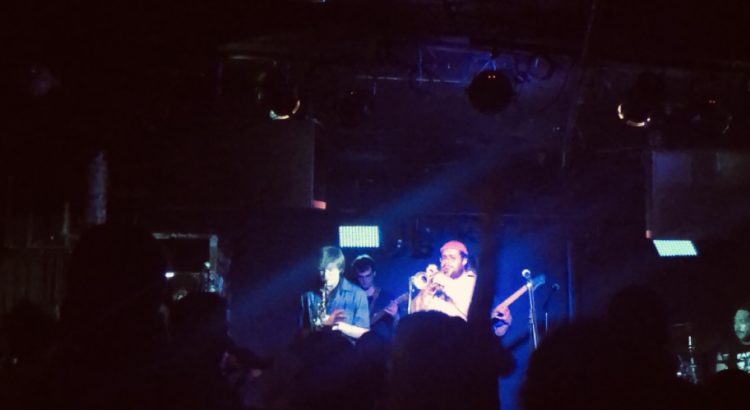
At that point, it was getting late for me, but I stayed for one of my favorite Ypsilanti-based groups, the incredible Sabbatical Bob. Describing themselves as “high-energy funk,” I was glad to hear them play after a year of witnessing their performances through a screen. While it was still great to hear them perform at events like Dance for Democracy, there is something irreplaceable about being there, about being able to feel the sound of the trumpet and sax, tearing up tunes while the audience around you bops along. 

It was an incredibly fun night out, and I encourage everyone to go out and support your local music venues and musicians. It’s been a tough year and a half for all of us, and we can all benefit from the arts. Get out there and get your groove on!

REVIEW: Broken Horses by Brandi Carlile

Despite being familiar with Brandi Carlile’s music, her new book Broken Horses took me by surprise. Generally, I would expect memoirs by artists to be enjoyable, perhaps gratuitous, for fans, but Broken Horses is, I daresay, of a different breed. It is impressive in its wisdom and authenticity, and a book that I would recommend regardless of whether the reader has listened to Carlile’s music.

The book chronicles Carlile’s life and development as an artist through present-day, and is punctuated by song lyrics (Carlile’s, as well as other songs and artists mentioned in the prose, including the Indigo Girls, Elton John, Dolly Parton, Johnny Cash, and others) and annotated photos. It is part narrative and part introspection, and it is self-deprecating, humorous, and raw.  The cast of characters is extensive, anchored in the center by Carlile’s musical “family,” including her bandmembers Phil and Tim, her wife, Catherine, and two daughters.  It is a vivid portrait of a human being who also happens to be a GRAMMY-winning singer-songwriter.

Broken Horses also traverses a wide range of themes in its three hundred pages: family, friendship, sexuality, religion, forgiveness, and many others. Carlile offers her thoughts and experience of each, without pretending to have all the answers. One of my favorite passages in the entire book is in relation to the genesis of the 2018 album By the Way, I Forgive You. In addition to its insight (even in its admission of lack of insight), it also, in my opinion, captures the essence of Broken Horses as a whole:

“Before I start sounding too earnest, understand that I wasn’t “teaching” forgiveness. I was and still am learning it. I’m not evolved. I’m as much a part of the problem as every other person in the world. This isn’t wisdom or insight, it’s a work in progress and it never did come from me. It came from our parents and grandparents. Our flawed heroes and our favorite TV shows. We were just playing dress-up and trying forgiveness on like a costume. We intend to learn these lessons over and over again the hard way for as long as we’re human. If you want the real thing 100 percent pure, the Everclear …you should talk to Lazarus.”

-Brandi Carlile, Broken Horses (2021), Chapter 17: By The Way

Quite fittingly, I would describe Broken Horses as a song above anything else (which makes sense, considering the author). It is a song of the human experience, and one that is not to be missed.

REVIEW – “Akeem Smith: No Gyal Can Test” at Red Bull Arts Detroit

Akeem Smith’s No Gyal Can Test exhibition at Red Bull Arts Detroit transgresses disciplinary classifications and the expectancy for a singular ethnographic history of dancehall, which is readily accessible to a globalized audience eager to exploit its cultural legacy.

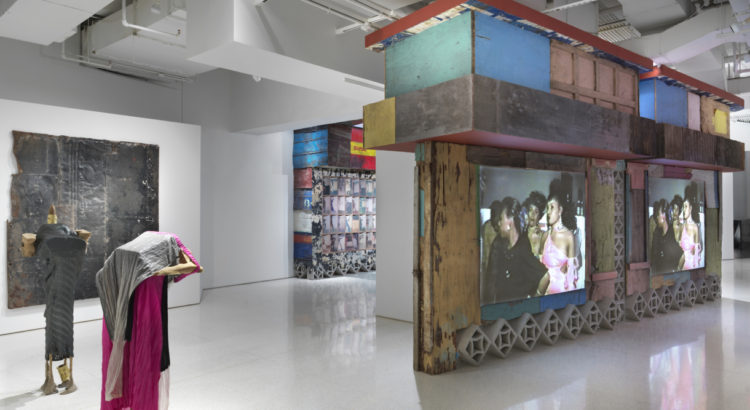
In Jamaica, upper-class families grill their home to deter robberies of their houses. Smith utilizes these grills to protect the archival dancehall photographic and film footage behind, which ranges the two decades between the 80s and 2000s. Protruding from the flat walls of the building’s underground tombs, these decorative homes symbolize the artist’s attitude toward a global viewership that commodifies the hypervisible women of the movement. The voyeurim of the gallery visitor questions the assumed invitation to peer through cast iron metal shields. What is offered and what is withheld? On the other hand, their installation can also be perceived in relation to wealthy Jamaicans’ refusal to accept the cultural and political revolution of dancehall as a national signifier. Viewers are meant to question their position within, or outside of, the household in order to better understand what is deserving of safeguarding.

In these and other wall works, photographs and videos are intentionally obscured, offering a limited visual scope to the memories they document. Queens Street, an assembled building with an exposed interior,  encases a single-channel video that plays abstracted and slowed-down footage of a dance. Because there is a gap between the welded metal doorway attached to the front of the house and the leftmost edge of the adjacent window, viewers are situated awkwardly outside this personal space peering indoors. The portrait included in Black Queen, a minimal and rectangular wall work made with salvaged, black building remnants, is hidden from view behind an top section of latticework. The woman’s face is almost entirely encased in its shadow.

Curated by Maxwell Wolf and Kenta Murakami, this unique expression of love culminates the preceding twelve years of archival work and outreach to honor the legacy of the dancehall community Smith grew up around in Kingston, Jamaica. Born in Brooklyn, NY and raised in the Waterhouse District in Kingston before returning to Crown Heights, Smith is the godson of Paula Ouch, the founder of the Ouch fashion house, an all women’s team that shaped the visual loudness of the era. Several of their garments on view are draped on mannequins sculpted by collaborative artist Jessi Reaves that commemorate the women of his youth and particularly Sandra Lee, the central fashion and hair stylist. Jewelry by Brando, his grandmother’s former partner, is juxtaposed alongside these original pieces. The interwoven nature of his life is further solidified through his grandma, who raised him alongside his mom, and co-owned La Roose club in Portmore, a coastal city that borders Kingston. Materials – corrugated zinc, tarp, repurposed wood, and breeze – from the building’s facade, as well as other disused social spaces, make up the main components of Smith’s deeply-personal installations.

While Smith’s process implements specific protocols to procure and ethically compensate Jamaicans who provided him with the exhibition material, the extension of these guidelines within the gallery are ultimately left to the discretion of the visitor. What is implicated through the exhibition’s free admission and allowance of photography that facilitates a capturing of images among visitors?

Akeem Smith: No Gyal Can Test is on view at Red Bull Arts Detroit in Eastern Market every Friday – Sunday from 12 pm – 7 pm until July 30. Reservations are required. Appointments to see the Soursop offsite installation at Woods Cathedral in Detroit can also be made using the same webpage: https://ngct.redbullarts.com


Artist Information:

Akeem Smith – Instagram: https://www.instagram.com/akeemouch/

PREVIEW – Akeem Smith: No Gyal Can Test at Red Bull Arts Detroit

Installation View of Akeem Smith: No Gyal Can Test at Red Bull Arts New York 2020. Photo by Daro Lasagni. All artwork courtesy the artist and Red Bull Arts

Red Bull Arts Detroit is hosting the second iteration of Akeem Smith’s traveling exhibition, No Gyal Can Test. This show, which premiered on April 16 and runs until July 30, explores the dancehall community in Kingston, Jamaica. Through collaborative sonic-sculptures that four-dimensionally collage ephemera – photographs, videos, garments and jewelery, along with architectural materials sourced from musical congregation sites now existing through public memory – Smith transports a display of togetherness resonant today in the ever-evolving and globalized community. Because Detroit’s cityscape reveals prevalent musical archives encoded within architectural fragments of former music and dance spots, I’m excited to see and hear how Smith’s exhibition is intimately recontextualized within a local arts space.

PREVIEW: Broken Horses by Brandi Carlile

If you are a fan of the music of GRAMMY Award-winning singer-songwriter Brandi Carlile, you won’t want to miss out on her new memoir, Broken Horses. Released in April 2021, the book recounts the events that have shaped her life thus far, as well as her path to becoming the musician that she is today.

Hardcover copies of Broken Horses can be purchased from your local bookstore (such as Literati if you’re in Ann Arbor) or checked out from your local library.

REVIEW: The War and Treaty Livestream

Husband and wife musical duo The War and Treaty, comprised of Michael and Tanya Trotter, presented a livestream last weekend that was a musical bright spot in today’s internet landscape. Performed real-time from their living room in front of a cozy stone fireplace, the evening also featured Max Brown on bass (who is originally from Ann Arbor!!) and Bam Holmes on drums.

The program, which seemed to be decided in the moment (which was especially refreshing, given that so many performances are pre-recorded given the current circumstances), included songs from The War and Treaty’s most recent album, Hearts Town, as well as new and never-before-performed songs written since the onset of the pandemic. Indeed, they noted that they have created tens of new songs in the last year, which is good news for fans of The War and Treaty hoping for new music in the coming months.

The performance itself reflected the times that we are living in – restless with everything being through a screen – and yet, it was also overwhelmingly joyous. On multiple occasions, the duo remarked on the loss of live, in-person performances, and especially of missing hugging fans. However, even through the computer, traces of these connections were palpable, in the Trotter’s clear love of the music (and in the active chat during the performance).

The War and Treaty’s music transcends categorization, fusing jazz, soul, folk, blues, and other influences into a result that is a treat for the ears. During the livestream, I was particularly struck by each song’s ability to conjure an atmosphere, in which even watching alone at home, the music brought the sights and sounds of long road trips, or crowded restaurants, or gatherings with friends into view in my mind’s eye. Perhaps it was just the fact that these scenes seem like distant memories a year into the pandemic, but it was nevertheless fascinating to me how on multiple occasions, listening to the music transported me out of my physical space and into seemingly far-off places.

My only disappointment regarding the livestream was that at just an hour long, it was on the shorter side for a ticketed performance – good, perhaps, for the screen fatigued, but a little sad given that I was enjoying the excellent music!

Overall, The War and Treaty put on a great virtual concert, and I would recommend their music to anyone who is not yet familiar with it! I hope that someday, when it is safe again, I will be able to experience their music live and in person.