PREVIEW: Greenie Night Live

This Saturday night, be sure to join University of Michigan a cappella ensemble 58 Greene as they present Greenie Night Live!

When? Dec. 7th, 2019 at 7PM.

Where? 1324 East Hall, University of Michigan.

Tickets will be $5 pre-sale, otherwise $8 at the door.

This event is on the Passport to the Arts, which means if you are a student with a Passport ticket voucher, you can come for free! Passports can be found at the Community Center in the dorms, Pierpont Commons, the Spectrum Center, or the Office of New Student Programs.

REVIEW: Stew & The Negro Problem

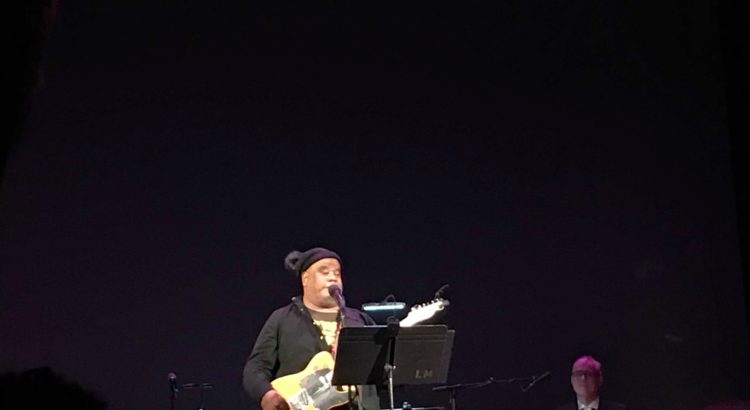
Stew’s poignant prose accompanied by Heidi’s soulful melodies create songs that encourage and make you think all at the same time. It’s not until after many listens do you fully grasp all the references within the lyrics. Notes of a Native Song is an album meant to train its listeners to analyze every situation. Songs within the album are a clarion call for activism. Stew and The Negro Problem’s performance was an illustration of how songs can shine light on social injustice and inspire a generation to take action.

Stew, feeling under the weather, started by lowering our expectations, stating that the current performance could not nearly be as good as the previous night. However, halfway through the opening song, we knew that his disclaimer was not true. Stew and The Negro Problem kicked off the performance just as their studio album does with a song titled Baldwin CountryBaldwin Country gave the audience background information about James Baldwin. Stew used the song as an appetizer to sate the audience’s initial inquiries as to what the album is about and what kind of music they were about to hear for the ensuing hour.

Stew and The Negro Problem artfully lulled the audience during Istanbul. The song acted like a palate cleanser for the ears. Istanbul was followed by the thought-provoking lyrics of Amen Corner and Proof. “Jesus ain’t no match for jazz and these police.” “When the restlessness of Jesus meets the patience of Job.” “Power is so powerful it can’t afford to pay people to speak truth to it.” “Power looking ugly, Power looking mean, but never painting power so that Power’s ever seen.” These two songs have driving melodies and powerful lyrics.

Florida, Stew jested was the only political song on the album. A song in which the band plays a laid-back Californian beat while Stew compares Florida to other states in the Union. Stew suggests that no state is better than another; each state has pros and cons. But quickly follows up with “It doesn’t matter if the weather is great if I gotta wear a bulletproof vest.” The amusing comparisons and harsh criticism of Florida, made Florida my favorite song in the performance.

I was introduced to Stew last year when SMTD performed Passing Strange. The first act is a feast full of political statements and nuggets of truth not often heard aloud. It opened my eyes to musicals that have a motive other than to entertain.

Without force feeding the audience, Stew and The Negro Problem served up a well-balanced performance—one that left me full all the while leaving me to beg for more. The insightful songs and sounds of Stew and The Negro Problem inspired me, and I am thankful they returned to the University of Michigan to once again share their mighty message of a movement.

REVIEW: Artist Spotlight: Nadim Azzam

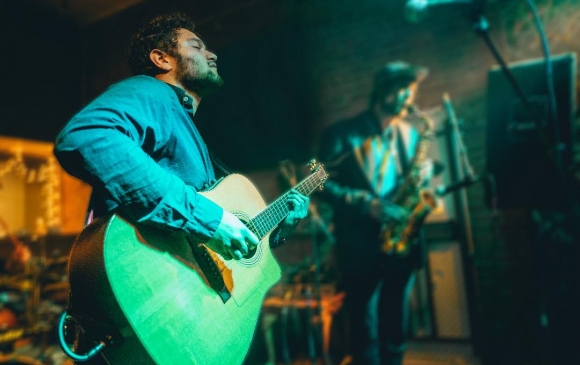
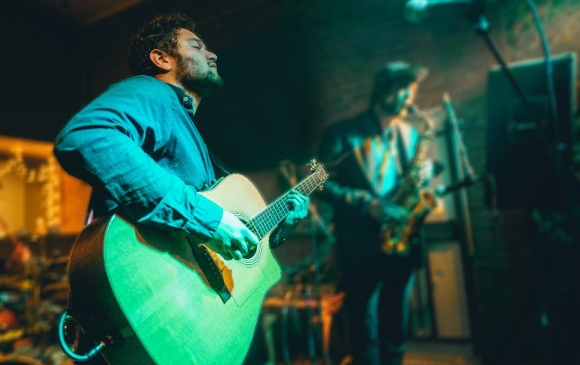
Nadim Azzam and his crew put on quite a performance at the Ark’s Artist Spotlight last night. Compared to my other experiences at the Ark, I found that this genre of music fell into a more distant category from the general body of work that has been presented before. Althea Grace’s bluesy indie opening set very much felt at home amidst the audience and atmosphere that represents the most beloved elements of the Ark.

What I greatly enjoy about Nadim Azzam is a unique charisma that can be consistently felt throughout his set in the rhymes and rhythms of his music. The personality of his sound comes from the self-evaluated rebelliousness of his teen years, as Azzam says, “Most of my songs are written to myself, a lot of them are about expressing struggle and pain while still trying to be hopeful. They can be about feeling lost while trying to find a way, wanting to become a better person and living up to potential.”

A personal highlight included the presence of a tight-sounding jazzy saxophone in the mix of acoustic qualities and 1950s’-sounding ballad-like presentation. I credit Nadim Azzam for the ambition that is required for such a bold merging of hip-hop, acoustic, and jazz, but I often found the seamed mashing of genres together rather disjointed. While the melodies and striking timbre of the group produced heartfelt sounds, I was generally less than impressed in the level of sophistication present in the group’s sung lyrics. However, the flow that Nadim put forth in his rap lyrics was impressive and seemingly well-rehearsed.

While Althea Grace played the part of a successful opener for Nadim Azzam, I am hoping that she finds herself returning to the Ark as a headliner one day. Her music is light and subtle with an element of mystery that she weaves into a captivating musical narrative.

From humble beginnings, Nadim Azzam began his musical journey upon the discovery of his love for music and vocalization on a wilderness exploration trip. His smooth tone sincerely gels with the music that he aspires to make widespread, as we are seeing his rise to greater appreciation in the ears of listeners, local or otherwise. From playing at the Ann Arbor Summer Festival in 2019 to the upcoming release of his full-length album in 2020, Nadim Azzam does not show any sign of slowing down.

PREVIEW: Artist Spotlight: Nadim Azzam

This Tuesday, November 26th, be sure to attend the Ark’s latest Artist Spotlight featuring Nadim Azzam, a 24 year-old Ann Arborite who fuses hip-hop, alt-rock, and jazz for a heartfelt and layered musical expression! Nadim is currently working on his first full-length album, which is expected in 2020. Opening for this eye-catching ensemble is singer-songwriter Althea Grace, indie blues musician.

The doors of the Ark open at 7:30, and the show starts at 8:00; while this event is free to the public, it will accept non-perishable food items to go towards Food Gatherers!


PREVIEW: Stew & The Negro Problem

In case you missed Tony Award-winning playwright and singer Stew last night, you have another chance tonight! Don’t miss out on a homage to the art and activism of James Baldwin in a music and theater experience through a contemporary commentary on Baldwin’s 1955 collection of essays on being Black in America. Notes of a Native Song is an irreverent and spirited rock ‘n’ roll song cycle that uses Baldwin’s work to explore race, love, class division, and politics through an exciting mix of rock, jazz, and soul. Catch Stew & The Negro Problem at the Lydia Mendelssohn Theatre tonight at 8!

REVIEW: Orchestre Métropolitain de Montréal

Last night, Hill Auditorium hosted the Orchestre Métropolitain de Montréal with singer Joyce DiDonato.  The concert started out with the overture to Mozart’s La Clemenza di Tito.  They performed this work with a smaller orchestra that only took up about half the stage.  The instrumentation consisted of strings, a few winds, a couple trumpets, and timpani.  Once Ms. DiDonato joined the orchestra, the trumpets and timpanist left and a clarinetist made their way to the front of the stage to be featured alongside her.  I had heard of Ms. DiDonato many times, but I had never actually heard her sing live.  She was incredible.  Her voice sounded exactly like you would expect an opera singer’s to sound.  This is likely because she has set a standard in singing that others strive to match.  The interplay between her and the clarinetist was fascinating the watch as they alternated similar phrases.  She was able to perfectly match the articulation and timbre of the clarinet using just her voice.  In addition, she mimicked the other winds flawlessly, especially in the first aria.  There was a moment where she had a run of doubled notes that the flute played at a different time where she embodied the character of a flautist to a T.  As an encore, she joined the orchestra for a rendition of “Voi che sapete” from The Marriage of Figaro.  She used an iPad for the arias from La Clemenza, but she had this one memorized.  It was clear she had performed it many times.  She really took control of the stage by incorporating some acting into her performance and having some fun with Maestro Nézet-Séguin and the assistant principal first violinist.  Overall, the first half of the concert was great, especially for those who are big fans of opera.  On the second half, the orchestra played Anton Bruckner’s Fourth Symphony.  Bruckner’s music is best known for it’s epic, massive moments and this symphony had plenty of them.  The size of the orchestra seemingly doubled between the first and second halves with a full brass section, a timpanist, and about half a string section joining the chamber orchestra from the first half.  I thought the orchestra performed the piece very well, overall.  There were some questionable moments where the horns might have had an off night or the timpani might have been too loud for my liking, but mistakes happen in performances and everyone has their own opinion as to what sounds best.  The piece seemed to follow a structure of peaks and valleys which, honestly, gets pretty old in a symphony that’s over an hour long.  We’d hear a couple minutes of really loud, awesome music, followed by some softer, prettier stuff.  I feel like most great symphonies have a few moments that are really special and people immediately think of them when they think of that symphony.  This one had so many big moments that I can’t remember any of them because, even though they were awesome when I heard them, they all blended together.  None of this is the fault of the orchestra, of course.  They played it in a very convincing manner and Maestro Nézet-Séguin commanded the podium with an incredible energy.  They closed the night with a really cool encore by Violet Archer, a composer I had never heard of.  I really enjoyed the piece and was grateful that Maestro Nézet-Séguin exposed the audience to it.  I have seen him perform twice at Hill now, and he has been fantastic both times.  I will surely be going back if I see his name on the UMS schedule again next year!