PREVIEW: Chick Corea Trilogy

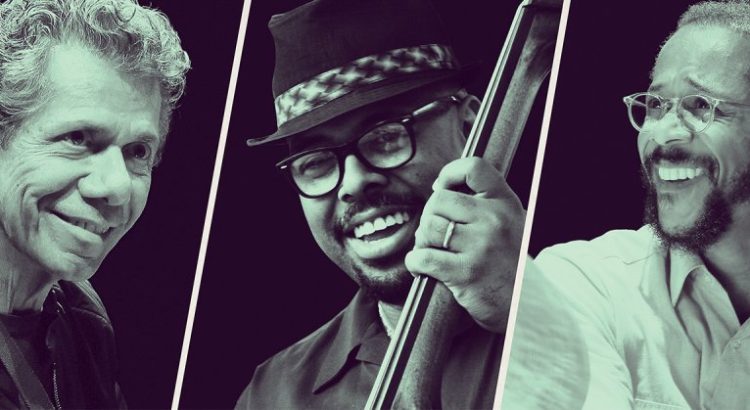
If you are a fan of jazz music, you won’t want to miss the star-studded Chick Corea Trilogy on Saturday, October 19 at 8 pm at Hill Auditorium! The ensemble, which includes pianist Chick Corea, bassist Christian McBride, and drummer Brian Blade, first collaborated together on their 2014 album Trilogy, which won two GRAMMY awards. All three members also boast impressive lists of achievements throughout their musical careers: Chick Corea, who started his career as a member of Miles Davis’s band, has won over 20 GRAMMYs. Brian Blade has performed with the likes of Joni Mitchell, Bob Dylan, Wayne Shorter, Seal, Bill Frisell, and Emmylou Harris. among other accomplishments. Christian McBride has appeared on over 300 recordings, played with musicans such as Paul McCartney, Celine Dion, Queen Letifah, and Renee Fleming, and won several GRAMMY awards.

Tickets can be purchased at the Michigan League Ticket Office or online. Since this is a UMS performance, student tickets are $12 or $20, depending on seat location!

REVIEW: Chamber Music Society of Lincoln Center

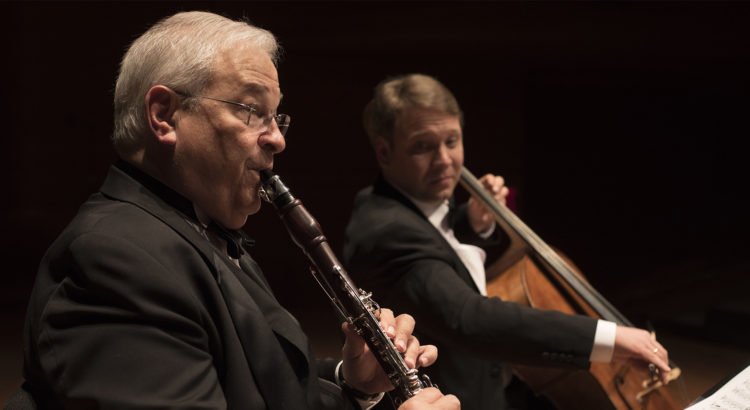
Once again, the Chamber Music Society of Lincoln Center did not disappoint. It is a joy to witness performances where those onstage are truly enjoying themselves, and this was one. The thirteen performers, in different combinations of instrumentation for each of the four pieces on the program, managed to effortlessly convey the character and emotions of the music, allowing the audience to get lost from reality outside the walls of Rackham Auditorium.

The first piece on the program was Henry T. Burleigh’s Southland Sketches for Violin and Piano, with Mr. Chad Hoopes on violin and Ms. Gloria Chien on piano. The piece was at times whimsical, serious, or soulful, and I was captivated by Mr. Hoopes’s ability to (seemingly effortlessly) draw a matching range of sound colors from his violin. His sound and his playing were flexible in a way that allowed the audience to experience the full range of the piece, and for this reason it was one of my favorites on the program.

Next up was Antonín Dvořák’s Quintet in E-flat Major for Two Violins, Two Violas, and Cello, Op. 9, followed by Leonard Bernstein’s Sonata for Clarinet and Piano. Both were flawlessly executed, and the Bernstein Sonata was fascinating in that is was his first published piece.

That said, for me, the real culmination of the evening was the final piece: Appalachian Spring Suite for Ensemble by Aaron Copland. Often hailed as one of the most quintessential works by an American composer, Copland in fact won the 1945 Pulitzer Prize for his efforts. While Appalachian Spring was originally premiered in 1944 as a ballet commissioned for Martha Graham scored for thirteen instruments, Copland wrote an orchestral suite version the following year, removing about eight minutes of the original music. The version performed by the Chamber Music Society of Lincoln Center was completed by Copland in 1958, and it is an arrangement of the 1945 orchestral suite, but with the original instrumentation. For me, it was particularly interesting to hear this version after the Ann Arbor Symphony’s recent performance of the orchestral version, because I somehow expected that orchestration in my head. Instead, each entrance was a new surprise. I especially enjoyed the chords in piano during the opening of the first movement, and how it fit with the scoring of the chamber version. Although it is not Copland’s original version, this 1958 version gives a sense of how the music must have sounded when the ballet premiered at the Library of Congress. For me, it is impossible to hear Appalachian Spring (in any version) without conjuring images of frosted landscapes, sunrises over the mountains, and running streams. It is a true musical escape, just like the Chamber Music Society of Lincoln Center’s Friday evening performance of it.

REVIEW: Out There: A Performance by art duo Princess

There is a distinct difference between natural weirdness and the sort that is manufactured. Entitling an album “Out There” is far too self-realizing a move to truly belong to the former distinction. Things can be disastrous in cases like these, and unfortunately Princess’ performance veered quite drastically into the side of inorganic. This is not to say that there was no value in their work; quite the opposite, the intentional obscurity of meaning, though cringeworthy, was useful in forcing me to figure my own ideas about what I was seeing and hearing.

A concept album seems perhaps the wrong medium for what these two are doing. There is simply a lot going on, and their work suffers as a result.  They have a good sense of rhythm and tune (especially the flow of the rapping sections), but whatever their flat choreography was supposed to be doing was not being accomplished. The lyrics were often impossible to glean much meaning from. Most notably, the “party-party-party” song, most of whose words were about as inspired as you might imagine. I could speculate on what the song’s purpose is, perhaps some link to the procedural, routine nature of party culture, and the poisons that hide within its mindlessly indulgent atmosphere–the sexual harassment and assault, the brainwashing of men to be hunters who deserve prey, of women to bat their eyelashes and be a thing to desire. But to expect an audience to leap this far to make any conclusion of meaning is a bit much.

A bit too dark to see, but they are currently on the ground in anatomical position.

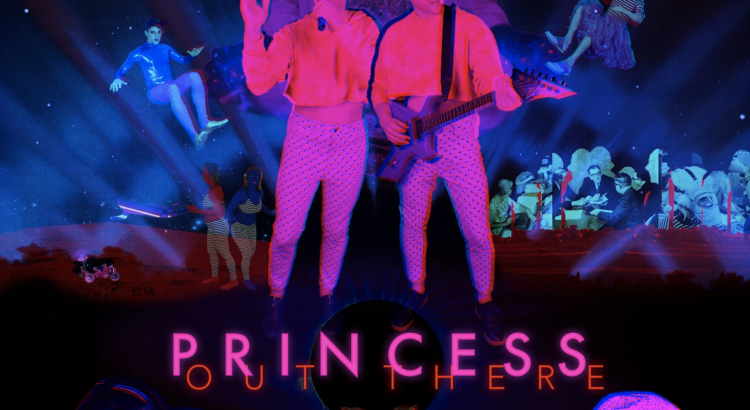
The space travel motif’s linkage to the album’s purpose was unclear. And though it was often visually striking, I found it relied too heavily on a single type of color scheme (red/blue combination and the vibrant, neon flat coloring of random objects). Also, the repetitive, jerky movements of the characters and objects in the video got old about halfway through the act. However, it still must be noted that the complex layering technique of visual artist Jennifer Meridian was impressive, if at times monotonous. Her work might perhaps be more suited for shorter videos and advertisements that demand the sense of excitement her design provides so well.

Mostly what I find fault with in the performance was its over-the-top brashness. I find it distracts from an audience’s ability to gather meaning from what they are experiencing. It’s more closely related to modern art than an exploration of misogyny in society. In all its spectacular glory I feel they are unable to develop their ideas into anything beyond the surface level. This is a shame, because the two clearly have an enormous creative capacity. I feel that, if they used their potential differently, they could have great success in creating thoughtful, deep, provocative art. While I and others in the audience can certainly derive our own meaning from the performance, the chasm over which we must stretch to get there is too wide. Perhaps this is the result of too many strongly creative people collaborating on a single project–in the process it became too much of a conglomeration than a precise piece of art.

If you’d like to check out the album for yourself, it’s currently available for preorder at their website bandofprincess.com. There you can witness one of their songs under the “videos” tab, and find other information about the band, including tour dates and background on the duo’s origins.


PREVIEW: Isango Ensemble: The Magic Flute

In its UMS debut, the Isango Ensemble, a South African theatre company, will be presenting three performances of a re-imagined look at Wolfgang Amadeus Mozart’s captivating score, transcribed for an orchestra of marimbas. This production provides a familiar and classical background alongside a vibrantly-contrasted foreground of a South African township setting.

This show will be playing October 16th, 17th, and 19th at the Power Center. I’ve been anticipating this performance for as long as I have known about it, for alongside being captivated by the works of Mozart, the Isango Ensemble’s work has been highly praised for its inventiveness and captivating performance! Be sure not to miss the Isango Ensemble this week!

Isango Ensemble: The Magic Flute

PREVIEW: Chamber Music Society of Lincoln Center

On Friday, October 11, members of the Chamber Music Society of Lincoln Center (CMS) will be performing at Rackham Auditorium! The program focuses on the “intrepid American spirit,” featuring works by Harry T. Burleigh, Aaron Copland, Leonard Berstein, and Antonín Dvořák (although he was Czech, he taught in New York).

If the Chamber Music Society’s appearance with UMS earlier this year was any indication, audiences can expect a technically pristine and spirited performance. The concert will take place at 8 pm, with a pre-concert talk presented by University of Michigan professor Dr. Mark Clague at 7 pm in the Rackham assembly hall. Tickets may be purchased at the Michigan League Ticket Office, or online at https://ums.org/performance/chamber-music-society-of-lincoln-center-2019/

REVIEW: Amadeus

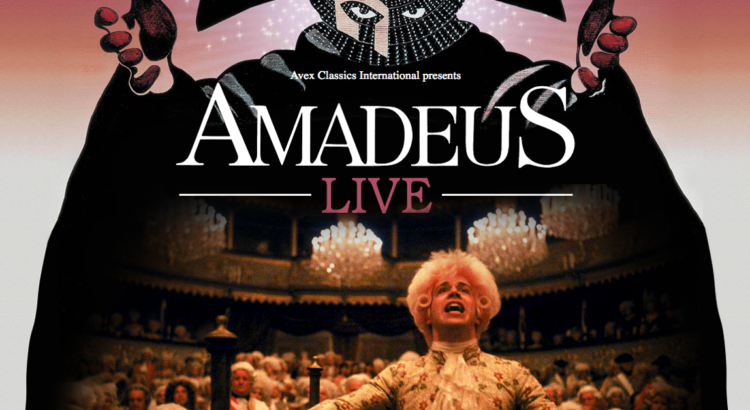
Having never seen the 1984 film Amadeus, I must admit that, despite its reputation for historical inaccuracies, it is certainly a gripping drama that portrays Mozart (played by Tom Hulce) as intensely human. That said, during the Sunday afternoon screening of the movie at Hill Auditorium with the Detroit Symphony Orchestra performing the soundtrack live, I had to keep reminding myself to watch the movie, not the orchestra.

In addition to being musically impressive, the DSO’s performance of the soundtrack live was fascinating because of the logistics involved with playing alongside a film. Conductor Jeffrey Schindler had a small screen in front of him, in addition to the scores, showing the film with overlays of the beat and musical cues. The precision necessary for such an undertaking is serious, when one stops to think about it. In certain parts of the movie, the live orchestra was accompanying soloists whose voices were recorded and part of the original movie – almost like reverse karaoke!

In terms of plot, the movie tells the story of the relationship between Wolfgang Amadeus Mozart, great composer but vulgar person, and mediocre court composer Antonio Salieri (portrayed by F. Murray Abraham, who won an Oscar for his role), whose jealousy of Mozart’s genius consumes him. To be honest, I never really figured out who I thought was the “good guy,” and who I thought was the “bad guy,” which is perhaps part of the movie’s point. Salieri had malicious intentions, while Mozart was just plain obnoxious. He behaved inappropriately, had an absurd laugh, a dirty sense of humor, and neglected to care for his family. His every action makes the audience cringe, but his music – oh, his music will soothe your soul. The juxtaposition of Mozart’s persona and his music is a stark one, and that is what irks Salieri. Despite his hatred of Mozart, the man, he cannot help but be drawn to Mozart’s music. One of my favorite scenes of the movie was when Salieri, as a mentally ill old man, describes hearing Mozart’s Gran Partita for the first time (If you’re not familiar with the piece, listen to the movement in question here). As the third movement plays in the background (which was performed live by the DSO winds), he gives voice to his recollections as if in a nostalgic trance:

“On the page it looked nothing, the beginning simple, almost comic. Just a pulse. Bassoons, basset horns, like a rusty squeezebox. And then, suddenly, high above it, an oboe. A single note hanging there unwavering, until, a clarinet took it over, sweetened it into a phrase of such delight. This was no composition by a performing monkey. This was a music I had never heard. Filled with such longing, such unfulfillable longing, it seemed as if I was hearing the voice of God.”

This scene, in my opinion, captures the underlying nuances of the movie’s plot.

While Amadeus may not be the film to watch if you’re seeking an accurate account of music history, it is a story that appeals to timeless themes and the complexities of the human condition, and the DSO’s live performance of the soundtrack only made it better!