REVIEW: Philharmonia Orchestra – Two Different Programs (Night Two)

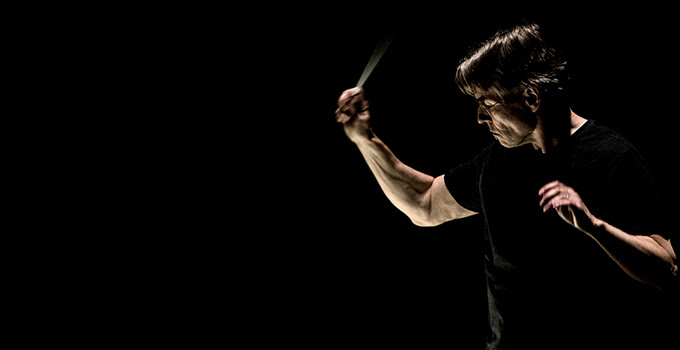
Sometimes, it is obvious that a person excels at their craft, even when you don’t have expertise in that area, and that is how I felt watching Esa-Pekka Salonen conduct the London-based Philharmonia Orchestra last Wednesday.

The first piece on the program was Arnold Schoenberg’s Verlärte Nacht, Op. 4. The title, which means “Transfigured Night,” comes from a poem by German Poet Richard Dehmel, and the piece is based on this poem. The poem’s main event, according to the program, is “a woman’s admission to her lover that she is bearing another man’s child,” but it also notes that “it may be advisable that we…hear it as an independent work of art, without referring to the program.” Frankly, I must agree with this. The piece is much more enjoyable without the bizarre plot of Dehmel’s poem crowding the mind, even though “the piece would not have ben written in the first place had it not been for [the poem].” Regardless, it is a lengthy piece in one movement, and the prevalence of dissonance does not allow for a grounded feeling to the listener. Face-value, it sounded other-worldly, but it is also an almost exhaustingly continuous piece.

After an intermission, the second piece on the program was Anton Bruckner’s Symphony No. 7 in E Major. In some ways, the Philharmonia Orchestra’s sound during this piece reminded me of the Philadelphia Orchestra’s sound from their Hill Auditorium performance last fall. Both orchestras had “bass-heavy” sound structure, in that the cello and bass sections brought out the lower voices of the piece. Additionally, there was some very impressive horn playing in the latter movements of the symphony. My favorite movement of the piece was the second, the Adagio. Besides being a pleasure to listen to, the historical context of this movement is rather fascinating. According to the program, the movement’s theme came to Bruckner when he was feeling very sad because “the thought had crossed [his] mind that before long the Master [Wagner] would die.” Bruckner was deeply moved by the music of Wagner, and it was while he was in the middle of composing the second movement that he learned of Wagner’s death. In fact, he had just reached the point in the composition where there is a jarring cymbal crash – the only one in the entire symphony. Equally intriguing is the fact that this cymbal crash occurs precisely in the middle of the one-hour symphony.

I don’t believe that either of the pieces on the program will be added as new favorites of mine, but nevertheless, I certainly enjoyed the opportunity to hear Esa-Pekka Salonen and the Philharmonia Orchestra’s Wednesday night performance in Hill Auditorium.
PREVIEW: Philharmonia Orchestra – Two Different Programs (Night Two)

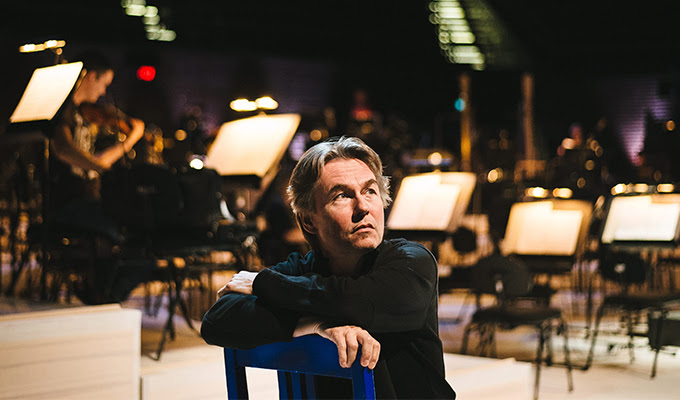
At 7:30 pm on Wednesday, March 13, the London-based Philharmonia Orchestra, with Esa-Pekka Salonen at its helm, will take the stage at Hill Auditorium for the second concert of its two night residency. Composer and conductor Esa-Pekka Salonen is currently the Principal Conductor and Artistic Advisor for the Philharmonia Orchestra, and he was formerly the music director of the Los Angeles Philharmonic. In 2020 he will take the role of Music Director of the San Francisco Symphony.

The evening’s program will consist of Arnold Schoenberg’s Verklärte Nacht, Op. 4 (Transfigured Night), originally a string sextet in one movement that the composer later arranged for string orchestra, followed by Anton Bruckner’s Symphony No. 7 in E Major.

Don’t miss the opportunity to enjoy a performance by the last major orchestra of the University Musical Society’s 2018-19 season! Tickets may be purchased online or at the Michigan League Ticket Office, and they are $12 or $20 for students, depending on seat location.

REVIEW: Yo-Yo Ma: Culture, Understanding, and Survival

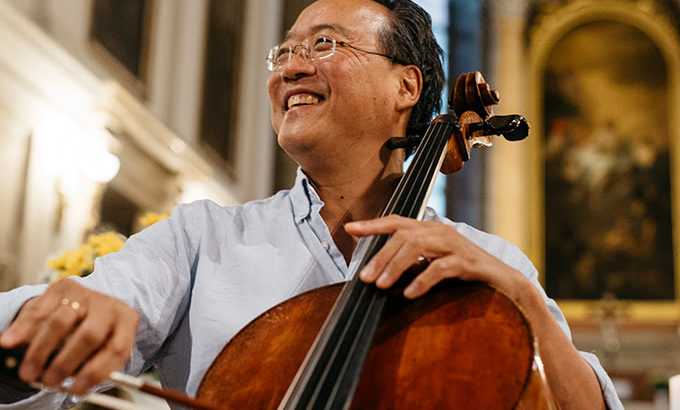
In all seriousness, I left Yo-Yo Ma’s special talk on “Culture, Understanding, and Survival” thoroughly convinced that he might be one of the coolest people on the planet.

After running onto the stage in a fashion more akin to a rock star, and a far cry from the stiff persona one might stereotypically expect of a virtuoso classical musician, Mr. Ma suggested that the evening begin with a bit of music. Then, to the audience’s confusion, he walked over to the grand piano onstage (“I think I left my cello in the taxi,” he joked, even though it was laying on the stage in plain view right behind him) and played the theme from Bach’s Goldberg Variations. It was a simple, nontechnical melody, but placid and contemplative at the same time, and it was evident that Mr. Ma’s musical skill is not confined to the cello (Did you know that he holds a degree from Harvard…in Anthropology?).

Mr. Ma covered a lot of ground over the course of his lecture, ranging from classical music history, to the scoliosis that affected him as a young adult, to great American composers like Duke Ellington and Aaron Copland, to the bushmen of the Kalahari, Charles Darwin, and the finches of the Galapagos islands. However, one of the evening’s unifying themes was “experimentation and experience.”  These two things, Mr. Ma pointed out, are what drive both the evolution of life and the evolution of culture, and what transformed him from a “cellist to a musician.”

Mr. Ma’s wisdom and humility was evident, even from the back of Hill Auditorium’s upper balcony. As he wove together his own experiences and wisdom, but his focus was never really on himself, but on the shared human experience. He spoke with admiration of cultural citizen exemplars Michelin-starred chef José Andrés, French artist JR, and Mr. Rogers. He made it clear that he’s not any different from the rest of us in the audience (albeit much, much better at the cello!).

Hands down, the highlight of the evening for me was when Mr. Ma played the Prelude to J.S. Bach’s Cello Suite No. 3. The piece consists of repetitive and conflicting “scales and arpeggios,” he told us, telling “a story in sound,” and with its final flourish, “we are celebrating the best of what can be.” In delving into the piece, he quoted T.S. Eliot:

“We shall not cease from exploration

And the end of all our exploring

Will be to arrive where we started

And know the place for the first time.”

At the end of his talk, he recalled this quote, “to arrive where we started / And know the place for the first time,” as he again sat down at the piano and played, for the second time, the theme to Bach’s Goldberg Variations. And he was right. The music, when heard a second time with Mr. Ma’s imparted wisdom swirling around my head, sounded hopeful and forward-looking, which is perhaps a reflection of the way I felt at the talk’s conclusion.


REVIEW: Sexual and Gender-Based Misconduct Awareness and Prevention in the Performing Arts

Immediately following a panel discussion on sexual and gender-based misconduct awareness and prevention in the performing arts, Strength & Sensitivity and Carla Dirlikov Canales of The Canales Project presented a truly fascinating performance.


Strength and Sensitivity is “a multimedia concert experience that blends contemporary music, poetry readings, and audience interaction to catalyze dialogue on themes of gender Dynamics, intersectional feminism, and empathy,” and their performance expounded on the themes discussed during the panel. One of the most thought-provoking works was Improvisation by Colleen Bernstein on piano. As she relayed to the audience, in the aftermath of one of the Michigan Daily articles concerning sexual misconduct and people associated with the School of Music, Theatre & Dance, Colleen Bernstein sat down at the piano, opened a voice memo on her phone, and improvised at the piano to try to make sense of what she was feeling. This recording was played through the sound system in Hankinson Rehearsal Hall on Tuesday night. For the duration of Improvisation, interactive questions appeared on a screen behind the stage, and audience members could text responses to a given number. Question included “What does this community need to do to make progress towards gender equality?” and “Describe how you feel right now in one word.” As I sat and watched the responses fill the screen, changing in size according to how many people had submitted that same word, I could hear hope, grief, and a sense of tranquility permeating the music. I especially appreciated that even the performance was continuing the dialogue that had been started.


The second part of the performance was presented by Carla Dirlikov Canales of The Canales Project. An SMTD graduate and acclaimed opera singer, Ms. Canales started Hear Her Song as an initiative that honors “distinguished women leaders through new songs inspired by their words, written by leading female songwriters and composers.” The project has commissioned over 40 songs to date. Ms. Canales’s performance was, without question, my favorite of the evening. My only disappointment was that due to time constraints, she was able to perform only three of the five programmed songs (how I would have loved to hear “This is What” in honor of Supreme Court Justice Sonia Sotomayor, or “What Greatness is Possible” for Jennie Boelkens!). She sang “Foster Love,” a song honoring Lynn Price, who has dedicated her life to reuniting siblings separated by foster care, and “Mercy,” honoring Sister Marilyn Lacey, founder of Mercy Beyond Borders. She then closed with the organization’s theme song, “Hear Our Song” by Katie Pfaffl. Although the audience at that point had dwindled to only about 30 people, the energy was palpable as Ms. Canales’s voice soared to the hummable, empowering anthem. In fact, she will perform that song later this month at the United Nations in celebration of International Women’s Day, which is March 8. It was an uplifting conclusion to an evening of hard conversation.


Tuesday’s performance on the theme “Sexual and Gender-Based Misconduct Awareness and Prevention in the Performing Arts” has given me hope that together, we can address the issues that need to be addressed.

REVIEW: Third Place Concert Series presents: Zelasko // LaBonte // Rosen

As the icy wind blew snow along the pavement like sand through a frozen desert, I walked into Bløm Meadworks. It was just after hours, but the promise of good music had drawn a modest crowd of around 30 people. After beer and wine was distributed and the audience settled into their seats, they killed the lights, and we were suddenly thrust into a warmth and calmness that rivaled even the most roaring of hearth fires. The red and blue glow of smaller lights along the wall and the low hum of the brewing vats beside us made the blizzard outside feel a million miles away.

The concert featured three vocalists: Rebecca HH Rosen, Jocelyn Zelasko, and Hillary LaBonte. Rosen is a singer-songwriter who tours all over the U.S. with various groups; a musical vagabond since 2014. Zelasko and LaBonte are contemporary classical singers, taking part in various operas. All three have immensely strong voices with tones and ranges that are quite unique from each other.

The music from Rebecca HH Rosen and the cellists made me feel such conflicting things at once I became stuck in a tight space, held by the sound, feeling secure and claustrophobic both. Though the songs made me automatically picture peaceful summer images of the sun and breeze and soft, long grasses, I cried through the entire 30-minute set. And it wasn’t as if I began to listen and take in the words, gradually tearing up at the beautiful intersection of voice and my favorite string instruments. No more than five seconds passed from the moment Rosen began singing and I felt tears hitting my cheeks. There was nothing sad about the experience; all at once I felt all that is good and beautiful in the world, every sunny day. The sound of the cellos, guitar, and voice was simultaneously impossibly smooth and strong and sweet. I regret that I could not pay much attention to the lyrics, most of which were written by Rosen herself.

The next singers, Jocelyn Zelasko and Hillary LaBonte, performed together in what proved to be the most wildly conflicting, experimental version of chamber music I have heard yet. Though maintaining a classicality that stretched into opera at times, much of their performance was illogical, though it provoked critical thinking. A few songs had no words at all, but were piercing and emotional enough to stay in my memory for days afterwards. This may have been the effect of the room’s odd lighting, but I swear I lost my sense of sight for a time, LaBonte’s hair and face melting together with her neck and shoulders. I do not have a clear idea of what this fleeting semi-blindness means. The last part of their set used audio description as a medium–they literally put headphones on and described the sounds their phones were playing. It sounds ridiculous and confusing, but it felt like something more. When combined with the wordless songs and the often irrational ramblings of ones with lyrics, I had a sense of reliance on the singers for information, on the stories they were piecing together for us. It was reminiscent of ancient oral storytelling traditions; I was grateful to gather and understand the details they were passing down.

This concert was just one in Bløm Meadworks’ Third Place Concert Series. The series features a wide variety of artists in a wonderfully-curated monthly event. Check their Facebook page (https://www.facebook.com/TheThirdPlaceConcertSeries/) to look for future events.


PREVIEW: Special Talk with Yo-Yo Ma: Culture, Understanding, and Survival

On February 26 at 7 pm in Hill Auditorium, legendary cellist Yo-Yo Ma will present a talk entitled “Culture, Understanding, and Survival” that will “explore the role culture can play in helping us to imagine and build a better future, drawing on examples from his own life as a musician and citizen.”

Don’t be turned away by the fact that this event is a talk and not a performance (though the rumor is that Mr. Ma will have his cello on him to provide musical illustration)! Though he has achieved pop-culture status as one of the greatest musicians of our time, he is also extremely intentional and human. I once listened to a podcast in which he compared mistakes onstage to Julia Child dropping a chicken on the floor, picking it up, and putting it back in the pan, which in addition to being hilariously funny, proves his down-to-earth and relatable perspectives. I am extremely excited to listen and learn from what Mr. Ma has to say.

Tickets may be purchased online or at the Michigan League Ticket Office. As always is the case for UMS events, student tickets are $12-20, depending on seat location.

On February 27, Mr. Ma will also host a Day of Action in Flint, Michigan, which will culminate with a celebration of Flint in a community cultural showcase at the historic Berston Field House.


“All the things I love about life outside music have to do with people, and playing the cello allows me to fulfill all those interests through music.”

– Yo-Yo Ma