REVIEW: Art Outta Town – Evita

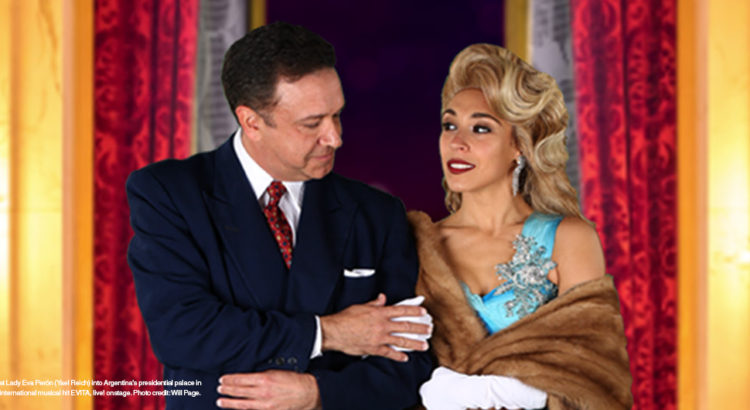
This past Saturday, Arts at Michigan sponsored a trip to the Stranahan Theater in Toledo, Ohio to see the musical Evita, which tells the life story of beloved Argentinian First Lady Eva Perón.

The music, which was composed by Andrew Lloyd Webber (of The Phantom of the Opera and The Wizard of Oz fame), is a blend of rock and traditional musical theater-type styles, with Latin American influences. I had never seen the musical before, but I knew the musical’s most famous song, “Don’t Cry for Me Argentina.” However, I also recognized some of the other songs!

Oddly enough, the musical begins with death – the first scene is Eva Perón’s death being announced over the radio, followed by her funeral, and the first song is “Requiem.” From there, the plot flashes back to her girlhood, and then moves through her life, to when she met her husband, Juan Perón, to his election as president of Argentina, to her time as first lady, and then back to her death. In other words, the plot is ultimately a circle. Separately, it is impossible to capture an entire (albeit short) life in a two-hour musical, and at times it felt like the “Spark Notes” version of a much more nuanced story, which left me wanting more.

Furthermore, the musical’s ending was probably the most abrupt conclusion to any musical I have ever seen. Eva Perón’s death was essentially the end, and there were no bows or loud applause, as is the usual for the end of a performance. Rather, a single spotlight illuminated the main characters one by one, in complete silence, and the audience applauded lightly. It was surprising, and I didn’t expect it to be the end of the musical, but in some ways, it made sense. It would not have made sense for the musical to end with exuberant bows music, right after its main character died. Additionally, the show’s abrupt ending mirrors the abrupt ending to Eva Perón’s life – she died of cervical cancer at age thirty-three.

One disappointment of the show was that the theater was suffering technical difficulties. The show did not start on time because of these issues, and it was extremely difficult, particularly during the first act, to understand the dialogue. Because of this, I had trouble following the storyline at times. Also, the set incorporated a large screen that displayed images of the actual Eva Perón throughout the musical, which provided a constant reminder that the events depicted occurred in real life. However, due to poor set design, from my seat in the upper part of the balcony, the top half of the screen was obscured by the top of the stage, and so I was unable to see Eva Perón’s face in most of the projected images.

Aside from some technical issues, though, Evita was a fascinating show that left me wanting to learn more about the complex woman whose life it illustrates.


PREVIEW: Frances Luke Accord and The Western Den

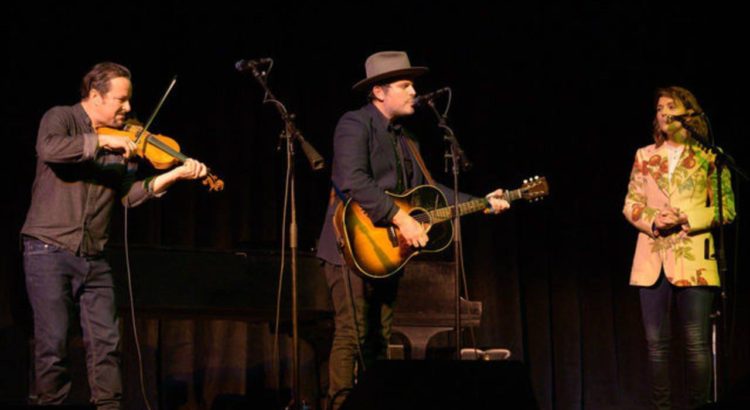
On Wednesday, February 6, 2019, The Ark in Ann Arbor will be hosting Frances Luke Accord and The Western Den, two duo groups whose legacies have been established and are continuing to flourish in the indie folk genre. These duos will be performing music from their newest and older releases, all the while combining unique, progressive sounds in a timeless and precedent art form.

Hailing from South Bend, IN, Frances Luke Accord members Nicholas Gunty and Brian Powers have known each other since attending the University of Notre Dame and have collaborated on nonprofit projects, full-length albums, and exploratory compositions. Hailing from Virginia and the island of Bermuda, Deni Hlavinka and Chris West met over experimental music compositions and have collaborated on several EPs in addition to establishing an inseparable relationship between themselves.

As these duos take the stage this week, I am ecstatic to experience the music and the emotion that they have to offer. As a note, this event is available to all students for no cost through the Passport to the Arts offered by the Arts at Michigan program from the University of Michigan.

PREVIEW: Art Outta Town – Evita

This Saturday, February 2, Arts at Michigan will be taking a group of students on a trip to the Stranahan Theater in Toledo, Ohio to see a matinee performance of the Broadway musical Evita for just $20!

Centered around the life story of beloved Argentinian First Lady Eva Perón, the musical features a Grammy Award-winning sound track by Andrew Lloyd Webber with songs like “Don’t Cry for Me Argentina.” The musical itself was awarded several Tony Awards, including Best Musical and Best Original Soundtrack.

For more information on Evita at the Stranahan theater, click here.

To learn more about Arts at Michigan’s Art Outta Town program, visit their website at http://artsatmichigan.umich.edu/programs/outta/.

REVIEW: SMTD@UMMA Performance: Press A-Flat to Play

I’ll be the first to admit that I’ve never played most of the games referenced at Sunday’s concert “Press A-Flat to Play” at the University of Michigan Museum of Art, but nevertheless, it was one of the most fascinating concerts I’ve been to this year. The event was very well attended, with very few open seats. Centered around Dr. Matthew Thompson’s research of video game music, the evening consisted of performances by the six students that make up his video game music piano studio.

Presented in the museum apse, there was a juxtaposition between the video game scenes projected on a screen behind the piano and the large classical paintings surrounding the audience in gilded frames. In part, I think, this highlighted one of the purposes of the concert – to feature video game music as art.  From the program notes: “Game music is crafted to further plot development, much like music in an opera, a music or for a film…Video game music, native to the Age of the Internet, is relevant, important, and as much art as anything else you’ve heard in this space.”

I particularly enjoyed the concert because, unlike traditional performances where the performers play the pieces in the program one after another, Dr. Thompson spoke in between the pieces, highlighting various parts of the upcoming piece. For instance, prior to the performance of “Stand Your Ground” from the game Final Fantasy XV, he discussed the difficulty of creating a piano arrangement that mimics the sound of the full orchestra that the piece was originally scored for. Before the audience enjoyed “Concert Paraphrase on Dearly Beloved,” Dr. Thompson mentioned that the piece references works by Liszt, Rachmaninoff, and Chopin. For me, these reflections added to the value of the performances, such that even though I was not familiar with most of the music, I still greatly enjoyed the concert.

One of the pieces that I couldn’t not recognize, and probably one of the audience favorites of the evening, was a jazzy version of the Super Mario Brothers theme. As not Dr. Thompson noted, not all arrangements of video game music attempt to be faithful to the original!

Finally, I could not help but notice the acoustics of the museum apse. Underneath the high ceilings and surrounded by stone columns, each note echoed through the space, creating a unique sonic effect that you wouldn’t normally experience in a concert hall!

REVIEW: Chamber Music Society of Lincoln Center

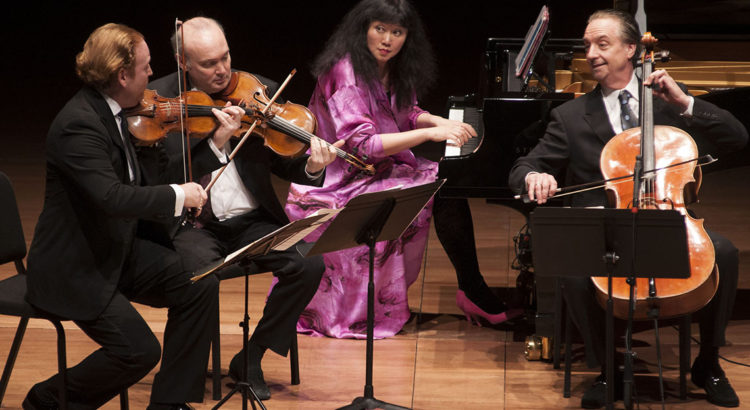
Technically flawless is the only way to describe Friday evening’s performance at Rackham Auditorium by pianist Wu Han, violinist Daniel Hope, violist Paul Neubauer, and cellist David Finckel of the Chamber Music Society of Lincoln Center. Each of the performers are highly accomplished musicians in their own right – just to give you an idea, Mr. Neubauer was appointed principal violist of the New York Philharmonic at age 21, and Mr. Finckel was the cellist of the Emerson String Quartet for 34 seasons. As a group, their music-making demanded the audience’s attention from the very first note, refusing to relinquish it until the concert’s conclusion.

The program consisted of piano quartets, which, counterintuitively, consist of a piano, violin, viola, and cello.

The first piece, Quartet in a minor for Piano, Violin, Viola, and Cello, Op. 1 by Josef Suk, was written by the composer when he was a seventeen-year-old student of Antonín Dvořák. With a dramatic first movement, ethereal and dreamlike second movement that fades into nothingness, and a third movement that is jarring, the piece concluded to rapturous applause.

The second piece, Johannes Brahms’s Quartet No. 3 in c minor for Piano, Violin, Viola, and Cello, Op. 60, was one filled with an underlying tension that never quite left the music, even during the sections that could be described as more tranquil. It was during this piece that I specifically noted Ms. Han’s skill on the piano – her fingers seemed to dance across the keys with extraordinary lightness.

The final programmed piece was Quartet in E-flat Major for Piano, Violin, Viola, and Cello, Op. 87 by Antonín Dvořák. However, the audience, thoroughly captured by the evening’s performance, called for and was granted an encore of Dvořák’s Bagatelles, Op. 47, V. Poco allegro. The piece was announced from the stage. It was noted, to the audience’s amused laughter, that Dvořák composed it when his publisher insisted that he work on something more popular than what he had been working on (he had been working on his Slavonic Dances, which are famous even today).

After the concert, the performers came out into the lobby of Rackham Auditorium to sign albums and interact with audience members. It is always fascinating to hear artists discuss their work, which is not usually an opportunity after classical performances!

Overall, the Chamber Music Society of Lincoln Center presented an evening of music of impeccable quality that was greatly enjoyed by the audience!

REVIEW: Folk Fest

What is folk? After attending the first night of the 42nd Annual Folk Festival, my definition and understanding of this genre of music has both expanded and blurred. Folk isn’t just banjos and mandolins with a Southern drawl. It is so much more, and Folk Fest is the perfect venue to show just how diverse and magical folk music can be.

Peter Mulvey. Credit: Andrew Rogers on All About Ann Arbor

Peter Mulvey was the MC for the night, offering his music in between sets, along with Ford car giveaways and a little story called “Vlad the Astrophysicist,” which he performed, partly by reading from the illustrated children’s book but mostly as a memorized spoken word piece that took you through an existential crisis of time and the universe. Who knew Folk Fest was going to get this deep?

Michigan Rattlers. Credit: Andrew Rogers on All About Ann Arbor
Parsonsfield. Credit: Andrew Rogers on All About Ann Arbor
Sam Lewis. Credit: Andrew Rogers on All About Ann Arbor

As the first act, Michigan Rattlers started off the night, the three-member band getting the audience excited with its folk-rock set. Sam Lewis gave us the clapping song we all craved for the night. Parsonsfield was a very talented band featuring an exciting variety of instruments, including the mandolin and harmonica.

Haley Heynderickx. Credit: Andrew Rogers on All About Ann Arbor

One of my favorite performers was Haley Heynderickx, a very calm and sweet soul with a gentle yet mystifying sound. She said, “If someone is scared of bugs and you collect them, this song is about you. Everything else has already been written.” Her sing-along song, “Oom Sha La La,” was so soothing and unique, I’m now looking forward to seeing her back at The Ark in March.

Gregory Alan Isakov. Credit: Andrew Rogers on All About Ann Arbor

After the intermission, a dim blue light illuminated the stage for Gregory Alan Isakov, setting the stage for the thundering music that was to come. Just as Peter Mulvey said in his introduction, there’s an immense stillness through his music. Bright globes matched the songs about space that moved you through time and the universe, all from a seat in Hill Auditorium.

Brandi Carlile. Credit: Andrew Rogers on All About Ann Arbor

Finally, the headliner brought the audience to their feet as she closed out a night of amazing folk music in style. Brandi Carlile is the most Grammy-nominated female artist this year with six nominations, including best album of the year.Alternating between guitars and the piano, her songs about life, love, and motherhood brought the emotions and power we all love her for.

Folk Fest was a phenomenal night filled with the best folk music around. Catch the second night tonight, or come back next year for the 43rd Ann Arbor Folk Festival that will definitely revolutionize how you engage with folk music and its deep and powerful meanings.