
REVIEW: Jose Miguel Sokoloff (Penny Stamps Speaker)

Jose Miguel Sokoloff is many things; first and foremost, however, he is an advertiser who loves his home country of Colombia.

For roughly an hour, we experienced a condensed version of Colombia’s history and its war with the guerrilla movement. Beginning with the Cold War, Sokoloff laid the groundwork of the guerrillas’ ideological foundation, followed by a gradual shift to an economical role after the fall of the Soviet Union.

The key to ending Colombia’s war with the guerrillas, he stressed, was realizing that the members were as much victims of the organization as the general populace.

We watched the growth of the advertising campaign against the guerrilla’s–from it’s missteps at the beginning to the enormous successes it has achieved in recent years. Always, the message remained the same: “Demobilization is the way out” / “desmovilización es la salida”

What struck me most was how successful Sokoloff and the nation of Colombia was with its advertising campaign, and its intersection of art and politics. Realizing that genuine testimonies were more important than professional actors, the campaign would always “speak to the human” in an effort to convey the message that the war would eventually end anyway.

The government concentrated on Christmas and family, because that was when the members were most vulnerable. Soldiers decorated trees in the jungle with Christmas lights. Glowing balls with heartfelt messages floated down the waterways that the guerrillas used for travel. The military sent soccer balls all over the country to remind the guerrillas what they were missing.

Most touching of all was a campaign involving mothers, in which they stated “Before being a guerrilla, you are my son” / “Antes de ser guerrillero, eres mi hijo”

Eres mi hijo

Overall I loved this talk. This was explicit proof that we don’t need extensive peace talks or military campaigns to dissolve the potency of a violent movement. Instead, this advertising campaign appealed to the hearts and humanity of the guerrillas in the jungle, and it worked.
REVIEW: Sundance Live Action Short Films

This was the first year I was able to see the Sundance Live Action short films. Therefore, the only comparisons I have are to other film festivals and to the Sundance animated shorts from last year.

Many people consider Sundance to be a festival that launches the careers of independent and relatively unknown filmmakers. Each year audiences around the country get to see their live action and animated short film collections.

In their collection description, Sundance stresses diversity, and this is something that is true without a doubt. Ranging from astronauts training in the desert to a BDSM-themed opera remix, the short films brought forth a wide range of emotions. This inconsistency was as much a weakness as a strength, however. Some shorts had clear and provoking deeper meanings, while others were simply entertaining little pieces that didn’t have as much staying power.

One of the best–if not THE best–was “Afronauts,” a fictional recreation of Zambian exiles preparing for a trip to the moon in 1969. Beautifully shot in black and white, it is a chilling commentary on the lengths we go and the sacrifices we make to achieve a perceived goal. My favorite part about this was the actors’ performances that didn’t even require dialogue to do most of the work.

An interesting thing about this collection of films was the importance of the story. Two examples here are “Dawn,” about a young teenager seeking to escape from her sheltered life, and “I think this is the closest to how the footage looked,” about a man striving to recreate the memory of his last day with his mother.

The film quality and production design of these two films is not even in the same ballpark. Yet, despite “Dawn’s” superior look and beautiful shots, I found myself enjoying “footage” much more. “Dawn” plays to tropes and its ending is basically a punchline, whereas “footage” strikes at the raw fears that we all have of losing those closest to us. This was an amazing example of how even films with lower budgets can shine brighter than more cinematic films.

Sundance’s selection of foreign films was refreshing. We had films in Hebrew, French, Russian, English, and a smattering of Mexican Spanish. Not all of them were thrilling, but they were genuine and unflinching depictions of the cultures that produced them. “Love. Love. Love” transported us to Russia and gave us different way to look at intimacy. “I’m a Mitzvah” was a fantastic collision of Hispanic and Jewish cultures in a foreign country.

Overall, a great slate of films. Completely incomparable to the animated films, these films are worth your time if you ever get to see any of them.

REVIEW: Detroit Symphony Orchestra plays “Firebird”

On Saturday night, the Detroit Symphony Orchestra delivered an energetic program consisting of Strauss’s Don Juan, Prokofiev’s Violin Concerto No. 1, Connession’s Cosmic Trilogy, and Stavinsky’s “Firebird” suite. Maestro Robert Treviño led the orchestra with much enthusiasm, and the audience was able to absorb that energy quite well.

Special shoutout goes to the violinist and concertmaster Yoonshin Song and the entire wind section. Ms. Song brought life to each and every phrase of Prokofiev’s tricky solo line. The orchestra supported her by accompanying her expressively and applauding after the performance, which attested to her leadership ability and trust she gains from the orchestra for her personality.

In addition to the concertmaster, this program highlighted the strength of the DSO’s wind section as a whole. As a wind player myself, I always experience the difficulty of working with such a large section to make one cohesive sound. Stravinsky’s “Firebird” Suite (1919) is a perfect piece to showcase their unity. “Firebird” features each principal player’s virtuosity as a solo player, but it also requires everyone in the section to create the “winds” sound — which they did very well.

But today, I also want to comment on something else that was on my mind during this performance.

I headed over to this concert after an entire day spent at the SphinxCon, the conference intended to spark conversations about inclusion and diversity in arts. For three days, participants like myself were able to listen to many empowering speakers and panelists that worked actively to disturb the dominant narratives and let the minorities’ voices be heard — whether it be race, ethnicity, socioeconomic status, indigenous affiliation, (dis)ability status, or otherwise. Then, I looked at the stage in the Orchestra Hall. The majority of the orchestra is white, and the largest racial minority group represented is Asian. There are a couple of Black musicians on stage, but this makeup surely does not represent the population of Detroit.

I have heard of DSO’s efforts to actively include the Detroit community, through frequent live streaming, ticket promotions, and local, more affordable performances. As “a community-supported orchestra,” DSO puts a lot of work into inclusion. However, the reality is rough. Classical music, or any art for that matter, is very expensive to maintain and present, yet making the tickets more expensive would exclude many, many populations. Pursuing arts as a career often takes economic stability, which is not something that everyone has. How do you disrupt that? …That’s the question that looms over the minds of many artists, arts organizations, stakeholders, and leaders.

By coming to the Detroit Symphony Orchestra’s concert to conclude my busy Saturday, I was able to synthesize a lot of information that I absorbed from the SphinxCon. These thoughts are always work in progress. Maybe one day, we can see the same program performed with an orchestra and an audience that represents the population makeup of the community…

REVIEW: Biorhythms Med School Student Dance Show

Well-dressed parents and friends entered the Lydia Mendelssohn Theatre, a somber atmosphere apt for an orchestra performance or Shakespeare performance. Biorhythms was nothing of the sort.

From the opening “Phlomax” to the sexually charged “Mance” performance at the end, the entirety of the show was full of energy, creativity, and enthusiasm. Unlike many companion pamphlets, the ones provided at this show had lyrics and descriptions that allowed the audience to follow allow with medical school-themed manipulations.

An altered rendition of OutKast’s “Ms. Jackson” begins “I’m sorry Ms. Rosen. I’m an M1. Never learned a single histo slide,” and in another instance the lyrics to Kanye West’s “All of the Lights” became “Cre-Lox. Post-docs. Primer stocks. Chalk Talks…”

As science major and possible pre-med student, I enjoyed the clever medical adaptations, as well as the plethora of creativity. One can only imagine the rigors of medical school without actually being in medical school, and consequently much of the show felt like an elaborate stress relief via performance. We watched Brazilian Samba, a Bollywood dance-off, flag dancing, a capella, and even an acoustic performer (Vince Pallazola).

Despite the diversity and talent throughout the show, there was a highly sexual aspect that detracted from its artistic merit. For every talented soloist, there was a group of young, half-naked bodies gyrating on the stage. At the risk of sounding like your conservative neighbor down the street, it was an awkward juxtaposition at times. Furthermore, since these were medical students putting on a show twice a year, the show had an overall feeling of a high school musical. The audience was dominated by friends and family, and most acts had a practiced but unpolished tone.

Overall, biorhythms was well worth the time. On a Sunday with not much else to do except study, the show was a welcome and entertaining distraction, and well worth seeing in the spring.

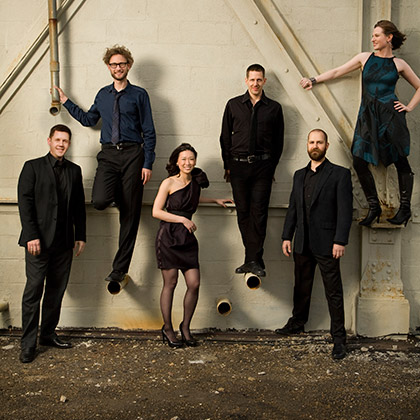
REVIEW: eighth blackbird

Image Courtesy via ums.org/performance/eighth-blackbird/

viii.

        I know noble accents

        And lucid, inescapable rhythms;

        But I know, too,

        That the blackbird is involved

        In what I know.

Inspired by the eighth stanza of Wallace Stevens’ “Thirteen Ways of Looking at a Blackbird” – indeed the Chicago-based sextet picked up the evocative feel of the poem. But I know, too, that some other magical, indescribable element is involved to make eighth blackbird what it is: talent and innovation.

One major element of blackbird’s contemporary style is dissonance, that moment when two notes clash against each other and you find yourself cringing a little. But the beauty of dissonance is that it’s an effortless effort to make someone appreciate the following note that shifts seamlessly into harmony. Without the dissonance, would we notice the climactic, chord-changing note that sets it all right? It’s hard to say. But eighth blackbird calls our attention to it.

My favorite piece was an original composition by the ensemble’s pianist, Lisa Kaplan. Entitled “whirligig for piano four hands,” it centers around spinning, chaos, and the circular movement of change. Not only did I fall in love with the whimsical title, I was intrigued by the concept of “four hands,” which I soon discovered means that two people play side-by-side on the same piano. The piece was divided into three movements. The first, “off-kilter,” showed a playful fight for a space between musicians. The two pianists stretched their arms up and under each others to reach the key just beyond their reach, resulting in a hilarious theatrical spar. Until truly, the bench itself was off-kilter and one of the pianists proved victorious by taking command of the entire piano, leaving the other, with no space of her own, reluctantly getting up from the bench. This, of course, marked the end of the piece, because you can’t play a piece for four hands without four hands! The second movement, “merry-go-round,” tinkled with the wound-up gracefulness of a jewelry box. I found myself closing my eyes as I was gently lulled into the peaceful recurring theme. Around the carousel we went…with childlike nostalgia…back into time…with this lullaby as our road trip soundtrack. In complete contrast, the third movement, “boogie-woogie,” showcased the body’s innate desire to jive. This was the ultimate jazz piano piece with all kinds of movement – foot thumping, body-rocking, head-banging, and most unusually, elbow-playing! Using the flat part of their forearms, the two pianists smashed their arms down on the keys in syncopated rhythms. Contrary to the expected “bull in a china shop” result, these spontaneous bursts of sound energized the background melody in a surprisingly refreshing way. It just shows that perhaps a little chaos in our life keeps us, well, on our elbows!

The ensemble proved that they weren’t afraid to bend the rules of music. Another spectacular part of their show was their performance of “Counting Duets” by Tom Johnson. Using only their voices and clapping hands, the musicians used numbers as a lyrical conversation. For example, two voices approached each other and alternated with : “1.” “2, 3.” “4?” “2.” “6!” “6?” and so on. But the magnificence wasn’t in the numbers, it was in the inflections, the tones, the way that the voices put on a theatrical conversation without using any words at all. It made me start to think about what music is…was this music? Just a bunch of people manipulating the way their voices said numbers? And then I realized. Yes. It was. Music, after all, is the artistic culmination of science, physics, and math, in its basic counting form. To emphasize the musicality of numbers and counting, eighth blackbird alternated between these vocal counting duets and romantic instrumental etudes by Gyorgy Ligeti; in the end, they mastered both the external and internal counting machines of music. And, more importantly, they’ve mastered the blackbird.


REVIEW: Knox Hamilton at the Blind Pig

What do you get when you bring a band from Little Rock to the Blind Pig on a Tuesday night? Catchy music and a great excuse to avoid the week’s workload.

Knox Hamilton is rare in two cases: not only are they a three man alternative rock band with a full sound, they also toured on the strength of a single song “Work it Out.” That is correct, you can only listen to and/or buy one of their songs.

For some bands, you might shrug and move on to the next Taylor Swift single, but Knox is one of the best bands I’ve seen at the Blind Pig. Not only did they joke around with the confidence of a more mature band, but their music was downright full of energy. Their EP should be dropping sometime in March and this is one collection of music I highly recommend purchasing.

Knox HamiltonUnder the trippy blue-red glow of the Blind Pig’s lights, we stood for a little less than an hour as the band played through its entire set. It was disappointing because their sound was infectious, and even better, there was only 1 filler song for the entire hour.

Knox Hamilton said they would return to Ann Arbor in the future and I fully recommend seeing them in concert.

Even better, they are active Twitter users: @KnoxHamilton