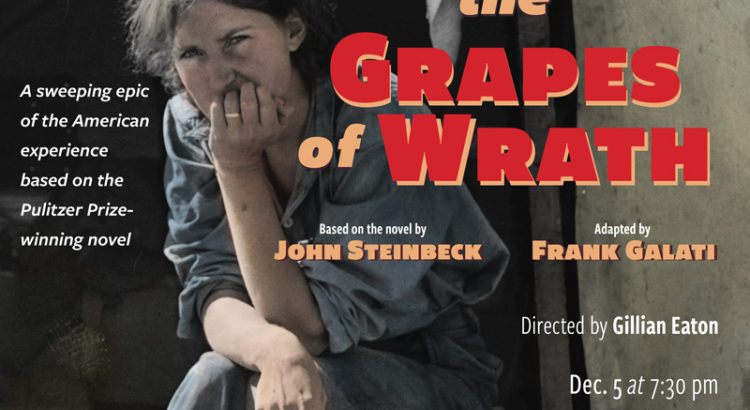
The Grapes of Wrath is playing tonight, Friday, December 6th at 8:00pm, Saturday, December 7th at 8:00pm, and Sunday, December 8th at 2:00pm at the Power Center. SMTD will show the heart-wrenching story of the Joad family, a group forced to leave their home in the Dust Bowl in Oklahoma in search of jobs and a better life. Instead of finding it, they struggle to be welcomed anywhere and even to survive. Don’t be too turned off by the dismalness, though–I’ve heard it’s also an uplifting ode to courage and resolve! With climate change and poverty combining and beginning to force people to move today, it’s a fitting time to think about the challenges and values brought up in John Steinbeck’s famous novel.
You can find information about tickets here: https://tickets.smtd.umich.edu/single/eventDetail.aspx?p=4478.
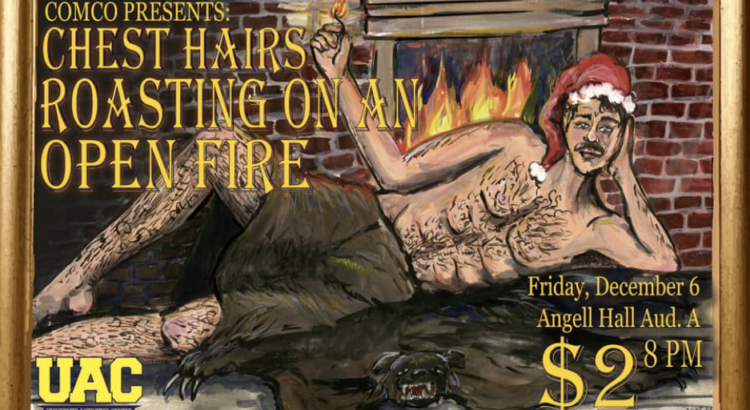
When I saw the poster for this event and noted the strikingly distinct abdominal muscles of their Burt Reynolds drawing, I knew I had to go. Finals szn is truly upon us, and I for one am crawling out of my skin trying to pull my GPA out of the grave I’ve dug for its once-great body. We deserve a break to simply sizzle in nonsense for a while.
Join me in this holiday-scented adventure in improv comedy Friday, December 6th at 8pm in Angell Hall, Auditorium A. Admission is just $2 for a wild night of laughs. Bring your friends, your coworkers, your lovers, and (most importantly) your chest hair. If I can find some way to stick some of my split end trimmings on my chest, I promise to do it in the shape of a heart.
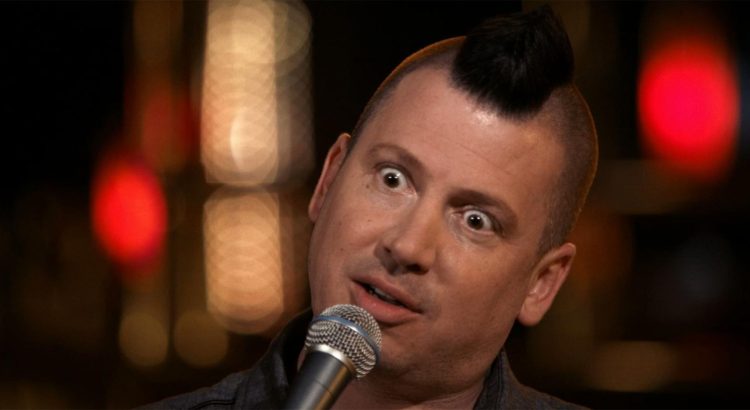
To say I was severely unimpressed would be a vast understatement, yet to call the experience uncomfortable would be an even greater one. The show began innocuously enough, with opening sets from local comedians Jeff Ford, Reese Leonard, and Bret Hayden. Though the openers contained a healthy mix of self-deprecation and poking fun at everyday frustrations, the headliner himself fell short in both departments and managed to present himself as misogynistic, transphobic, Islamophobic, racially ignorant, and generally worthy-of-cringe – all within a one hour time span. In hindsight, Landau’s initial shoulders-back-beer-belly-out swagger onto stage should have primed me for the untamable discomfort that was to follow, a discomfort amplified with each distasteful joke about marginalized communities that was somehow ‘validated’ by waves of tipsy, white laughter.
I’ll admit it; Landau is not an unfunny comic. During his set’s rare, unproblematic moments, his lackadaisical demeanor actually contributed to the joke’s delivery and drew out some genuine laughs. His fast-paced opening line and commentary about his colorful drug history were humorously original, but beyond those candid pockets, the premises of most of his jokes were rooted in the systematic objectification and demeaning of women and mocking the advancement of societal acceptance for communities like the LGBTQ+. Within minutes of taking the stage, Landau took an inappropriate jab at the Dearborn Muslim community and had the audacity to then improvise with two audience members with South Asian features by insinuating that they were Muslim, and later labelling them Indian. To add even more icing on the cake, Landau scanned the front row for more people of color to continue his racially ignorant bit with, before targeting my East Asian-looking friend. After that extended punchline, Landau’s attempts accelerated downhill: the white male comic found it in his place to objectify Transgender people as hybrid cars, continuously refer to women only in demeaning sexual contexts, all while under the cookie-cutter guise of lauding women for “being so strong” in undergoing menstruation and pregnancy. Oh, and shaming his wife’s post-childbirth vagina in reference to a wigged squirrel.
However it would be fruitless to paint Landau as the only perpetrator of such “comedic” tastelessness – he is but one of many contributors to America’s rampant ‘comedy man’ problem – which plagues the industry from Louis C.K to Richard Pryor and now, Dave Chappelle, with his Netflix special Sticks & Stones. Whilst sitting in the darkened room at the Ann Arbor Comedy Showcase, enshrouded in raucous and affirmative white laughter, I finally realized the twisted nature of today’s American, male-dominated stand-up scene. Comedians such as Landau escape true scrutiny and are enabled to ascend to platforms like Comedy Central, using their privilege and defensive powers of “just wanting to make people laugh” to justify gross jokes all the while eschewing all political correctness as antithesis to ‘free speech’, or the art of stand-up itself.
Theatre in the round? Kind of. But, like, more than that.
The University Musical Society brought this production of A Midsummer Night’s Dream to the Michigan Theatre as a National Theatre Live streaming on Sunday, November 24.
Director Nicholas Hytner’s take on the classic is comical, enchanting, and the most entertaining Shakespeare I have seen performed. During an intermission interview Hytner stated he began work on the play with some very strong ideas. First was the use of silks and aerial performance, as well as modeling the world of Athens after that of Gilead in The Handmaid’s Tale to reinforce the contrast between the repressive culture of the city and the freedom of the forest. The most effective directorial decision made by Hytner was to switch many of Titania and Oberon’s lines, changing the usual plot so that Titania is the one to trick Oberon, instead of the other way around.
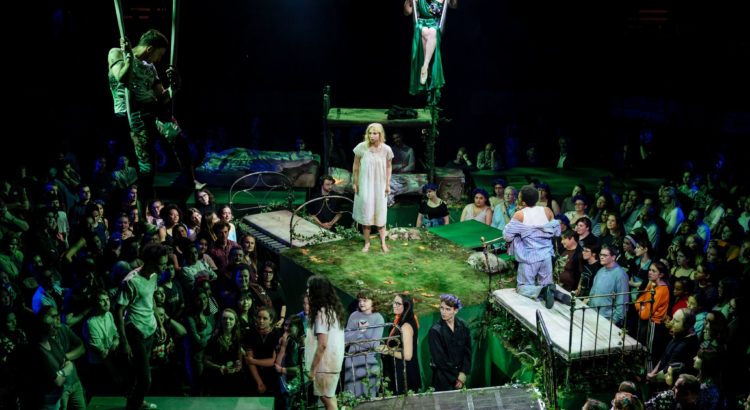
In addition to his role as director of this production Hytner is also the co-founder of Bridge Theatre, a new 900-seat performance venue in London designed with a high degree of adaptability. As director he takes great advantage of this unique space to create the magical world of the forest. Production designer Bunny Christie uses this canvas masterfully as platforms are raised, lowered, and shifted through a standing audience to create an immersive and magical world. Beds that signify actual sleeping quarters in Athens return festooned with moss, vines, and leaves to represent the trees and landscape of the forest. The fairies’ domain is made of flying aerial silks which the actors use to great effect, spinning, twisting, and posing to illustrate their prowess in magic and spellcasting.
Photo by Manuel Harlan.
The lighting design of Bruno Poet and sound design of Paul Arditti both work with the scenic design to create a wonderful sense of atmosphere. While the lighting in Athens is stark and monochromatic, it shifts to deep greens and ethereal purples once the story shifts to the forest. Poet also does a great job of creating focus on specific areas. While holding Titania in a spotlight, a burst of light reveals Puck, having sprung up on the opposite platform. Arditti’s well-chosen sound combines with these lighting effects to create an almost tangible magic in the air, reinforcing the omnipresent nature of the mischievous fae. His atmospheric soundscape is near perfect. The best sound atmosphere is one that goes unnoticed. It is felt but never inserts itself into the scene. The low synth chords of Athens and the lilting strings of the forest do just that. They imbue the audience with a feeling that not only fits the words of the playwright but also justify the other design elements.
Photo by Manuel Harlan.
Christina Cunningham’s designs also reinforce the director’s visions. The stark and simplistic grey dresses of the Helena and Hermia in the city, combined with their white head coverings produce a broadly dystopian impression. The plain black suits of Theseus, Egeus, Demetrius, and Lysander are a uniform of masculine power. It is in these elements that Hytner’s inspiration from TheHandmaid’s Tale is most evident. The Rude Mechanicals are costumed in jumpsuits, highly reminiscent of the party uniform of Orwell’s Nineteen Eighty-Four. However, the most striking Athenian costume is Gwendoline Christie’s first as Hippolyta. Her black gown is beautiful in its simplicity and powerful in its monastic silhouette. She is striking, posed as a stark statue in a glass cage, placed there by Theseus. The costumes of the forest characters present a more fun, whimsical image. Puck flits in and out of scenes in patchwork jeans, graphic tank, and colorful armbands. The other fairies have faces painted with glitter and look more like acrobats or fashion models than beings of nature. Oberon, cast by Hytner as a frivolous playboy, is perfectly gorgeous for most of the play in long flowing gold silk robe, often shirtless underneath.
The one pitfall in the costume design is Christie’s green gown as Titania. This dress is emerald green, silky, more than floor-length, and one-shouldered. The asymmetrical floral detail on the bust contributes to a hyper-feminine and soft picture. This picture directly contrasts the headstrong, vengeful Queen that arises with Hytner’s line arrangements. What would make sense in a traditional rendering of Midsummer just doesn’t work here.
The sheer amount of talent, wit, comedy, and spectacle in this show had me thinking back to it constantly. It made me glad to have seen it and glad to be studying theatre. If there’s one major objection I have, it’s that there’s almost too many ideas in this production. The audience participation and reaction is a riot to watch, the aerial work is amazing, the acting top-notch, and the designs gorgeous. But I at times felt lost in the concept of it. While likening Athens to the theocracy of Gilead creates a striking stage picture, the extremely heavy real-world consequences of that dystopia doesn’t seem to fit in the comedic, self-aware romp of the rest of the production. The aerial acrobatics are well-integrated until Gwendoline Christie spends her time as Titania just sitting on a silk, buckled in, drawing attention to the fact that she is not an aerial artist. The comedy is refreshing until the Rude Mechanicals’ performance near the end is so drawn out that people are checking their watches.
But don’t get me wrong- this is a fantastic production. I haven’t read Midsummer for years and my memory of the plot was fuzzy, so this was a refreshing dip back into the story. And there’s so much more I could write about. Before this my favorite Shakespeare play was Twelfth Night, but Puck may have just bewitched me into changing my mind.
This Friday at 10 pm and Saturday at 7:30 pm, ubiquitously funny stand-up comic Dave Landau will be performing at the Ann Arbor Comedy Showcase to up the cheer for all your weekend Thanksgiving festivities! In addition to his fresh and relatable takes of finding mirth in everyday occurrences, Landau has a formal background in improv from the infamous Second City Comedy Theatre in Detroit and has made numerous appearances on Comedy Central, HBO, Sirius/XM Radio, and “The Bob and Tom Show”. In addition, Landau finished as a finalist on Season 8 of NBC’s Last Comic Standing, and became a fan favorite and 3rd mic on The Artie Lange and Anthony Cumia Radio Show, later renamed The Anthony Cumia Show with Dave Landau.
Tickets may be purchased in advance for $14 here, or $16 at the door!
First, let me say that this was monumentally better than reading the play on paper! The creation of an engaging and unique show is difficult with such an old and re-used play, but this was a stunning rendition of Midsummer Night’s Dream.
To preface, this show would not have been enjoyable had I not known the storyline beforehand. The accents of the actors (all from England) on top of the Shakespearean language made it difficult to understand the show. So, I would not say this show is accessible to everyone, only those who have a prior knowledge of the play and of Shakespearean speak. That being said, the entirety of the performance was absolutely amazing- beautiful, witty, and unusual.
The set of the play was a theater in the round, with people standing directly around the stage and occasionally partaking in the show. I believe these people represented an old style of theater, where those who could not pay for actual seats could stand and watch the show from right up close to the stage. The actual stage itself was several platforms, which rose and lowered to fit the scene. Props were minimal; most of the show took place on several beds. This was more than enough, however, because the acting did not need props in any way. Their performances were fanatical and emotional, and they were very much able to use the difficult language in interesting ways. They emphasized just the right words to make their speech understandable, as well as funny. The incorporation of humor was most brought across by their dramatic movements, and each character was truly humorous in their own way.
I really enjoyed the addition of arial hammocks to the show, which are thick cloths hung from the ceiling that look similar to swings. All of the fairies, including Puck and Hippolyta (the forest queen), used these arial hammocks hanging from the ceiling, and Puck did some very cool tricks on the hammocks. There were flips, spins, swinging, and more. We found out during intermission that he had only been training for a few months, which was very impressive. This gave the show a really otherworldly feeling, and helped make the fairies look more magical, because they were “flying” as they spun and went up and down in the hammocks.
The costumes of the cast were also very interesting, as it was a mix between modern dress and very mythical or Athenian clothes. For example, when Hermia and Lysander fled to the forest, they wore old fashioned pajamas and plain garb, but carried a very modern looking backpack. I also really loved the dress of the fairies, as well as the dress of the king and queen of the forest. They wore many colors, based in green (as a representation of forestry, I assume) and were all covered in sparkles. Since the stage was mostly sparse, it helped the actors in their colorful costumes stand out even more.
What I really liked the best, however, was the fact that it was a live showing. This affected several parts of the viewing experience, most of all making it feel like the audience was about 3 times as large as our audience in the theater. This made the laughs bigger, as well as the applause, and it helped create the experience of being in a theater, which is what I think the makers of National Theater Live were intending. It also made the show more unique and interesting, as there were several moments where actors broke character, or interacted with the audience, which would not happen in a movie.
I would recommend anyone who does not have the ability to see a play live in a theater to try and attend a showing like this, because it was a fantastic alternative to seeing the play in theater. As we were viewing it from a camera, we got all the best views, since they could switch to different perspectives, as well as zoom in for close ups of the actors to see all of their facial expressions and movements perfectly. The fact that it was in the round was also not an issue, as we always had the best angle. This was a fantastic live performance of Midsummer Night’s Dream, and I would encourage everyone to keep their ears open for the next National Theater Live’s performance so they can also attend one of their great events.