REVIEW: Sankai Juku, Meguri: Teeming Sea, Tranquil Land

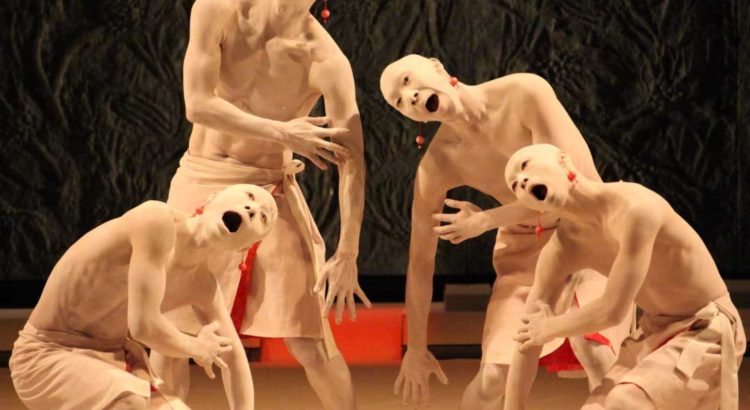
After experiencing the Japanese dance form of butoh through Sankai Juku’s meditative performance, I felt both emotionally disturbed yet liberated. The continuous 90-minute ‘dance’ performance, composed of seven distinct acts, is supposedly choreographed to emanate the circularity within processes and systems such as the earth’s transformation and its movement through the four seasons. The eight performers are powdered a stark white from head to toe, donning bald heads, asymmetrical earrings, and mostly white, sarong-like costumes on their lower halves. They move in correspondence to emotionally dynamic music and express a “dialogue with gravity” through both graceful and grotesque movements marked by spinning, jumping, and eerie bodily gesturing. It is personally difficult for me to describe Sankai Juku through a traditional ‘dance’ perspective; I fail to see it confined to any form of dance theatre that I have experienced before. Sankai Juku as a whole feels more akin to a poetically disturbing expression of the human experience, while their interpretation of meguri translates as a storytelling experience that is facilitated by the mostly monochrome stage lighting that changed with each act.

I thought Ushio Amagatsu’s portrayal of the grotesque within the context of meguri communicated to the audience particularly well; Act V, titled Forest of Fossils, left me especially disturbed with my thoughts asunder. It was during this section that I finally reached some sort of understanding of the performers’ wide, gaping, mouths and permanently perturbed eyes – to me, they communicated agony in discovery and marked the climax of the program. During Act V, only three performers are present on a stage set aglow with greenish light; the music is both tensely trembling and pulsating with the sounds of rocks grinding, which calls to mind the natural shifting of the earth’s tectonic plates. Paralleling the earth’s provocations are the performers, who appear the most agitated that they have been, with one performer gesturing the most frantically and in the most ‘agony’ – at one point, that performer drags his limbs across the powdery ground in a tight spiral to form two symmetrical circles, then subsequently emotes in pure tension and agony around the formation of those two circles. The remaining two performers respond in an unsettling symmetry, and their generally upwards arm movements seem to be grasping at some unattainable substance or idea. The desperation and agony contained within this grotesque imagery, combined with the increasingly jarring music, left me feeling deeply unsettled and in rumination of Amagutsu’s artistic intent behind that section.

As much as I enjoyed the dichotomy between the grotesqueness of Amagutsu’s work and the beauty in the circularity and meguri it conveyed, I think the most uniquely beautiful aspect of Sankai Juku is how the performance manages to maintain universality in evoking the most visceral of emotions from its audience. My disturbed reaction to and interpretation of agony from Act V, Forest of Fossils, differs from the next audience member, yet the emotional impact of this does not seem to suffer in the face of Sankai Juku’s widely interpretable themes derived from the human experience.


REVIEW: Sankai Juku’s Meguri: Teeming Sea, Tranquil Land

Sankai Juku’s Meguri: Teeming Sea, Tranquil Land is a unique show to say the least. If you’ve never heard of the Japanese dance form of butoh, this is a good introduction. 

Butoh began in post-WWII Japan as a response to both traditional and Westernized forms of dance that were popular at the time. The dancers typically perform in all white body makeup and the style is characterized by controlled, slow gestures as well as grotesque and somewhat disturbing movements. 

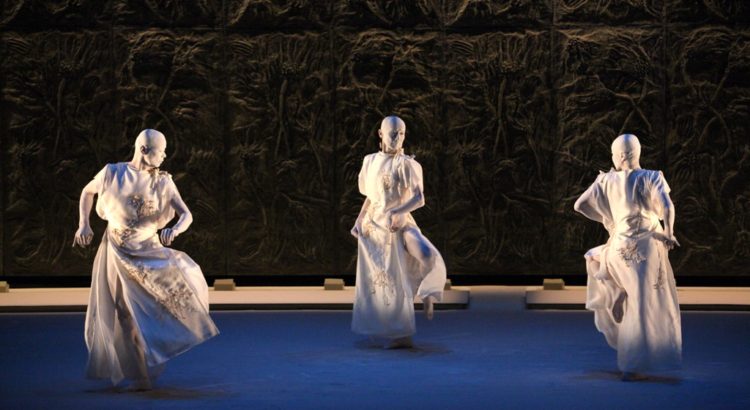
All of this and more is present in Sankai Juku’s performance. Directed by Ushio Amagatsu, Meguri consists of seven sections, delineated by color scheme and number of dancers. As the name of the show implies, imagery of the sea plays against imagery of the land with the use of blue, aqua, and warm amber lighting by technician Genta Iwamura.

The dancers, painted white from head to toe and wearing bald caps, are clad in light, off-white simple garments, with the color of the linings usually changing to match the lighting of a certain section. This simple realization of costume by Masayo Iizuka does well at avoiding being overly theatrical while still fitting into the world of Meguri. 

Although Amagatsu does not present any concrete narrative within Meguri, these motifs create the overall impression (at least for me) of the primordial Earth and life’s emergence from the sea onto dry land. The beautiful backdrop of sea lily fossils, credited to Roshi, contribute to this sense of history. 

As I said, Amagatsu’s choreography does not tell a story, but rather sets a mood. The music and sound design by Takashi Kako, YAS-KAZ, and Yoichiro Yoshikawa is my favorite element of the show. With a healthy mix of orchestral strings and winds as well as some layers of synth, the music provides a cinematic sense to the choreography. Without it the performance would seem much less interesting and important. 

Overall I’m glad the University Musical Society brought this world-class performance to our campus. While not for everyone, Meguri: Teeming Sea, Tranquil Land transports and transfixes the viewer, and there’s something to be said for watching something that is so magically disturbing. 

REVIEW: DisEducated

A musical that captures the anxieties of being a college student, while also making you laugh. Blank Space Workshop’s presentation of Diseducated took place this past Friday and was a privilege to watch. Blank Space Workshop is in their second year here at Michigan and provides a space for developing shows to be workshopped, re-worked, and staged in a short period of time. 

The plot centered around a college English Literature 101 class, in the struggling english department of a struggling university. The english class is taught by the Professor Whitley, a distinguished scholar, holder of two doctorate degrees, and a world-renowned singer/songwriter. Well, sort of. Whitley has never read any of the books he’s teaching, and his titles are decently illegitimate, which becomes evident almost immediately to our main character Beatrice. Beatrice is a fan of classic literature and finds concern in Whitley’s unorthodox teaching methods. To highlight, the class is taught a song about grapes, instead of reading Steinbeck’s The Grapes of Wrath. The class has been drinking tequila, to really understand the classic “Tequila Mockingbird.” Whitley prefers to fake it until he makes it, asserting that a lot of people today aren’t as well-read or as well-rounded as they make themselves out to be. Our protagonist is forced out of her comfort zone, and finds herself taking charge of her deteriorating academic situation. 

 The Cast of DisEducated

The performance was staged in a large classroom in the Walgreen Drama Center, the perfect ambiance for the musical. The audience sat in our orange desks with chairs attached, reminding us of the feeling of sitting in a class that just isn’t right for you- just like Beatrice. The show’s music touched on issues such as Tinder (and Grindr) culture, beefing up your resume, and most interestingly the frustrating differences between GenZ students and the adults tasked with teaching them. Every lyric was relatable, and tastefully forced us to laugh at ourselves. 

The show raised questions about how we see education. Are you reading Steinbeck, or are you pretending that you have for your colleagues? Does it really matter if you have? Is it shameful to enjoy GenZ delights such as multitasking and swiping right? Most importantly, the show was enjoyable. The writing is peppered with clever nods at what it’s like to be our age, like opening the show with a Nick Colleti vine reference. Everyone in the room was having fun, whether they were laughing at GenZ or Baby Boomer critiques. 

A huge congrats to the show’s writers Sammy Sussman and Allie Taylor.

REVIEW: The Pirates of Penzance

Probably the funniest, most talented by many standards performance from SMTD that I’ve seen in my time here, The Pirates of Penzance was full of absurdity, puns, and laughter, just as Gilbert and Sullivan intended.

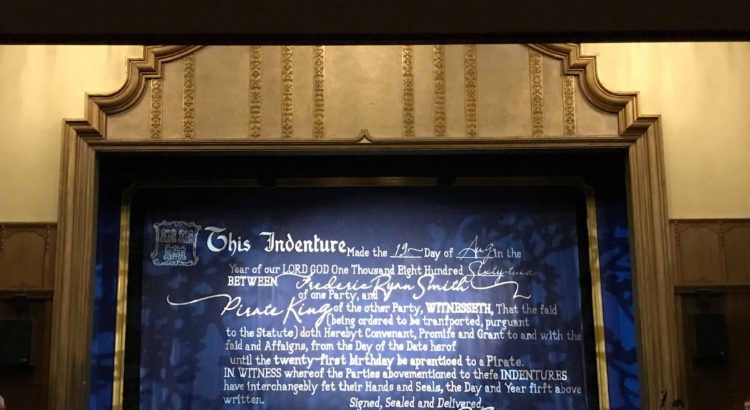
From the very first second once the curtain rose, the bright and defined set, with its water and moving pirate ship, set the expectations high. And right away, Commodore C. Primous III’s appearance as the Pirate King exceeded those expectations. His facial expressions, body language, grand movements, and flippant words all felt eccentrically alive on that stage, instantly captivating everyone’s attention and love. Jacob Ryan Smith was a handsomely ignorant yet loyal Frederic, his lack of knowledge for what he desperately desired driving the show forward. However, the female cast members arguably carried the show. Both Nina White’s performance as Ruth and Lauryn Hobbs’s performance as Mabel gave me chills. Their vocal prowess, humorous delivery, and enticing acting truly left me in awe.

Each group of performers were magnificently fabulous with their own defining characteristics. The tough (with a soft spot for orphan) pirates; the beautiful, curious daughters; the incompetent, bumbling, yet extremely talented tap dancing police officers—they all shined on the stage, each individual cast member contributing an extra flavor of personality to the stage.

It’s hard to highlight some favorite moments of the show because of the extraordinary energy that carried through every moment. However, certain instances do stand out due to the extreme talent and sheer joy that they brought. The Major General’s show-stopping number, “I Am The Very Model of a Modern Major-General,” elicited much delight from everyone. Wilson Plonk completely rocked that song, his precise and articulate rapid singing blowing everyone out of their seats. Once his daughters and the pirates joined in for some insanely fast and insanely in-sync choreography, I didn’t realize I was holding my breath through that entire sequence until there was a break in the dancing. Words can’t describe the admiration and amazement that grew in me during that number. The tap battle between the Pirate King and the Sergeant also deserves a notable mention. I felt so ridiculously giddy and happy watching their skills transform into our laughter, I truly felt all my troubles were washed away in those moments.

SMTD’s production of The Pirates of Penzance honestly blew me away, and I know that Gilbert and Sullivan would have been proud of each and every cast, crew, and orchestra member that made this performance beyond emotions and words.

PREVIEW: Sankai Juku


Look out for a review on Sankai Juku’s Meguri: Teeming Sea, Tranquil Land this weekend! I’m super excited to see some contemporary Japanese butoh in this dance show brought to the Power Center by UMS. If you’re looking for a unique night of dance and theatre, this might be the show for you. Sankai Juku will be performing two shows, Friday Oct. 25 and Saturday Oct. 26 at 8 PM!

REVIEW: Sense & Sensibility

As a tried and true fan of Jane Austen, I was thrilled to find out SMTD’s first theatre production of the year would be the famous Sense & Sensibility. I resonate with Austen’s work because there’s realness and rawness to her characters beneath layers of social conventions and eighteenth century polity. Beneath the postured spines seated on cushioned dinner chairs, beneath the kind and ordinary curtsy of a bonnet-clad woman, beneath the pleasant laughter, the polite greetings, the performative manners, there is a precisely calculated diplomacy. Austen knows how to make a domestic novel scintillate with political and social meaning– she knows how to write a powerful and flawed woman grapple with a society entrenched in performativity. 

My roommate, who is currently taking a class on Jane Austen, accompanied me to the play (or I accompanied them– it was an assignment on their part). I wasn’t familiar with the book, though I’ve heard it’s slightly less compelling than Pride & Prejudice, which I believe is difficult to surpass in mastery and drama as it is. Thus, there was an innocent blankness to my viewing the performance, which I sometimes prefer to an oversatured understanding of context and previous adaptations (re: my review on The Goldfinch here can explain how my loving a book too much ruined the movie). 

The performance opened a few minutes before the lights officially went down; the characters started dressing on stage, men and women together, chitchatting, gossipping, fixing each other’s hair, playing cards, tossing a birdie around. It felt extraordinarily Brechtian, the show before the show, the actors initially as equals to the audience. Then– the lights went low and a Black-Eyed Peas started playing! Our characters, clad fully in regency-era attire, began a coordinated hip-hip-ish dance routine, danced while they brought the dead Mr. Dashwood in his shroud to the stage. Lights down; the gossips starts speaking heatedly about the Dashwoods’ newfound poverty, and thus begins the play. 

The story follows reserved Eleanor Dashwood and her emotionally eccentric sister, Marianne Dashwood, through a marriage plot. The Dashwood family are now poor and trying to stay reputable after the death of Mr. Dashwood. Their marriages must be well-calculated. Initially, both girls have men of interest, but as the plot goes on, these relationships slowly reveal prior commitments, betrayal, and heartbreak. Though the story finally ends on a happy note, we are taken through an emotional ride between two sisters: one who is unnaturally stoic, and another who has unrestrained melodrama, pitching us between the highs and lows of love and romance in a constrained and classist society. 

I truly loved this play. Some of the creative liberties they took were marvellous as well as comical: the gossips impersonating animals (one had acting like a horse down to a T!), some of the lines stressed just perfectly, and a few of the most mundane moments were the ones I remember most: the surreal moment were music started playing when the dashing Willoughby walks into the room in classic rom-com style, when Eleanor and Marianne’s beds were propped up standing up to face the audience– all of these essentially get at the whimsy and wit in Austen’s world. Set against a beautiful pastel stage that immersed me in the blush-toned hues of rolling countrysides and polished China, pink berets and umpire waistlines, I felt transported and enchanted. SMTD has never failed me in one of their performances, but this was a treat to watch. As an avid Austen fan, this was perhaps one of my favorite renditions of her work.