REVIEW: Constellations

It is simply astounding that out of all the possible things that could happen, out of all the ways things could turn out, it is this one way that events align. How astronomically unlikely it is that two people would meet each other, at this time and at this place, and be suited enough to each other that they could form an attachment, remain woven into each other’s timeline; how much more possible that they never meet at all, never become the people they need to be to be suited to each other. In any romance, or even any story involving the meeting of people, or maybe even any accounting of an interaction between two objects, it is a given that the paths of those individuals did cross, and what matters is everything that follows. Constellations accounts for the possibility that nothing follows, that the spacetime continuum doesn’t allow for a story at all. In bringing to the foreground the laws of physics, it reminded me that everything that does happen is wondrous just because it happened, and not something else. Somehow Constellations maintains the inevitability of a single possible outcome and also confirms the existence of infinite potential outcomes.

Time is linear, and yet it must go in parallel lines because so many different end results occurred in the play. And it must be intuitive to understand this at some level because even with the same lines, and cuts forward and backward in time with no cue but lights and tone of voice, those vignettes assembled clearly into cohesive alternate timelines. There are so many ways to say the same words, all of which change the way the characters perceived their timelines if not the timelines themselves. Skillful is the least you need to be to switch from angry to loving, bouncy to pensive, in a split second, and these actors were worlds better than merely skillful. I didn’t expect each vignette to be so short—really just a few lines before it was repeated with a different interpretation—but those little snippets of story were enough to give the show the texture it needed.

It was very full-bodied for a show that was only an hour and ten minutes long. It felt much longer, not longer because it was boring but longer because it was mesmerizing enough that it felt as if there was too much story there to have unfolded in only an hour. I think several lifetimes happened over the course of the play, lifetimes that contained laughter, awkwardness, poignancy, anger, and love all at once.

I realize this isn’t a review so much as it is a reflection. Perhaps that defeats the purpose, but I mention this because any show that makes me think, the way Constellations did, is worth seeing. Had I been asked before tonight, I would have told you that if you had enough numbers, enough variables, and an equation, you could calculate the outcome of the universe. And perhaps I still would. But tonight, string theory seems closer and truer than it ever has before.

REVIEW: (I Could Go On Singing) Over the Rainbow

This weekend, my roommate and I made our way for the first time to the Stamps Gallery lobby. There we were handed vibrant pink and yellow earplugs and told to wait near the ticketing table. As a small group gathered, sonic noise (there is no other descriptor for it) started up from a cornered off section of the large room. A man came out and in a pleasant shout over the noise told us that if we wanted FK Alexander to sing to us, we just had to hand her our ticket. We were encouraged to move around during the show and assured we did not need to be sung to unless we wanted to be. With that, we entered through the black curtains partitioning us from the sound.

I waited two seconds and then stuffed my ear plugs into my ears; even muffled I didn’t feel I was missing the effect. I sat down on a cushion placed at the very front of the audience line and waited eagerly.

In her artists’ statement, FK Alexander says that she strives for healing and recovery “through sensory overload together with grueling repetition and ritual”. If my experience counts for anything, I would have to say she’s onto something.

By the third person to be song to, I knew her ritual well enough to recite it (for those of you I convince to attend, I won’t ruin it for you). But it’s then that suddenly I remembered I’d been in a community production of The Wizard of Oz when I was in the 4th grade. When the last show was over, I remember clutching a box of my make-up, shoes, and gifts from the cast, and crying into my mother’s shoulder completely heartbroken. I’d had such an amazing time in the show and when it was over I didn’t know what to do.And this memory led me to how my mom and I used to always watch Judy Garland movies when I was little; we’d sing her songs around the house. And that made me miss my mom and realize I hadn’t called her in awhile. Suddenly my eyes were a little watery; I couldn’t tell you how many times FK Alexander had sung the song at that point. I decided to move locations, maybe someplace further from the stage where the base of the noise wouldn’t pound so violently in my chest and make my eyes blink so much.

FK Alexander (Photo Credit: Jannica Honey Photography)

Standing at the back of the space, I was able to watch FK Alexander’s face better as she sang to each individual. Watching her eyes and the slight tweaks of her mouth, I was able to see her form a connection with everyone she sang to; being witness to this was a beautiful experience in itself. So while I didn’t get sung to in that hour, I walked away feeling a little lighter.

I encourage anyone who is remotely interested in the experience I just described to go see (I Could Go On Singing) Over the Rainbow before they leave Ann Arbor. You may be surprised by what you remember about yourself or how overwhelming sound can leave you feeling less overwhelmed.

PERFORMANCES:
Friday, January 26 8pm
Saturday, January 27th, 8pm (This performance is 3 hrs with no intermission)
Tuesday, January 30, 7:30pm
Wednesday, January 31 7:30pm
Thursday, February 1 7:30pm
Friday, February 2 8pm
Saturday, February 3 9pm

Location: Stamps Gallery

TICKETS

PREVIEW: (I Could Go On Singing) Over the Rainbow

“This sounds so uncomfortable…and awesome.”

This was my verbal reaction to my roommate, as I scrolled through my UMS email newsletter and read the description for (I Could Go On Singing) Over the Rainbow. I clicked on the “Learn More” button; I was intrigued.

FK Alexander

FK Alexander’s performance is 65 minutes of a static recording by Judy Garland singing “Over the Rainbow”; FK Alexander proceeds to sing this song with her over and over again. But she is not alone- she sings it to individual audience members as she holds their hand and stares deeply into their eyes. Uncomfortable, yet?

The Okishima Island Tourist Association, comprised of Lea Cummings and Sarah Glass, add noise and sound to the experience that requires the performance disclaimer to read “This sonically immersive performance features sustained loud noise, strobe lights, and limited seating”. The whole experience sounds overwhelming, strange, and wonderful. Still intrigued and a little apprehensive of what I was signing up for, I bought tickets for me and my roommate- after checking that you volunteer to be sung to and are not chosen randomly for audience participation.

(I Could Go on Singing) Over the Rainbow is part of UMS’ “No Safety Net” series. This is an initiative launched to foster conversations about difficult topics through theater. It’s slogan is “Provocative Theater. Courageous Conversations. Safe Spaces.” It’s purpose is to confront audiences with situations that might be uncomfortable and because of this discomfort, are also awesome art.

To hear more about the “No Safety Net” series, watch this video about other performances coming up. If you’re still curious about (I Could Go on Singing) Over the Rainbow and want reassurance of what you might be getting into check out this preview video.

PERFORMANCES:
Friday, January 26 8pm
Saturday, January 27th, 8pm (This performance is 3 hrs with no intermission)
Tuesday, January 30, 7:30pm
Wednesday, January 31 7:30pm
Thursday, February 1 7:30pm
Friday, February 2 8pm
Saturday, February 3 9pm

Location: Stamps Gallery

TICKETS

REVIEW: Underground Railroad Game

I’m glad I got a warning from my professor before I actually watched the play. “Explicit scenes,” he wrote in a mild-mannered email, “some nudity.”

Some, indeed. The image of Teacher Caroline, in skirt and bra, using a school meter ruler to lift Teacher Stuart’s penis in a sexually charged after-school fantasy is still burnished in my scantily prepared mind.

But don’t get me wrong. While sex plays a big part of the play, it’s not a publicity tool there to generate WTF moments. It’s a crucial sub-theme explored within the context of the modern racism the creators are trying to break down and show audiences.

Stuart and Caroline, leaders of Confederate and Union “soldiers”

Their agents? Middle school teachers Stuart, a “progressive” white teacher and his black colleague/romantic partner Caroline, who are on a quest to teach impatient middle schoolers (i.e the audience) about the silver lining of slavery: the Underground Railroad. Interestingly, while this classroom narrative initiates the play, it’s not the main feature nor the closer. Instead it served more as strategically-placed intermissions that relaxed some of the visual, emotional, and mental overload delivered by the three other interweaving narratives (so that our brains don’t just explode in one sitting).

The first narrative is one where we see Stuart and Caroline outside of the classroom on the street, talking on the way to class. Their conversations turn coquettish at times but uncomfortable in most. Stuart often stumbles around making earnest comments that often sound racist (in discussing the possibility of them becoming a couple, he blurts out that he needs to check with “her people”). Caroline takes them without offense and responds with her own racist jokes (at one point she does a Mean Girl imitation). These scenes point at the obviousness of race in today’s often-termed “post-racial” society.

Slave and Abolitionist

The second narrative is a role play that involves the characters Stuart and Caroline act out for their “students” in class: an abolitionist and the slave he tries to protect. It’s a simplified children’s story that exaggerates the “good parts” of slavery, satirically portrayed fairytale style, with a hero and a damsel in distress. Fittingly, the play cuts this narrative before it comes to a conclusion almost all the time, as if it denies its overstated significance in the conversation about racism.

The third narrative is set in the bedroom (and the couple’s shared fantasyland). It’s here that the play explores a lot of its discussion-worthy themes in racism. One of the most memorable scenes in the play happened in this setting. What was initially a “Meet a Slave” lecture (Stuart interviewing Annabelle/Caroline the slave for the students) turns increasingly sexual FAST after Annabelle/Caroline starts complimenting Stuart’s body. But this is no ordinary sex scene.

A/C (in an elevated curtain-like dress): “What do you like about me, Teacher Stuart?”

S: “Your voice.”

A/C: “What do you like about it?”

S: “It feels like it-”

A/C:”Comes from the Earth? Rolls…over my body?” (starts unbuttoning her blouse while motioning for Stuart to come over. She starts to hum a spiritual, haunting tune.)

With Caroline’s torso fully naked, Stuart comes over, suckles her breast, then crawls under her ballooned dress. Yep, its definitely R-rated.

But it takes an interesting look at race relations. A slave, bound and reduced to her manual labor, is at the same time glorified (she is much bigger than Stuart on top of invisible stand), and fetishized for her association to the Earth. She becomes a form of enslaved Mother Earth that is treated as an object but at the same time, enshrouded by a primeval form of energy that attracts and fascinates white men.

These interesting investigations on race were sprinkled throughout the play. During my class discussion after the play, we touched on things like Stuart’s “progressive racism” and Caroline’s “revenge” fantasy that explore racial relations from two sides of the divide. Overall, Underground Railroad Game is definitely one of those plays that you will remember for a very long time. Now, I’m gonna get back to figuring out how they did it all.

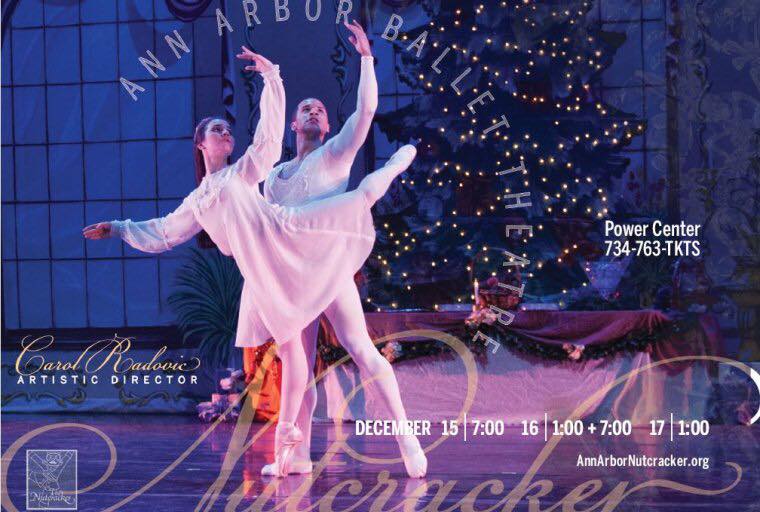
REVIEW: The Nutcracker – Ann Arbor Ballet Theatre

It’s always rather conflicting when attempting to indulge in the holiday spirit during the everlasting finals season. Time spent seeking out the festive spirit typically leaves one in guilt for time loss from studying. However, The Nutcracker was being performed on campus so this would be exempt! There were two different groups performing The Nutcracker on campus. So, I chose to see the Ann Arbor Ballet Theatre perform at the Power Center.

The opening scene takes place in the Stahlbaum Home on Christmas Eve. From the beginning, I noted that the acoustics could have been better given that they would need to compensate for not having a live orchestra pit. However during Act I, Scene I, I undoubtedly still felt the Christmas festivity transcending from an evening spent with gifts, sweets, and dancing around the Christmas tree. Unaware of the Ann Arbor Ballet Theatre and all of its members, I was utterly pleased to see so many young performers on stage. From ages perhaps as low as five years old to older teens, it was a sight to see so many young performers expressing themselves through theatre and dance.

Act I, Scene III, The Land of Snow, was a guaranteed crowd-pleaser. To my surprise, they had fake snow falling onto the stage! From the snowflake-like blue lighting and  background to the complementing snow fairy outfits and dances, this scene was aesthetically pleasing and beautifully accompanied by Tchaikovsky’s “Scene in the Pine Forest” and “Waltz of the Snowflakes.”

Act II: The Kingdom of Sweets, carries the bulk of the story and most rousing parts. During this, Clara and her newly gifted nutcracker arrive at his Palace high atop Sugar Mountain in the Kingdom of Sweets. (How could we not be the least bit of enlivened by a scene held in a place called The Kingdom of Sweets?) This scene is composed of several intensive and rather intimate waltzes that represent various ethnicities. To begin is Chocolate: a high-spirited Spanish dance. Next is the Arabian Coffee, a sultry, languid dance. Arguably, the most detailed and personal dances of them all with slow, thoughtful movements in sync with their partner. Coffee was the most expressive dance where the audience had the chance to analyze each intentional movement according to the music. In all fairness though, Coffee is the lengthiest and has the slowest tempo of all six dances, so this impression may be biased. Following Coffee was a much more upbeat, high-pitched lively and athletic Chinese inspired dance called Tea. To trump Tea’s lively nature, Trepak outperforms its predecessor with a much faster-paced beat in light of a Russian folk dance that is filled with bravura. To close out the divertissements, we are left with Marzipan, which in contrast, is a pas-de-trois, performed by three people — all followed by an appearance by Mother Ginger and her beloved Sugar Plums.

The curtains begin to close as Clara’s wondrous dream begins to fade while she finds herself back at home with only memories of a magical night. Upon the curtains closing, we are left with a matched feeling in comparison to the characters as we have followed along on their adventurous journey overnight and also come to a silent, peaceful close. Even in a wicked time known as “Finals Season,” time should be allotted for the holiday classic, The Nutcracker.

REVIEW: Violet

Looking for something to do to help you forget about the stress of exams and assignments this weekend?  Violet is the perfect musical to do just that!  The University of Michigan’s School of Music, Theatre, & Dance brought to life this story that has hilarious, beautiful, and heartbreaking moments interwoven in.  Even on a Thursday night, the audience was completely standing at the end after being left speechless.

Violet is about a young woman (Natalie Duncan) whose face was disfigured when her dad (Jamie Colburn) accidentally hit her with an axe.  She grew up her whole life with people staring at her scar, or even worse, refusing to look her in the face.  She finally decides to travel to meet a television preacher (Ben Ahlers) who she hopes will heal her scar.  Along the way she meets Flick (Justin Showell) and Monty (Charlie Patterson), two soldiers on the road.

Natalie’s voice couldn’t have been any more fitting for the role of Violet.  One must have a decent Southern accent and some killer vocal chords to captivate the audience; and she did just that.  The audience was laughing while she was singing “All to Pieces”, about how she wants her physical features changed up like those of celebrities.  They got chills during the strong performance of “On My Way” done by the cast.  And they sobbed during Violet’s solo of “Look at Me”.

I typically recommend shows here and there to see, but this one cannot be missed.  It is such a beautiful story with a cast who did not disappoint.  The expected, but still shocking, amount of talent in this show blew the audience away.

There are still three shows left at the Arthur Miller Theatre: 12/9 at 2pm and 8pm, and 12/10 at 2pm.  Tickets are $20 for General Admission and $12 for Students with ID.  More information can be found at http://tickets.smtd.umich.edu/single/EventDetail.aspx?p=3355.