REVIEW: Ryoji Ikeda’s superposition

Ryoji Ikeda’s superposition made me think about being human in a technology-heavy and science-driven world. And no, you don’t have to be a physics nerd to appreciate this performance (because I certainly am not). In fact, I’m going to focus on the non-scientific aspects of this performance.

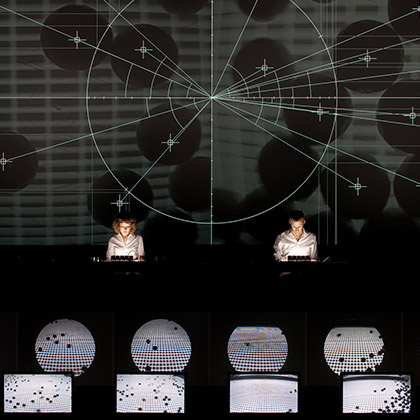
The stage set-up was pretty simple: 10 Mac screens in the very front, 10 slightly bigger screens a few feet back, and 2 big screens behind them all. In between, there was a table of equipments set up for the two human performers to add life to the work — playing morse code at each other, experimenting with different tuning forks, solving cryptic crossword puzzles, and so on.

The two human performers typed out messages that were impossible to process real-time, because multiple screens showed totally different messages. We can only focus visually on one aspect — what the performer is doing, what one (not both) of them is typing, or what is on the front screens. That’s human. As humans, we can’t do everything.

As humans, we sometimes find discomfort in scientifically-produced “music”. superposition explored the effects of using booming bass, almost inaudible low-frequency drones, piercing high pitch, clashing near-frequency notes. These cause mild physical pain and discomfort. Sharing these emotions make us human, too.

Another aspect of human-ness was in the pitch forks. In this segment, the two performers each took a pitch fork tuned to “A” — but with different frequencies, used in orchestras worldwide. The U.S. American standard is often A=440Hz, but in other countries, any frequencies from A=419.9Hz to 454.7Hz are possible (source: 10 small screens in the performance). And indeed, they sound different. The performers played two of these 10 differently-pitched tuning forks at a time, which cause the vibrations to clash against each other. This reminded me of how much tuning A can be a source of conflict between musicians. Even the difference between using A=440Hz or A=442Hz to tune can cause problems to orchestral musicians that are expected to play perfectly in tune all the time. These cultural differences and conflicts are very much human — computers can’t feel the anger and frustration that come with them.

But, in the end, what is the significance of this human-ness in today’s world?

The fun part of this performance was my attempt to figure out what the performance actually means. There is no definite answer. superposition asked me a very vague, open-ended question — what’s the humans’ role in a society where technology and science replaces a lot of our roles? Hashtag: food for thought.
REVIEW: Twelfth Night

“What was the most foolish thing you’ve ever done for love?” read sticky notes that adorned the Arthur Miller Theatre ticket booth. Equally creative, humorous, and heartbreaking, answers included “Dressed as a gentleman and pretended to be a eunuch,” and “Fell in love with a girl who was pretending to be a man.” If this sounds like Shakespeare’s comedic drama “Twelfth Night” to you, then you’re correct!

“Twelfth Night,” a play appropriate for Halloween with its disguises and mistaken identities, actually refers to the festival that traditionally occurs at the end of the 12 days of Christmas. On this particular night, well-off citizens would become servants and enjoy the “low-class” revelry, such as cross-dressing, copious amounts of eating and drinking, and un-Christian merriment. Likewise, servants would act as masters for “just a little while.” Keeping this in mind, Shakespeare drops his audience plop down in a world where people don’t act as society says they should. Love can cause blindness, danger, and also, hilarious situations.

The play, performed this past weekend by the Ann Arbor Civic Theatre, begins when Viola (Carol Gray) finds herself on the coast of Illyria, having survived a shipwreck that she believes has killed her twin brother, Sebastian (Richard Graham). She disguises herself as a man and calls herself Cesario in order to acquire work serving Illyria’s Duke Orsino (Greg Kovas). But, she soon falls in love with Orsino, who has ordered her to court Countess Olivia (Kaela Parnicky) on his behalf. Olivia, is in mourning and has refused to see any suitors for seven years, until Cesario comes and awakes Olivia’s lustful appetite.

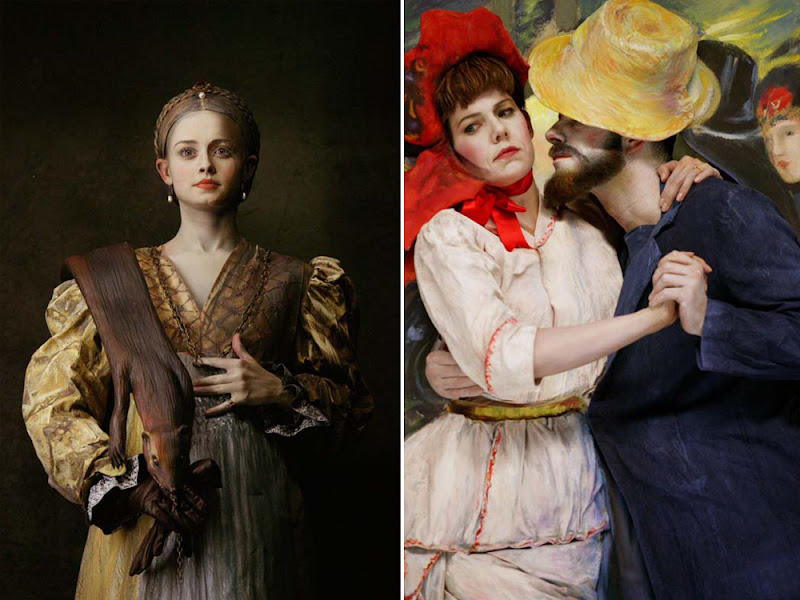
With such a complex web of many love triangles, you could easily find yourself drifting in and out as if you were lost at sea, waiting for a perfectly timed slapstick fall or jibe by the drunken Sir Toby Belch (Jeff Miller) or adorkable Andrew Aguecheek (Chris Grimm) to reel you back in to the plot. But director Kat Walsh and set designer Nathan Doud made the play visually accessible with the set design, especially with the use of tableaus. As the curtain raised up for the first time, we saw three large frames from which the actors exited or entered the stage. It looked as if we were watching a “living museum.” Think of the Museum of Living History from Gilmore Girls.

Image via kateofdiamonds.tumblr.com

The tableaus allowed the primary characters of the upcoming scene to be artfully displayed, as if in a painting, while others first spoke of them. It worked really well, especially given the play’s theme that there is always more than meets the eye.

Walsh made use of her actors’ musical talents: both Carol Gray (Viola) and Richard Graham (Sebastian) play violin, so they began the play with a harmonious duet. It must be a twin thing! Also, Dory Mead (Feste) sang with such power and sweet emotion that gave me goosebumps. Her songs were so beautiful and indeed almost characters themselves, despite their sometimes depressing and morbid themes.

The actors gave outstanding performances that dialed up feelings of pathos and joy, love and embarrassment; feelings that all humans have experienced and could relate to, as seen at the posting wall outside of the theatre, where audience members could write their own answers to the original question of “What was the most foolish thing you’ve ever done for love?” Walsh and her Ann Arbor Civic Theatre team have achieved the timelessness of Shakespeare. I can’t wait to see if they will try another Shakespeare in the future. If you’re interested in upcoming A2CT performances, check out their website: www.a2ct.org.

Review: A Street Car Named Desire – Young Vic Theater, London

16A02B1620424AF8A4A314481F759C83

This past summer, London was graced with a new staging of Tennessee Williams’ Pulitzer Prize winning play, ‘A Street Car Named Desire’ at The New Vic. The London production featured Gillian Anderson (The X-Files, The Last King of Scotland) as Blanche DuBois, Ben Foster (Six Feet Under, Lone Soldier) as Stanley and Vanessa Kirby (Insomniacs, About Time) playing Stella. The production was directed by Australian director Benedict Andrews.

This production of ‘Street Car’ was filmed and broadcast by National Theater Live to the Michigan Theater and theaters around the world.

‘A Street Car Named Desire’ has won acclaim in both its live productions as well as the iconic film starring Marlon Brando and Vivian Leigh. The cast of The Young Vic’s production holds up in the face of the historic accolades dished out to previous casts.


The play is set in New Orleans in Summer. Blanche DuBouis (Anderson), a fading Southern Belle, shows up unannounced at her younger sister Stella’s (Kirby) apartment, where she lives with her working class husband Stanley (Foster). Blanche is an unreliable narrator of her circumstances. She hides crucial piece of her past and the reasons for leaving her teaching job in Mississippi.

As Blanche laments losing her appearance and not having the interests of a man, all the while drowning her sorrows in alcohol, Stella takes care of her sister, allowing Blanche to criticize her way of life, her husband and her home, as Stanley becomes more suspicious and irritated by Blanche.

Eventually Stanley discovers Blanche’s secrets, her dirtied past as a disgraced woman who turned to selling herself to the pleasures of men. He confronts her and eventually, on the night Stella is giving birth to his child, rapes her. Blanche then completely falls apart and in the end is institutionalized. Stella seems to be aware of the rape but remains with Stanley out of fear and obligation to their baby.


The relationship between Blanche and Stanley in this production was one of curiosity, flirtation, disgust, fear and tension. Although the two seem to mistrust and loathe one another, there is an element of intrigue and desire reverberating underneath. Anderson skillfully kept the illusion of Blanche alive throughout the production. Her approach to shaping the plot and upsetting the relationships in place were so skillfully executed that the moment of fracture was a visceral experience.

Foster’s Stanley, the working class bread winner and abusive husband, charmed the audience while making them uneasy, waiting for him to lose his temper. Foster’s chemistry and physicality with both women was highly sensual and familiar, adding to the on-stage chemistry driving the plot.

Kirby brought justice to Stella, an often overlooked and somewhat forgotten character in this story. This Stella was not just background, she was an important element to be contended with throughout this story, not only as the battered, pregnant wife and sister, but as a young woman, deeply in love and managing the chaos around her. Kirby brought three dimensionality to Stella, a treatment the character rarely receives.

The set design, as well as acting, contributed to the intensity of this piece. The set was built on a rotating device, which slowly revolved throughout the production, giving the audience, sitting in the round, a constantly changing view of the action. There were no solid walls of the apartment, allowing for consistent visibility of the action in the two room apartment no matter the seat. Due to this transparency, the audience watched as actors showered, used the toilet and changed clothing. There was no privacy, bringing the audience into the experience the characters had sharing a two room apartment in the French Quarter of New Orleans.

Almost every piece of theater streamed into The Michigan Theater by National Theater Live has been phenomenal. These screenings provide a wonderful opportunity to experience professional theater without flying half way around the world.

The Next NT Live event at The Michigan Theater will be ‘Skylight’ starring Bill Nighy and Carey Mulligan on 11 December 2014.

article-2705848-200EA3D600000578-768_634x611

PREVIEW: Twelfth Night

Image via lolaslolz.wordpress.com

Do you remember in the 2006 Amanda Bynes movie, “She’s the Man,” Channing Tatum went off on a glorious inspirational speech that went like this : “Be not afraid of greatness. Some are born great, some achieve greatness, and others have greatness thrust upon them.” He was actually directly quoting a line from Shakespeare’s “Twelfth Night,” which the plot of “She’s the Man” was based on!

The original love triangle comedy will be performed by the Ann Arbor Civic Theatre, a community group that has stolen local hearts with past productions, like Shrek and Les Miserables. I’m very much looking forward to see if the troupe modernizes the Shakespearean classic or keeps it in its traditional form.

What: Ann Arbor Civic Theatre’s “Twelfth Night”

When: 10/30 -11/2 (8 pm Thursday-Saturday, 2 pm Sunday)

Where: Arthur Miller Theatre on North Campus

How Much?: Free with a Passport to the Arts; $11 at the door.

If you like to read up on Shakespearean plays before you go (which can be very helpful sometimes), I recommend a quick summary skim on Sparknotes. Or, better yet, just grab some friends and host a pre-play screening of “She’s the Man”!

REVIEW: Pirandello’s Six Characters in Search of An Author

Image via mlive.com

What would you do if you were a director of a play and six unknown figures show up on your stage, claiming to have been abandoned by their author, and beg to be characters (not actors) in your play? If you are already confused, then you are reading it correctly. Italian playwright Luigi Pirandello has written a “staged inception” where reality and fiction are constantly in battle, and seem almost interchangeable at times. The French theatre company Theatre de la Ville has taken Pirandello’s literary genius and has brought it to life with a full throttle of energy. The choreography between scene changes was fluid, almost balletic. The characters (played by the French actors) were expressive and experienced. They knew how to use their whole voice and body in every motion, every projection. For me, it almost didn’t matter how ridiculous the play in front of me was becoming – I was entranced by the beauty of the French and the collective imagination.

Although the play itself is quite innovative, experimental and sometimes difficult to follow, that was quite expected from simply reading the playbill synopsis, which was written as if it was a script itself. It was like we, the audience, had become characters cast in Pirandello’s piece to play the role of “AUDIENCE.” Yes…whoa…my exact thinking.

The only problem was the logistics of the subtitles. Because the play was performed solely in French, English subtitles were very necessary to even attempt to understand what Pirandello was trying to get across. But, unlike a movie, where your eyes can flutter peripherally from scene to text, the electronic marquis was so far above the stage that you couldn’t focus on both stage and screen at the same time. I always felt like I was missing either one or the other, and therefore, could not appreciate fully the humor and wit of the dialogue, nor the theatrical skills of the actors. Because this specific play is both visually and linguistically dependent, it would be beneficial for UMS to consider alternate placements for the subtitles in order to achieve maximum audience enjoyment and understanding. And UMS should not let language barriers or a little bit of absurdist literary theory stop them from trying again, because pushing the boundaries of the arts is what UMS does best. Just not pushing them too far that we can’t see the subtitles!


PREVIEW: Ryoji Ikeda’s superposition

Ryoji Ikeda’s superposition brings a Japanese visual and sound artist to prove that art and science can interact. As a part of UMS’s International Theater Series, Ikeda creates a show that combines “synchronized video screens, real-time content feeds, digital sound sculptures, and for the first time in Ikeda’s work, human performers.” (UMS.org)

Photo by Kakuo Fukunaga

When: Friday, October 31 at 8pm -and- Saturday, November 1 at 8pm

Where: Power Center for Performing Arts

Tickets range from $12-20 for students, with ID. If you are first-year or sophomore, you are eligible to go to an UMS performance for free thanks to Bert’s Tickets program. Read more about how to claim your Bert’s Ticket and/or use other Student Ticket deals here!