PREVIEW: Bat Boy, the Musical

Yes, Bat Boy. The School of Music, Theatre, & Dance will be performing the musical at the Arthur Miller Theatre, Nov. 15-18. This American musical was written by Keythe Farley and Brian Flemming with music and lyrics by Laurence O’Keefe. The plot is based on a June 23, 1992 Weekly World News story about a half-boy, half-bat, dubbed “Bat Boy”, who grew up living in a cave. It has never made it to Broadway, but succeeded for several years Off Broadway, winning several awards such as the Elliot Norton Award, the Richard Rodgers Development Award, and the Richard Rodgers Production Award. I think it’s going to be good, and it’s by the Musical Theatre school so, needless to say, expectations should be high.

Bat Boy the Musical
Bat Boy the Musical

Get your tickets soon!!

citations:
http://en.wikipedia.org/wiki/Bat_Boy:_The_Musical
http://events.umich.edu/event/9696-1171537

PREVIEW: God of Carnage

It seems that my tastes of late have been very French. First I reviewed Ionesco’s Rhinocéros, and now I’m tackling Yasmina Reza, another French writer. His play God of Carnage depicts an evening involving two children’s respective parents. The action is centered around a playground scuffle between the children in a public park; the pairs of parents meet to discuss the incident in a civilized fashion. Yet as the play progresses, the parents behave more and more childishly and soon we see just how quickly their pretense of civility falls away to reveal the chaos within. I’ve been told the play is uproariously funny. Best yet, and like all Basement shows, it’s free!

What: God of Carnage

Where: Walgreen Drama Center, Studio 1

When: 7:00, tonight, October 27

For more information, visit www.basementarts.org/

I would like to note that in my experience with Basement Arts, the audience isn’t as varied as it could (and should) be. I see mostly people from the theatre or musical theatre program there to support their friends, a few parents, and even fewer strangers. Basement Arts has provided free theatre to the University and its students for nearly a quarter of a century; I urge anyone who can attend this play, or future productions, to do so. Theatre is a vital part of the cultivated life, and what’s more, it’s great fun and an opportunity to get out and meet people!

PREVIEW: Monkeys and Playbills

Head over to Arthur Miller Theatre November 8-10 to see Basement Arts’ FREE performance of “[Title of Show]”. Basement Arts is an entirely student-run performance network on campus and their shows are always beyond one’s expectations. The show, [Title of Show], is super clever. It tells the story of four friends who band together to write a musical. The songs are great, the laughs are rich, and its a great time. I can’t wait to see the show and you shouldn’t either! AND IT’S FREE!

Title of Show
Title of Show

Hope to see you there 🙂
more info on their website: www.basementarts.org

REVIEW: Sunday in the Park with George

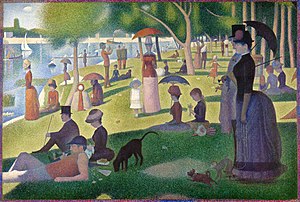
Friday night, I had the privilege of seeing “Sunday in the Park with George” as performed by the Musical Theatre Department here at the School of Music, Theatre, & Dance. The premise of the show is the story of Georges Seurat, the creator of the famed painting “A Sunday Afternoon on the Island of La Grande Jatte”. He struggles with success and criticism of his work in his time period, never having sold a painting during his lifetime. He has difficulties balancing work and his relationships with others and ends up losing his mistress and model, Dot, to another. George is an interesting character in a lot of ways. His concentration to his art and failure at succeeding at much else for one thing is quite perplexing and the attention to detail in his work is astonishing. The show mentioned also that it took him two years to finish the painting “A Sunday Afternoon on the Island of La Grande Jatte”. I thought the musical did a lot to represent accurately Seurat’s work habits and advanced concentration to his work.

The show was definitely a success, the actors and actresses, singing, and dancing was entirely up to par, as anticipated. Some standouts from the show include the actress performing the role of Dot. Her voice was absolutely phenomenal and she totally reminded me of Bernadette Peters, who played the role while it was on Broadway. The lead, George, was so good at mimicking a crazed artist, affixed in both his paintings and his work. He flitted around the stage, particularly in the scene “The State of the Artist,” where he hovered between appearing interested in potential investors and posing for photographs. It was a whirlwind of a scene and it played to his strong points.

The middle of the show, in all honesty, was sort of a snore. The three hour-long performance droned on and I felt bored with the nitty-gritty of the plot while the songs seemed to me rather dull. The first act was definitely better than the second, but it still wasn’t entrancing. I truly believe, however, that this was due entirely to the writers of the show and not the men and women of the Musical Theatre department. I think the show isn’t Sondheim’s best, but it is such a cool concept, basing the entire plot and musical numbers on a single painting and its artist – it’s worth portraying. I think with a few more crowd-pleasing numbers and less dialogue-heavy scenes, it would have worked better.

All was restored for me, including the immensely boring middle parts, when that final song “Sunday” was performed at the ends of both acts. It’s such a beautiful song and the melodies seem to flow directly from the heart. It has the usual Sondheim ring to it, finishing with a bang and a grand flourish of the arm. I loved it. And when the musical ended and the backdrop went white, Dot leaves the stage while George’s final word coincides with the emotions of the audience: Harmony.

I don’t believe I would recommend the show to a friend if it were inconvenient for them to see it; although, if it was right in your backyard with an amazing cast, I wouldn’t say no to a ticket. Glad I saw it, but glad it’s over. Can’t wait for what show they put on next.

PREVIEW: Sunday in the Park with George

This weekend come see the stunning U-M Musical Theatre department perform the beloved Sondheim production “Sunday in the Park with George”! Inspired by the painting “A Sunday Afternoon on the Island of La Grande Jatte” by Georges Seurat, this fictionalized story tells of this painter’s life and his interactions with his lover and model, Dot. The book is by James Lapine, who also worked on such popularized shows as “Into the Woods,” “Falsettos,” and “Passion.” He frequently collaborates with Stephen Sondheim and this show is considered one of their best (info from wikipedia.org)

“A Sunday Afternoon on the Island of La Grande Jatte” by Georges Seurat

The show is running October 11th-21st at the Mendelssohn Theatre – buy your tickets soon!!

REVIEW: Oh, a rhinoceros! From apathy to rebellion.

It’s always difficult to leave a play with a full sense of what you thought about it. The problem is compounded when you are met with an absurdist play, particularly when it is a monolith like Rhinocéros, filled with layers of meaning, humor, and pathos. This production, courtesy of the Théâtre de la Ville, left me with very conflicting, and yes, absurd, thoughts.

For those unfamiliar, the plot (such as it is) is thus: in a small French town (though admittedly the setting is never named), Bérenger and his friend Jean meet for a drink, when a rhinoceros passes by, running in a full-tilt rampage. The appearance of the rhinoceros is cause for much discussion and argument among Bérenger, Jean, and the other witnesses (each a kind of cartoon of a character). The argument leads to a near fistfight between the two friends, and no one seems to know anything more about the rhinoceros – even after a second one appears (or is it the same one?).

In the next scene, Bérenger returns to his 9-to-5 job at a law office. Everyone is reading newspapers, and discussion of the rhinoceros(es?) is still at the forefront. Some claim they did not exist, others swear to seeing them; but though nothing more is really accomplished, and Bérenger himself, so uninterested at the first sighting, now tries to prove that the rhinoceros was real. Questions, twisting of words, and belligerent challenges cause Bérenger to question not only whether he had even seen a rhinoceros, but the very nature of evidence. The world around him increasingly represents the question, “How can we know anything? Can we trust our senses?”; Bérenger increasingly finds that the answer is “Yes!” The ability to trust one’s own senses is vital if one is to keep one’s sanity, and the first freedom is the freedom to tell the truth as it is.

Meanwhile, the frenzy about the rhinoceroses begins to terrify Bérenger more and more. There is a moment which should have been comical, but which truly struck me dumb: in the office scene, as a rhinoceros rampages outside, everyone loses their head simultaneously and begins hopping about like wild chimpanzees. A moment later, they return to themselves, but the betrayal is irreversible; we’ve all seen the beasts inside the suits. When terror strikes, reason is the first to leave the party.

Everyone around Bérenger “turns” – even Jean, the last person he expected to – leaving him completely alone. Apathetic at first, Bérenger is forced first to confront the reality of the rhinoceroses around him, and then to take a stance. He is unable to join them, even though for a moment he desperately wants to. He is left no choice but to resist them – completely alone – and it is here that the play ends – with Bérenger’s inspiring and terrifying declaration: “I’m not capitulating!”

Ionesco’s play, while originally an allegory for the rise of the Nazis, is a chilling reminder of that most inescapable part of human nature: humans will always pay attention to disruptive things, even if they are also destructive. The temptation to join in the destruction is irresistible for most (think mob psychology). What is terrifying is that each person’s reasons for turning into a rhinoceros (or, joining the Nazis) were, on the surface, perfectly reasonable: loyalty to one’s husband, loyalty to one’s colleagues, “keeping up with the times,” etc. Only with hindsight does one feel the horror of how easy it is to convert.

This production, located at the Power Center, was very impressive in several ways. First, the ensemble deserves quite a hearty round of applause for their synchronization. Actors are illusionists, and having played Jean once in a production of Rhinocéros, I can confirm that the illusion of a rampaging rhinoceros in the town square is one of the trickiest scenes to stage I know of. Certainly this show was visually striking – I couldn’t help noticing that everyone looked miserable in their stuffy suits. Bérenger, though unkempt, anxious, and bewildered, seemed the sanest and freest person in the play.

The last thing I wish to remark upon is the use of actual rhinoceros head puppets, each so large that they cover more than half of the actor holding them up, and all exquisitely realistic. Held up at various levels and behind a scrim, swaying ominously, and lit so that only the head of the whole “rhinoceros” was visible, each rhinoceros seemed terrifyingly real, ready to charge out of the darkness. Moments such as that made me understand viscerally the anxiety that Bérenger suffers.

The absurd makes us laugh, but it is also a harbinger of horror; in reason we find security, but in Rhinocéros, neither reason nor the absurd offers us any hope. There is only fear; there is only confusion; there is only destruction.

It is truly a pity that Rhinocéros played for only three nights at the Power Center; I would have loved to see it once more, to wrap my head around it a little more. In the meantime, I would suggest that theaters around the country produce more plays from this unconventional yet powerful genre. Absurdism is startlingly underrepresented, and it has so much to offer, even if it doesn’t leave us with that “feel-good” sense of closure when the curtain falls.

So hats off to the Théâtre de la Ville, and to UMS for bringing them to Ann Arbor. And the next time you see a “rhinoceros,” reflect: is apathy an option?