Review: The Music of Studio Ghibli

Photos are provided by the Ann Arbor Symphony Orchestra

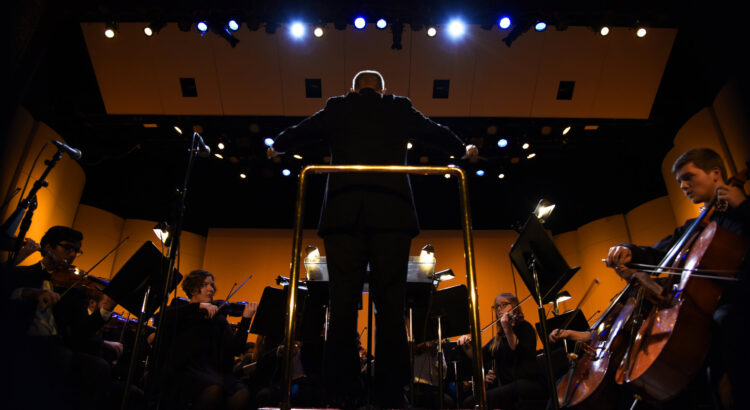
On Saturday, March 15, and Sunday, March 16, the Ann Arbor Symphony Orchestra gave their highly anticipated performance of The Music of Studio Ghibli under guest conductor Wilburn Lin at the Michigan Theater. The program consisted of music all composed by Joe Hisaishi, including the Symphony Variation: Merry-Go-Round/Cave of Mind (from Howl’s Moving Castle, 2004), Orchestra Stories: My Neighbor Totoro (1988), Kiki’s Delivery Service, and Spirited Away. 

Howl’s Moving Castle is one of my favorite Ghibli films, so I was delighted that its music opened the night. Because Merry-Go-Round of Life is an incredibly iconic piece and so well-known, I was a bit afraid that the performance would deviate from the original score or lack the same musical satisfaction. However, the orchestra’s rendition was beautiful. The canonic melody seamlessly weaved between the different string and wind instruments, and I particularly liked the pizzicato variations from the strings. My only complaint is that it could’ve gone longer, though I might be biased because I love the piece so much. Though the next part of the variation, Cave of Mind, is a piece I don’t often listen to, I got goosebumps because the brass solo makes it a hauntingly beautiful piece, and I could vividly recall the exact scene where this soundtrack is played during the concert.

The performance of Orchestra Stories: My Neighbor Totoro was interesting because the orchestra decided to add Japanese narration, spoken by Momo Kajiwara, to further enhance the storytelling. To be honest, I don’t love this movie because I don’t find the plot to be that engaging, but this addition made me see the film in a different light. The narration was splitinto eight different sections that summarize the movie’s plot with an English translation provided in the program, and it helped paint the innocent and mystical atmosphere of the movie for those who were unfamiliar with it. Furthermore, I love Totoro as a character, so I found it endearing that there was also someone dressed as Totoro to take pictures with.

The next feature was Kiki’s Delivery Service. I was taken aback by how short the piece was (or maybe I just found it so enjoyable that I got lost in time). Nevertheless, the performance of Kiki’s Delivery Service stood out to me among the rest of the program because of the concertmaster spotlight. The violin solo’s melody differs from the main theme, making it a fun addition to the piece as a whole, and the concertmaster played with a beautifully pure and clean tone.

The night then concluded with the Spirited Away Suite. Spirited Away is one of my favorite Ghibli films alongside Howl’s Moving Castle, so I was blown away by how similar the orchestra’s rendition of Spirited Away was to the original soundtrack. Furthermore, the gorgeous and somber piano melody further enhanced the quality of the music. 

Overall, I loved this concert. It was my first time getting to see the Ann Arbor Symphony Orchestra perform The Music of Studio Ghibli, and it will most definitely not be my last.
REVIEW: Stefan Jackiw Plays Tchaikovsky

Photos are provided by the Ann Arbor Symphony Orchestra

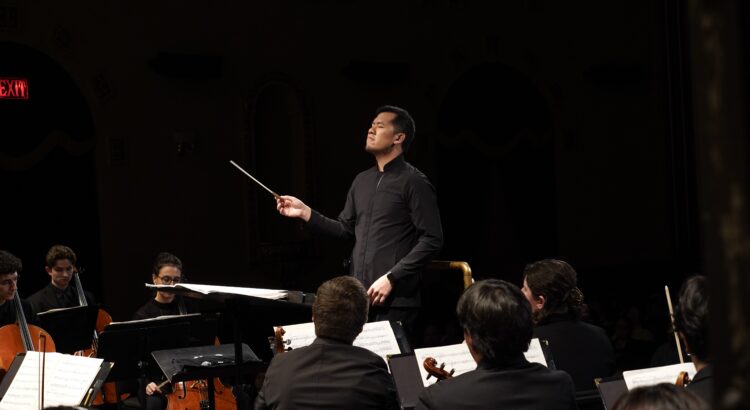
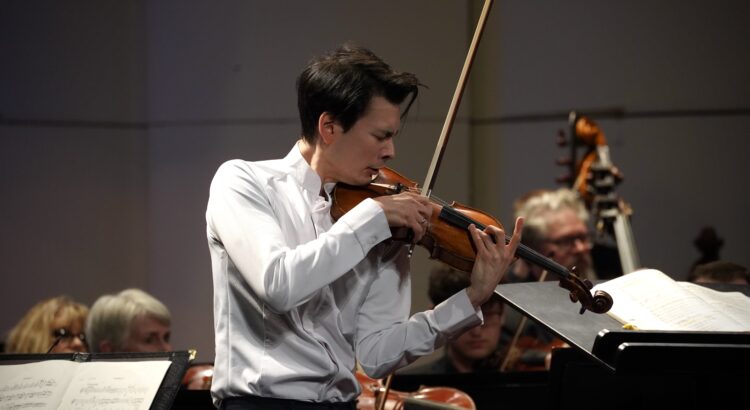
The Ann Arbor Symphony Orchestra’s February 2025 MainStage took place on Saturday, February 22, at 8 PM in the Michigan Theater, and alongside performing Montgomery’s Overture and Shostakovich’s 10th symphony, theyaccompanied violinist Stefan Jackiw who gave a phenomenally clean and vibrant performance of the Tchaikovsky Violin Concerto in D Major.

The Overture was the first piece in the program. It was my first time hearing Jessie Montgomery’s Overture, but it was incredibly enthralling. The piece opens with strikingly dissonant chords played by the entire orchestra that serves as a unique melodic line. These chords continue to be the main feature before the violins begin to take over with faster-moving notes that are then accompanied by changing chords in the brass instruments. Overall, it was a piece that can be largely described as a musical cacophony and served as a great introduction before moving on to the brighter melody of the violin concerto, which was the highlight of the night.

Similar to many other members of the audience, Tchaikovsky was the main reason why I wanted to attend this concert, as it’s one of the most famous violin concertos. The concerto’s grand melody truly makes the violin sing, which requires the soloist to have a high level of technique. The first movement, Allegro moderato, opens with a gentle melody from the orchestra that slowly builds up to the soloist’s entrance, which is low and soulful and evokes a sense of yearning that Jackiw’s strong vibrato captured perfectly. As the melody continues to ascend in pitch, its playful character grows and flourishes with runs before once again blending into a more soulful tune. I particularly admired Jackiw’s ability to bring out a full sound during each note no matter how short while using the full length of the bow, which requires accurate control of the bow’s weight with your hand. 

The second movement, Canzonetta: Andante, similarly opens with a slower-moving melodic line from the orchestra. However, the soloist’s entrance remains somber and slow for the majority of the movement, a tasteful contrast to the preceding flightful first movement. 

The opening of the third movement, the Finale: Allegro vivacissimo, is then startling. The orchestra is silent as the soloist’s part features strong, rich chords that Jackiw still manages to play with a clear and bright tone. He retained this brightness throughout the whole concerto, which was especially impressive during the last movement as it’s twelve minutes long, and it’s many character changes. The last section of the finale which consists of fierce spiccato was especially impressive, and spectacularly concluded the end of his performance.

Though I love Shostakovich, it was hard to imagine how the last piece of the program, Shostakovich’s Symphony No.10 in E minor, would make for a more satisfying conclusion to the night than the Tchaikovsky. The Moderato begins somberly slow, but the second movement, the Allegro, picks up and starts to set a frantic, anxious atmosphere that often comes with Shostakovich’s music. The character of the piece was fleshed out even more once the short, staccato notes opened the third movement, the Allegretto. Though the mood this piece evoked was much more different than the Tchaikovsky—much less cheerful—the ending of the finale was just as grand with fast notes from the violins and loud chords from the brass.

Overall, I enjoyed this concert. I am so happy I got to hear the Tchaikovsky Violin Concerto live, and Stefan Jackiw did an amazing job at bringing the piece to life. Though he’s a soloist I hadn’t heard of before I’ll keep an ear out for him moving forward.


REVIEW: The Government Inspector

Photos are provided by Peter Smith Photography

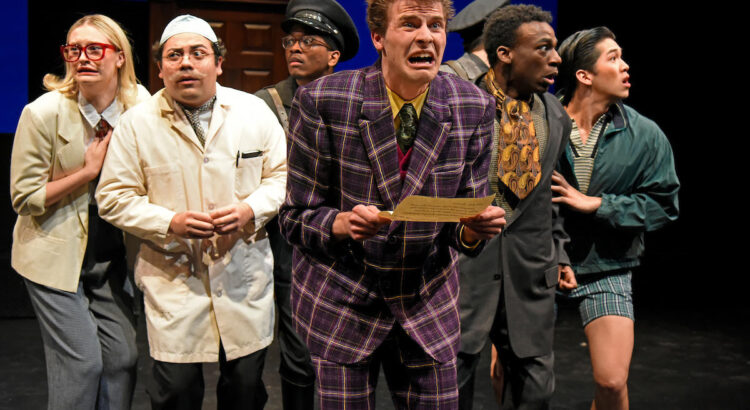
Directed by Malcolm Tulip from February 20-23 at the Arthur Miller Theatre, students from the School of Music, Theatre, and Dance performed Jeffrey Hatcher’s adaptation of the musical The Government Inspector by Nikolai Gogol. Though I was disappointed by the lack of singing and dancing in the production that typically characterizes a musical, it was still enjoyable to watch because of the goofy characters and comedic plot twists. In addition to the great acting, the outfits and set design further added to the immersive setting and made it a satisfying experience.

The plot takes place in a small Russian town in the 1830s. When the greedy and corrupt mayor, Anton Antonovich (played by Fabian Rihl), realizes that a government inspector has come for a visit, panic ensues as he and other high-ranking residents such as the judge, hospital director, and school principal attempt to win the inspector’s favor and cover up their misdeeds. However, their efforts are in vain due to mistaking the inspector for another visitor, Hlestakov, who relishes in their attention and money while continuing to hide his true identity as a depressed, low-level servant.

Though there was a short musical number introducing each character at the beginning, it was hard to keep track of them all because of the vast number of characters and their Russian names. Nevertheless, my favorite part of the musical was the characters. I loved the character dynamic between Hlestakov, played by Sam O’Neill, and his servant, Osip, played by Vanessa Dominguez. Hlestakov’s pathetic personality accompanied by Osip’s cold-hearted demeanor made them a hilarious duo. Similarly, I also loved watching the hospital director, played by Christine Chupailo, and the doctor, played by Gabriel Sanchez. Because the doctor didn’t speak the native language, the comedic timing of their messy dialogue made me laugh throughout the whole musical.  

I particularly enjoyed watching the chaotic interactions within the mayor’s family. The mayor and his wife have a tumultuous relationship with each other and their daughter. However, Hlestakov’s arrival adds fuel to the chaos as he begins to get romantically involved with the mayor’s daughter, Marya Antonovna, and his wife, Anna Andreyevna. Student Nova Brown’s portrayal of Anna was especially amusing because of Anna’s bold flirting and her promiscuity. Furthermore, it was interesting to see how their indifferent daughter, played by Kristabel Kenta-Bibi, flirted with the mayor in comparison. 

Overall, though I wish there was more music involved, I highly recommend seeing this show. The unique characters and satirical plot made the whole audience laugh, yet it was still able to highlight the consequences of human greed and stupidity.

REVIEW: The Turn Of The Screw

March 28 | 7:30 | The Lydia Mendelssohn Theater


Slightly haunted, challenging and contemplative— The Turn Of The Screw is a properly spooky ghost story. The novella by 19th-century writer Henry James is a piece of gothic fantasy best known for its adaptation into the opera by English composer Benjamin Britten and librettist Myfanwy Piper.

The eerie disposition felt akin to Sweeney Todd’s dreary Fleet Street or last season’s Elizabeth Cree at SMTD. Britten’s work features just 6 voices from the Department of Voice and Opera and 13 instruments in the orchestra.

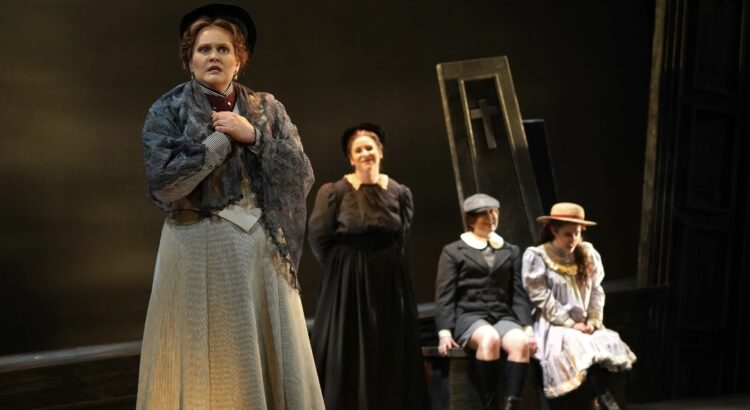
We arrive at a remote country house in East England at the turn of the previous century. A young governess (Christina Parson) is hired to care for two children, Miles and Flora (the lively Haley Hunt and Francesca Herrera), alongside Mrs. Grose (Danielle Casós), the housekeeper. As time passes, the Governess becomes convinced that the house is haunted by malevolent spirits of a former servant, Peter Quint, and governess, Miss Jessel (played respectively by Alexander Nick and Jennie Rupp, an earth-shattering soprano). Her obsession with protecting the children intensifies as the line between reality and delusion blurs, leaving the true nature of the threat ambiguous.

Christina Parson as The Governess.

Christina Parson (the Governess) sparkles musically and dramatically, as if the score was written for her. She seldom leaves the stage during the performance, proving a role made for a seasoned soprano with stamina. Her journey is emotional, as she challenges paranoia amid her deep compassion. Parson crafts a beautiful arc for this character, especially as the erratic feelings intensify.

The ambiguity feeds into the tense storytelling, sonically and dramatically, making it the true enchantment of the piece. This opera succeeds on its intellect and the brilliance of the performers. The cast of six performs with a vocal maturity far beyond their years as well as cultivates the most dramatically satisfying opera I’ve seen at the University: the chemistry of Herrera and Hunt was joyful, and Rupp and Nick were a chilling duo onstage. Ms. Casós has enjoyed many fantastic performances in University Operas over the years, and her elegant Mrs. Grose was no less enchanting.

This score is unlike that of Mozart or Puccini—Britton’s score feels more like a soundscape than a dramatic statement. It houses some evocative nostalgia but doesn’t give the audience a memorable tune to carry out of the theater. Though Myfanwy Piper’s libretto is full of vitality, young Miles’ deathly call, “Malo,” still echoes in my head.


Image thanks to Univ. of Michigan SMTD.

REVIEW: Pops en Pointe

April 19 | 7pm | The Michigan Theater


The Michigan Pops is one of the most beloved student organizations on campus—and don’t ask me. Ask any one of the hundreds of attendees at the Michigan Theater on April 19.

Founded in 1995, the Michigan Pops brings talented musicians from across the University Campus to perform a concert each academic semester. The orchestra is led by music director Luca Antonucci, and associates Nicholas Bromilow and Francisco Fernandez, three fierce Doctoral Conducting students from the School of Music.

“Pops En Pointe” discovered a selection of repertoire surrounding dance (if that wasn’t completely obvious from the title). The first pieces were the non-negotiables in the dance-related classical canon, including Brahms’s “Hungarian Dance No. 5” and Tchaikovsky’s “Nutcracker Suite”, in which a touching “Waltz of the Flowers” warmed my heart. Auruto Marquez’s fiery “Danzón no. 2” featured striking solos across the ensemble.

If you know Pops, they aren’t without their fun. Instrumentalists introduce pieces in mouse hats or bird costumes. They accompany full-length selections with silly videos made by members of the ensemble. And host a mini game show onstage with members of the audience mid-concert. Quirky, engaging bits (that are often too long) are always a memorable part of the Michigan Pops experience.

The slightly underwhelming but charming DJ’s A Cappella group performed selections from ABBA’s “Mamma Mia” after intermission. This is not the first time I’ve heard the Michigan Theater’s sound system being unsatisfactory for vocalists. With boomy mics and offset balance, this performance was no different, washing the voices. Some solos remained intact, but were delivered somewhat unexuberantly, perhaps inhibited by the sound constraints.

The Michigan Pops hosts an annual concerto competition for high school students. This year, stunning young cellist Trevor Nelson from Huron High School was the recipient. He performed a cut from Camille Saine-Saëns’ “Cello Concerto No. 1 in A Minor”, a beautifully dramatic and declamatory piece. A gifted and humble performer, he plays for the Michigan Youth Symphony Orchestra and has brought his musicianship around the world to Spain and Toronto.

Pavani Anand, the Executive Director of the Michigan Pops, closed the concert with a heartfelt speech about her relationship to the cello and her mother, who encouraged her throughout her youth. Equally, her speech emphasized the defunding of arts organizations across America.  Her call to support live music comes at a crucial time as the National Endowment for the Arts (NEA) recinds hundreds of grants to major arts organizations across America.

Music gives us the facility to dance and bring communities together, and without it, who are we?


Photos thanks to The Michigan Pops.

REVIEW: John Splithoff at The Ark

Last Wednesday, I went to The Ark as a fan of the opener and left with a newfound appreciation for live music. Singer-songwriter and multi-instrumentalist John Splithoff brought his signature charisma and soaring vocals, filling the venue with energy and soul.

Splithoff, who first rose to fame in 2016 with his hit “Sing to You,” released his newest album, Far From Here, this March. A reflection on the chaos of a busy, ever-changing life, the album drew many first-time concert goers to The Ark, something Ark staff confirmed with a quick show of hands.

What drew me, though, was opener Evann McIntosh. After going viral in 2019 with the dreamy track “What Dreams Are Made Of,” the now-21-year-old has only sporadically released new music. At the Ark, they and their guitarist performed mostly unreleased material. Personally, I am now looking for it to be officially released; there were several songs I would love to add to my playlist. Despite a few awkward pauses between songs, McIntosh’s buttery-smooth vocals kept the audience engaged. A clear standout was “Blue Movie Magic,” their newest single, released just a week prior.

McIntosh’s chill, groovy R&B set made for a smooth transition before Splithoff and his three-piece band kicked things into high gear. He burst on stage to roaring applause, dancing his way to the mic. Though not his first time at the Ark, it was his first performance there since releasing “Far From Here,” and he was back with a vengeance.

There are moments when you’re reminded that some artists simply love music — and Splithoff embodied that joy. You could tell that he was having the time of his life up on stage, flexing his musical chops and showing off his talent. Between impressive vocal riffs and leading crowd call-and-responses, he effortlessly switched between guitars and keyboard, never missing a beat or a note.

But Splithoff made sure that his band also had their time to shine, with solos from the drums and keyboard alongside backing vocals from the bassist.

His set mixed fan favorites with new tracks, including a beautiful moment during “Kyoto Snow” when he asked the crowd to light up the room with their phone flashlights. The performance revealed his stylistic range, flowing from soulful ballads to upbeat, synthy pop. He even worked in a few Ann Arbor-specific ad libs, nodding to the city, the popcorn in the crowd, and Midwestern family values.

One of the most charming moments came during a story he shared while seated at the keyboard. Earlier that day, he ran into two fans in line at Frita Batidos, an Ann Arbor staple, who had driven from Canada just to see him. They asked him to play “Steady,” and he did. After closing with his biggest hit, “Sing to You,” he returned for a heartfelt encore and played another fan request, “Paris.”

Splithoff lit up The Ark, making the small venue feel expansive and electric. His return to Ann Arbor marked both a milestone in his career and a true celebration of live music.John Splithoff is touring with Evann McIntosh through May.