Review: Macbeth… I mean…. The Scottish Play

My apologies for this rather belated review of National Theater Live’s (NTL) stream of Macbeth at The Michigan which occurred on Sunday the 27th of October.

This is the third performance Michigan Theater has streamed from NTL in London. This was my least favorite. There were some elements I appreciated but over all it was a disappointing performance. Although this production starred Kenneth Branagh as the Scottish king and Alex Kingston as Lady Macbeth, and was directed by Rob Ashford and Kenneth Branagh, staged in an abandoned church and ran with out an intermission, there were many problems.

Personally I am not a fan of Kenneth Branagh, he always comes across as a highly arrogant and self important person, no matter the role he play. Granted many of the roles he has played, Gildaroy Lockhart (Harry Potter) and Hamlet, are considerably narcissistic characters. However, I find him to be an unappealing actor.

Alex Kingston did a lovely job as Lady Macbeth. Although she seemed to have a little problem with over-acting at times.

The staging of this production in an abandoned church was the best choice made by the artistic director. The aisle was the stage, covered in earth which became muddy from the rain which fell from the ceiling during scene 1 act 1, effectively creating the feeling that we were in the Scottish highlands.

The actors abandoned Shakespeare’s essential iambic pentameter, which was an odd choice. Sometimes the rhythmic speech indicative of this style can detract from the story, I didn’t find it to be a bothersome artistic choice in this case. However, the ernest delivery of EVERY SINGLE LINE was rather annoying. There wasn’t much difference in speech where something banal was happening, and those where someone was murdered or murdering. Rather tiresome.

There were a good number of sword fights in this play. They were stiff and over-rehearsed. I can appreciate the difficulty of this kind of physical acting and staging, but at this level of professional theater, I expected better.

Last, but certainly not least, the filming… oh dear god the filming. For some reason the videographer decided to get creative with the arial shots. Considering the live audience would never have had an opportunity to see the production from that particular angle, this was an unfortunate choice.

By the end, we all had to pee. You would have too if you’d sat through close to 3 hours of Shakespeare right after dinner. Coming into this production I didn’t expect great things, due to my dislike of Kenneth Branagh. I left having my minimal expectations met, which is shocking because this production was well received and reviewed when it was on stage earlier this year.

So it goes.

REVIEW: Chrome Sparks, Man vs. Indian Man, & Solar Year @ The Blind Pig

I walked down the cold, windy streets of Ann Arbor at 10 pm, unsure of what to expect at the Blind Pig. Although I enjoy listening to music and my library consists of thousands of songs, I would never consider myself a music aficionado. Unlike my roommate, I do not divide and subdivide my genres into obscure genres like spacesynth and chiptune; and if my library was lacking in any department, electronic was definitely one of them. Fortunately, the concert was not only a perfect opportunity to delve into electronic music, it was an example of the atmosphere and people that also listen to the atmospheric sounds of the genre.

Before going to a concert I like to “research” the headlining artist’s discography, but not the opening acts. Everything about them is completely new and unbiased. Man vs. Indian Man’s gig was only their second time playing a concert. When Jeremy announced this at the beginning of his act, I was shocked: what Man vs. Indian Man (MvIM) lacked in musical innovation and set list, they more than compensated with stage presence. Lead singer Clavius Crates molded his style along with the crowd, picking up maracas and other similar instruments as he pleased, dancing and gyrating to the beat, giving and taking energy to and from the ravers in the middle of the crowd. MvIM’s music began slow and deliberate, then gradually increased until it was impossible not to be swaying and bobbing to the beat. Overall I was pleasantly surprised by the first opening act.

After MvIM’s performance, Solar Year was a bit of a letdown. In retrospect, their cool tones and lumbering sound would have been good as a standalone opening act, but they did not work well as a bridged between MvIM and Chrome Sparks. At the same time, a video of the palace combined with the repetitive melodies and voice modulations were effective—it’s a shame they performed when the crowd was energized.

Chrome Sparks simply stood above the others. When Jeremy stepped on the stage and played the first two songs I noticed two things: a confident stage presence and a polished sound. In my mind, these are the things that help distinguish an established artist from amateurs or up and coming groups. Each song was lush, complete, and complemented by a series of videos on the backdrop. As a film enthusiast, I was especially touched by the editing and how it related to each track. Clips from old movies, historical footage, bizarre shapes, funky colors, everything. On top of that were the lights working their magic and the crowd of people dancing to the beat. This was how you experience music. My personal highlight was when Chrome Sparks played their hit song Marijuana. So much energy, people, and music.

Chrome Sparks at the Blind Pig

Review: Basement Arts – No Exit

Basement Arts, an awesome organization on campus, produced the play No Exit by Jean-Paul Sartre. The performances were on Thursday at 7 PM, on Friday at 7 and 11 PM and Saturday at 7 PM. All the performances were free and held in the Walgreen Drama Center. The performances were pretty well attended, as Basement Arts shows usually are. The Director was AJ Kolpach, Assistant Director, Alison Hacker, Stage Manager and Lighting, Jake Meyers, Set Designer, Daniel Estrella, and Sound Designer and composer, Samuel Johnson.

No Exit is an existential play, originally in French, in which two women, Inez and Estelle, and one man, Garcin, are escorted by a valet into a locked in a room where they remain together for all eternity as their hell. The most famous quote from the play, “Hell is other people” summarizes the entire plot. Plagued by the mistakes made when they were alive, and unable to find peace in the room due to their inherent flaws, the characters Garcin, Inez, and Estelle, reveal their biggest transgressions on Earth and, after an hour and a half, reach an impasse in their interactions with each other, revealing how they will remain stuck in an impossible dynamic with each other for all eternity.

Garcin was played by Aaquil Rowe, the Valet by Mingquan Ma, Inez by Nicole Gellman, and Estelle by Cayley Costello. Costello was by far the best actress. Her character was a social climber who had married an old, rich, man after her parents passed and was in hell for drowning the child she had with a lover. In the room, she is tormented by her need to feel desired by men. Costello did a great job of making her character vulnerable, high society, and really captured how worthless Estelle felt without validation. Aaquil Rowe was very passionate as Garcin, a pacifist who deserted the war, and abused his wife. Garcin was tormented by the idea that anyone would find him a coward, and is unable to physically love Estelle until Inez stops thinking of him as a coward. He was very expressive but flubbed his lines a few times.

No Exit
No Exit

Nicole Gellman did a good job of playing the sarcastic, cruel, lesbian, Inez, although the character seemed a little two dimensional, although that is not necessarily Gellman’s fault. Inez enters the room ready to admit to the murder she committed and fully realizes the point of the room and pits Garcin and Estelle against each other, which means, by the end of the play, the character has not really grown. The Valet, Mingquan Ma, was ok, although his diction was a little unclear.

The set on stage was a bit sparse, but still succeeding in creating the scene, with two couches, one chair, a door, a mantle, and a styrofoam bust. There was only one set issue which really brought the audience out of the moment. There is supposed the “unmovable” bronze bust on the mantle but it clearly moved and shifted around the mantle whenever anyone touched it. Original music was also created for this production by Samuel Johnson. Most of the background music was fine but there was one song sung by Inez which seemed out of place and did not have much to do with any of the characters.

Overall, Backstage Arts is a great organization on campus. This particular production was fine, anyone would have had difficulty with such an unusual play. Everyone seemed to have tried their best to make this existential play relatable and down to earth. I look forward to the next Backstage Arts production.

If you want to get involved, here are some links:
Basement Arts: Facebook
Basement Arts

REVIEW: The Table, by Blind Summit

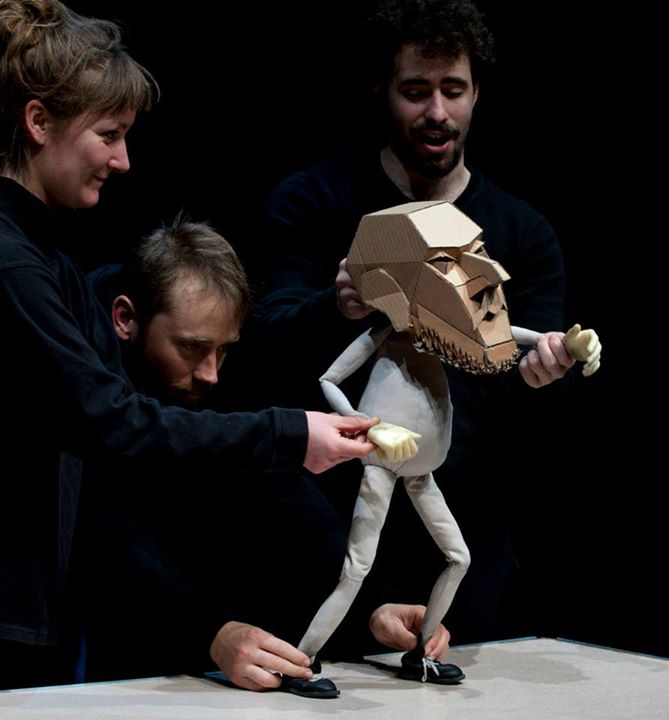
One politically incorrect British puppet, one sturdy American table and three improvising puppeteers. As our Bunraku puppet hero points out, no expenses were spared in the making of this evening.

It’s a show – about a puppet – on a table.

As the puppet keeps reiterating at the beginning, that’s really all that happens in the 70 minutes of this show. And what’s impressive is that it actually works.

So many productions nowadays on TV, film, or even theater emphasize the spectacle element with special effects overloading the senses of the viewers. Instead of aiding the storytelling process, the effects take front and center while the story is relegated to the back burner. The Table by the Blind Summit Theater is a welcome departure from this trend, exploring the basics of storytelling and what it means to be human using only the bare necessities.

The basic premise is that our protagonist puppet is undergoing an existential crisis because “all [he] gets asked to do are birthday parties and reenactments of some folktales set in Eastern Europe!” Our puppet wants people to know that he’s got dreams; he just doesn’t know what they are. So when a London-based Jewish organization tapped him to enact the life of Moses, our puppet was more than happy to comply. This is where the show gets its Bible inspiration—throughout the show, we return loosely to points of Moses’ life, but we never stay there for long.

What the show really turns out to be is an investigation of what it means to be alive. The puppet is quick to point out that “[he’s] not actually alive—it’s just a series of intricate movements!” In one of my favorite sequences of the show, the puppet and the puppeteers demonstrate what exactly these movements are, and how they can manipulate them. At one point, our puppet even demands his operators to lie him down (it’s okay, he’s a professional, he won’t die) and the puppeteers comply. We see that our puppet can still exist without a direct physical component—in fact, losing his ‘body’ is almost a liberation of sorts, freeing his existence from many physical restrictions. In a snap second he can change his size and do crazy contortions, which makes for a very interesting picture when the physical puppet is lying down on a side of the table yet his presence is still on the stage.

Of course, it’s the three puppeteers who make all of this happen. One takes his bum and right arm, another person takes his feet and the third puppeteer voices him and moves his head and left arm. It takes three puppeteers to bring one puppet to life, and it’s amazing how it’s all done in improv. At one point in the show, because one of the puppeteers are “busy in the bathroom,” the company asks one of the audience members to come down and replace him; even with this new element, the puppeteers make the illusion of life quite convincing. It shows how intricate their collaborative process is, involving acting upon and interacting with each other’s movements.

They’re not shy to reveal that they’re just following three basic rules—focus, breathing, and fixed point. Focus refers to what is being looked at on the stage; by the puppeteers keeping their eyes on the puppet throughout the show, the audience in turn is forced to focus on the puppet and makes him come alive. Breathe in—hold—breathe out; breathing serves as the basis of all movements, so all of their actions are based on the process of breathing. Fixed point is similar, but it refers to the organization of movement.

So there’s really not that much to recreating life on stage, which is what theater is supposed to do. Just three basic rules, that’s it. And life too—in one of my favorite moments of the show, our puppet pulls himself together in the midst of a breakdown by reminding himself to focus and to breathe in, hold, breathe out. Sometimes it’s so easy to get bogged down by the weight of your own existence or just life itself, but nothing’s really that complicated—just focus, breathe in, hold, breathe out. Huh. Even I didn’t realize that this show had such a semi-deep message; it just kept me laughing for 70 minutes. That’s the magic of this show—that it’s so approachable and at the same time, funny—and it certainly fulfills what Blind Summit sets out to do: “presenting new puppets in new places in new ways to new audiences, seeing puppetry as a radical part of the reinvention of theater in our time.”

REVIEW: In a World…

1982 Barbara Kruger
1982 Barbara Kruger

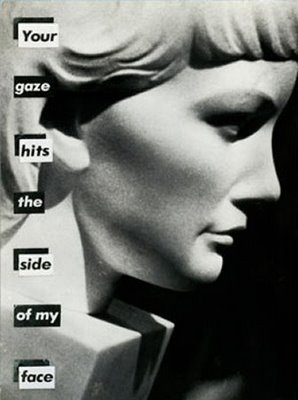
“Your gaze hits the side of my face,” in her 1982 piece, artist Barbara Kruger explores the male gaze through this iconic photograph. Throughout the last century, much has been said about the relationship between feminism and being seen; Kruger interprets the male gaze as an aggressive force that adds a layer of meaning to the classically beautiful form of the face seen on the piece.

We as a society often discuss the power relations regarding sight and the perception of women. Lake Bell’s directorial debut “In A World…” spins a slightly different take on the subject, dealing with the male voice in place of the male gaze. Think of all the movie trailers you’ve seen—“In a world…” rings a deep, bass, male voice. The protagonist Carol (played by Lake Bell)’s father (Sam Soto) is one of the most prominent voices in the industry, a guy who has his own autobiography, a lifetime achievement award and even a band of faithful groupies. And of course a misogynistic set of values and a complete bag of insecurities can’t be left out.

Carol is a vocal coach and aspiring voiceover artist hoping to break into the male-dominated field someday. Her father advises her to just concentrate on the accents that she does so well, because people just don’t want to hear female voices on trailers—“it’s not being sexist, it’s just the truth!” In an interesting turn of events, Carol catches a lucky break when Sam’s heir apparent Gustav Warner flakes out on a trailer due to a sore throat. After successfully stealing his gig, Carol starts getting attention from film producers, including one for the new epic movie ‘The Amazon Games’. The movie is gathering attention because it plans to bring the ‘In a world…’ trailer back; now the attention is on whose voice will utter those iconic words.

[Spoiler Alert: This paragraph will discuss the outcome of the epic trailer voiceover battle]

All is revealed at the awards ceremony at the end of the film, perhaps the most interesting scene in the movie from a dialogue perspective. Two conversations give the movie’s feminist take a deeper twist—the first is the bathroom conversation between Carol and the Amazon Games producer. Notice how it’s placed in the bathroom? These two female figures in a male-dominated world are talking in a male-prohibited space after hearing Carol’s voice emerges victorious in the epic voiceover battle. A shell-shocked Carol thanks the producer for picking her, but is quickly put down by the producer who says that she’s using Carol to further her feminist cause: “You were picked because I wanted to use you. Girls all over the world hearing your voice will be inspired…you weren’t picked because you were the best, because frankly you weren’t.”

The second conversation that changes the movie happens between Sam and his thirty-year-old new wife. All throughout the movie she’s depicted as an annoying groupie-type with a baby voice; in a scene where she deals with a hysterical Soto after he realizes that his daughter was picked over him, Soto’s wife transforms into an assertive female figure who tells her husband to suck it up and go thank his daughters after receiving his Lifetime Achievement Award. And it works.

Overall, Bell (who wrote, directed, starred in, and produced the film) utilizes dialogue and words very effectively. There are some interesting snippets utilizing the interplay between words and the visual—Gustav saying “culture was my education,” while doing clearly uncultured things, Louis having to resort to flailing his arms for Carol’s attention when Carol doesn’t stop talking. Another interesting element is the use of phone conversations to further various plot threads at once; simultaneous situations that sometimes parallel each other and at other times contrast with each other are woven together elegantly.
Growing up, I’ve always been one of those girls with a husky voice set in the lower registers; a voice that is not very ‘feminine,’ i.e., not the sexy baby voice (which apparently is greatly appreciated in the bedroom). I came to appreciate my voice when I started doing debate and public speaking, an arena where I found that a girl with a low voice appears apparently more logical arguer and less like a hysterical nagger. Before then, I hated my voice because it seemed to set me apart from other girls, made me less ‘girly’ in a way. I guess that’s why they call it finding your voice, the process of becoming more comfortable with who you are and learning how to accept yourself for who you are. And that’s what Carol (and Lake Bell) ultimately strives to do—Carol with her clinic for girls who aren’t taken seriously because of their sexy baby voices and Bell with her endearing film.

Watch the trailer here!