Blur the Lines was a collaborative effort sponsored by SMTD Collaborative Student Assembly (CSA). SMTD CSA’s Facebook
The performance was on October 19th in the Arthur Miller Theater at the Walgreen Drama Center. The cast was made up of student volunteers from several majors in the School of Music Theater and Dance. The goal of the event was to create, and perform, a one hour show in 24 hours.
Through Facebook promotion, Blur the Lines rounded up two volunteer composers, two writers, a director, several musicians, dancers, and actors, as well as PAT majors and a MUSIC THEORY major, to donate around 24 straight hours of their time to creating this show. First, the script writers and composers met at 8pm and wrote the show until 8am, when the performers joined in order to rehearse until the show started at 8 pm. Apparently this was the first year Blur the Lines had been organized, but I had no idea because the show was so put together, but it explains why so few people knew about it despite the Facebook efforts. However, I have no doubt, as the semesters progress, this will become a widely attended event.
It is honestly difficult to review the show because it’s such a unique situation for people to perform under, and it doesn’t seem to allow for much editing, which is arguably the most important part of the creative process. The concept of the show was supposed to be a day in the life of a person, starting in the morning, and ending at night. Honestly, that concept did not really come across. The whole show was made up of several, individual scenes about extremely varied topics. There was a scene with young love at the beginning and a scene revolving around a funeral towards the end but most of the scenes in between didn’t seem to have a strictly chronological order or revolve around time, like the theme suggested they would. The scenes also varied from great hits to scenes which could have benefited from much more editing. However, the show still had many great moments.
One of my favorite scenes was a monologue about a “Magic Girl”. I enjoyed the writing, which was very memorable, and the staging, which was active enough to hold the audience’s attention, while still complimenting the text, and music, instead of distracting from them. The scene following was also enjoyable, and extremely relatable for anyone who has grown up in a religious family, but is atheist. This monologue described how a person, forced to attend Sabbath every weekend with their family, struggles with a lack of ability to spiritually relate to the ceremony in a life “measured in Sabbaths”. The most entertaining scene was a monologue spoken by a girl about her desire for emotional and physical contact. What made this scene so unique was her “duet” with the violinist, who would respond musically to her advances, and eventually broke up with her. The two dancers in the cast also had a modern dance segment, which was very beautiful.
Honestly, what I recommend even more than seeing Blur the Lines next semester is PARTICIPATING in it. Everyone involved had the absolute time of their life and learned so much about themselves, and the creation process, no matter their major. It was also a great way for students to bridge the gap in SMTD, which is a school very separated by majors. But, what will lead to an even better experience is that the organization is planning on expanding it’s reach to the whole school, not just SMTD. I urge you to like SMTD CSA on Facebook and keep in touch about when the next Blur the Lines will be. This is an event which can only be made better by a bigger variety of student involvement, so I really hope you keep this on your radar and at least attend the next performance to see if you would like to get involved in it!
Jasmine refuses to accept her economic comedown by keeping her old habits as a socialite. She flies first class; she pays generous tips; she and her sumptuous designer clothes seem so incongruous with the noisy and messy streets market in San Francisco; and of course she would not accept her barbarous lower class admirer. From the intermittent flashbacks, we see her former extravagant life in New York, and slowly we scrape the fragments together and the reason of her irrevocable destitution unravels.
In order to be an interior designer, she takes computer classes and works as an assistant for a dentist. She meets her ideal partner, Dwight, but she instinctively lies about her situation. Dwight finally finds out about her lies and leaves her. In the end of the film, she moves out of her sister’s apartment and sits on a bench in the street, talking to herself and not knowing where to go.
Although the film depicts the tragedy of Jasmine and alludes to a rather serious theme, the script is full of humor. There are many funny scenes in the film that made me chuckle, although I failed to get the Park Street and Brooklyn part. Her impatient and absent-minded attitude to the indecisive patients at the dentist’s office and her harangue to the boys about tipping big in the restaurant were the two scenes I found most hilarious.
The acting of Cate Blanchett in this movie is just beyond perfect. She successfully portrays Jasmine’s decent and condescending attitude, her hypocritical and snobbish manner and her desperate and hysterical anxiety. Every single glance or posture convinces me that she is the real Jasmine. She definitely deserves the next best actress Oscar.
The first half of the program featured Christopher James Lees conducting the University Philharmonia Orchestra. First, the ensemble played Carmen Suite No.1 by Bizet. Each movement featured a famous theme from this popular opera. It was well played and cute. Then, David T. Little’s piece, Haunted Topography, was performed. THIS PIECE WAS AMAZING!
David T Little
David T. Little attended University of Michigan as a Masters Student in Composition less than a decade ago. Now he is one of three composers to ever have been commissioned by the Metropolitan Opera, and is currently nominated for a Grammy. Many of his works are connected by a theme about the horrors of war and this piece, Haunted Topography, is no exception. Before the piece began, David T. Little explained his inspiration. One of his friends ran a group called Vet2Vet which helps veterans help other veterans. A story David T. Little heard was about a mother of a dead veteran who could not start the grieving process because she had no idea where her son died. David T. Little’s friend used his connections to help identify where her son had been killed and the mother was able to heal. This piece, Haunted Topography was Little’s musical response to that story.
It started off with a haunting piano solo vibraphone accompaniment. The vibraphone, occasionally doubling the piano, gave the impression of a person was playing a piano in a very old, completely empty house. Different instruments slowly entered, leading to an amazingly textured climax of the piece. At the end, after the pieces had slowly drifted, the timpani and vibraphone continued on. The vibraphone, once playing along, had turned into a death knell as the timpani imitated the sounds of war, and death’s resounding march. This incredible piece stole the show. The composition was incredible and the Philharmonia did an amazing job performing it.
The University Philharmonia Orchestra followed this contemporary piece with something completely different, Haydn’s Symphony no. 2. Emulating typical baroque and classical performance style, Christopher James Lees conducted from his seat, playing harpsichord in the middle of the orchestra. In order to see him, all of Philharmonia, besides the cellos, had to stand, which gave the piece a unique energy. It was quite enjoyable and a good way to lighten the mood before Intermission.
The University Symphony Orchestra played with professional precision, per usual. Wagner’s Overture to Tannhäuser was immaculately performed, although a little emotionally removed and stilted. Lutoslawaski’s Concerto for Orchestra was a 20th Century piece also inspired by the terrors of war. However, while Haunted Topography had reflected on the emotional journey of those affected by war, Lutoslawaski aimed to recreate war’s terror on the musical stage. There were an incredible amount of players on stage for both of these pieces since both call for a very large orchestra. I think of the side effects of the amount of players was a lack of extremes in dynamics. There was a lot of forte with very little juxtaposition which took away from the emotional content of each orchestra piece.
This Wednesday evening, Stamp Nation, a newly formed student organization, performed a concert on the diag featuring all student performers. The concert featured performers from a variety of genres: everything from acoustic guitar, to funk music, to hip-hop. The decision to perform at the diag was a great idea. Students walking by who were uninformed about the concert discovered it firsthand. I also admire the performers’ confidence—it takes a lot of guts to perform in such a public setting, in an environment where the audience is free to leave at any time. Performers had different levels of experience. For some, it was the first live performance they’d ever participated in, and they stuck to covering songs by favorite artists. Others, like student Brandon Canniff, performed music they had written themselves.
The Stamp Nation club deserves a lot of credit for organizing the event successfully. The club is a meeting point for students with interest in music at various levels of prior experience. Some of the bands at the concert actually formed after meeting at the club. The club also arranged for speakers, provided by the university, in order to conduct the concert.
Stamp Nation faced one challenge Wednesday night: concert had difficulty maintaining stable audience numbers for the entirety of the concert. I suspect this is because of the weather, but luckily, Stamp Nation plans to set up another concert near the end of winter term, when the weather has improved.
Although relatively new, the club has big plans for the future. They plan to create a music mentorship program. Students looking for instruction will be set up with a tutor skilled in the musical style the student wants to learn. Stamp Nation also discussed the possibility of setting up an online page compiled with music their members have recorded. I wish them the best in their efforts and hope they continue to attract student interest, if they continue to grow, they will be an excellent resource for aspiring student musicians. Keep an eye out for concert footage—the club also arranged for the concert to be filmed.
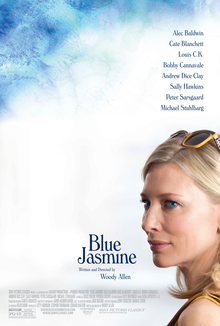
What: Blue Jasmine, the latest film by Woody Allen!
image from wikipedia
If you are a Woody Allen fan, don’t miss this film! Personally, I’m also really excited to watch this film because one of my favorite actresses, Cate Blanchett, plays the lead, Jasmine. Jasmine is a socialite experiencing a hard time that is quite different from her former life of luxury, turning to her sister in San Francisco, struggling and trying to rebuild her life.

 When: Sunday, October 27th, 4:30pm