About a week ago I had stumbled upon information for Anti Diet Riot Club’s life drawing sessions. Anti Diet Riot Club is a London-based organization that fights against diet culture and works to empower individuals to love themselves and their bodies. Loving their message, and interested in seeing what a virtual life drawing session would be like, I took the leap and registered.
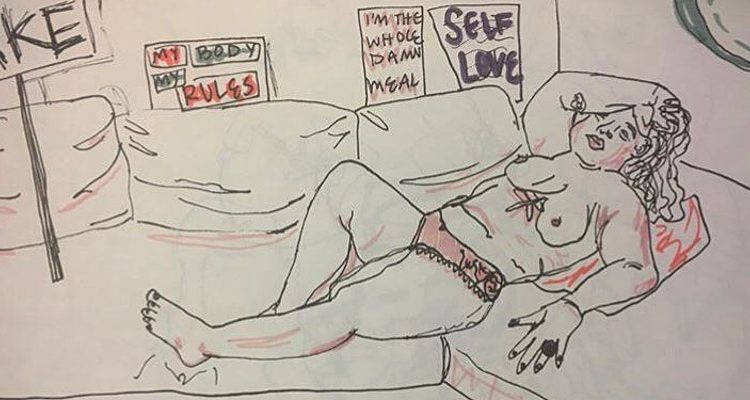
a layered sketch from the session
The event, held on the 4th Wednesday of each month, is advertised as “NOT a serious art class” and is instead meant to be an exploration of creativity as a way to challenge perfectionism and what we’ve come to see as typical beauty standards. Studies have shown a correlation between attending life drawing sessions and positive body image.
My artistic skills with a pencil and paper are typically limited to stick figures and simple doodles, but I sat down with my paper and markers ready to take on the challenge of drawing the human body.
As soon as I logged into the Zoom call, I was met with a gallery full of smiling participants of all ages, in their respective Zoom squares. There were about 140 participants in the Zoom call, and we did a check-in through the chat. Most people were calling from England, but as I typed that I was calling from the States, I was excited to see that people from all over the world were joining in on this drawing class–Scotland, Poland, Germany, France, and a few people from the US, joining from Colorado and New York.
three sketches from the drawing ‘games’ we did
The session was guided with silly drawing ‘games’ to help “kick the perfectionist out–” beginning with a simple, 1-minute timed sketch of our amazing model, Lucie. Any worries or hesitations I had about my drawing abilities disappeared once we started flowing through the exercises. Drawing without looking down, drawing with the non-dominant hand, drawing using only triangles or circles, using bold colors, and having a set amount of time for each sketch took the focus off of creating “perfect” art and left space for simply admiring the human form and putting it on paper, to the best of my untrained ability.
The session reminded me, in quite an emotional tidal wave, of how objectively beautiful the body is. Seeing the body, and especially types of bodies that aren’t often recognized in mainstream media, as a piece of art helped to mute the ingrained judgements that often blare, unwelcomed, at the thought of my own body’s ‘flaws.’ Artistically appreciating the details of a real and ‘imperfect’ body made a clear and powerful difference in the way I felt about myself after the session versus before.
If you are interested in joining next month’s session, tickets are available at Eventbrite (also linked below) and cost £5 – £8 (roughly $7 – $12 US). I will definitely be joining again, and for now I move into the rest of my day wrapped in confidence, compassion, and self-love.
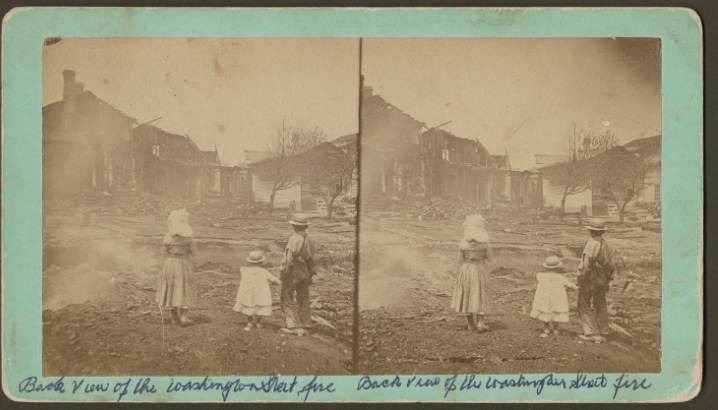
Like a telescope, the camera takes a lens to both distance and bring closer the image on the other side: something captured which previously went unexplored, an instant in time that is taken and set into memory. In both instruments, what we see is something we’ve created with the help of the setting of the time, the cultural moment, the positions of various actors across a space. Just as a telescope offers a look into the positions of an infinite number of celestial bodies in relation to one other, a camera creates a record of social climate, inequities and labor for justice.
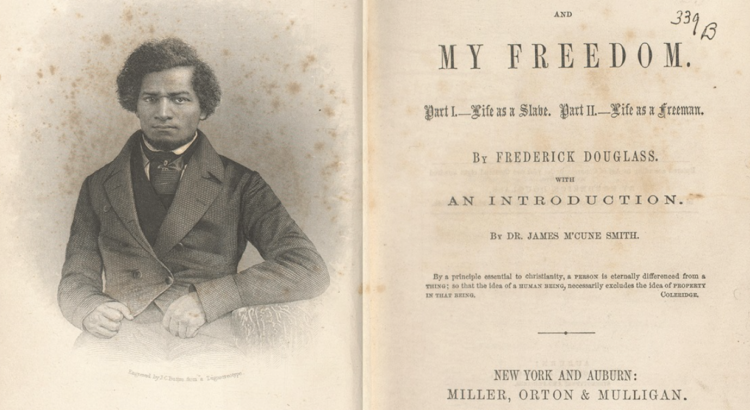
But that’s enough for botched and rambling similes. The Clements Bookworm discussion was a great addition to simply viewing the online exhibit alone. Samantha Hill was invigorated as she spoke on the pieces in the collection, highlighting many Michigan photographers and communities. There wasn’t time to go through each picture in the detail it seemed she wanted to, but her summaries did a great job to show overarching themes and the changing trends of the representation of Black individuals and communities over nearly two centuries. The reversal of negative stereotypes/caricatures in portrayals of Black people is an ongoing, complicated process which the artistic greats of history, like Frederick Douglass, expanded into new media.
As photography became omnipresent, saturating first the print news and eventually dominating the Internet, it grew in accessibility, challenging everyone to really consider their identity, how they’d like to be perceived, where they fit into the rest of society. From the first powerful, dignified portraits of Douglass to today’s glamorous Fenty photoshoots, self-expression and framing of POC has evolved and strengthened with race discourse and culture, continuously inspiring new questions and conversations, driving our society towards equity.
Hill discussed The Colored American Magazine, one of the first periodical publications to celebrate Black art and achievements. I wish she had talked a little longer on this, given the great influence of media representation, especially after the Internet became ubiquitous. She brought it into the present a while later, with examples of former President Obama in magazines.
For me, the media brings up an interesting thought: how does putting one’s representation back into the hands of another change the resulting image? Whitewashing in magazines and Instagram ads is an obvious example, but what about posture, facial expression, two important factors in Douglass’ revolution? The style of dress, the position of the subject in what kind of background? We’ve seen a regression of some kind, or rather a continuation of what had already existed. What would Douglass say to us if he saw how his vision and goals have evolved?
For more online events from the staff at the Clements Library (which I’d definitely recommend attending!), check out their Facebook page, William L. Clements Library. Discussions occur fairly frequently, covering a range of art and history topics. If you’d like to watch the recorded webinar from this exhibit, you can find it here.
Photography, while being a comparatively new art form, has a rich history. Its power to explain and illuminate complicated ideas in a single image is immense, and has led to some of the most impactful art in the world.
This month’s event focuses on Frederick Douglass’ transformative work in photography; how his lectures and images inspired the next generations of creators to bring the Black experience into the art world. Join in on an online viewing and discussion with Clements Library fellow Samantha Hill and graphics curator Clayton Lewis February 19th at 10AM.
How do women of color, specifically black women, employ mark making to transform overlooked spaces to imagine future potentialities? Focusing on making processes as generative healing, both Olivia Guterson and Avery Williamson, two muralists commissioned by the Ann Arbor Art Center, are interested in mobilizing the power of line as a tool for letting go. Collective loss and struggles for survival are projected into portals, offering lenses through which to map out realizable landscapes of growth, joy, and play.
During my conversation with Williamson, she remarked about the power of black abstraction as “a way to engage with the loss of [African American history] and alsoto celebrate the opportunity to imagine alternative worlds and lives.” Directing their focus to an incomplete archive, a juxtaposition of ancestral cloth, texts and annotations, and family photo albums, Guterson and Williamson’s work looks back as much, if not more, than it looks forward in order to self-realize diverse possibilities and individualized languages for expression. After sorting through queries, both theirs and mine, and pulling concepts and direct quotes from conversations with each artist, I am interested in a unifying question that runs through their work. How does the anonymity of abstraction lend its way to an ambiguous existence, encased within the permeable membrane between portraiture and landscape, that leaves traces of the past while denying the possibility of a future reimagined without gaps?
Olivia Guterson, a Detroit based interdisciplinary artist and new mother also known as Midnight Olive, began our conversation confiding in me that she didn’t talk much as a young child. Although this was temporary, her commitment to making things has developed in conjunction with the development of a mode of communication that is uniquely hers – a language of line based patterns. This creative sensibility is illuminated in her later remark, “To teach is to seek to understand and then make sense of for others,” a practice she compared to the artist’s process of making and leaving behind personal artifacts. The mural Guterson drew is exactly this, a release.
Talking about Nalo, her son of several months, and her grandparents, I came to comprehend the role of family in certifying her connection to art making. Sitting on the pavement of the parking lot as Guterson hugged to the wall to draw the last flower of her mural, she told me this was the third time Nalo and her had been separate for a several hour block. On prior occasions, he was strapped to her chest as she dragged her sharpie pen across white painted bricks to replicate patterns from her grandmother’s wedding dress on the leaves of drawn flowers. This collapsing of time and space runs through her work; a weaving of generations of familial history into floral landscapes that juxtapose imagery from the fabric and quilts of Black Americans and Eastern European Jews. It is this connection to family, and possible lack thereof, symbolized by her white Jewish grandmother not gifting her and her siblings with a quilt at the age of thirteen, or the legacy of enslavement inhibiting a clear drawing of ancestry, that has Guterson infusing her natural landscapes with historical motifs as a conduit for rebirth and growth. The white space in between the flowers allude to this, and complicate an already multifaceted relationship to the act of giving. “I needed to take up space because I was given space and I don’t feel that way anymore,” Guterson says. “I realized I didn’t need someone to gift me my heritage through a quilt or something. I had the ability to create my own language and a lot of healing through it.”
Olivia Guterson’s mural, 111 N Ashley St, 2020, Photo: Courtesy of Ann Arbor Art Center
Avery Williamson, an Ann Arbor based interdisciplinary artist, began making the meditative line paintings in 2017 in response to the epidemic of killings of black people at the hands of police. While these works existed primarily in black and white, a value scale consistently employed in Guterson’s drawings, “What the Water Gave Me” is painted with ultramarine, white, and payne’s grey acrylic paint and medium. The scattered marks, referenced by Williamson as “guts,” are produced throughout a long timeline of active processing, extended because of the scale of the work. Additionally, dictated by its size, Williamson stood above the metal panes, which lay face up on her studio floor, as she painted. This process, in which Williamson interacts with her “canvas,” or metal panes, in “as an arena in which to act”, (Rosenberg, 1952) is similar to painting methods of the mid twentieth century action painters. Harold Rosenberg, an American art critic and influential figure regarding Abstract Expressionism, wrote, “What was to go on the canvas was not a picture but an event.” Avery’s identity as a black woman offers an incredibly important perspective through which to reframe such critique, as many of the ascribed artists were white men, and see contemporary black abstraction through a process centric lens. Swimming through a series of events into a sea of expansive blue, this portal gives birth to the power of water and its dynamic currents into a hopeful future where black joy and healing are prioritized and unconstricted.
Avery Williamson, What the Water Gave Me, 113 W Washington St, 2020, Photo: Courtesy of the Ann Arbor Art Center
The meditative actions, or modes of creation, of Olivia Guterson and Avery Williamson unveil murals that exist as archival documents for the public’s viewing. Both artists expressed this act of leaving behind as an important part of iterative processing; a glimpse into a passing of moments let go of. “The personal archive can tell us so much more because there are fewer hands mediating us and our relationship to the objects and the words,” William says. I believe our only option is to enter these portals to explore all that these two women have left for us to discover.
Olivia Guterson’s mural is on display at 111 N Ashley and Avery Williamson’s “What the Water Gave Me” at 113 W Washington. In addition to these aforementioned artists, the Ann Arbor Art Center also commissioned eleven other muralists, so don’t forget to check out the other exhibited work while you’re in downtown!
What does it mean to commit a crime against reality? How is this realness defined through actions to capture and liberate it through additive transformations? What can experimental approaches to using technology do to construct alternative realities advocating for Indigenous futures? New Red Order (NRO) explores these issues in their first solo exhibition, Crimes Against Reality, at the Museum of Contemporary Art Detroit (MOCAD), which runs from October 1, 2020 until January 10, 2021. Amidst increasingly publicized conversations about race, nationhood, and equity worldwide, and particularly in the United States, New Red Order’s exhibition is showcased to the public during a time of long overdue reflection and gradual unlearning among the most privileged.
Crimes Against Reality exhibition view at MOCAD
The “public secret society,” a spinoff of the Improved Order of Red Men, an all white fraternal organization established in 1834 in response to desires to “play native,” was created in 2016 by core members Zach and Adam Khalil, of the Ojibwe tribe in Sault Ste. Marie, and Jackson Polys, of the Tlingit tribe in Alaska. By identifying as such, it classification exists in relation to anthropologist Michael Taussig’s concept of a “public secret,” developed in his book Defacement (1999), and described in depth in Kenneth Surin’s article, “The Sovereign Individual and Michael Taussig’s Politics of Defacement” as “among other things the creation of social subjects who ‘know what not to know,’ thereby instituting a pervasive ‘epistemic murk’ whose core is an ‘uncanny’ dialectic of concealment and revelation, though the secret revealed in this case is, qua public secret, not really a secret (49)” (206, 2001). NRO works to “confront” and “rechannel,” two words used by Jackson Polys, long standing and overlooked desires for indigeneity that lie at the core of our national identity as a way of clearing the murk.
New Red Order is future oriented and committed to expanding Indigenous agency, as stated within their “who are we” portion of their website, https://www.newredorder.org. Approaching the 3 Cs – contract, concealment, and capture – as a methodology to create successful informants, another reference to anthropology, among non-Indigenous allies, this society fosters growth of decolonial perspectives, in physical and virtual realities. The films, Culture Capture: Terminal Addition (2019) and Never Settle (2020), their dark humor filled recruitment video, illuminate the process of building a virtual repository of monuments and museum artifacts, or the stolen collectibles framed as such. These rendered models, generated from differently angled captured photographs, are then mutated via a glitch, or series of phase changes, that transforms them. This glitch, or interruption of normalcy, calls for a reevaluation of hegemonic relations that we refer to as reality. Applying computer technology in investigational ways, New Red Order succeeds in conducting “a small speculative step toward rectifying the violence committed by museum archives and the settler colonial icons that guard them.” (Never Settle, 2020) “The society of statues is mortal. One day their faces of stone crumble and fall to earth. This botany of death is what we call culture. And this is how we capture it.” (Culture Capture: Terminal Addition, 2019)
New Red Order, Culture Capture: Terminal Addition, HD video, 2019, Photo: Courtesy of the artists
This day is among us. Now how do we, as settler colonial Americans, foster important discussions about overshadowed cultural issues, or culture as it was defined above, to devise a better and ultimately decolonial society? New Red Order: Crimes Against Reality is on display alongside two additional Detroit-based artists’ solo exhibitions, Conrad Egyir: Terra Nullius and Peter Williams: Black Universe. All three exhibitions close on January 10, 2021 so make sure you visit MOCAD, now open Thursday through Sunday, this weekend or late next week!
I walked into the gallery with a stomach ache, and walked out with an even bigger knot.
Heidi Kumao has put together an excellent portrayal of the gaps in justice systems in cases of sexual violence. It is often characterized as a short list of events, identifiable with clear beginnings and ends. We know who the players are (we call them aggressors, rapists, victims) and what should happen to each party after the event has occurred (getting fired, jail time, police report, testifying). We know what counts and what doesn’t, and what responses are valid. Of course, none of this is actually true; there are countless ways in which someone can be affected by sexual violence, and to reduce such experiences down to more easily digestible stories is a powerful insult, putting into question a violated person’s reality.
The layout of Kumao’s pieces is minimalistic on purpose, each stitch and fabric scrap made infinitely more intentional. And while the arrows on the floor (to direct single-direction traffic in the gallery, allowing for social distancing) were not a part of the exhibition, they fit the theme: there is one way to reconcile with and bring justice to sexual violence. It’s procedural.
A textile medium was an inspired choice: fabric is manufactured neat and orderly, but on close inspection it has a propensity to unravel, to knot, to incorporate impurities, to lasso in sharp burrs, to tangle. It has holes in it, all over the place, it’s easily pierceable, complicated, diverse in stitch and texture. Lint and fuzz make abrasion evident, stains remain embedded. It calls up thoughts of bedding and thus the fiction of dreams, as the exhibition title suggests. It’s also representative of traditional womens’ work: sewing, mending, weaving, embroidering.
Her motifs capture well the double-edged properties of gaining a platform for self-advocation. Thechair is a seeming promise of a seat at the table, but it always comes paired with a spotlight, and an audience (the Langston Hughes reference is intentional, given the added layer of opposition that women of color face in their search for justice). Connections are tenuous threads, which grow into chaotic knots and simplify into lines, noting the difference between reality (complex stories, lasting results, diverse reactions) and the imagined (straightforward descriptions, single narratives).
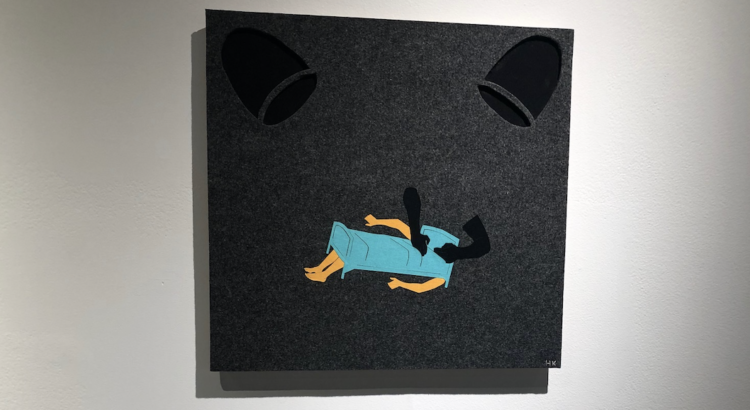
The most poignant piece to me was one called “Reluctant Narrator,” a little square scrap of felt maybe six inches wide. One chair sits with another, a tangle of thread upon it, which the other chair is pulling into a thick, straight line.
It’s become the norm to accept heroism only in those able and willing to share their trauma with strangers, putting themselves on a stage and accepting skepticism and hatred in exchange for benefitting the good of others. We welcome the poised, and lack respect for the silent.
The exhibition will be on display until December 4th. The gallery is open 2-7pm Tuesdays and Fridays to anyone with an Mcard; unfortunately, they’re not presently able to open to the public. However, they have a wealth of online resources like discussions with their featured artists and news about goings-on in the Ann Arbor art scene on their website, https://stamps.umich.edu/.