
REVIEW: Real and Imagined

Professor Heidi Kumao’s solo exhibition features fabric works and experimental animations that capture ordinary conversations and relationships. What sets Professor Kumao’s work apart from other artwork exploring a similar concept is not only the unique medium, but also the fact her work is told from a feminist perspective. She explores underlying emotions and tensions in everyday interactions by representing trauma and power imbalance. The title, Real and Imagined, reflects public support for and backlash towards women who have spoken up about assault, harassment, and misconduct. A woman’s experience can be believed to be an honest account but dismissed as wrongly remembered or entirely made up.

Professor Kumao’s work is minimalistic, but her work is far from lacking meaning or appearing overly simplistic and therefore unclear. Her work is almost playful or childlike – the style is reminiscent of something you’d see in a picture book. However, the seemingly innocent appearance of Professor Kumao’s artwork is sharply contrasted by how effectively she is able to convey emotion in her work.

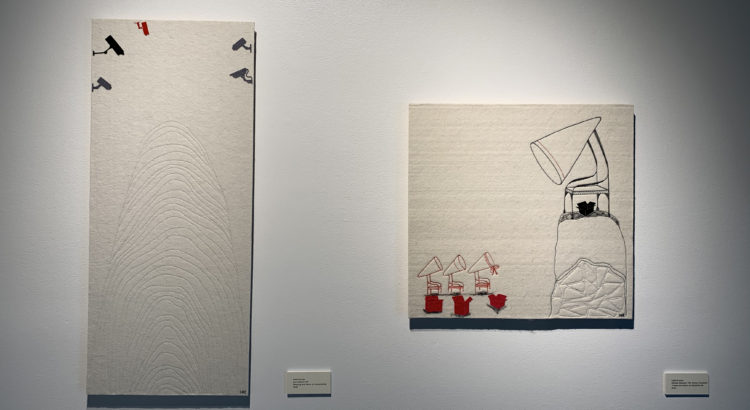
For example, in the above piece titled “Consultation,” we see what is unmistakably a gynecologist’s office, with the door, chair, and the exam chair with stirrups. Although there are only really three focal points in the piece, with the background being all white, Professor Kumao was able to clearly set the scene, as well as create an atmosphere of unease with the vivid red. Red, as we all know, is often associated with danger or a warning, but Professor Kumao deliberately created a sense of discomfort rather than immediate danger. The scene can be interpreted as simply unsettling, but also preceding or directly following the suggested danger.

The jumble of thread sitting on the chair appears multiple times throughout the exhibition, including in the below piece titled “Reluctant Narrator.” In this piece, the thread is being pulled at, hinting at the unraveling of a narrative. She once again uses red, but the thread is in more disarray than the thread in “Consultation.” This seems to directly reference the “Reluctant” part of the title, again creating a sense of unease. On the other hand, in “Consultation,” the thread is still entirely intact, suggesting that perhaps there is something that happened around the time of the scene depicted.

Obviously, these are just my interpretations of some of Professor Kumao’s work, but I find it so impressive how effective her work is. There is always some blank space in each piece, but rather than leaving each piece seemingly unfinished, she is able to tell a story without overcrowding the felt canvas. Furthermore, I can only imagine how long it took to create this exhibition. The felt cutouts have a sense of depth, and you can always tell which way a chair or spotlight is facing. Her shapes are very distinct and it’s clear why she chose to include them – office chairs to represent power imbalances and spotlights to represent public scrutiny.

Overall, Professor Kumao’s exhibition is very strong and very impactful. It leaves room for interpretation, but it isn’t needlessly confusing. It’s clear that she put in a lot of time and care into this project, and I would encourage you to see it in person.

Real and Imagined is currently on display at the Stamps Gallery, which is open on Tuesdays and Fridays to visitors with an M-Card and a mask.

PREVIEW: Real and Imagined

Until December 4, Stamps Professor Heidi Kumao’s solo exhibition is on display at the Stamps Gallery. In this exhibition, Professor Kumao features narrative fabric works made from fabric cutouts and machine and hand stitching on felt. Professor Kumao uses these fabrics and experimental animations to visualize the psychological and emotional undertones behind everyday interactions and relationships. The title, “Real and Imagined,” is inspired by the backlash to the #MeToo movement, and how a woman’s testimony can be accepted as reality as dismissed as fiction at the same time.

I am very much looking forward to Professor Kumao’s exhibition. Her featured work has a very distinct and playful style, contrasted by the serious subject matter. I’m already impressed by how strong the message of each piece is despite how minimal the style is. I can only imagine how much care and time went into this exhibition, and I’m quite excited to see it in person.

The Stamps Gallery, located at 201 S. Division Street, is open on Tuesdays and Fridays from 2-7 to visitors with an M-Card and a mask.

REVIEW: Copper Plate Embossing – Ann Arbor Art Center ArtBox

The Ann Arbor Art Center is a nonprofit arts center that hosts rotating exhibits in its gallery, various classes for children and adults, as well as an art shop. Located on W Liberty Street, the art center is one of the oldest community arts organizations in Michigan as it was established in 1909. Upcoming classes include sketching, comics, calligraphy, and perspective drawing. However, this weekend, my friend and I stopped by the art center to pick up some ArtBoxes.


The art center’s ArtBoxes are effectively art supplies in a box for the purpose of at-home art projects. The box this time around was designed for at-home copper plate embossing. An embossed pattern is raised against the background of the plate, whereas a debossed pattern is sunken into the surface. This project encouraged both methods. This was a perfect socially-distanced activity for me and my friend, who has a balcony. The box comes with a copper plate, a frame, stickers to stick the plate to the frame, a wooden stick for embossing, a piece of paper for you to sketch your design on, protective packaging, and instructions.


The process is very straightforward. You sketch a design on the piece of paper provided (it fits to the size of the copper plate) and trace it onto the plate with the wooden stick provided. My friend very carefully traced out the symbols for the four nations from Avatar: The Last Airbender onto hers, complete with very straight lines to divide the square into four. I started tracing a celestial design, but just ended up freehanding it directly onto the plate. I thought it was cool that by both embossing and debossing, you can end up with really interesting textures, from small Braille-like dots to angular spirals. Another enticing aspect is that due to the nature of embossing and debossing, if you flip your plate over, the design is still there, but the raised surfaces are now sunken and vice versa. So, if you don’t like one side, just flip it over. Furthermore, what’s nice is that any mistakes can be incorporated into the design or they can create new textures.


The overall process is very quick – my friend took more care with her design whereas I was just improvising as I went along, but neither of us took more than an hour. That being said, you can take as much time as you want, but being less meticulous doesn’t detract from the quality of the final product at all.


The ArtBox is available for free with a Passport to the Arts voucher, which can be found at the Union, the League, or Pierpont Commons!

PREVIEW: Copper Embossing with the Ann Arbor Art Center

The Ann Arbor Art Center has been offering virtual programs and hands-on activities you can do from home this year, in lieu of the in-person art classes that would be offered in a more normal time. This month, the Art Center is offering a copper embossing kit, no prior experience required, with all materials needed included in the kit. Copper embossing is a very tactile form of visual art that involves using tools to imprint shapes and grooves in a sheet of copper. It’s a great opportunity to try out a less common visual art form and to have something engaging and creative to do while we’re unable to attend as many arts events in person.

U of M students can get a free kit with the current Passport to the Arts! You do need a physical copy of the Passport voucher to redeem the free kit. Due to COVID precautions, Passport vouchers are available in less locations on campus this fall, but you can find them at Info Desks in the Michigan Union, League or Pierpont Commons (I picked mine up in the Union)! Once you’ve gotten your voucher, head over to the Ann Arbor Art Center 10am-6pm Tuesday-Saturday to exchange your voucher for a kit and get embossing!


REVIEW: Avatar the Last Airbender and The Legend of Korra

Avatar: The Last Airbender and The Legend of Korra both explore a world created by Michael Dante DiMartino and Bryan Konietzko in which some individuals possess the ability to “bend” one of four elements: water, earth, fire, or air. The two animated series follow Aang and Korra, two incarnations of the Avatar, whose duty is to maintain balance in the world and act as a bridge between the human and spirit worlds. The Avatar has the ability to bend all four elements, and is reincarnated into a new body each time they die.


Avatar was added to Netflix in May, and despite it being a kids’ show that aired from 2005-2008, it quickly made its way into Netflix’s top 10 list where it stayed for 61 days, breaking the record previously held by Ozark (57 days). I didn’t watch Avatar when it first aired, but when I watched it this summer, I loved it. I think what makes Avatar so successful is that even though it’s intended for a younger audience, it doesn’t shy away from serious topics, which expands the target audience. The show addresses themes from gender discrimination to war, imperialism, and genocide. Another way the show is successful is in how it’s structured: it’s episodic, so the episodes can stand alone, but they all contribute to the overall plot. This makes the show more exciting, as each episode tells its own story.


Not only does Avatar have a great plot, it also has unique and lovable characters. Even the side characters have their own personalities and motivations. Since Avatar is a kids’ show, the creators did not show any onscreen deaths, and they were able to work this as a character trait into the main protagonist, Aang. Aang is a monk and also twelve years old, and refuses to kill the man who was responsible for the genocide of his people. This man, Fire Lord Ozai, is the main antagonist of the show, and when he and Aang finally face each other, the conclusion is unexpected but original, and overall very satisfying. One very popular character is the son of the Fire Lord, Prince Zuko. I believe that I can reasonably claim most people that watch the show love Zuko. He’s essentially Kylo Ren and Jaime Lannister, but actually written well, and with motivations that actually make sense.


Recently, there have been plans to develop Avatar into a live-action series on Netflix. However, the original creators of the show, DiMartino and Konietzko, both announced they would be leaving the show. They stated that Netflix had a vision to make the show more mature, but they still wanted the show to be for kids. I initially was 100% on the creators’ side, but after watching Korra, I’m intrigued by what a more mature Avatar show would look like.


The Legend of Korra is intended for a more mature audience – for the kids who watched Avatar and then grew up. The show’s villains essentially represent communism, theocracy, anarchy, and facism – and it gets pretty dark. In season 4, Korra has PTSD and spends a good part of the season in recovery, and her character isn’t the same as season 1. It’s quite sad that Korra started off as a cocky and fun-loving young woman, but in order to be humbled she had to process a great deal of trauma. The creators of the show have proved that a more mature story can successfully take place in the world of Avatar and Korra, and it’d be interesting to see Netflix’s spin on an already iconic story. However, if Netflix is going on the Riverdale-maturity route, then I completely understand why the creators chose to leave. I also understand the creators’ frustration with a lack of creative freedom, as there are reports that Nickelodeon gave the creators a really difficult time during the production of Korra – not only because she is a female Avatar, but also because she is a woman of color. The ending of season 1 is a little rushed, and the beginning of season 2 is rather slow, but Nickelodeon initially only gave the creators one season, and greenlit season 2 halfway through the airing of season 1. Then, seasons 3 and 4 – the strongest seasons of the show – weren’t aired at all and were uploaded to Nickelodeon’s online streaming service instead.


Overall, Korra gets a lot of hate, but I think you can be understanding of the circumstances surrounding seasons 1 and 2. Both seasons are still very good, and season 3 is on the same level as Avatar. I’m interested in seeing what’ll become of the live action show as the creators did say some individuals they hired themselves have stayed on the show. But for the time being, watch Avatar: The Last Airbender and The Legend of Korra on Netflix!

REVIEW: Yesterday

Streaming on HBO is Danny Boyle’s Yesterday, a story about how we are to prioritize our lives when good fortune drops into our lap. Jack Malik is a struggling musician who wakes up one day to an alternate reality in which he is the only person on Earth who remembers the Beatles and their music. As a hopeful artist who never has felt praised for anything of his own creation, Jack sets out to make a name for himself by producing the music of the Beatles for himself. As success and fame seize him and “his” music, we see Jack struggle with his own identify as he learns of what he truly wants from his life.

As an audience member who has never been a devoted fan of the Beatles, I tried to watch this film without a perspective that is dulled by adoration of the Beatles’s legacy.  Entering into this movie, I expected the themes to be closer to ones of sentimentality, such as desirous love or musical devotion. More prevalent, however, was the theme of what it means to be authentic despite the allure of obtaining mass appeal.

Just like the alternate universe in which Jack finds himself, Yesterday possesses a odd feeling of over-saturation. The execution of the characters’s motivations, while often resonant with real life, seemed slightly off and left me to believe that the script-writers did not properly prepare for certain plot set-ups. That being said, the majority of the characters appeared normal in comparison to Jack’s second manager, Debra Hammer: a representation of surface-level production value that only cares about Jack’s profitability. This larger-than-life persona is a caricature of executives from the music industry in real  life who are in the business of sucking currency out of a creative entity. While Debra works to build a solely-profitable image for Jack, we see Elle, Jack’s first manager, who had only worked to affirm and encourage who Jack already was. The stark distinction between the two managers is offered as a choice for Jack; is it more valuable to be widely profitable as a product, or uniquely valued as an authentic being?

As Jack dives deeper into his woven lie, he grows increasingly anxious that someone knows his secret and that he will be put to shame for the liberties he has taken with the Beatles’s music. The pace and sequencing plays on the feelings of anxiety that many may know as an imposter syndrome. As Jack is credited as a genius, he feels increasingly lost in the image that has been developed for him.

What is the cost of accepting the love that we are freely given? So often it can be easy to hope for love that is given for what we offer the world, but there is a sort of indescribable sacrifice one must make in order to be loved just as they are. Despite its occasional nonsense and the unpredictable writing, Yesterday is a charming film that sparks thought and reflection about personal authenticity, and hopefully draws to mind someone in your own life who has valued you even at your lowest points.