
REVIEW: As Far As My Fingertips Take Me

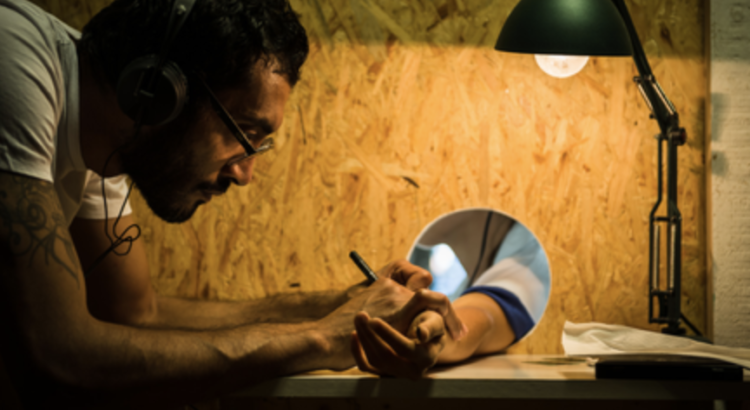
You put on the headphones, and they themselves seem significant: the wires connect but they constrict, you have to rely on the tinny sound for information but it blocks out your surroundings. The whole experience was full of these contradictions, to the point that I had to consciously stop myself from thinking through them in order to pay attention. There’s the white wall to my side, and though I can see the borders of it from where I sit I can’t see the other side, so it’s as good as infinite. A little light is coming from where I’ve offered up my arm to the artist, Basel Zaraa, and I’m tempted to look down and through to meet his eyes but I know that something will be broken if I do.

The felt-tip marker is brushing over the flesh on the inside of my forearm and my palm, and I hate how gently he’s holding my fingers down because already I’ve associated him with a Dublin Regulation fingerprint database employee. When I realize I’ve put myself in a position I am privileged to never experience, it’s jarring and it’s a feeling that’s creeping like sweat along my forehead.

I don’t feel any one thing completely after, except for quiet. Not quieted, not disquieted, not just not speaking and not just alone. Quiet is the only adjective I can give myself. I’m sad for what I don’t know and especially for why I don’t, the stupid luck that let me be born into stability and the politics that let others live out of backpacks. Travel is so often romanticized, but there is a difference between travel by choice and by circumstance (further reading: https://doi.org/10.1002/9780470670590.wbeog940).

So in about 15 minutes I’m in and out of another world, halfway a vagabond myself. I’m back and walking home and I feel homesick but mostly physically so, my eyes kind of glassy. It’s a little disappointing that I wasn’t physically transported, though of course that would be impossible. I’m still in Ann Arbor, Michigan walking down the street, and I have no reason to fear that I won’t be here tomorrow. There is a constant stream going through my head berating me for how little I know about the world, and it feels like an abuse to wear this tattoo on my arm like a costume.

But I can use that guilt he’s given me, to take learning into my own hands and to get politically involved. Where the law does not protect the safety of people worried for their lives, there is a problem, a violation of human rights. As election season is upon us, it is a perfect time to get involved and get the right people elected. With primaries right around the corner, the time for active research is now.

You can find out more about Tania El Khoury’s work on her website: https://taniaelkhoury.com/
PREVIEW: As Far As My Fingertips Take Me

Imagine what a lonely terror it is to lose your home to violence and instability, and then be cast into a stranger’s land. For most of us, this will never be our reality, but for the 70 million forcibly displaced peoples around the world, it is.

As Far As My Fingertips Take Me forces the subject to take on the identity of the refugee for a couple of minutes, reading the poignant writing on the wall and offering a nervous arm through to the unknown. This innovative one-on-one exhibit design incorporates the poetic and visual artworks of Basel Zaraa.

The work is the brain child of Tania El Khoury, a contemporary live artist known for her productions that illuminate issues that are of both the heart and political machine. This exhibit in particular has toured far and wide, gathering awed reviews from major publications like The Washington Post and The New York Times. 

The exhibit will be shown at the U-M Institute for the Humanities from January 24, 2020  February 2, 2020, tickets: ums.org. Be sure to arrive 15 minutes ahead of your showtime as the schedule is extremely strict.

REVIEW: Take Your Pick: Collecting Found Photographs

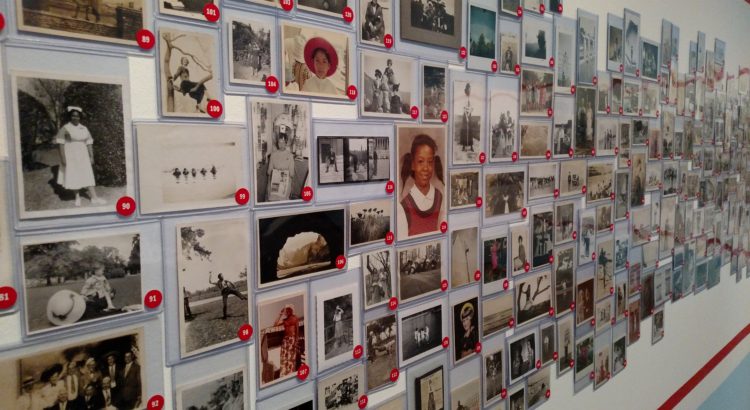
Take Your Pick: Collecting Found Photographs, currently on view at the University of Michigan Museum of Art, is no ordinary art exhibit. Consisting of 1,000 found photographs from the private collection of Peter J. Cohen, it challenges viewers’ own definitions of what is art and what is not.

The photographs on display are distinctly human in that they capture the ordinary moments, places, and milestones in the lives of the people shown, or the person behind the camera. Since the images have no context, I felt a bit like I was looking into the photo albums of a stranger, and it was almost like I shouldn’t be there. Who knows what the personal significance of each of the photographs were to those who captured them or kept them, and what right do I have to be looking at them on a museum wall? While some depict weddings or similarly obvious events, others capture moments whose importance is unknown to museum-goers, provoking the imagination.  Many have people in them, while others show landscapes without anyone in sight, though the presence of the photographer can be sensed on the other side of the camera. A select few have captions scrawled in the margins or even across the photograph, documenting the images’ contents. Probably most strikingly, none of the photographs in the exhibition were ever intended to hang in a museum, but visitors can vote on their favorites to join the UMMA permanent collection.

On another note, the photographs are, as the exhibition description points out, a byproduct of an era that has now passed, and I found it quite interesting to consider this while I looked at them. Fifty years from now, what will the footprints of normal lives from today look like? Most photographs only ever exist in the digital sphere, after all, and so they will not be sitting out at flea markets in dusty old boxes. In this respect, Take Your Pick has an almost history museum-like quality.

I especially enjoyed the opportunity to vote on my favorite photographs, and this opened a whole new question: how is one photograph more deserving than another? Since I had no answer to this, I selected the images that I found most interesting, or evocative, or beautiful. I’ve included a few of my favorites in this review. Perhaps the point is not to judge or appraise each image, but to simply be in the moment, surrounded by the photographs’ humanity.

It’s not too late to cast your own vote, since Take Your Pick: Collecting Found Photographs since voting continues through January 12, 2020. You could also get a snazzy “I voted at UMMA” sticker! After that, the final selections to join the museum’s permanent collection, based on the voting tally, will be on view from January 14 through February 23, 2020.

REVIEW: Terrence Malick’s “A Hidden Life”

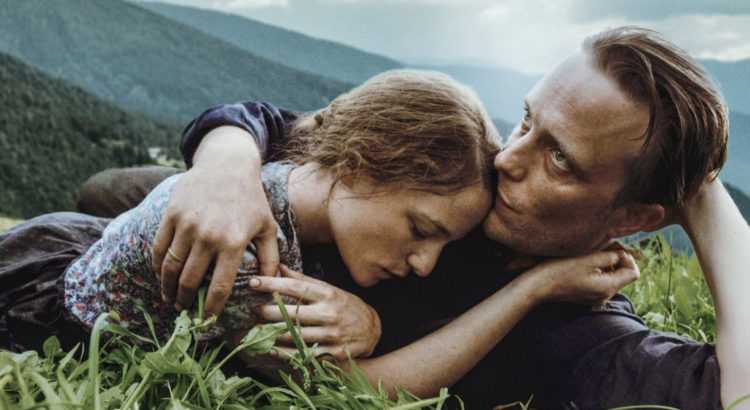
If we are given a free will, what we are responsible for? Terrence Malick’s A Hidden Life is a meditative narrative that journeys through such a question. The beauty of Malick’s work lies in his consistent demonstration of deep meaning  through intricate layering, stunning cinematography, and an eye for the simple and the remarkable.


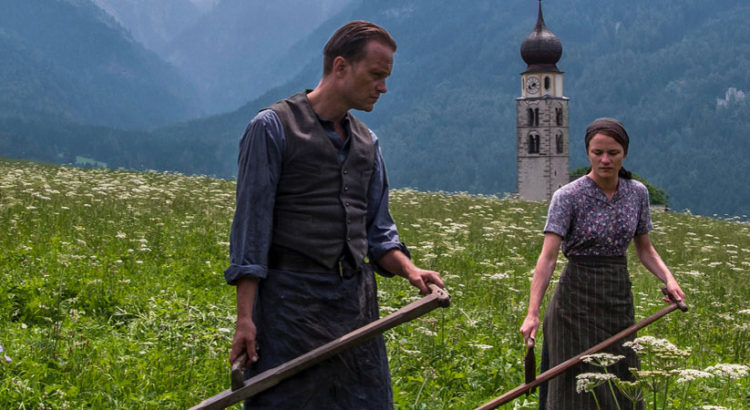
The true story of Franz Jägerstätter is of an Austrian farmer who conscientiously objects to joining Hitler’s fascist regime in World War II, undergoing bitter persecution and ultimately execution for such a stance. Throughout these trials, his deep faith in God and pure love for his family continually prompt an examination of conscience that progressively solidifies his inner call to honor the sanctity of all human life.

While this story of Franz Jägerstätter is considered to be Malick’s most sequential film to date, A Hidden Life goes deeper with what I would call a non-sequential analogous portrait of Christ’s Passion from the New Testament. As the audience follows Franz through his suffering that leads to execution, we are introduced to several characters that serve as representational figures of Jesus’s Passion: a judge as an interrogative Pontius Pilate-type, a taunting soldier, and Franz’s lawyer who acts as the Last Temptation of Christ, reminiscent of the Martin Scorsese film of the same title. Franz demonstrates that if we are given a free will and are capable of choosing the good, all actions, even controversial and solitary ones, have meaning. By refusing to swear any sort of public loyalty to Hitler, he sacrifices his life and the joys of home yet to come.


It is from this, however, that this film explores the dueling natures of freedom and captivity through juxtaposing sequences of Franz’s captivity with shots of his once-sublime home life. Malick captures leisure, family life, and earnest work to be simple and good, all in a truly atmospheric fashion that serves to encapsulate true freedom to live and love well. Having fought the good fight, Franz is executed. A final, long shot of him riding his beloved motorcycle home serves to represent the eternal resting place to which he journeys on. This film possessed an organic perfection that I have not encountered in a very long time. Suspended at the closing shot of our film, and still hanging in my mind, are George Eliot’s thoughtful remarks from Middlemarch:

“The growing good of the world is partly dependent on unhistoric acts; and that things are not so ill with you and me as they might have been, is half owing to the number who lived faithfully a hidden life, and rest in unvisited tombs.”

PREVIEW: Terrence Malick’s “A Hidden Life”

Coming this Friday to the Michigan Theatre is Terrence Malick’s latest work of cinema, A Hidden Life: 

Based on real events, A Hidden Life is the story of Franz Jägerstätter, an Austrian peasant farmer who refused to fight for the Nazis in World War II and is subsequently faced with charges for treason. His deep faith and his love for family, however, keep his spirit alive in the face of great hardship.

Terrence Malick’s A Hidden Life will be playing at the Michigan Theatre December 20th through December 26th!

Visit michtheatre.org for specific showtimes and additional information!


REVIEW: Wild Lights at the Detroit Zoo

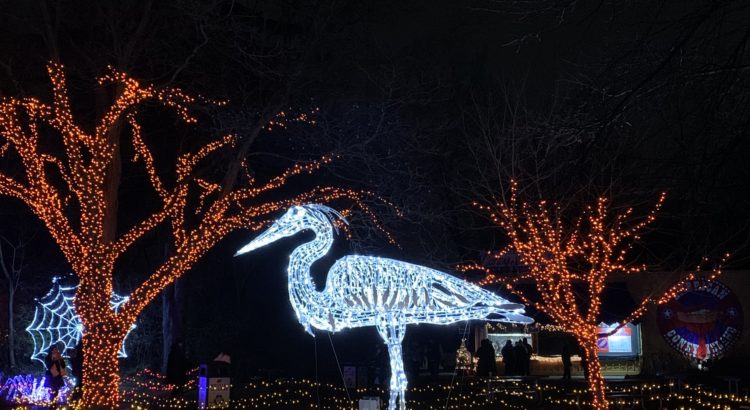
From its “glowing reviews” and advertisements, the Detroit Zoo promised that its annual, 29 day ‘Wild Lights’ show would be nothing short of 5 million LED lights worth of pure holiday exuberance. After attending this past Saturday, I can partially attest to that – the experience of strolling through large-scale LED animal sculptures and holiday-themed decor, supplemented by several regularly operating animal exhibitions, was wholly conducive to the family-oriented ambience the Zoo stresses with most of its events. The Wild Lights show boasted a meticulously illuminated total of 280 sculptures, 230 of which were animal-shaped, positioned for prime group photo opportunities throughout the front half of the zoo.

Upon entering, visitors were greeted with trees brightened by monochrome string lights and an equally eye-catching wildlife sequence played continuously on a large screen. Though blatantly drawing upon your typical holiday motifs, like the giant walk-in holiday ornament and bright green Christmas tree displays, the Zoo also had a couple of outlier light displays. These included a lavender-colored spiderweb, its stiffly perching spider that resembled a taco shell holder, and other refreshing oddities like a sneaky ‘polar bear’ ready to attack a beehive. Though initially underwhelmed by the filler trees’ clashing, garish colors, I was eventually won over by more dynamic displays like the little hummingbird whose wings seemed to flap up and down through an alternating light trick, and branches that seemed to rain light on passerby.

Outside of their Wild Lights event, the Detroit Zoo prides itself upon the 140 pieces that constitute its Fine Art Collection that “…showcase humanity’s relationship to animals and inspire a passion and interest in the natural world”. This and the other artworks I was able to view during the event emphasized the Detroit Zoo’s nationally prominent focus on conservation efforts, animal welfare, and the release/reestablishment of endangered species. Even so, I found it ironic that the statement ‘All Animals Are Important’ was displayed in the North American River Otter Exhibit, within steps of a hot dog stand.

Personally, the most visually stunning bodies of work I encountered were the softly lit, geometric sculptures positioned around the perimeter of other LED lit sculptures. Visitors are invited to gently spin the works, and as they do so, the piece’s inner light seems to shift and refract off of each intricately carved, triangular panel. Each hanging sculpture was similar in overall structure to the next but unique in their repetitive, fractal-like carved patterns; I thought this was the most elegant presentation at the Wild Lights Event.

If you’d like to brighten up your day (or night), make sure to go experience this marvelous walk-through light show, preferably with a warm group of people you find tolerable to maximize the aesthetic photo-taking opportunities. Unless they sell out beforehand, you’ll be able to buy tickets online until January 5, 2020 for the multiple showtimes they have available.