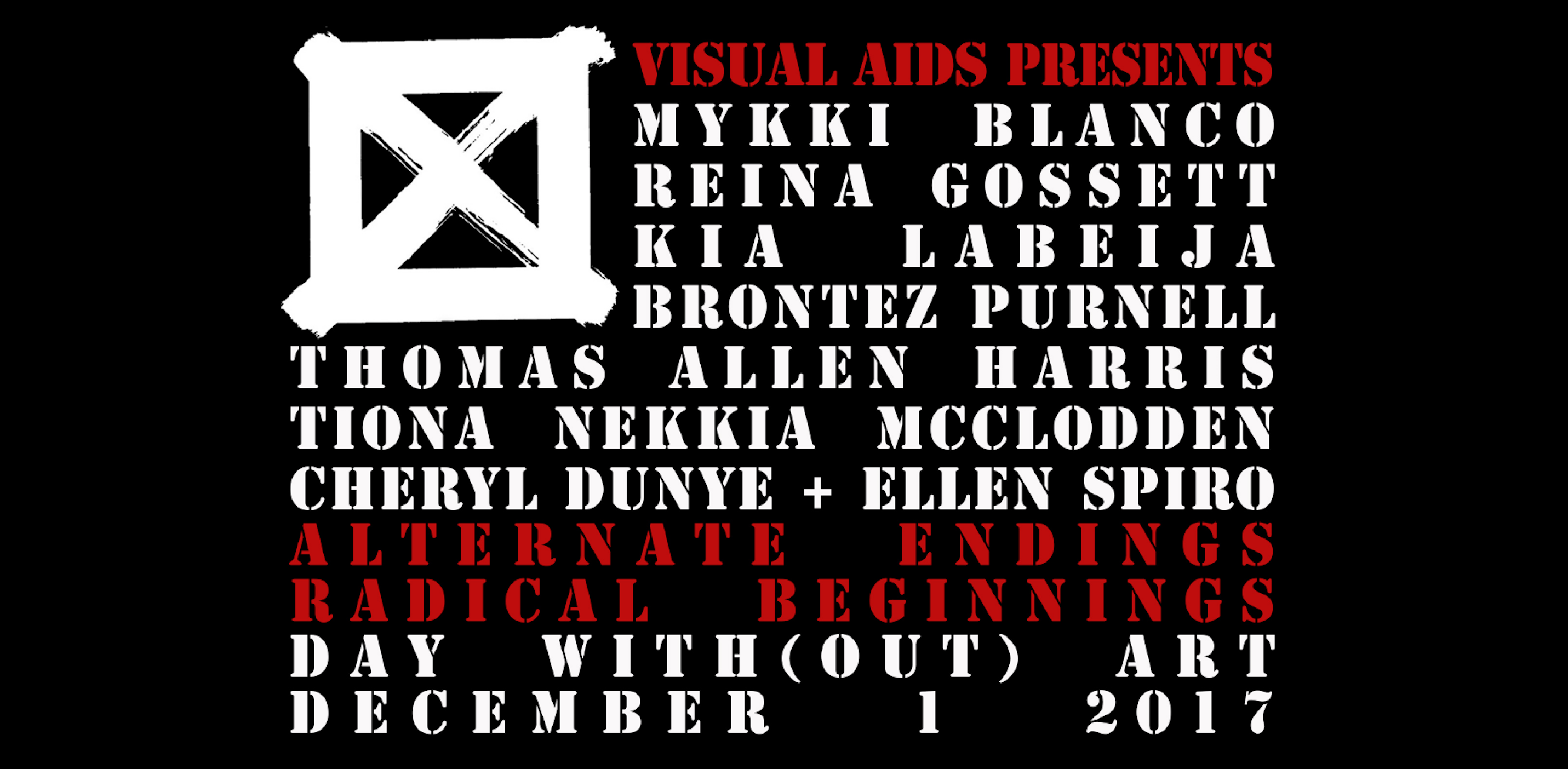
Explore Black experiences of the AIDS epidemic through seven different video artworks screening at the University of Michigan Museum of Art this Friday, December 1st, at 6PM.
The ALTERNATE ENDINGS, RADICAL BEGINNINGS shorts program premieres on World AIDS Day as part of Visual AIDS’s annual Day With(out) Art. The line-up features works by artists Mykki Blanco, Cheryl Dunye, Ellen Spiro, Reina Gossett, Thomas Allen Harris, Kia Labeija, Tiona McClodden, and Brontez Purnell.
December 1st, 6PM. Helmut Stern Auditorium, University of Michigan Museum of Art (525 S. State St). Free entry.
Screening to be followed by discussion with Bré Campbell (Founder of Trans Sistas of Color Project), Leon Golson (Director of Prevention Programs for Unified HIV Health and Beyond), and Demario Longmire (U-M graduate and HealthCorps Fellow).
From November 10, 2017 to December 16, 2017 is Stamps’ annual Undergraduate Juried Exhibition, located at the new Stamps Gallery at 201 S. Division Street.
Featuring the exceptional work of Stamps students, jurors (Anne-Marie Kim, BFA 2004, Samara Pearlstein, BFA 2008, and Ron Watters, BFA 2001) have selected a showcase of the best works to be recognized. From sculpture honed with the eye of industrial design, to illustrations steeped in keen social commentary – the works present the possible beginnings of the next Picasso or Ansel Adams or Emily Carr (and so the list goes on). Go out there and support your fellow students; see the art of what’s happening now.
Free entry! Open from noon to 7pm, on Tuesdays to Saturdays.
Walking into the UMMA exhibit, you are greeted by a sky blue wall detailing a small biography of Matisse. On the other side is Kelly’s biography, with Kelly’s collection of sketches in that section.
I looked at Kelly’s side first, since it seemed to be the smaller collection. I noticed a lot of experimentation with differentiation of line thickness. While all the sketches were simple in nature, they had a subtle artistic quality to them. For example, in “Catalpa Leaf,” there were two lines. They started off thick at the top, and only crossed each other at the bottom of the leaf. The lines faded out there as well, adding a sense of fragility to the leaf that likely was meant to represent the leaf’s qualities in reality. This theme was present in most of Matisse’s sketches, so I see where the dialogue comes in between the two artists.
Regrettably, photography was not allowed in the exhibit. Here is an image of “Catalpa Leaf” I found from the internet!
After viewing Kelly’s sketches, I went over to the Matisse side of the room. I noticed a lot of exploration of the fluidity of form, as a lot of the objects in Matisse’s sketches seemed to blend into one another while still retaining their own shape.
One of my favorite Matisse sketches was called “Dance movement, Christiane.” It detailed the legs and lower torso of a ballerina. The lines, like in most of Matisse’s sketches, were shaky. I thought maybe the unsteadiness of the lines was a representation of the dancer’s movement. The woman I was with argued that maybe Matisse was inebriated while drawing it. Both opinions are reasonable, I think.
A lot of Matisse’s other drawings demonstrated the progression of his creative mind. For instance, “Acrobat, study” depicted a woman in the bridge position, with her torso facing the sky. Matisse’s use of lines reminded me a little of the Kelly drawings – the only steady stroke represented the woman’s stomach. If you’ve ever done the bridge stretch, you’ll notice the stretch in your core. Matisse seemed to represent this in his ink strokes. The rest of her form was loose and not accurate in any means. Even from an expressionist viewpoint, it was not beautiful.
The sketch next to it, however, was interesting. Entitled “Four studies of acrobats,” the figures were more well-defined and biologically accurate. To me, this made them more aestethically appealing. It definitely showed a progression in Matisse’s line of thought regarding how he wanted to portray the acrobats.
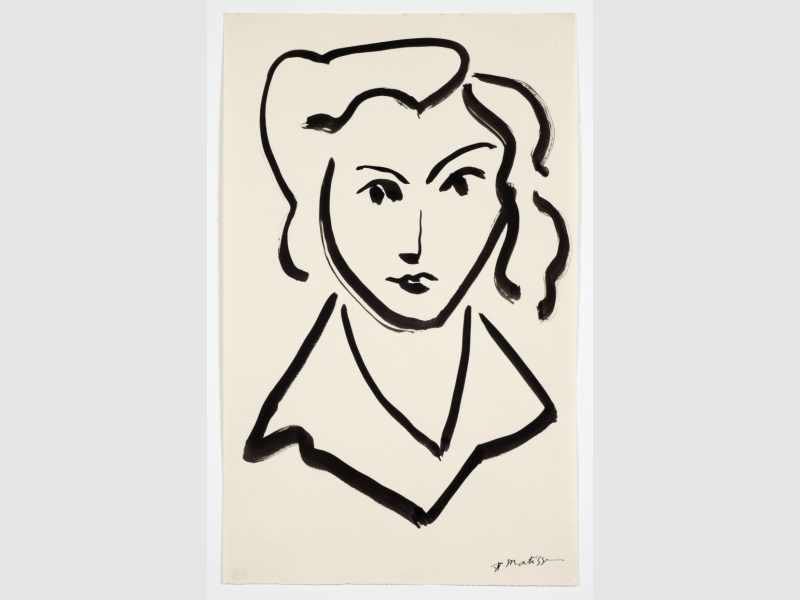
Other aspects of the Matisse collection that I found interesting were the drawings that reminded me of Picasso’s technique. “Veiled woman” had many cubist qualities, such as the characteristics in her face and the way her arm melted into the veil around her head. Beside “Veiled woman” was “Themes and variations VI.”The subject’s veil is unfinished, but should cover her face. Her face, however, is obviously still visible and exposed to the viewer. The same goes for her breast. This suggests that Matisse saw her face and torso as the most captivating parts of her, and used expressionist technique to portray that.
Lastly, Matisse used lines to represent light. In “Study, boat” the lines around the plant in the window are squiggly. I saw this as the movement of light as it’s dappled by the world outside. Of course, in a sketch, it’s impossible to make your subjects move. Matisse accomplished a sense of movement by using different stroke techniques.
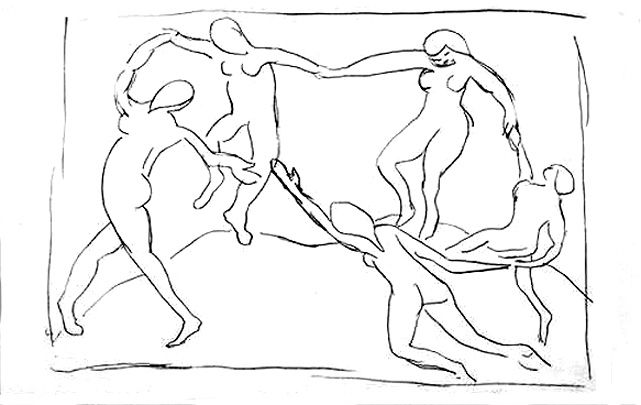
In conclusion, I was impressed by the collection at the UMMA. It was fun to see “The Dance” in sketch form – it was actually really underwhelming compared to its meaning in expressionist history. The progression of Matisse in his drawings and the (albeit somewhat minimal) dialogue between him and Kelly added a lot to my interpretations of the exhibit.
As someone interested in visual arts, Matisse has always presented somewhat of a predicament. His works when viewed on their own have been criticized as lacking in artistic technique – harsh words to describe a world famous painter. After taking a history of art class in which we briefly analyzed Matisse, I had to agree. His work looked almost childish, shaky and unsure. It wasn’t until we looked at “The Dance” that I changed my opinion.
It was the meaning behind the painting which made it beautiful… for me, anyway. I’m sure a lot of people admire Matisse for his technique. I, however, disagree. I like to look at things in an almost backwards sort of way – how did the intended meaning influence the actual piece? What did Matisse mean for “The Dance” and how does that meaning show up on the canvas?
That’s why I’m so interested in the UMMA exhibit, which opens tomorrow. It’s from 11-5 until February 18th in the A. Alfred Taubman Gallery I. It’s a collection of “forty-five rarely exhibited works by Matisse made in the first half of the 20th century, which reveal his process and range of creativity as a draftsman…” (according to the UMMA’s website). Presented alongside Matisse’s work are drawings by Ellsworth Kelly (1923–2015). Also taken from the website, “Kelly selected nine of his own lithographic drawings that derive from his time in France during the 1960s, when the American artist studied Matisse’s sketches and studies of nature and human figures.”
This exhibit will present a dialogue between two artists and will hopefully provide new insights regarding the meaning of each collection.
Art is a powerful tool for community awareness and social change, which is why Redefine, a student organization that connects social justice and the arts, has coordinated Shift, an event intended to highlight the immigrant experiences of students on campus, as well as to champion diversity within the Michigan community.
Shift will feature artists from the Middle East, India, Bahamas, Puerto Rico, Brazil, as well as from many more areas. There will be narratives that center around the experiences of immigrants, refugees, and international students. The event will feature multicultural performances, a two-hour art exhibition, and FREE FOOD.
I am a member of Redefine, and I know that the e-board has been working tirelessly for the past few weeks in preparation for this upcoming event, partnered with the student organizations Zeta Omega Eta, Refugees to College, Iraqi Student Association, Students Organize for Syria, and The Call for Humanity. Please check it out! This event promises to be a spectacular night.
Event details:
When: Thursday November 16, 7-9PM
Where: The Pendleton Room at the Michigan Union
Cost: FREE!!!
With the University of Michigan’s Bicentennial Year coming to a close, our beloved Central Student Government will be hosting its very own Illuminations World Showcase (not to be confused with the spectacular IllumiNations performance at the World’s Happiest Place on Earth!). However, with a similar approach to that of Disney’s Epcot World Showcase, CSG’s intent is on celebrating the diversity of its student communities here at the University. Although the Bicentennial Year comes with celebrating the University’s history and milestones achieved, the Illuminations Showcase is intended to foster a vision of the legacy we strive to see the University uphold for its many years to come.
This event is comprised of two parts: a food fair of numerous authentic, international cuisines followed by a performance exemplifying our students’ talents from across the globe. Some of the groups you can expect to see are the African Students Association and Arab Students Association along with many others.
The food fair will be held at Ingalls Mall at 5 PM and the culture show at the Lydia Mendelssohn Theatre in the Michigan League at 7 PM. Both events are entirely free with no tickets necessary.



 The subject’s veil is unfinished, but should cover her face. Her face, however, is obviously still visible and exposed to the viewer. The same goes for her breast. This suggests that Matisse saw her face and torso as the most captivating parts of her, and used expressionist technique to portray that.