
REVIEW: Moana 2- The Movie

As someone who loved the original Moana, I approached the sequel with high expectations—curious to see if it could capture the magic of its predecessor while offering something fresh. The Moana 2 Film Showing at Kochoff Hall provided the perfect setting to experience this much-anticipated continuation.


First off, the animation in Moana 2 was stunning. Disney’s commitment to visual excellence shines brightly, with rich, vibrant colors that brought the South Pacific setting to life even more beautifully than the first movie. The water, a central character in the original film, remains a breathtaking feature, with its fluidity and depth adding to the immersive experience. The animation team has truly outdone themselves, seamlessly blending traditional hand-drawn techniques with computer-generated imagery to give the film a dynamic and polished feel.

Image Via Disney.com


The themes of Moana 2 continue the exploration of self-discovery, courage, and the bond with one’s heritage. While these elements are still present and impactful, the story doesn’t quite reach the same emotional heights as the original. The plot introduces new challenges and characters but feels a bit more formulaic at times. The stakes, though important, don’t have the same weight that made the first film so memorable. It’s as if the film tries to recapture the magic without fully succeeding in doing so.

Image Via Disney.com.


The heart of the film lies with Moana herself, voiced once again by Auli’i Cravalho. Her growth as a leader is apparent, and Cravalho’s voice work remains as powerful as ever. However, there were moments where the supporting characters—particularly Maui—felt underused or less developed than in the first film. The dynamic between Moana and Maui is still charming, but the magic of their first encounter doesn’t fully carry over.


As for how Moana 2 fits into the larger Disney universe, it seems to follow the familiar trajectory of sequels that expand on their established world but struggle to reach the depth of the original. It’s a solid addition for fans of the first film but may leave others feeling a bit detached. While it doesn’t redefine the Disney landscape, it adds to the collection of films that continue to champion empowerment, heritage, and the spirit of adventure.

Moana 2 offers a visually stunning, albeit slightly predictable, continuation of the beloved Moana story. While it doesn’t quite match the original’s emotional impact, it still provides an enjoyable cinematic experience. For those who were drawn to the themes and the world of Moana, this sequel is worth the watch. It may not be a perfect fit in the Disney pantheon, but it’s still an enjoyable ride for fans of the first movie.
REVIEW: Nate – A One Man Show

Have you ever felt your jaw ache from being dropped in shock for a whole hour?

No? Oh, well, that’s too bad. You sure are missing out… To experience it firsthand, go see Nate – A One Man Show

In its 146th season, the University Musical Society (UMS) presents Nate – A One Man Show (Nate for short), as its penultimate showing in its fourth iteration of the “No Safety Net Series.” This series of performances promises “audiences a platform to engage with high-impact theatre that challenges conventions and confronts complex themes head-on.” Nate is no exception. 

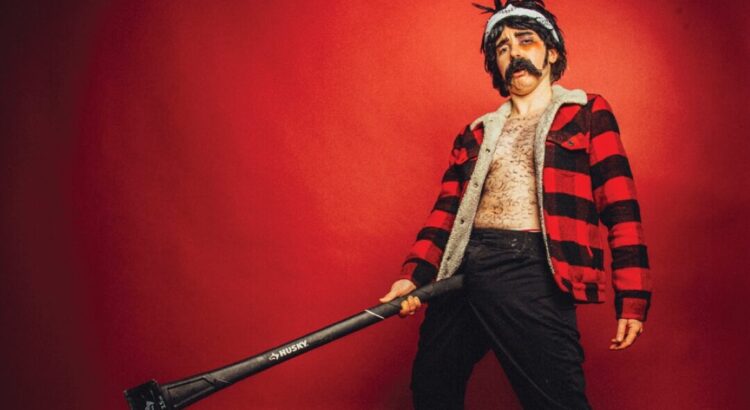
Created and performed by Natalie Palamides, Nate – A One Man Show is an hour long comedy performance that shocks and shines through the smoke of fake Marlboro cigarettes. Performing entirely in drag, Natalie becomes Nate: a shorter and overconfident look alike to the Brawny paper towel man who sports a cowboy mustache, black eye, and cargo pants. 

From start to finish, Nate shocks, disgusts, and humors the audience. Palamides plays an exhibitionist who demands applause and validation, and the audience willingly gives it up. As Nate quips, “bitches be thirsty.” And we sure are, drinking up every crude joke, racy pose, and can of free LaCroix that Nate hands out. 

Nate pouring LaCroix down his face to simulate crying
Nate pours a can of LaCroix down his face to “feel something.”

Speaking of liquids, beware the splash zone! Nate has a tendency to spray the audience whether it’s from the cans of LaCroix he shotguns or the shower he takes in a kiddy pool. I sat in the mezzanine thanking G-d that I wasn’t anywhere near the chaos of this show. Audience participation is voluntary, of course, but, as this show examines, consent isn’t always black and white. 

Throughout the show, Nate asks many audience members (and the stray mannequin) for consent to interact with them in whatever raunchy way the show calls for. Even a general liability waiver is signed at one point. Beyond legal documentation, the show’s usage of asking for consent highlights the grey areas in which we ask for and give consent. This important conversation, masked by comedy, asks more questions than it answers, leaving me with a sour, but welcome taste in my mouth. 

Behind the absurdity that Nate presents, lies a familiar, yet unstated debate: man vs bear. Recently a point of division on social media, the debate asks “would you rather be alone in the woods with a man or with a bear?” In this case, would you rather be alone in the theatre with Nate or with a bear? 

Maybe someday we will have answers to these questions. Maybe one day, it’ll be easier to be alone with someone like Nate in the woods. For now, though, Nate will continue to ride his toy motorcycle into theatres across the globe, and audience members will continue to drive their cars to these theatres to feel the weight of their jaws on the floor. 


If you weren’t able to catch Nate in Ann Arbor this February 5th-10th, you can watch Nate – A One Man Show on Netflix.

REVIEW: The Best Kept Secret: Student/Faculty/Alumni Art Exhibition

Walking through Best Kept Secret: Student/Faculty/Alumni Art Exhibition at the Stamelos Gallery, I felt that familiar rush—when art doesn’t just sit on a wall but reaches out and grabs you. Some pieces hit me immediately, demanding attention with their boldness, while others worked more quietly, drawing me in over time. What stayed with me were the ones that sparked something deeper—a sense of curiosity, nostalgia, or even discomfort. As an artist myself, I know how much intention goes into every brushstroke, every composition choice, and every texture. Seeing these works in person, I couldn’t help but think about what decisions led each artist to their final piece, how they balanced control and spontaneity, and what emotions they left embedded in the canvas.

Photo Credit: Mardigian Library

Aleesia Sciacca’s piece immediately caught my attention with its playful yet surreal composition. The smiling figure, rendered in what looks like thick, almost clay-like strokes, feels simultaneously whimsical and unsettling. There’s a childlike joy in the exaggerated, almost cartoonish elements—the floating hearts, the bright colors—but the presence of the knife, the dismembered arms, and the eerie face reflected in the table add a layer of unease. It’s a clever juxtaposition of innocence and something darker, which I admire. The textured, almost sculptural quality of the paint enhances the tactile experience, making me wish I could reach out and feel the surface. As someone who works with different media, I appreciate how Aleesia uses texture to enhance the meaning of the piece rather than just for aesthetic appeal.

Photo Credits: Mardigian Library

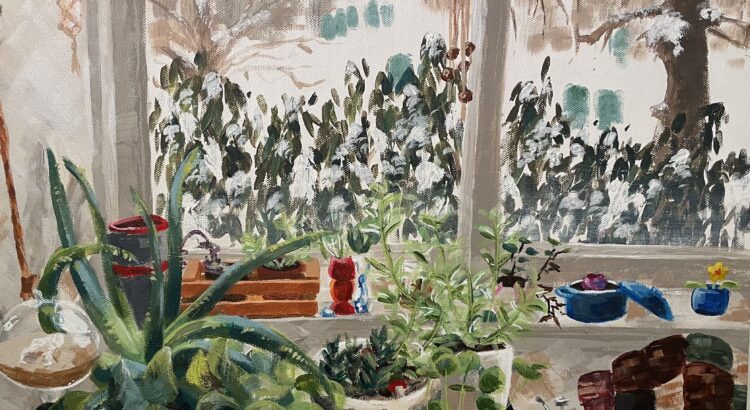
Paige Allen’s painting feels like a breath of fresh air—literally. It perfectly captures that quiet, contemplative moment of looking out the window on a winter day. The contrast between the lush greenery inside and the stark, snow-covered world outside is beautifully handled, both in terms of color balance and brushwork. The organic, loose strokes in the plants make them feel alive, almost growing beyond the edges of the canvas, while the background’s subdued tones keep the scene grounded. There’s a lived-in warmth to this piece, as if we’re peering into someone’s personal space. I especially appreciate the way light is handled here—subtle, diffused, natural. It’s not easy to capture the way winter light filters through a window, but Paige does it masterfully. This piece resonated with me because it feels like a moment I’ve lived—one of those in-between spaces of time where everything is still, yet full of quiet energy.

Dr. Madeline A. Berkay ’s charcoal drawing is raw and aggressive in the best way. The stark contrast, the exaggerated expressions, and the almost grotesque rendering of both figures make it impossible to look away. There’s a primal energy to it—two entities locked in an unrelenting confrontation. The creature on the left, with its snarling, exaggerated mouth, mirrors the human on the right, blurring the line between them. I find this fascinating because it challenges the idea of who (or what) is the real monster. The rough, almost frantic strokes add to the intensity, making it feel like this argument is happening in real-time. As someone who has worked in charcoal before, I admire the control Dr. Alexa has over the medium—it’s easy to let it get muddy, but she keeps the contrast sharp and intentional. This piece makes you uncomfortable, and I think that’s exactly the point.

Leaving the Best Kept Secret exhibition, I found myself replaying certain images in my mind, as if the pieces had imprinted themselves in a way I couldn’t shake. Each artwork spoke its own language—some playful, some deeply introspective, others confrontational—but all carried a distinct presence. What struck me most was the raw honesty behind them. As an artist, I understand how vulnerable it can feel to put your work out into the world, to let others interpret and dissect it. That vulnerability is what makes art powerful. This exhibition wasn’t just a display of talent; it was a glimpse into the minds of those willing to express themselves in ways that words often fail to capture. Walking out of the Stamelos Gallery, I wasn’t just inspired—I was reminded why we create in the first place.

REVIEW: Caroline Shaw and Gabriel Kahane

What does it mean to “be infinite”?

Though one could ponder this, well, infinitely, Argentinian short story author Jorge Luis Borges does so in seven pages in his 1941 work Tower of Babel, which inspired Caroline Shaw and Gabriel Kahane’s newly-commissioned Hexagons, presented by UMS. In Tower of Babel, we follow a nameless, elderly man through an infinite, hexagonal library. Each shelf has randomly arranged books, each containing exactly 410 pages. While most pages have no discernible meaning, other librarians allege that it could take just one book to reveal the library’s secrets, and thus, the meaning of life. A profound paradox about human nature and the finite time we have alive, I entered the auditorium excited to witness philosophy come to life through music.

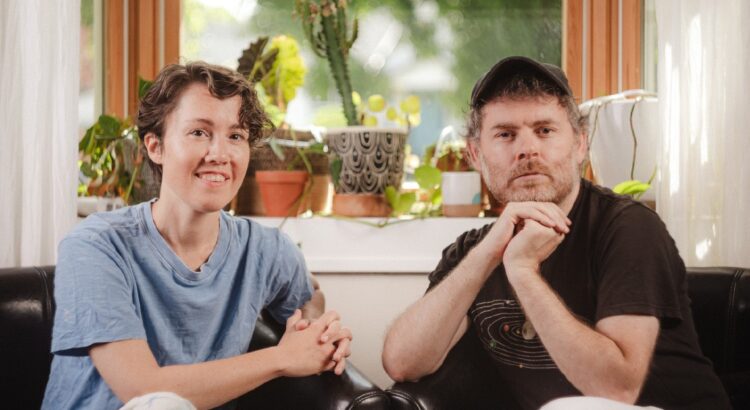
Kahane and Shaw had ideas to write operas about Borges’s text separately, a tension that remained musically unresolved on stage. While Kahane’s fascinating hybridization of singing and songwriting created mini-musicals, Shaw’s enrapturing yet foreboding vocal presence consistently grabbed my attention throughout, often waysiding Kahane entirely. While I marveled at the interplay between Shaw’s impressive choral singing and Kahane’s flowing piano melodies, which were undoubtedly virtuosic, the theatrical elements of the piece left much to be desired.

About halfway through, the performers pause, slowly producing two boxes of books. Placing them atop a desk near their instruments, they each switch on a reading lamp, and calmly begin pulling books from said boxes. Reading these random books aloud, they begin separately at first until the boundaries between their voices blur, and their words become more frantic, producing unintelligible chaos until they fall silent – a metaphor for a busy world that felt too on the nose for such experimental work. 

Perhaps my heart rests too heavily with Borges’s text, as the audible landscapes of Hexagons evoke feelings of restraint and nostalgia for a familiar past, than those of infinitude and unraveling chaos to find meaning I felt destined to hear. As Shaw longs,Oh, to be a blind librarian, I have lost any sense of connection between Hexagons and Borges and am bewildered by this dimension of longing for impairment. Furthermore, their decision to finish their performance with Kahane’s To Be American played into these notions of nostalgia that I found troubling. While they pined about escaping to the forests of Northern Michigan, I was left pining for something more than a personal requiem. The only seemingly infinite components of the performance were Shaw’s vocals cascading through the auditorium and my confusion. 

Hexagons rests at the edge of musical infinity: contemplative of the subject from a safe distance, yet not totally sure of how to manage the responsibility of creating aninfiniteperformance. As treasured books continuously become subpar movies, I am disappointed that the only meaningful dimension added to Borges’ philosophical text was music alone. Though I am excited by a future increasingly inclusive of experimental repertoire, my only hope is that it becomes a medium to embolden texts to exist beyond their pages — beyond the restraints of the written word itself, and within the infinite realm of music.

REVIEW: Babygirl

O Nicole Kidman, what can’t thou do? What heights canst thou not reach?

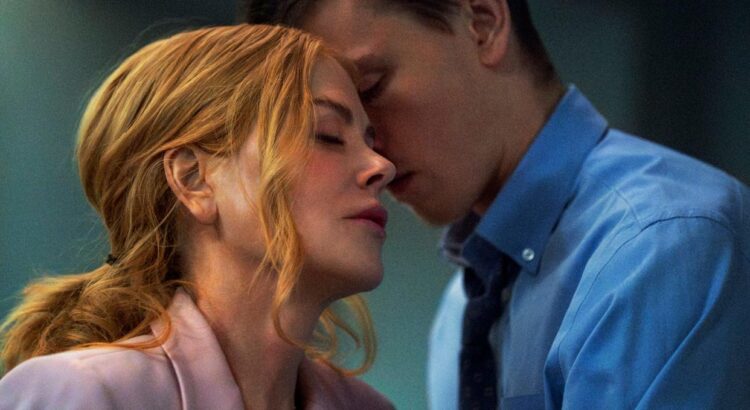
In Babygirl, Dutch director Halina Reijn is intent on liberating us unenlightened Americans from the shackles of shame and fear. Her modus operandi is to throw us headfirst into a world of dominance and submission, of power-plays and betrayal. Without pitch-perfect performances from Kidman and her costar, the sizzling Harris Dickinson, Babygirl would flatten into cheap comedy. Yet against all odds, this movie works, turning us on and teaching us a lesson all at once. 

It takes a special type of plot to have several people in the audience walk out halfway through the movie, one of them muttering “disgusting…” under her breath. Babygirl is sure to be repulsive, even offensive, to some people. The movie follows Romy Mathis – girlboss CEO of a robotics automation company, mother to two well-adjusted teenagers, and wife to an adoring husband (Antonio Banderas). Yet something is off in this charmed life. In the very first scene, Romy, after faking an orgasm with her husband Jacob, tragically and hilariously runs to another room and masturbates to cheap Internet porn. Romy has love and riches, but is hiding a shameful secret that is ruining her life: she craves submission in the bedroom. Samuel (Harris Dickinson), an enigmatic intern at her company, quickly sniffs this out. He draws her into an affair that she can’t resist, and the film snowballs from there. 

Although Babygirl received generally positive reviews, the negative feedback tends to point out that actually, Romy and Samuel are villains. “In a real-life scenario, Samuel would have been instantly fired,” says the Standard. The Guardian notes that as Romy conducts her affair, “Her poor husband…is left wrangling the kids and trying to direct his latest off-Broadway show.” NPR laments that the film “…feels out of touch with our post-MeToo era.” This criticism misses the point. Babygirl is a work of fiction, not a documentary. Its purpose is to lead us out of the noose of shame and into the open air of pleasure. 

For this reason, the scenes featuring only Romy and Samuel are the lifeblood of the film. In their first rendezvous, Samuel is unsure of himself but organically comfortable with giving orders. Go stand in the corner. Get down on all fours. Eat this strawberry-flavored candy out of my hand. “You’re mine,” he says without words. The scene is a potent mix of awkwardness and passion. It works because Samuel is neither a sadist nor a douchebag. Unlike the infamous Christian Grey, who “likes to whip little brown-haired girls like you because you all look like the crack whore—my birth mother,” Samuel wears his power well. Samuel knows what he’s doing. 

In another scene, a nervous Romy invites her lover to a fancy hotel room. She follows his directions, taking off her dress and getting on her knees in front of him. The scene changes, and suddenly it is Samuel performing for her, swaying to George Michael’s “Father Figure” as Romy’s eyes follow his body. This is the female gaze at its best, and Samuel is its perfect recipient. Here is someone comfortable in his own skin. Here is someone who knows that what he puts out will be well-received. Reijn’s talent is channeling just the right combination of danger and allure. Beauty, power, dominance – it doesn’t take much to convince the audience that these are virtues to be admired.

There are certain aspects of this movie that I think are superfluous. Reijn alludes to Romy’s childhood, which was apparently full of cults and gurus, in engineered EMDR therapy sessions. Romy’s assistant ends up discovering the affair and extorting Romy for a promotion. There is a girl-boss final moment that feels contrived. None of these B-plots are necessarily bad, but they’re a distraction from the central theme: what Romy wants and what Samuel can give. 

When the pair are inevitably caught, culminating in a violent altercation between Jacob and Samuel, Jacob is distraught that his wife would be enraptured by such cheap thrills like submission. “Female masochism is nothing but a male fantasy,” he mutters through tears. “No, you’re wrong. That’s a dated idea,” says Samuel, to the man he has just cuckolded. The people agree, Harris Dickinson. Give the people what they want. 

REVIEW: Thornetta Davis

Detroit royalty came to Ann Arbor last Wednesday.

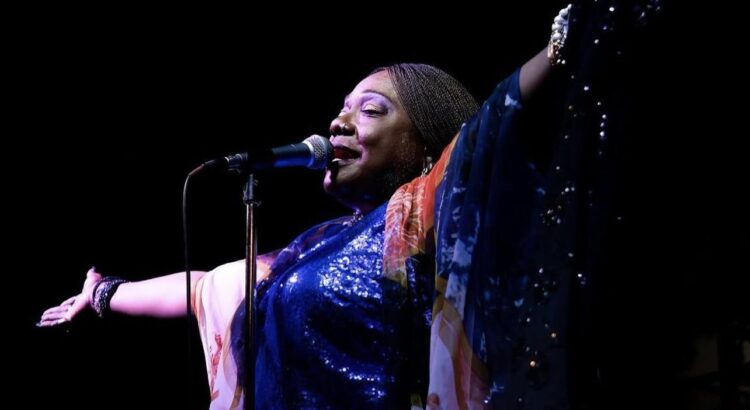
Thornetta Davis, Detroit’s Queen of the Blues, took the stage at The Ark alongside the Thornetta Davis Band, delivering a performance that brought the house down. 

I, along with everyone else in the packed venue, had the time of my life. Going into the concert, I wasn’t sure what to expect. I didn’t even know the difference between jazz and the blues (and, after my research, I’m still not quite sure). But the audience — mostly made up people several decades older than my friend and I — definitely knew. The excitement in the air was palpable, a shared anticipation that made it clear this was more than just another night.

When Davis finally stepped onstage, her black feather fans and sparkling outfit drew raucous applause before she even sang a note. She opened the concert with “I Gotta Sang the Blues,” a playful, self-assured song in which she explains why she sings the blues: “The blues ain’t been nothing but good to me.” The moment set the tone for the night: bold, soulful and full of heart.

Throughout the concert, Davis moved seamlessly between rollicking, dance-inducing numbers like “I Need A Whole Lotta Lovin’” – which included a call-and-response section that the entire crowd, except for me, seemed to know instinctively– and poignant ballads like “I Am America” which brought a standing ovation. But my personal favorite was “I’d Rather Be Alone,” which Davis concluded with a cheeky, resounding, “Bye!”

The crowd played a big role in the energy of the night. Though I might not have known much about the blues, the rest of the audience sure did. When Davis mentioned the musical group The Chisel Brothers, a woman in the front row stood up and proudly displayed her Chisel Brothers jacket. 

The intimate set-up of The Ark also allowed for effortless interaction between Davis and her fans, making for an electric yet personal experience. At one point, an audience member enthusiastically shouted that she owned not one, but two, of Davis’ CDs. The night was filled with dancing, clapping and joy, culminating in a final standing ovation that brought Davis and her band back onstage for an encore.

Speaking of her band, the Thornetta Davis Band radiated pure joy as they played. Each member had their moment to shine, taking turns delivering riveting solos from the drums to the piano to the guitar to the bass. The chemistry between Davis and her band was undeniable, with the music and her voice blending together so seamlessly that at times she felt like another instrument in the ensemble. 

I left the concert not only with a newfound appreciation for Thornetta Davis and the blues but also with a fresh sense of musical curiosity. The experience inspired me to seek out more concerts featuring artists I am not familiar with, to step outside my comfort zone and to embrace genres I’ve yet to explore. If this concert proved anything, it’s that great music — regardless of genre — has the power to bring people together.