PREVIEW: Tom and Jerry

Tom and Jerry is a classic TV show that began on tv in the 1940s. It is the classic tale of a cat and mouse outsmarting and chasing each other, with a classical music soundtrack, in a cartoon. And now, Warner Animations has produced a movie version! The movie follows Tom and Jerry in New York City, where Jerry has moved to a fancy hotel, and Tom has been hired to get rid of him. The classic cat-and-mouse battle ensues, and threatens to ruin a wedding, careers, and possibly the hotel itself. The movie got a 25% on Rotten Tomatoes, so I am excited to see how it holds up. Or I’ll just give it a serious critical eye!

I watched Tom and Jerry every Saturday morning as a kid, and I cannot imagine this movie turned out good. I am excited to critique it and compare it to the original Tom and Jerry!

The movie is available on Hulu now.

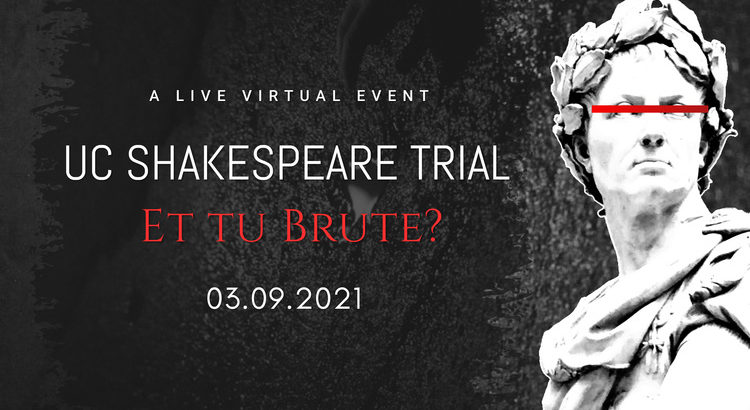
REVIEW: UC Shakespeare Trial – ‘Julius Caesar’

As a pre-law student who loves the arts and humanities, this event had me geeking out. In their third annual Shakespeare Trial, University of California at Irvine was able to expand their audience to people across the country like me who wanted to tune in to have a say in Marcus Brutus’ criminal trial.

“Friends, Californians, Zoomers, lend me your screens,” began the prosecuting attorney Dean Erwin Chemerinsky of Berkeley Law. Using the text of Shakespeare’s “Julius Caesar” as evidence, and California law as the foundation of the trial, the trial centered around two questions: 1) Is Marcus Brutus guilty of the murder of Caesar? and 2) Is Marcus Brutus guilty of inciting insurrection? Professor Bernadette Meyler of Stanford Law argued that Brutus applies for the necessity defense–that he was protecting himself and the Roman Republic from immediate harm by killing his dear friend Caesar.

Prior to the official start of the trial, we were treated to monologues from the characters of Brutus and Antony, performed by the talented actors of the New Swan Shakespeare Company, to set the scene and bring the characters to life.

Completely unscripted and organized like a criminal trial, I enjoyed watching the seasoned lawyers make strong, compelling arguments in front of The Honorable Andrew Guilford Presiding. Brutus’ killing of Julius Caesar, and whether or not Brutus applies for the necessity defense, is a heavily political question. During the trial, the attorneys were not afraid of using parallels to our modern times to create an understanding of the gravity of the situation. 

I loved the concept of courtroom as theatre, audience as jury, and the idea of exploring Shakespeare through legal inquiry. What I am so interested in, in my own academic studies, is the intersection between the humanities and social sciences. Because both are things created by people, they are interconnected and important to each other. What can we learn when we examine one with the lenses we typically reserve for the other? In this specific case, what can we learn from Shakespeare putting it in this new light? How does putting Brutus on trial cause us to look more critically at the play’s text and thoughtfully formulate our own opinions about the events that occur? 

At the end of the trial, the Zoom audience voted to decide the verdict via Zoom poll. It was decided that Brutus was guilty of the murder of Julius Caesar, and by a smaller margin it was decided that he was not guilty of inciting insurrection.

I’m glad that I was able to attend this event, and I encourage those of you who miss live arts events as dearly as I to look for amazing events that would normally be restricted to geographical location, that are now accessible through online platforms.

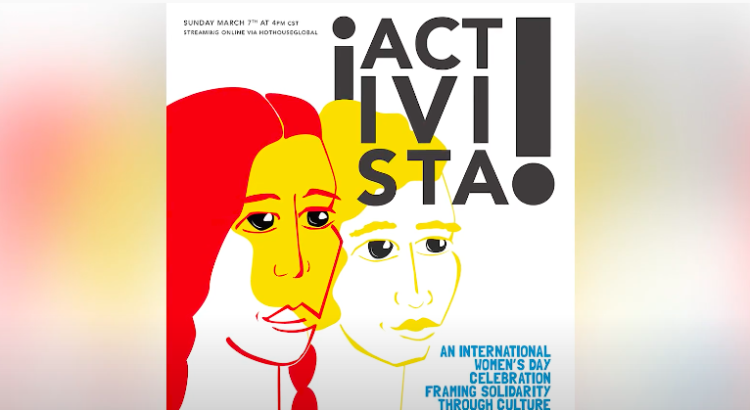
REVIEW: ¡ACTIVISTA! An International Women’s Day Concert

In honor of International Women’s Day, I attended the live stream of HotHouse’s “¡ACTIVISTA! An International Women’s Day Celebration.” A virtual concert comprised of musical performances, spoken word and poetry, and a bit of Q&A with some of the artists, ¡ACTIVISTA! was a wonderful arts experience. Live streams are one way to mindfully engage with the arts during the pandemic, and this one was a masterfully curated experience, hosted by Chicago-based organization HotHouse and publisher Haymarket Books.

Natu Camara

The artists featured in the performance came from all around the globe, and covered a wide range of topics from refugee rights to environmental justice to anti-colonialism. I truly enjoyed the blending of music and poetry performances during this event. Culture and vision wove through each piece of the performance, beginning with Farah Siraj’s haunting song honoring refugee women, written in Arabic, and ending with Kyung-Hwa Yu, a South Korean artist reviving the Korean stringed instrument cheolhyeongeum in contemporary music.

Angel Bat Dawid

A truly intercultural collection of pieces, there were a variety of languages represented in the art. There were poems in Spanish and Zapotec, songs in Sousous and Arabic. A painful song written about child marriage performed by the lovely Natu Camara and her band from Guinea. COLLECTIVA, a group of women who formed recently online during the pandemic to share their passion for music virtually and across oceans. One of my favorite moments from the concert was a thoroughly enchanting improvised bass clarinet solo by Angel Bat Dawid. Lyla June of the First Nations, with the gripping words, “they say that history is written by the victors, but how can there be a victor when the war isn’t over?”

Janel Pineda

It was a beautiful experience to watch these powerful women and their art shared together in a common space, in celebration and solidarity. I am reminded through these pieces that art can be expressive and lovely while also being a firm call for change. While extremely personal and masterful, these pieces also contain the seed of movement. They contain past, present, and future.

Available online to watch at: https://youtu.be/d4Cn6eCvSX8. Consider a donation, if you are able, so that HotHouse can continue to provide virtual concerts free of charge to viewers all over the world.

REVIEW: Raya and the Last Dragon

Raya and the Last Dragon is Disney’s newest film, and it has a lot of firsts for Disney: it is their first film to be inspired by Southeast Asian culture, it has a unique score, and it even looks and feels like a video game at times. But, despite these firsts, the film is quintessentially Disney. It features goofy side characters and has some corny dialogue, and its overall message makes it a Disney film at heart. The titular heroine, Raya, seeks the last dragon, who she hopes will vanquish the menacing Druun monsters that have been ravaging her home. Raya belongs to one of five tribes that had previously been united under the land of Kumandra, but were divided by the arrival of the Druun. Raya’s adventures take her through Kumandra, where she witnesses the widespread effects of the very monsters that have been devastating her own home.

The overall message of the film can probably be ascertained by this premise alone; audiences have a pretty good idea of what lesson the characters will learn early on in the film. As the runtime is just under two hours, the story and Raya’s development feel very simple. Perhaps the film could have focused exclusively on Raya and her foil introducing a kind of complexity and grey area Disney does not explore as often. That being said, the film is not overly predictable, nor does lack redeemable qualities.

Most of the film’s strengths are technical. The film features a beautiful soundtrack, with whimsical themes for the fantastical moments, and also lively themes to accompany the thrilling action sequences. It’s amazing to see how much Disney’s animation has evolved over the years as this film showcases some of Disney’s most exciting fight scenes to date. There is a battle near the end of the film that is flawless – Raya’s rage comes across so strongly just from the lead-up, locking audiences in for the actual fight.

Whenever Disney is praised for their diversity, it can always be called into question. The film’s creators took great care to travel to Southeast Asia as well as hire cultural consultants, however the majority of the principal voice cast is East Asian. East Asian roles in film are already minimal, but there are even fewer opportunities for Southeast Asian actors. Though the film celebrates Southeast Asian culture, the casting can come across as a misstep. The film is streaming on Disney+, which is not currently available in Southeast Asia. However, the voice of Raya, Kelly Marie Tran, is the first actress of Southeast Asian descent to voice a lead role in an animated Disney movie. Tran was harassed online by Star Wars fans following her breakthrough role in The Last Jedi, only to be written to the side in the trilogy’s conclusion. Despite this, Tran has persevered, and her determination makes her the perfect fit for the role of Raya.

Raya and the Last Dragon is imperfect, but it is a worthy film that teaches trust and forgiveness to kids in the most Disney way possible.

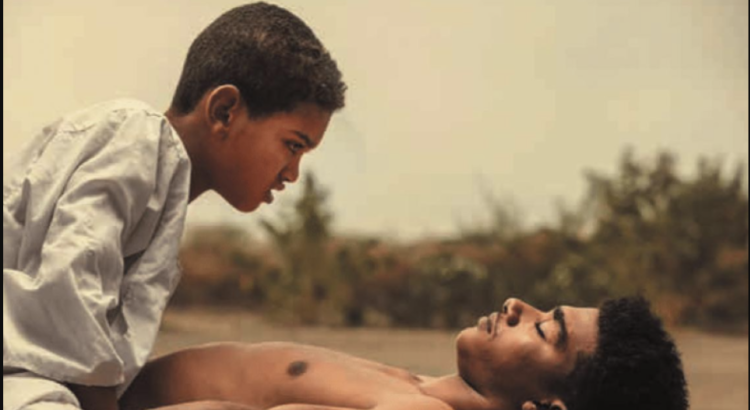
REVIEW: You Will Die At 20

Recently I’ve been thinking more about mortality; I guess I’m not old, but everything these days feels like a crossroads. They are each so definite, a fixed point in time that demands a decision, either by me or whatever fate or force controls me. For Muzamil, all other paths have been eliminated; it’s just a short, straight path to a certain end. It feels like there are a million hidden stops along the way; they come out of nowhere, they hinder, they allow you to pass. I don’t know what that is, but in the context of You Will Die at 20, I guess it’s the townspeople, everyone preventing Muzamil from living without severe restrictions on where he goes, what he does.

Having only a little time on Earth is supposed to increase the value of life. Knowing that it will end, likely before we want it to (or more precisely, before we’re adequately prepared for it to), should free us from monotony, allow us to respect each day as something special. But thinking about the ending inserts countless checkpoints, countless worries: are you eating healthy, exercising, getting your teeth cleaned regularly, had your flu shot, checking that your car mirrors are positioned correctly, getting your oil changed often, making enough money, making enough money to retire before you die, making enough money in case of an emergency? The stops expand a life, drawing out its borders infinitely. Now it’s too long, too much. Sakina numbers the days in chalk on the walls of a sunlight-slashed room, waiting for her child to die. The main difference in opposing views of mortality is the degree to which one accepts their end, no matter how untimely. There is mourning, and there is apathy. With each there is some ratio of fear to happy passiveness, the very worst kind of Punnett square. There’s not necessarily one option that’s the best, or least likely to ruin the psyche, but when something forces you into extremes, like a sheikh prophesizing your early demise, it can seriously alter your mental state for a startling amount of time.


The village, much like its residents, is almost totally austere: rather neutral tones but harsh surfaces, little life able to grow, stark. The amount of calm, steadiness, in the characters and their surroundings was unsettling, but of course that’s where the movie’s power is.Where there are richer colors, the contrast with their surroundings hurts to look at, makes you feel like crying no matter the subject of the scene. Excitement was always paired with doom, at some point down the line; there was always worry behind the beautiful points.

Most of the movie covers Muzamil’s 19th year, his last-ditch efforts at individualism, or just proving he’s alive. Early-onset death throes, the last dregs. If we lived more like that, tried to feel more, all of the time, would we be better or worse? As people, friends. Citizens, leaders. I’ll invite you to watch this movie and try to think about that. You can access it for free until March 17th.

You can find both in-person and at-home showtimes for the Michigan and State theaters here.

REVIEW: Unsettling Histories: Legacies of Slavery and Colonialism

Although it might be tempting, or even the norm, for arts institutions to uphold the veils that American and European art so often hold just for the sake of fitting aesthetics, the Unsettling Histories exhibit at the University of Michigan Museum of Art does just the opposite. Assistant curator Ozi Uduma has put together a remarkable collection of works that spark discussion- who is shaping the narrative, and what messages are they explicitly or subconsciously trying to portray?

When I first entered the gallery space, the exhibit seemed fairly conventional, with portraits lining the walls and several works occupying the floor space. The real impact of the exhibit stems from the descriptions alongside each work, each deliberately including the harsh realities faced by marginalized communities at the time, and forcing the viewer to reconsider the way they take in the work.

One such example is the oil painting Mount Hood from The Dalles by John Mix Stanley. From afar, I saw a simple idyllic landscape scene, which turned out to be not so innocent after all. The caption acknowledged how the stereotypes used in many of Stanley’s paintings played a role in encouraging removal of Indigenous communities to promote Western expansion. I remember feeling taken aback after reading the description and surprised that the painting could do so much harm, which just goes to show how effective the exhibit was in revealing the darker side of such works and the ways in which narratives can be exploited for harm.


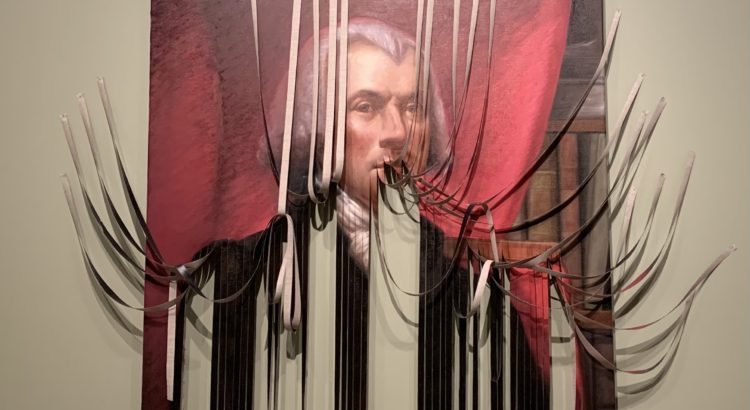
The entire collection was created in response to a work new to the museum, Flay (James Madison) by Titus Kaphar, which held the central position in the room, rightfully. To me, this work was the most impactful because it directly addressed the hypocrisy of America’s Founding Fathers in their mission to fight for freedom while they simultaneously owned slaves. The portrait of James Madison is cut into strips at the bottom, a reference to his position as a slave owner. Although I knew of the dark history of most of America’s founders, seeing it explicitly conveyed in a visual manner served as a powerful reminder about the truth of America’s history. This exhibition was an intense and compelling experience that I would highly recommend, and I feel like I walked away with a greater appreciation of the power of art and how it has been used to harm others in the past.