
REVIEW: Knives Out

Everyone loves to play detective. Whether it is investigating a particularly bad break-up or scrutinizing a suspicious rash, we are drawn to the mysterious, the unsolvable. We long to fill that blank where knowledge should be. We long to pull out that red thread and start connecting scraps of newspaper and random headshots, all precariously pinned up on a corkboard. We probe because we care and because we can’t help ourselves. We want the honest truth and nothing but. Rarely, though, are the answers as fascinating as the mystery. The boyfriend was a jerk. Web M.D. categorizes your deadly rash as common (How dare they!). You are left searching for the next great investigation. The mystery of the missing college essay, perhaps? Well, dear detective, search no further than your local movie theater, for I may have just the mystery for you.

Image result for knives out

A rich man is found dead on his 85th birthday. Cause of death: suspected suicide. His family is simply heartbroken. Or at least, that is all they will admit to the police detectives assigned to the case. Still, all clues seem to suggest that eccentric author, Harlan Thrombey (Christopher Plummer) died by his own hand. Case closed, time to get some donuts and coffee. Except…. hasn’t it only been ten minutes since the movie started? That’s the best trick of Knives Out, the one that makes you sit up in your theater seat and pay attention. It is a film most carefully paced. One that knows when to sprint with the audience and when we all need to catch to catch our breath. Knives Out doesn’t try to outthink its watchers, it wants to investigate alongside us. It is a sense of companionship that makes you feel invited into the mystery instead of merely being a spectator. Much of the credit for the warmth of this film must go to Rian Johnson, the writer and director. His script is clever and light on its feet, weaving its way between different characters and emotions. Yet, it never strays too far from the person that is undeniably its emotional center, Marta Cabrera (Ana de Armas).

For, mysteries are not only fascinating because they try our intelligence, but because of how they can squeeze emotion from our dried-up hearts. We come to care about those involved in the case. We sympathize with some. We accuse all the rest. Mysteries work because the audience is asked to dispense justice, distinguishing who deserves it and who doesn’t. Perhaps that is why it is integral for mysteries such as Knives Out to draw characters precisely. It must have a full idea of who each character is from the start but reveal aspects of that portrait at the right time. Too early and the puzzle clicks together before the popcorn runs out. Too late and the characters become inhuman pieces of a plot. Shrewdly, Knives Out chooses not to define its inhabitants directly. Instead, it allows each character to depict themselves first. Then, it chips away at that conceited image, revealing a truer picture underneath. Using visual cues and contradictory actions, the film allows us to discover who the heroes are for ourselves. Along the way, lies much intrigue and a considerable amount of fun.

Image result for knives out

So, dear detective, if you choose to take the case, beware of the enthralling charm of Chris Evans in a cable knit sweater. Perhaps, befriend the friendly gentleman detective (Daniel Craig) who loves singing Sondheim. There is a mystery afoot and you are just the one to help solve it.


PREVIEW: The Believers Are But Brothers

The Believers Are But Brothers is a production that I already know will stand out in my mind when I think of theater in the future. Showing tonight and throughout this weekend, this show portrays the radicalization of young men today, using multimedia techniques to illustrate what it means to become a politically-minded person in the internet age.


For a $15 student ticket, you can come see this piece something that will either be a great statement on the polarization political culture of the United States or a cheesy attempt at alt-right condescension. This piece is an important venue of self-reflection, not only in ourselves but in how our peers are digesting and translating an alarming sector of American culture– and more importantly, of youth culture.

PREVIEW: As Far As My Fingertips Take Me

Imagine what a lonely terror it is to lose your home to violence and instability, and then be cast into a stranger’s land. For most of us, this will never be our reality, but for the 70 million forcibly displaced peoples around the world, it is.

As Far As My Fingertips Take Me forces the subject to take on the identity of the refugee for a couple of minutes, reading the poignant writing on the wall and offering a nervous arm through to the unknown. This innovative one-on-one exhibit design incorporates the poetic and visual artworks of Basel Zaraa.

The work is the brain child of Tania El Khoury, a contemporary live artist known for her productions that illuminate issues that are of both the heart and political machine. This exhibit in particular has toured far and wide, gathering awed reviews from major publications like The Washington Post and The New York Times. 

The exhibit will be shown at the U-M Institute for the Humanities from January 24, 2020  February 2, 2020, tickets: ums.org. Be sure to arrive 15 minutes ahead of your showtime as the schedule is extremely strict.

REVIEW: NT Live: All My Sons

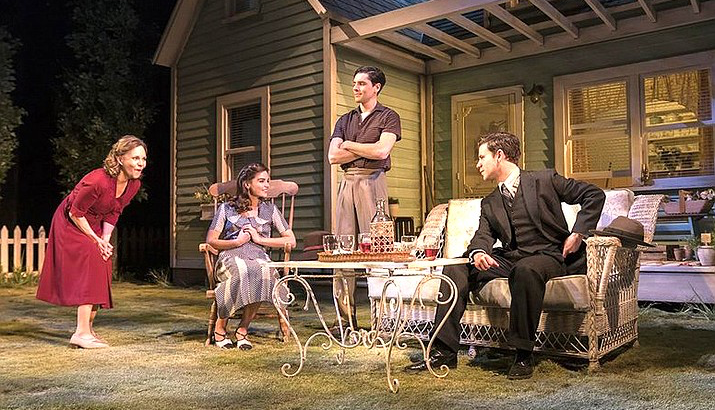
As always, the National Theater Live company put on a compelling show, paying tribute to our very own Arthur Miller, who attended the University of Michigan and even has a theater named after him on North Campus. The show is a classic, and it was well acted. Going into it blind, its twists took me by surprise and the way the play ended certainly shocked me. (Don’t worry, no spoilers!) This play aimed viewers’ attention much more on the acting, which was very different from the last National Theater Live play I saw, which was much more focused on the integration of acting, set, and costume.


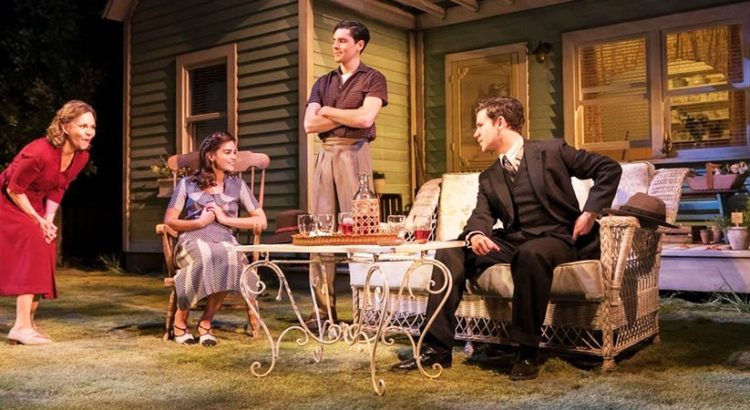
The show begins in the backyard of the family of whom the show is centered around. And then they stay there, in that setting, for the whole show. I thought that was a very interesting choice with both pros and cons. First, I got a bit bored of that same setting, and I had expected it to change after intermission. Also, there was certainly a limit as to what could be performed or shown on a stagnant set. Despite these possible setbacks, the show was full and interesting nonetheless. The play was less focused on anything besides the words and acting, and the actors brought that forward well. The acting was thankfully good enough to keep the show from getting boring, because the production was barely more than just the actors on the stage as the set was unchanging. On the pros side, this also meant that the set could be very detailed and specific because it did not need to be moved in any way. This style was unlike plays I have seen before, usually with moving sets and gaudy costumes, and it sort of surprised me, although not necessarily in a bad way.

As the actors had the most prominent role to play in a performance with a stationary set, they were definitely the thing I focused most on. I was impressed by the range of each actor, although I thought the men played much stronger than the women (other than Sally Field of course). Their emotions were certainly strong, but I was surprised that I was unmoved, and did not feel very attached to the characters. I did enjoy the performance of Oliver Johnstone playing George Deever, the frazzled and angry brother who unravels the whole lie that the Keller family is keeping. He was the actor whose story I bought the most into, and I felt his pain when no one believed his claims. I liked that the cast was very small, and I thought it helped to keep the focus of the performance on the story being told.

Overall, I thought the play was a little boring and drawn out. I do think that the intended audience was a bit older than me, judging by the fact that the majority of the crowd was above the age of 50. Perhaps if I had done some previous research to understand the themes better, it would have been a more enjoyable show. But, I did have a pleasant experience watching the play and enjoying the superb acting!

REVIEW: NT Live: All My Sons

Upon the uncertain arrival of their deceased son’s sweetheart, everything that has happened to the Keller family seems to be coming back all at once. The year is 1947, and we, the audience, are dropped into the backyard of Joe and Kate Keller’s family home. Since losing their eldest son Larry in the war, the Kellers and their remaining son, Chris, all have found their individual ways of coping with the grief that accompanies the loss of a loved one. Having found closure, Chris and Ann Deever, the once-sweetheart of Chris’s brother, both find in each other an opportunity to start fresh and build a life that is their own. From this comes a great heartbreak within Kate, who still refuses to give up the hope of her son’s return. Overshadowing these, however, is the reemergence of Joe Keller’s old secrets, and a new stirring of bad blood among Joe Keller and the family of Steve Deever, old neighbor and once-business partner who is now incarcerated for a crime that is still denied.

From the Old Vic in London, National Theatre Live presented an absolutely captivating production of Arthur Miller’s “All My Sons,” and despite the medium of live broadcast, the gripping performances and the quality coverage allowed for the entering-in of a truly epic yet intimate experience in classic theatre. Miller’s writing to this day stands as strong and compelling content that not only sparks the imagination of an audience, but introduces challenging themes and ideas that often act as convictions that remain ever-present.

Having seen “All My Sons” a time before this at a college level, I truly enjoyed comparing my two viewing experiences, and ultimately stumbling upon some new realizations. For example, a great theme that is touched upon is the notion that when one’s light of honesty goes out, they live in the darkness. From NT Live, there was a noticeably greater hopelessness in the atmosphere that was put forth, and the consequences of deep-seated dishonesty seemed to be made more resonant with the audience members. Entering into this play can be quite challenging to watch, for it’s not only pulsed with family drama and tragedy, but also a close look at how selfishness can lead to a chaos that tears family apart.

Two elements in this production that felt almost mis-matched in my mind were the contrasting tones from the characters of Chris and Kate Keller. While both actors performed their parts with great competence, the moods of the deliveries felt almost too distinct as Chris Keller delivered lines that were relatable and natural, while Kate Keller’s delivery held a wistful melancholy that often brought the peripheral activity to a thoughtful stop.

I frankly did not care for the pre-show short film that explored the production and cast perspectives on Arthur Miller’s work. One can very easily enter into this play without a production note that tries to persuade audiences that the content and themes are comparable with our economic climate today. A great work of art such as this can often tempt those involved to feel as though “this story needs to be told, now more than ever,” but a work’s timeless quality is cheapened when a seemingly self-righteous view of current events is present.

With a paced beginning up until a truly-climactic ending like a contemporary Shakespearean Tragedy, NT Live’s “All My Sons” had me on the edge of my seat, entranced by the scope and intimacy of this show. I left the Michigan Theatre with adrenaline pumping through my veins, anticipating the next show from National Theatre Live that I hope to one day experience.

REVIEW: No Safety Net Student Kickoff Party

My companion and I arrived at the event 30 minutes early, as there was advertised free food 30 minutes before the performances began. I commend them on the choice to provide Jerusalem Garden, as this is a delicious caterer and the food was accommodating for different dietary restrictions (unless you hate all vegetables). While the space was not exactly ideal (there were almost no places to sit), we waited patiently for 30 minutes for the performances to begin.

It was not an issue that the Canterbury House is a small venue, because the crowd was small as well and got smaller as the performances continued. This might have been a good thing, because the performances got stranger and more unique as the night went on. However, I did not enjoy sitting on the floor for 2 hours, not counting the fact that most people actually stood for most of the evening, which I am sure was uncomfortable. Fortunately, the performances were interesting enough that it was bearable to not have seating for the audience.

The first performance was an improv group, The Midnight Book Club. They were very funny, taking a suggestion from the crowd and rolling with it, as well as doing continuous scenes that circled back around each other in ways that kept the audience’s attention. Their performance went by quickly, as it was well executed and purposeful. The second performance was a young woman who rapped, made her own beats, and sang. I did not enjoy this performance as much as I liked Midnight Book club, perhaps because I enjoy improv more than rap music, but also because I did not find her to be particularly talented. However, I could appreciate her rhythmic style and lyrics, even though her overall performance was not to my taste. The third performance was spoken word poetry by a man in gorgeous eyeliner. His poems were sad, and full of gorgeous hyperbole and symbolism. He spoke very fast, however, making it hard to hear every detail, and I wish I had been given a copy of the poems to look at more closely so I could understand all of the deep insights he was making. The final performance was definitely the most eccentric one of the night. The group was advertised as an improv music group, so I assumed it might be a little bit jazzy, or something similar that would round out the evening quite nicely. Instead, I was met with a cacophony of sounds that I would definitely not define as music. This group all played instruments, but they were not playing them together. When the saxophone player started wailing and making crying noises through the mouth of her saxophone, I knew that the group was much too interpretive for me. At a point or two, they seemed to all come together slightly and play as a group, but most of the time I was just confused as to what the mood, goal, or sound the group was trying to produce. It was certainly a performance I will not forget anytime soon.  Maybe that was their goal!

Overall, I do think it is very refreshing to watch small student groups perform when I usually only watch full out, professional shows. While the evening’s entertainment may not have been exactly what I had expected, I certainly am glad I went, at least for an interesting story to tell other people.