REVIEW: Little Women

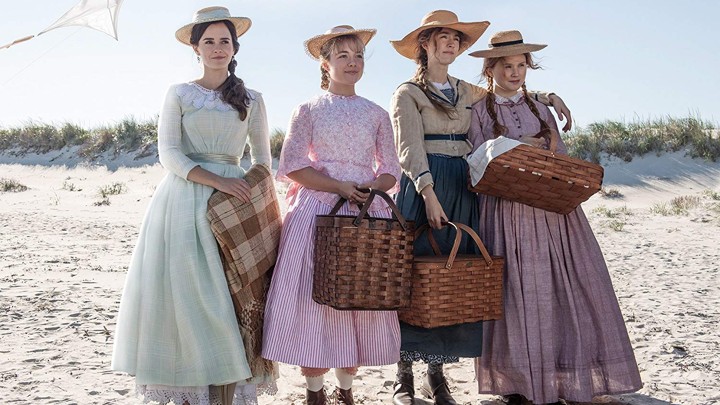
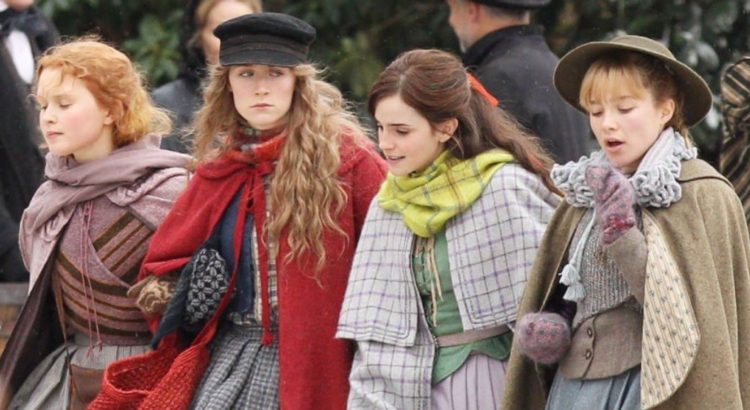
Little Women was a highly enjoyable (if somewhat saccharine) film. I wasn’t previously familiar with the novel, but after seeing this I looked into the source material and previous adaptations to contextualize what I saw. Ultimately, I think Greta Gerwig did a pretty good job at grounding and animating a PG story that has been told many times in many different ways.


Gerwig notably changes the plot structure in this version of Little Women, using the non-chronological order to reflect interesting parallels from the sisters’ childhood and adulthood. I found this be effective in conveying themes and character development, and with that, it also reflects Gerwig’s thorough understanding of the text. The ending, in its own meta way, acknowledged the fact that Alcott never wanted to marry off Jo’s character–in the same way the author herself never married. As much as I appreciate Louis Garrel’s work, I somewhat wish Gerwig took the final step of just eliminating his character and the convenient marriage ending for Jo. At the same time, though, I still can appreciate the awareness and nods to Alcott’s intentions reflected in Jo and her discussions with her editor.


There were many actors and actresses I like in this film, but I was surprised to find that Florence Pugh had the best performance of them all. This is the first time I’ve seen her work (to be fully transparent, I’m just too squeamish for Ari Aster’s movies), and I found her to inhabit Amy in a very believable and watchable way. Sometimes her performance honestly contrasted the others to their detriment. Maybe this is due to her character being more traditional, but Emma Watson’s Meg seemed a lot less three dimensional compared to Florence Pugh’s Amy. Lastly, I thought Bob Odenkirk as the father of the March family was an interesting casting choice. His comedic presence precedes him for me personally, so seeing him inserted into this drama felt like an act of satire. While that took me out of the story a little bit, I think it also created this meta-textual feeling that this adored father figure as a cornerstone of the family is a joke. The older March sisters and their mother are the ones actually sustaining the family, so at the end of the day, I think that choice (if it was an intentional choice) and that new meaning was smart and added another layer to this generation’s adaptation.


Little Women is an enjoyable film that makes you consider the nature of adaptation when one takes a look at the many, many other versions over the past 100 years. It’s interesting to use this text as a way of diagnosing society’s changing attitudes towards women and feminism, past simply its utility as a warm story of family and love. I highly recommend seeing this film and doing a little research into this culturally significant story and its implications through time.



REVIEW: Take Your Pick: Collecting Found Photographs

Take Your Pick: Collecting Found Photographs, currently on view at the University of Michigan Museum of Art, is no ordinary art exhibit. Consisting of 1,000 found photographs from the private collection of Peter J. Cohen, it challenges viewers’ own definitions of what is art and what is not.

The photographs on display are distinctly human in that they capture the ordinary moments, places, and milestones in the lives of the people shown, or the person behind the camera. Since the images have no context, I felt a bit like I was looking into the photo albums of a stranger, and it was almost like I shouldn’t be there. Who knows what the personal significance of each of the photographs were to those who captured them or kept them, and what right do I have to be looking at them on a museum wall? While some depict weddings or similarly obvious events, others capture moments whose importance is unknown to museum-goers, provoking the imagination.  Many have people in them, while others show landscapes without anyone in sight, though the presence of the photographer can be sensed on the other side of the camera. A select few have captions scrawled in the margins or even across the photograph, documenting the images’ contents. Probably most strikingly, none of the photographs in the exhibition were ever intended to hang in a museum, but visitors can vote on their favorites to join the UMMA permanent collection.

On another note, the photographs are, as the exhibition description points out, a byproduct of an era that has now passed, and I found it quite interesting to consider this while I looked at them. Fifty years from now, what will the footprints of normal lives from today look like? Most photographs only ever exist in the digital sphere, after all, and so they will not be sitting out at flea markets in dusty old boxes. In this respect, Take Your Pick has an almost history museum-like quality.

I especially enjoyed the opportunity to vote on my favorite photographs, and this opened a whole new question: how is one photograph more deserving than another? Since I had no answer to this, I selected the images that I found most interesting, or evocative, or beautiful. I’ve included a few of my favorites in this review. Perhaps the point is not to judge or appraise each image, but to simply be in the moment, surrounded by the photographs’ humanity.

It’s not too late to cast your own vote, since Take Your Pick: Collecting Found Photographs since voting continues through January 12, 2020. You could also get a snazzy “I voted at UMMA” sticker! After that, the final selections to join the museum’s permanent collection, based on the voting tally, will be on view from January 14 through February 23, 2020.

REVIEW: Terrence Malick’s “A Hidden Life”

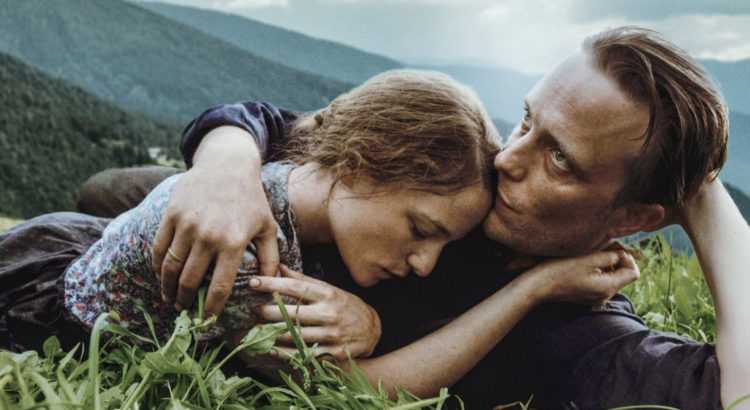
If we are given a free will, what we are responsible for? Terrence Malick’s A Hidden Life is a meditative narrative that journeys through such a question. The beauty of Malick’s work lies in his consistent demonstration of deep meaning  through intricate layering, stunning cinematography, and an eye for the simple and the remarkable.


The true story of Franz Jägerstätter is of an Austrian farmer who conscientiously objects to joining Hitler’s fascist regime in World War II, undergoing bitter persecution and ultimately execution for such a stance. Throughout these trials, his deep faith in God and pure love for his family continually prompt an examination of conscience that progressively solidifies his inner call to honor the sanctity of all human life.

While this story of Franz Jägerstätter is considered to be Malick’s most sequential film to date, A Hidden Life goes deeper with what I would call a non-sequential analogous portrait of Christ’s Passion from the New Testament. As the audience follows Franz through his suffering that leads to execution, we are introduced to several characters that serve as representational figures of Jesus’s Passion: a judge as an interrogative Pontius Pilate-type, a taunting soldier, and Franz’s lawyer who acts as the Last Temptation of Christ, reminiscent of the Martin Scorsese film of the same title. Franz demonstrates that if we are given a free will and are capable of choosing the good, all actions, even controversial and solitary ones, have meaning. By refusing to swear any sort of public loyalty to Hitler, he sacrifices his life and the joys of home yet to come.


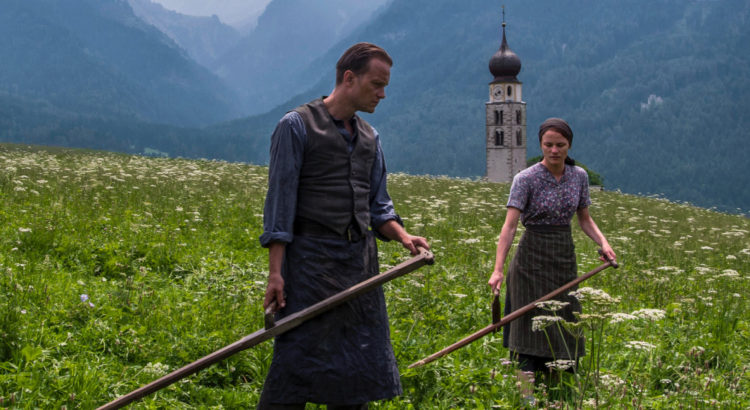
It is from this, however, that this film explores the dueling natures of freedom and captivity through juxtaposing sequences of Franz’s captivity with shots of his once-sublime home life. Malick captures leisure, family life, and earnest work to be simple and good, all in a truly atmospheric fashion that serves to encapsulate true freedom to live and love well. Having fought the good fight, Franz is executed. A final, long shot of him riding his beloved motorcycle home serves to represent the eternal resting place to which he journeys on. This film possessed an organic perfection that I have not encountered in a very long time. Suspended at the closing shot of our film, and still hanging in my mind, are George Eliot’s thoughtful remarks from Middlemarch:

“The growing good of the world is partly dependent on unhistoric acts; and that things are not so ill with you and me as they might have been, is half owing to the number who lived faithfully a hidden life, and rest in unvisited tombs.”

PREVIEW: Little Women

Little Women is the story of a group of sisters in the mid-19th century all trying to find their place in the world. The film is directed by Greta Gerwig, whose previous work Lady Bird proved her to be a highly insightful and skilled director and writer. Lady Bird also featured actors Saoirse Ronan and Timothée Chalamet, and so to see these great creatives working together again gives me great confidence that Little Women will definitely be a film worth seeing over this winter break, even (especially?) if its trailer portrays it to be slightly sentimental.

REVIEW: Knives Out

Knives Out is fantastic. It’s funny, clever, well-written, and well-directed. None of the humor is forced, cringy, or cheesy. Many of the jokes reference present-day trends and politics, but it never seems like writer-director Rian Johnson is trying too hard to make the film relatable to the audience. Although the film does follow a classic whodunit formula – discovery of the crime, interviews with the suspects, the following investigation – its premise is very original. The way the events pan out are creative and unexpected. The story itself is very tight and clean; there are no gaping plot holes as the film literally explains everything. Everything that happens was previously hinted at, but everything is very subtle and keeps the audience engaged as a result.

The film would not have been nearly as good if it weren’t for the actors. Every member of the Thrombey family is unique – distinctive – and they all shine in their own ways. Chris Evans came across as over-the-top in the trailers, but in the context of the film, he fits right into the ridiculousness of the Thrombey family. The family dynamic is so fun because all of the characters are so eccentric. Jamie Lee Curtis plays the eldest of three who all benefitted from their father’s tremendous wealth, and her character insists that she started her company from the ground herself, and that her husband works for her. The two youngest members of the family, a juuling feminist and an active member of alt-right twitter, provide underrated and entertaining interactions. My personal favorite member of the family was Toni Collette as a lifestyle guru and essentially Gwyneth Paltrow.

The biggest standouts of the film were the two leads, Daniel Craig and Ana de Armas. Craig plays Detective Benoit Blanc, who has a strange southern accent that somehow works. His character has some of the best lines, including a comparison between a will reading to a tax return by a community theater and a long monologue relating donuts and donut holes to missing evidence. On the other hand, de Armas’s character is much more unassuming, but rather than being a stereotypical Latina maid, she is the heart of the film. Marta is charming, sweet, sly, and ruthless all at the same time. De Armas’s performance shows that she is an actress to be on the lookout for. Since moving to Hollywood where she immersed herself in English lessons, she has starred alongside Robert De Niro, Jonah Hill, and Ryan Gosling. De Armas has spoken about her being able to relate to the character of Marta – both wanted a better life for themselves and their family.

It’s clear that writer-director Rian Johnson took great care in creating the character of Marta, and into allowing a newer actress to shine alongside some of the biggest names in the movie industry today. It’s clear that all of the actors had a blast on set, and it’s impressive that Johnson was able to create a film that is both character and plot driven. Johnson could have easily channeled his efforts into one aspect or the other, but instead he was able to weave absurd characters into an outrageous storyline, resulting in a film that is nearly, if not flawless.

REVIEW: A Hidden Life

A Hidden Life, at its core, is the story of a man that refuses to swear an oath of service to Hitler. Beyond this guiding plot point, though, this film displays and questions important themes found back then and now. Ideas like the effect of the individual, the meaning of citizenship, and the value of morality are abound in this movie, and I enjoyed the way they were explored: openly and with a steady pace.


A specific aspect of the film that I found interesting was the language choice. The setting changes between Austria and Germany, and both English and German are used throughout the film. Ultimately, to me, it looks like English was just used for contemplative voice overs and when necessary in the plot. This was really intriguing, as you would experience characters speaking both languages. I don’t speak German, so piecing together the German and English-speaking sides of each character added another layer to my closeness to and contextualization of these characters. Another aspect of this language choice was that (outside of plot-essential points), the Nazi figures in the film pretty much just spoke German. It’s definitely a different effect to hear prison guards screaming abuse in German rather than English– this had me thinking about how Americans conceptualize and stereotype the German language. Not to say the director was trying to do anything more than stay historically accurate, but there’s definitely a certain public cultural memory that’s accessed with the German language being used like that.


Terrence Malick’s form of storytelling may not be for everyone, but I find the contemplative and non-linear aspects of his work to be the most compelling. Shots move in thoughtful, visually challenging ways that aren’t afraid to linger and create highly meditative moments. The beautiful Austrian mountains and a gritty Berlin prison offer two central settings that aren’t hard to make visually intriguing. That may be true, but by the end of the film I found myself taken by the sense of place achieved by Malick. When the setting returns to the lush hills of Austria, one feels the heartache of home. When one re-enters the prison setting throughout the film, one feels the tension of the compound. The places created in A Hidden Life are transferred quite vividly to the viewers’ minds, and thus create an intense, seemingly intimate understanding of the aura and symbolic relevance of the place.


I encourage people to see this film, to take the time to let Malick’s world swallow you whole, and to experience the cerebral yet very grounded and real work he has created.