REVIEW: Black Christmas (1974)

Before seeing Black Christmas (1974), I thought that the market for Christmas-themed movies was already saturated with titles. Having seen this film, I’m convinced that Christmas scripts face far less scrutiny than their non-holiday affiliated counterparts. Scary Christmas? You got it. Action hero Christmas? Easy. Low budget Thanksgiving-Christmas-New Years romcom with live action reindeer flights and pyrotechnics? Why not. As far as holiday movies go, Black Christmas, without a doubt, is one of the strangest and most unique titles that I’ve ever seen.

Initially, I decided to see the movie because I was very, very curious to see how Bob Clark blended two seemingly opposed themes: slasher violence and Christmas cheer. I didn’t really expect a masterpiece in Black Christmas, but the film pleasantly surprised me. Instead of getting the wacky, shocking-for-all-the-wrong-reasons hodgepodge that I’d thought the film would be, Black Christmas turned out to be a palatable slasher film with great acting and thoughtful set design.

Although the title of the film is Black Christmas, the character of the picture is truly that of a horror movie, as the plot could absolutely stand on its own legs without the help of holiday synergies. Further, the film truly embodies the spirit of the classic 70’s Slasher: the deranged killer constantly calls the landline to make threats to his victims, the murders are overwrought with gore, and the real identity of the maniac is concealed throughout the entire film. If you enjoy the unsophisticated rampages of Jason Voorhees and Freddy Kreuger, then you’ll surely appreciate Black Christmas.

Additionally, the film contains a few genuinely hilarious moments that occur at very well-timed intervals: the script actively provides for moments of levity, usually using supporting characters, while retaining the emotional gravity of the situation. As such, the movie has a great balance of different character types: instead of relying on the protagonist or the antagonist to provide moments of emotional color outside of their respective arcs, the supporting characters Black Christmas are able to provide humor without compromising the suspense of the plot. I especially appreciated the film’s usage of mischievous characters and painfully cringey situations.

While Black Christmas didn’t disappoint, it didn’t really impress. No single aspect of the film fell short of my expectations, but the overall lack of originality in the movie served to significantly constrain my opinion of it. I was hoping that Black Christmas would have integrated more “Christmassy” paradigms into its plot, but essentially, the movie is a standard Slasher-horror film neatly wrapped in gingerbread wrapping paper. Instead of drawing inspiration from both thematic centers to create a completely original idea, the film just, albeit cleverly, mixes the two distinct film styles. It’s weird, kind of scary, kind of funny, and a great conversation starter. If you have time, give Black Christmas a go, but if you don’t, you’re not missing out on a whole lot.


6.3/10
REVIEW: Marriage Story

I didn’t expect this movie’s main plot to follow the legal process of divorce. To be honest, I thought it would follow their falling in love, too. Be warned, there is none of that kind of heartwarming. But the movie still finds a way to feel loving and even a little uplifting to me.

It’s quite a feat, since the movie really is about the technical process of divorce. It shows the difficulty of finding lawyers, the cost (ironically at the expense of the child’s savings), and the frustrating double levels of communicating through lawyers and face to face. I might think a movie about the legal system would be dry or boring. I didn’t.

I read that the director based it off of his own experience with divorce and his child. I can tell! All the examples of when the kid wanted something different than what his parents had planned felt real, because how frustrating is that? One scene shows Driver flying all the way from New York City to L.A. for a little time with his son, but his son doesn’t feel like going with him. But who are the parents to tell the child what he should want, really? All to do in their position is be patient, but I completely sympathized with them in those scenes about how hard that can be.

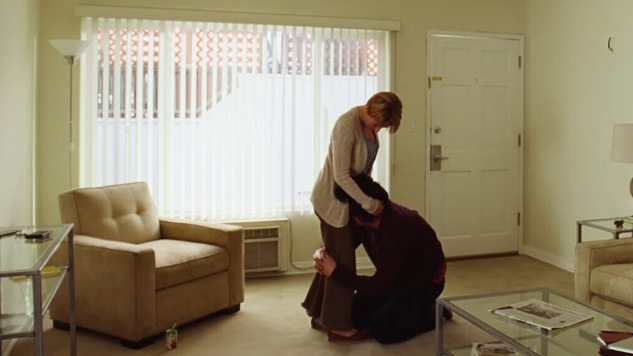
The part that felt the most realistic to me, though, was the scene that a lot of people are talking about. It’s the ugliest, most shocking scene, when Adam Driver and Scarlett Johansson (the parents divorcing) are fighting in his apartment, frustrated with each other about this process they’re going through. Both of them are spitting, tears rolling, noses running, yelling their worst at each other at the top of their lungs. The image at the top, here, is from the end of the scene.

Before Driver collapses at Johansson’s feet, he yells the worst thing imaginable at her: “I wish you were dead.” Without the right lead up about Driver’s character, he’d become a monster. With a disgusted response from Johansson, he’d become a monster. It seems like the hardest needle to thread, avoiding vilifying Driver, but the movie does it. I actually feel closer to Driver’s character when he says it.

How is that possible? The movie succeeds so much at convincing me that both of them love each other, and that makes me think that’s why they’re so thrown for a loop, so out of sorts. Sure, they have a different kind of love than what keeps a family together, but some kind of love, nonetheless. He’s grieving the end of their relationship. Driver immediately regrets what he said, is disgusted with himself, and apologizes; Johansson forgives him without hesitation. She knows how he feels. However oddly, they’re on the same page. And the movie ends with an even stronger sense of their being on the same page, despite how sure they are about divorcing.

My review is, please watch this movie. It feels like an authentic account of parents separating. More than that, it highlights parts that other movies and stories aren’t bold enough to try–the ugliest parts. In a world where divorce happens all the time around children, I think we could stand to be generally better emotionally versed about it for these kids. Even prepared to be these parents, to some extent. I’m writing as one of these kids, but I think there are plenty of other ways to relate to these characters. I say we make more movies like this one, making sense of love in marriage and divorce.

REVIEW: Waves

Waves is a complicated and untraditional work, but at the same time, it left me hoping for more depth. I should say now that this review is riddled with spoilers, so if you haven’t seen it I highly encourage doing so as the film unfolds in a unique and unexpected way.


So the essential plot of this film is that a suburban family copes with the oldest son, Tyler, murdering his pregnant ex-girlfriend, Alexis. There are two halves to this film: the first, detailing Tyler’s downwards spiral that leads him to being sentenced to life in prison, and the second showing the family (namely his sister Emily) coping with the effects of the first half.


To begin with the things I liked about the film, I think it’s very well-made. The camerawork specifically at times pulls off these fluid movements that really accentuate the action of the movie. The cinematography made me personally reflect on the the unique options a lot of films just don’t take a risk on in the way Waves does. The soundtrack to the movie is also used in an interesting, borderline Baby Driver kind of way–however, a few tracks were some of my favorite songs and did take me slightly out of the movie, though I guess that’s a me problem (just an example, I found myself chuckling at the use of “IFHY” by Tyler, The Creator as Tyler punches a hole in his wall out of rage…Tyler, The Creator’s music has such a sense of humor to it for me it just really didn’t match the intended effect). Using contemporary music simultaneously allows for a special kind of relation to this work for audiences and puts a time-stamp on the piece in a meaningful way, so ultimately I place this artistic choice as a net-positive on my experience.


The structure of this film is unique. It is composed of two halves when I didn’t know it would be two halves, thus leaving me waiting after the climax of the first half for the film to end–I thought I was watching a prologue. And it’s clear why I felt the structure to be jarring; these two halves are like two different movies. I couldn’t help thinking as I left that theater that this movie felt like the result of a filmmaker wanting to make a sequel (or even a trilogy) of films, but could only make one. The style of the first is heavily contrasted by the second, and yet overall I do think it could have worked. I understand this choice as the focus and tone of the story really shifts, but in the end it didn’t all come together for me due to a disparity of depth in the two halves.

The first half, to be honest (and a little mean), was like a stylized after-school special. “The popular, handsome star athlete gets an injury that puts him out of his identity-defining sport so he turns to his dad’s painkillers and alcohol and also his girlfriend gets pregnant and wants to keep her baby so they break up and in an alcohol and drug-fueled rage he kills her at a prom-adjacent after-party.” I have no issue at all with this story being told (and honestly, I’m still trying to diagnose how much I oppose this half because he’s a highly masculine athlete). I think adding depth to cliché concepts like this one (as much as it makes me feel like a bad person to say this tragedy is a cliché) is a totally worthwhile effort. The issue here is that I feel like I never really got inside Tyler’s head; there’s nothing especially dynamic going on character-wise. It felt pretty surface level and I found myself feeling very little for him.

Cue the next half of the film, as Emily finds a way to escape the alienation her brother caused and the family as a whole tries to reunite. Again, maybe I just relate more to the quieter Emily, but this half had so much more going on, emotionally. (Which doesn’t make sense due to all that’s happening in Tyler’s story!) I felt like the overall performances were better and the plot took more intriguing turns in this part. (I also have to mention that Lucas Hedges is now exonerated from my previous contempt, between his role in this section of this film and Honey Boy.)


Waves is a good, interesting film. Maybe my issues with it are just a negative interpretation of artistic choices, but at the end of the day I personally felt it was a beautiful but slightly lop-sided film.

REVIEW: Star Wars: The Rise of Skywalker

The final installment in the Star Wars sequel trilogy starts where The Last Jedi left off, meaning it starts off where The Force Awakens left off. I’m no The Last Jedi hater, but if I’m being honest, not much happened in that movie. At this point, Rey is still figuring out her powers and who she is, Kylo Ren is still figuring out if he’s completely evil, and Leia has again enlisted the help of Finn and Poe to thwart whatever diabolical plan the First Order has just set into motion.

The Rise of Skywalker has terrible reviews. It has a 58% score on Rotten Tomatoes, compared to The Last Jedi’s 91% – the same The Last Jedi that is perhaps the most polarizing episode in all of Star Wars. Still, The Rise of Skywalker does have an 85% audience score. Going into the movie, I thought, “There’s no way it can be that bad.” And I was pleasantly surprised! As a whole, I truly enjoyed The Rise of Skywalker. That being said, I did have some issues with it.

First, there is one spoiler that made me turn to my friend in the theater and ask, “Was that really necessary?” It is just one thing that the film doesn’t linger on for very long, but at the same time, that just goes to show how unnecessary it was. Crossing out of spoiler territory, it should come as no surprise that there are some fights and action sequences that involve the use of the Force. Unfortunately, these battles aren’t always terribly exciting as they just involve people pointing their hands at each other. It’s kind of the same deal as Harry defeating Voldemort in The Deathly Hallows – hair is being blown back, clothes are rippling, the two sides are clearly straining with effort… but they’re also just standing there. Overall, the action isn’t this movie’s strongest point – the last battle is mindlessly chaotic and difficult to follow.

Perhaps one of the strongest aspects of the film is that we finally get to see the main trio come together. Unfortunately, up until this film, the main trio of Rey, Finn, and Poe didn’t really feel like a trio. In the prequels, it was clearly Anakin, Padme, and Obi-Wan, and in the original trilogy it was clearly Luke, Han, and Leia. Even though there were pairings within the trios – Anakin and Padme and Han and Leia as the couples, Anakin and Obi-Wan and Luke and Han as the close friends, and Luke and Leia as the twins – it was clear from the beginning that there was a main trio. In the sequel trilogy, there was a bigger emphasis on Rey and Finn in The Force Awakens, which makes sense as Poe was supposed to be killed off initially. Still, Rey is separated from the other two throughout nearly all of The Last Jedi, which is a shame as her character didn’t even get much significant development from her solo quest. Furthermore, the sequel trilogy established strong relationships between Finn and Poe and Finn and Rey early on, but Rey and Poe don’t even meet until the end of The Last Jedi. But, in The Rise of Skywalker, they do have a unique relationship full of banter and a mutual love of BB-8, and as a result, it’s clear both characters and Finn have a place in the main trio.

Ultimately, The Rise of Skywalker is not a bad movie. Sure, I had my issues with it (I didn’t get to talk about the criminal underuse of Lupita Nyong’o!!), but it is still a fun film. I don’t feel an immediate need to re-watch it like I did with The Force Awakens, but I think it’s still worth seeing in theaters. I would just recommend going in with an open mind.

PREVIEW: Terrence Malick’s “A Hidden Life”

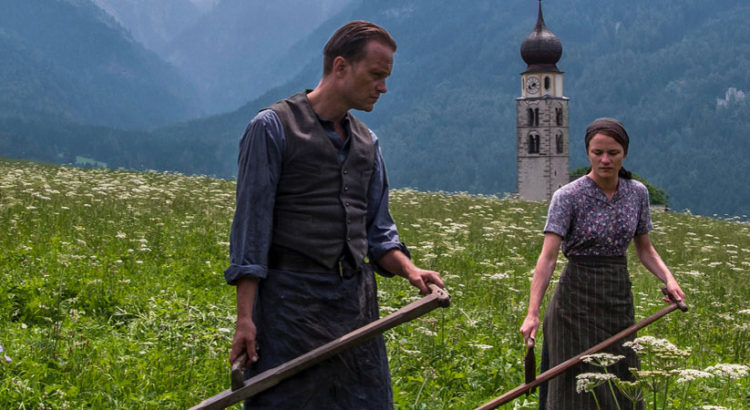
Coming this Friday to the Michigan Theatre is Terrence Malick’s latest work of cinema, A Hidden Life: 

Based on real events, A Hidden Life is the story of Franz Jägerstätter, an Austrian peasant farmer who refused to fight for the Nazis in World War II and is subsequently faced with charges for treason. His deep faith and his love for family, however, keep his spirit alive in the face of great hardship.

Terrence Malick’s A Hidden Life will be playing at the Michigan Theatre December 20th through December 26th!

Visit michtheatre.org for specific showtimes and additional information!


REVIEW: A New Brain

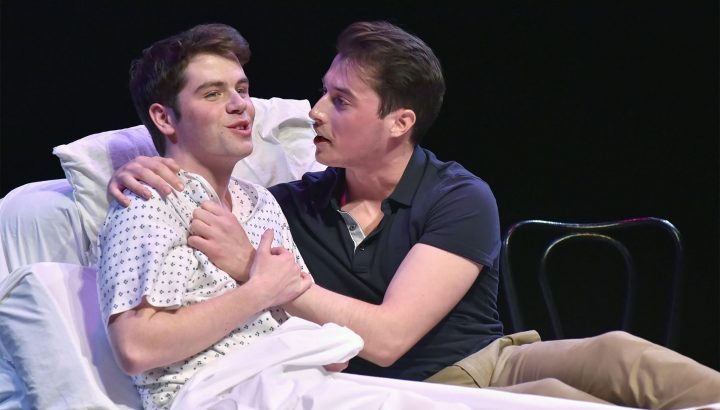
A New Brain follows the life of Gordon Michael Schwinn, a composer who must write songs about green frogs, spring, and “yes.” SMTD delivered a wonderful performance of this one-act musical, despite some problems with the original book itself.

I walked out of the Arthur Miller Theatre amused, but also slightly confused by some of the character relations and the plot. The relationship between Gordon and his partner Roger seems tense from the beginning, and it seems to be because Roger is obsessed with sailing in the open waters and Gordon struggles to write the songs that are stuck in his head and can’t get out. Their tenuous relationship throughout the course of the musical just seemed off to me, though Luke Bove and Jack Mastrianni performed their roles wonderfully.

The minister seemed unnecessary to the whole thing, while the presence of the homeless lady also confused me a bit, since her appearances and interactions with the rest of the characters didn’t seem to add much to the rest of the musical. She consoles Roger, sells Gordon’s books, and sings a poignant song asking for change—both for physical money and social change. While that message rang true, it seemed rather out of place for this musical. However, once again, Daelynn Jorifand her powerful voice stirred lots of emotions, especially during her solo number “Change.”

Finally, moments of the plot confused me a little as well, especially as Gordon started to hallucinate or when he first fell into a coma and the progression of that. Madeline Eaton, who plays Gordon’s mom, also had a shining moment in her song, “The Music Still Plays on,” though it seemed to suggest that Gordon had actually died while he was in the coma.

Nonetheless, the stage props and transitions, as well as the creative use of the ensemble, pushed these questions to the back of my mind. Given the few problems I had with the characters and plot, the SMTD cast was exceptional, selling the whimsical humor that underlies the nature of this play. Owen Claire Smith as the Thin Nurse and James Young as the Nice Nurse contrasted each other perfectly with their sassy attitudes. Especially during numbers such as “Gordon’s Law of Genetics,” the over-the-top choreography and break from characters added much entertainment to a somber and serious topic for a musical. The idea of Gordon dying before he could get all the songs he wanted to write out into the world is a stark reality for many individuals who have so much potential, and yet life (and death) happens. Thankfully, A New Brain approaches this prospect with lots of light and energy, inspiring us to make the most out of the time we get and giving us all hope that it will work out in the end.