REVIEW: “Duos” by Anda Jiang

November 5th, 2024 | 8:00pm | McIntosh Recital Hall


Election Day is not normally a day I opt to see a recital. Yet, on this particularly tense Tuesday, I dropped into violinist Anda Jiang’s “Duos” at The School of Music. I thought it an interesting theme for this uniquely divided day, and I wondered how it was relevant to the duality we’re facing in the United States currently.

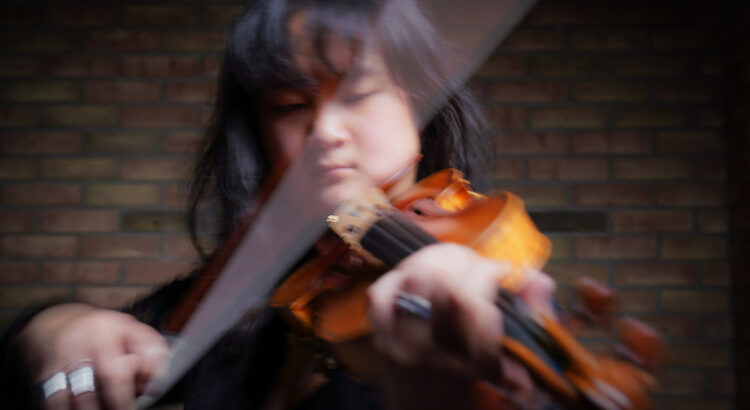
Ms. Jiang programmed five pieces on her recital, all staples of the violin repertoire. The set began with an angsty Zoltán Kodály work, Duo for Violin and Cello, Op. 7 (1914). Jiang performed only the first movement, “Allegro serioso, non troppo with cellist counterpart, Lauren Matthews, a technically versatile player with a magnificent buttery sound. The two had a striking musical presence together and masterfully navigated abrupt tone shifts throughout the piece. Kodály knits beautiful melodies alongside overt messaging of tension—the duo is in harmony, and suddenly there’s friction. The piece was composed in 1914, during the brink of WWI in Kodály’s home country of Hungary. Perhaps this sonata contained a response to the growing tensions in the Austro-Hungarian Empire.

The program moved to an effortlessly expressive Schubert, his Fantasie in C Major (1827). Ms. Jiang performed four movements alongside the stunning Rena Wu on the piano. This piece is known to demand extraordinary technicality from both the pianist and the violinist, an ambitious repertoire choice that entirely paid off. Ms. Jiang’s sensitivity to the piece struck me—her ability to take charge with engaging string melodies while leaving adamant space for Schubert’s brilliant contrapuntal piano lines to shine through, especially in the second movement, “Allegretto”.

Anda Jiang and her mother, Lydia Qiu.

The penultimate set included Debussy’s La Fille aux Cheaveux de Lin (1910) and Beau Soir (1891)which recruited Lydia Qiu to the piano—hilariously noted on the program as (pianist, mother). This set of two tunes is characterized by sweeping nostalgia and colorful impressionistic sounds, a favorite performance of mine from the evening. In addition to the performing familial duo, Ms. Jiang mentioned that her father built the violin she plays on (how cool!), which houses a stunningly bright and shimmering sound.

Joining the closing piece was dynamic pianist Aleks Shameti, one of the recent winners of the 2024 SMTD Concerto Competition. The two performed one of César Franck’s most well-known compositions, all four movements of the Sonata for Violin and Piano. The piece contains beautiful cyclic themes, opting for a satisfying finish to the set. With an absolutely enchanting performance, I hear a duo full of harmony emotionally and melodically. Funny enough, Franck wrote this piece in 1886 as a wedding gift for the 28-year-old violinist Eugène Ysaÿe, which was premiered publicly with Ysaÿe and pianist Marie-Léontine Bordes-Pène, who performed it first at his wedding. I suppose unity was implied from the beginning.

This recital reminded me why we make music—to comment, to express, to find unity in our strange human experience. Duality exists naturally in life— marriages, disputes, families, and mere instrumentation. On a day like November 5th, the messaging of duality becomes more complex and cynical, when it doesn’t always have to be. I’m not sure if Anda Jiang’s “Duos” was intended to be political commentary or not, but regardless, she reminded me of the sheer power of harmony.


Images thanks to Anda Jiang.
REVIEW: Through the Lens: The Henry Ford Estate’s Timeless Beauty

The Nature Photography event at the Environmental Interpretive Center on November 14th was an experience I’ll carry with me for a long time. It wasn’t just about wandering the trails of the Henry Ford Estate; it was about seeing this historic space through the eyes of the students who had captured it with their cameras. Their photographs didn’t just frame the estate—they transformed it, revealing a place I thought I knew in ways I hadn’t imagined.

The Henry Ford Mansion . Photo By Alexa Mckray

The student photographs lined the trails like quiet whispers of their perspectives, each one inviting me to pause and see the Henry Ford Mansion in a new light. The mansion, with its stately stone facade and commanding presence, became more than just a historic landmark through their eyes. One photograph caught the mansion bathed in the soft, golden hues of a sunset, the light making the stone seem alive, glowing with warmth.

Another portrayed it on a misty morning, its edges blurred and softened by fog, giving it an ethereal, almost dreamlike quality. Standing there, with the real mansion towering above me and these interpretations surrounding me, I felt like I was experiencing its many layers—its strength, its mystery, its quietness—all at once.

It was in the orchard where the students’ work really resonated with me. Walking among the bare, twisted trees, I stopped at a photograph of the last apple of the season, clinging stubbornly to its branch. Another image focused on the intricate lines of a gnarled trunk, its bark peeling to reveal the scars of time. These moments, frozen through their lenses, made me pause and look closer at the orchard itself—its beauty, its endurance, its history.


Images By Katrina Brown And Kai Richardson

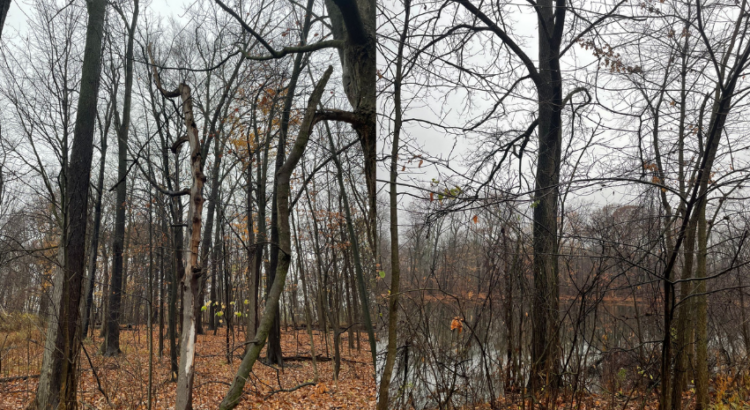
The pond, still and reflective in the late autumn light, was another scene transformed by the students’ photographs. In one, the water was alive with lily pads under the green canopy of summer. In another, it was frozen and dusted with snow, radiating the stillness of winter. Standing there, I felt a deep appreciation for how photography can carry us through time and seasons, reminding us of nature’s constant transformation.

This event wasn’t just about the photographs—it was about the way they made me feel. They invited me to look closer, to see the familiar in a new light, and to connect with the estate in a deeply personal way. Each image wasn’t just a capture of a place but a piece of the student’s perspective, their way of seeing the world.

Walking those trails that day felt like stepping into a conversation—one between the students, the estate, and myself. Their work didn’t just show me the beauty of the Henry Ford Estate; it reminded me how much beauty there is in looking, really looking, at the world around us.

REVIEW: Threads of Justice and Legacy: Lester Johnson Art at the Stamelos Gallery

Visiting the Stamelos Gallery at the Mardigian Library on Monday was a powerful experience that gave me a deeper appreciation for Lester Johnson’s work. Stepping into the space filled with his vibrant pieces, I felt the energy of his journey as an artist, a journey that is deeply rooted in the history and culture of Detroit and the broader African-American experience.

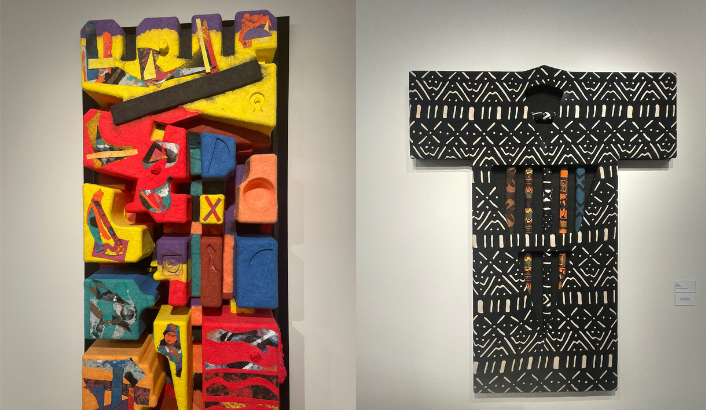
The exhibition, FOUR: Lester Johnson’s Selected Works, is a captivating reflection of his life and creative evolution. As I stood in front of his large-scale totem sculptures, I couldn’t help but think about how Johnson’s work is so deeply connected to his childhood in Detroit’s Westside, a historically rich Black community. Growing up just blocks from the iconic Blue Bird Inn, a hub for jazz legends like John Coltrane and Miles Davis, it’s clear how the rhythms and melodies of Detroit’s jazz scene shaped his creative vision. Johnson’s art is infused with the spirit of this music, often created with it playing in the background, as he seeks to channel its energy and emotion into his sculptures and paintings.

Courtesy of Lester Johnson
26 Wood, Fiber, and Fabric Totems. Courtesy of Lester Johnson

One piece that particularly struck me was the 26 Wood, Fiber, and Fabric Totems, which are a tribute to Rosa Parks and Judge Damon J. Keith. These works, rich in color and texture, tell a story of resilience and community. The fabric, woven with African-inspired patterns, speaks to the ways in which culture can bind people together, even in the face of adversity.

For Johnson, fabric is more than just material—it’s a symbol of the strength and unity that communities, particularly Black communities, have built over time despite systemic challenges. The totems were a poignant reminder of the importance of honoring the past while continuing to fight for justice.

As I walked through the gallery, I was also reminded of how much Johnson’s personal experiences shaped his artistic direction. His move into papermaking in the 1980s, influenced by Al Loving and Lynn Forgach, marked a turning point in his work.

I could sense the new textures and depth in pieces like Lynn’s Song and Nerfetiti, where paper became a medium for exploring his longstanding fascination with primal cultures and natural materials. The three-dimensionality of the work felt so immersive, like I could reach out and touch the cultural stories embedded in the fibers of the paper itself.

Courtesy Of Lester Johnson
Lynn’s Song and Nerfetiti. Courtesy of Lester Johnson


The most moving aspect of Johnson’s work is its ability to connect deeply with the viewer. Each piece tells a story—not just of the artist’s journey, but of the shared human experience. Whether it’s the universal struggle for justice or the celebration of the cultural legacies that shape our lives, Johnson’s art invites us to reflect on what unites us as individuals and as communities. My visit to the Stamelos Gallery was a reminder that art isn’t just about what we see on the surface; it’s about the stories, struggles, and triumphs that are woven into every brushstroke, every piece of fabric, and every sheet of paper. Johnson’s work is a testament to the power of creativity to honor the past and inspire the future.


REVIEW: Arbor Glyph

The Student-led Exhibition Committee is a newly-formed group of Stamps students, faculty and staff who aim to provide more opportunities for undergraduates to exhibit their work. The SEC’s inaugural exhibition “L’Assemblage” was displayed last winter in the Stamps building, and the committee has now brought student work to the walls of the Stamps Gallery with “Arbor Glyph.”

Tucked away in a small side room off the main display space of the Stamps Gallery, “Arbor Glyph” is an understated but cozy exhibition. An inviting semicircle of wooden chairs filled with soft pillows faces the single, large-scale artwork. A carpet softens the tile floor, and black fabric covers the walls. Calm instrumental music, mixed with birdsong, plays softly. The environment feels calm and secluded, a comfortable hiding place.

The artwork itself is a combination of painting and projection, spread across three tall paper panels that form a single image of a chaotic, colorful forest. The painting was created collaboratively by about a dozen Stamps students who attended a painting event in October. Their only direction was the prompt “depict a tree.” This spontaneous method of creation is apparent in the wide range of styles that share space on the canvas, from bold streaks of ink to carefully placed brushstrokes.

As I approached the work to take a closer look, I realized that where my shadow fell onto the wall and blocked the projection, the colors disappeared. I had been aware that there was a projected element to the artwork, but it was so well integrated that I had failed to notice that the painting was composed with only black ink. The colors of the piece are an illusion produced by the projector overlay, bringing vibrancy to the shades of gray.

Arbor Glyph, detail. Shadows cast onto the artwork reveal the shades of gray beneath the colorful projection.

The longer I looked at the piece, the more small details I noticed. Apples among a tree’s scribbled branches. Birds in the sky. Animals lying beneath the trees, sheltered by their branches. Mushrooms growing in the undergrowth. These details added subtlety and life to the scene. I also noticed that the colors of the projection seemed to shift over time, particularly the sky, which cycled through blues, greens and purples.

The artwork and the space encourage this kind of contemplation—I found the chairs comfortable and the music very calming. The small room felt like a peaceful refuge, and I was content to spend a long time with the piece, watching the colors slowly shift.

I enjoyed the exhibition itself, but to me, the most valuable aspect of “Arbor Glyph” is the mission it represents. While there are existing opportunities for Stamps students to exhibit their artwork in the Stamps Gallery, such as the Undergraduate Juried Exhibition, those opportunities tend to be very selective and set a high bar for entry. There is value in recognizing exceptional work, but there is also value in creating space for work that might not otherwise have the chance to be publicly displayed. The Student-led Exhibition Committee is creating exhibition opportunities that are more accessible for students, and for that I applaud them.

“Arbor Glyph” is on display at the Stamps Gallery until November 16th.

REVIEW: Touch by Ericka Lopez

“Please do not touch the art.”

In most museums, art exhibits or galleries– at least that I have attended– that message is posted loud and clear. But at Touch, an art exhibition by Ericka Lopez housed in the Institute for the Humanities Gallery, touching the art is encouraged.

Lopez was born with limited vision and today is completely blind. As a result, her art-making process comes through the sense of touch and her memories of color. The exhibit houses three different types of pieces: mixed-media sculptures, ceramics and punch-rug textiles. 

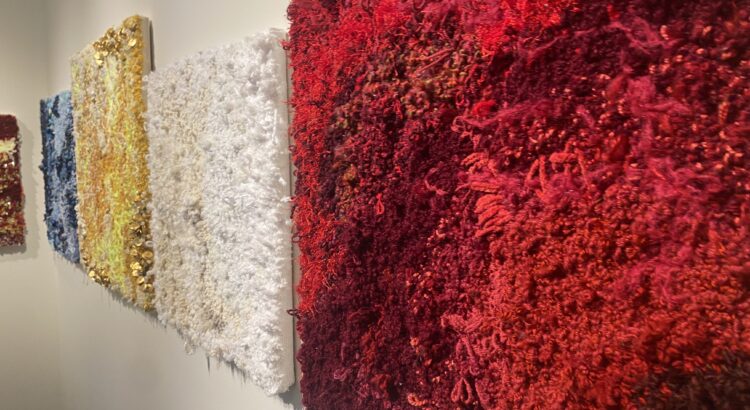
I walked into the small square room with some trepidation. The exhibit is housed in the Institute for the Humanities Gallery, a square room on the first floor of Thayer Academic Building. I went during the middle of a weekday, so the gallery was understandably quiet. What drew my eye immediately were the circular mixed-media sculptures hanging on the wall. Each one looks different, and are colorful amalgamations of yarn, beads, buttons, fabric and even keys. 

Multi-media sculptures at Touch, by Ericka Lopez. Courtesy of Madison Hammond.

It felt unnatural to touch an art exhibit. I gently reached out, and realized how much the texture of the piece added to the experience. The plastic beads and bundles of string contrast each other visually, but they contrast even more in texture. These everyday objects take on a new life in these pieces.

I moved on to Lopez’s punch-rugs. Each of these pieces follow a cohesive color scheme, and with the eye look a bit plainer than the multi-media sculptures since they don’t include as many mediums as the sculptures. (Don’t worry, though; there are still plenty of beads and buttons here).

Punch-rug pieces from Touch, by Ericka Lopez. Courtesy of Madison Hammond.

Despite being completely blind, Lopez uses color masterfully. According to Amanda Krugliak, the exhibit curator, Lopez has figured out how to distinguish different colored materials based on touch and scent. This unique method is part of what makes Lopez’s pieces so creative and imaginative; the exhibit is unlike any other that I’ve seen. It pushes the boundaries of the future of art.

I decided to try closing my eyes before touching each of these pieces– and this is how I suggest enjoying most of the exhibit, but these pieces especially. Lopez places different textiles in intentional patterns to create a landscape that comes alive as you feel it. 

In the center of the room, Lopez’s ceramic pieces sit atop two tables. The deeper meaning behind these pieces escaped me at first. I stared at the beautifully glazed coil pots before scanning the QR code to read about the pieces, where I learned that the warped and lopsided shapes come from Lopez hugging or holding the pots before firing. The relationship between the body and the art, the artist and her pieces, is what makes these pieces meaningful. 

Ceramics at Touch, by Ericka Lopez. Courtesy of Madison Hammond.

Accessibility within the arts can seem tricky. How can one convey a two-dimensional painting to someone who can’t see the painting? But exhibits like this, which also include exhibit descriptions in Braille next to the pieces, show that visual art can interact with more senses than just sight. For someone like myself, who is not visually impaired, the addition of the physical texture and sensory experience of touching the pieces made the exhibit feel so much more personal. Maybe more art should be made to be touched.

Touch is open 9-5, Monday through Friday, until December 13.

REVIEW: Murder on the Orient Express

Before I saw Rude Mechanicals’ production of “Murder on the Orient Express,” I had no idea what to expect. Somehow, despite the source material by Agatha Christie being so iconic, neither the plot nor the ending had been spoiled for me.

Going in, I had no preconceived notions of what this play should look like – and, like with all murder mysteries, I think that is the best way to do it. 

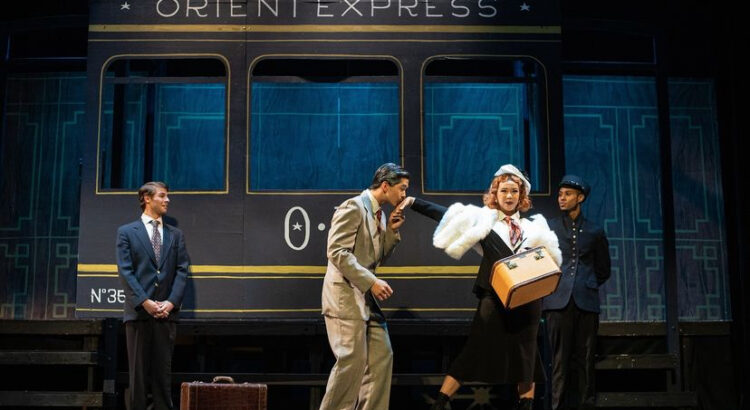
The play opens with a blinding blast of light from the stage, mimicking a train’s headlights, before diving into the show. Hercule Poirot (Ty Lam), a world-renowned Belgian detective, is traveling from Istanbul to London on the Orient Express, a train line owned by his friend, Monsieur Bouc (Fabian Rihl). Once aboard the train, a kooky cast of characters including the chic and dramatic Princess Dragomiroff (Bobby Currie) and the over-the-top Helen Hubbard (Olivia Sulisz) soon find themselves trapped when the Express gets stuck in a snowdrift.

Amidst the hubbub, a dead body is found with eight stab wounds. It’s Samuel Ratchett (Jax Coates)… or is it? Poirot is immediately on the case.

The Rude Mechanicals cast performs “Murder on the Orient Express” on November 8, 2024. Photo by Ellie Vice.

While the play is, at its core, a murder mystery, it is also a comedy. In the program, director Anderson Zoll says they “leaned into the humor and heightened theatricality” to give the show “a generous dose of camp.” And overall? I think they succeeded. 

As someone who didn’t know the plot before going in, it was a bit tough to follow at first because nearly every character has a different accent. A terribly tough task, to truck through the 100 minutes in an Irish, Russian or Swedish accent. But once the cast fell into stride, the show chugged along like a well-oiled machine. The Rude Mechanicals machine, perhaps. 

Part of what heightened the “campy” aspect of this production were the cheeky asides and musical transitions between some scenes. For instance, in one of the first scenes, a character remarks that Lam’s mustache “doesn’t even look real!” In response, Lam moves the open newspaper he is obviously hiding behind to give the audience a pointed look over the mustache that is, very obviously, fake. In one of the scene clearings, the ghost of Daisy Armstrong (Christine Chupailo) performs a beautiful ballet sequence; but in the context of the flippancy of everything else, it almost made me laugh. 

While the whole cast was great, Rihl, Currie and Sulisz stood out. With a healthy dose of physical comedy and almost-constant movement, Rihl really played into the stressed businessman who will do anything to keep his customers happy. Even when not speaking, Rihl’s reactions to other characters and their actions simply made so much sense; of course he would dust off the seats before someone sits down to be interrogated! Currie plays Princess Dragomiroff in drag, a choice that felt so natural it made me search whether the role was usually played in drag. And Sulisz, from using Michel the Conductor (Jaden Gonzalez) as a handrail to climb onto the train to singing show tunes to herself in a pink robe, drew some of the biggest laughs. The loud, dramatic American traveling solo, the character Sulisz played was both familiar and novel, and altogether magnetic.

Some of the more serious moments fell flat, but they were few and far between, and the play did wonders as a comedy. A good comedy immerses the audience in a world and lets them leave their worries at the door, if only for two hours. While the plot was interesting, it was ultimately the way the cast embraced their roles and “committed to the bit” that made it so enjoyable.