
Until death do us part. That’s what most couples promise each other during their wedding vows. It is a statement, both uplifting and bleak. It expresses the hope of a forever while acknowledging that life has no absolute guarantees. Separation is always a possible outcome. But knowing that doesn’t minimize the pain, startlement, and humiliation when you have to say good-bye to the promise of “Always”. Marriage Story is about one of those good-byes. Except for Nicole (Scarlett Johansson) and Charlie (Adam Driver), it can’t be a farewell forever. For, they have a young son to take care of, a family that must be preserved even through divorce. With a star-laden cast and an award-winning director in Noah Baumbach, Marriage Story has all the potential of an incisive and emotional film, perfect to watch during this Thanksgiving break. This film is being shown at the State Theater. Tickets can be bought online or at the box office ($8.50 with a student ID).
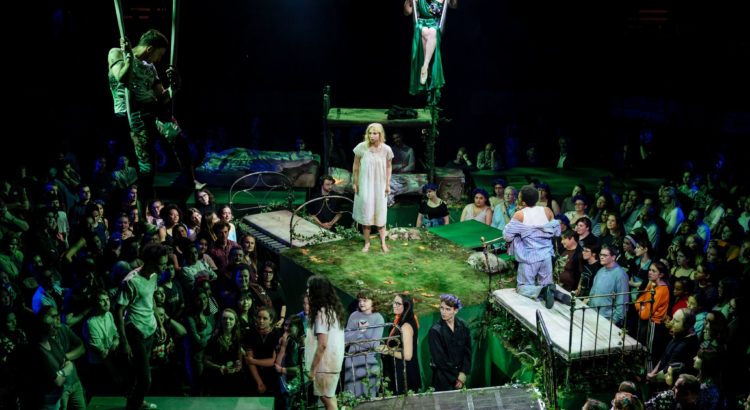
REVIEW: A Midsummer Night’s Dream
Theatre in the round? Kind of. But, like, more than that.
The University Musical Society brought this production of A Midsummer Night’s Dream to the Michigan Theatre as a National Theatre Live streaming on Sunday, November 24.
Director Nicholas Hytner’s take on the classic is comical, enchanting, and the most entertaining Shakespeare I have seen performed. During an intermission interview Hytner stated he began work on the play with some very strong ideas. First was the use of silks and aerial performance, as well as modeling the world of Athens after that of Gilead in The Handmaid’s Tale to reinforce the contrast between the repressive culture of the city and the freedom of the forest. The most effective directorial decision made by Hytner was to switch many of Titania and Oberon’s lines, changing the usual plot so that Titania is the one to trick Oberon, instead of the other way around.
In addition to his role as director of this production Hytner is also the co-founder of Bridge Theatre, a new 900-seat performance venue in London designed with a high degree of adaptability. As director he takes great advantage of this unique space to create the magical world of the forest. Production designer Bunny Christie uses this canvas masterfully as platforms are raised, lowered, and shifted through a standing audience to create an immersive and magical world. Beds that signify actual sleeping quarters in Athens return festooned with moss, vines, and leaves to represent the trees and landscape of the forest. The fairies’ domain is made of flying aerial silks which the actors use to great effect, spinning, twisting, and posing to illustrate their prowess in magic and spellcasting.

The lighting design of Bruno Poet and sound design of Paul Arditti both work with the scenic design to create a wonderful sense of atmosphere. While the lighting in Athens is stark and monochromatic, it shifts to deep greens and ethereal purples once the story shifts to the forest. Poet also does a great job of creating focus on specific areas. While holding Titania in a spotlight, a burst of light reveals Puck, having sprung up on the opposite platform. Arditti’s well-chosen sound combines with these lighting effects to create an almost tangible magic in the air, reinforcing the omnipresent nature of the mischievous fae. His atmospheric soundscape is near perfect. The best sound atmosphere is one that goes unnoticed. It is felt but never inserts itself into the scene. The low synth chords of Athens and the lilting strings of the forest do just that. They imbue the audience with a feeling that not only fits the words of the playwright but also justify the other design elements.

Christina Cunningham’s designs also reinforce the director’s visions. The stark and simplistic grey dresses of the Helena and Hermia in the city, combined with their white head coverings produce a broadly dystopian impression. The plain black suits of Theseus, Egeus, Demetrius, and Lysander are a uniform of masculine power. It is in these elements that Hytner’s inspiration from The Handmaid’s Tale is most evident. The Rude Mechanicals are costumed in jumpsuits, highly reminiscent of the party uniform of Orwell’s Nineteen Eighty-Four. However, the most striking Athenian costume is Gwendoline Christie’s first as Hippolyta. Her black gown is beautiful in its simplicity and powerful in its monastic silhouette. She is striking, posed as a stark statue in a glass cage, placed there by Theseus. The costumes of the forest characters present a more fun, whimsical image. Puck flits in and out of scenes in patchwork jeans, graphic tank, and colorful armbands. The other fairies have faces painted with glitter and look more like acrobats or fashion models than beings of nature. Oberon, cast by Hytner as a frivolous playboy, is perfectly gorgeous for most of the play in long flowing gold silk robe, often shirtless underneath.
The one pitfall in the costume design is Christie’s green gown as Titania. This dress is emerald green, silky, more than floor-length, and one-shouldered. The asymmetrical floral detail on the bust contributes to a hyper-feminine and soft picture. This picture directly contrasts the headstrong, vengeful Queen that arises with Hytner’s line arrangements. What would make sense in a traditional rendering of Midsummer just doesn’t work here.
The sheer amount of talent, wit, comedy, and spectacle in this show had me thinking back to it constantly. It made me glad to have seen it and glad to be studying theatre. If there’s one major objection I have, it’s that there’s almost too many ideas in this production. The audience participation and reaction is a riot to watch, the aerial work is amazing, the acting top-notch, and the designs gorgeous. But I at times felt lost in the concept of it. While likening Athens to the theocracy of Gilead creates a striking stage picture, the extremely heavy real-world consequences of that dystopia doesn’t seem to fit in the comedic, self-aware romp of the rest of the production. The aerial acrobatics are well-integrated until Gwendoline Christie spends her time as Titania just sitting on a silk, buckled in, drawing attention to the fact that she is not an aerial artist. The comedy is refreshing until the Rude Mechanicals’ performance near the end is so drawn out that people are checking their watches.
But don’t get me wrong- this is a fantastic production. I haven’t read Midsummer for years and my memory of the plot was fuzzy, so this was a refreshing dip back into the story. And there’s so much more I could write about. Before this my favorite Shakespeare play was Twelfth Night, but Puck may have just bewitched me into changing my mind.
PREVIEW: Pain and Glory
Not everyone gets a chance to look back. Most of the time, life moves too quickly or too erratically. To properly track its irregular movements, to be able to tie the story of a life into a neat bundle, is usually an impossible task. But film demands the impossible. In Pain and Glory, Salvador Mallo, a once-fiery film director, has not attempted the impossible in some time. Tired out by the many professional and personal mistakes, weighed down by pain, he is at a standstill. Recounting the life of this brilliant and flawed man is another brilliant and flawed man, director Pedro Almodóvar. Almodóvar is responsible for such artistic masterpieces as The Skin I Live In. This newest endeavor, Pain and Glory, is once again a hit among critics. However, it is also a far more personal story than Almodóvar has ever written. If you want to experience the impossible and truly take a look at a life in full, Pain and Glory is currently showing at the State Theatre. Tickets can be bought online or at the box office ($8.50 with a student ID).

PREVIEW: Dave Landau
This Friday at 10 pm and Saturday at 7:30 pm, ubiquitously funny stand-up comic Dave Landau will be performing at the Ann Arbor Comedy Showcase to up the cheer for all your weekend Thanksgiving festivities! In addition to his fresh and relatable takes of finding mirth in everyday occurrences, Landau has a formal background in improv from the infamous Second City Comedy Theatre in Detroit and has made numerous appearances on Comedy Central, HBO, Sirius/XM Radio, and “The Bob and Tom Show”. In addition, Landau finished as a finalist on Season 8 of NBC’s Last Comic Standing, and became a fan favorite and 3rd mic on The Artie Lange and Anthony Cumia Radio Show, later renamed The Anthony Cumia Show with Dave Landau.
Tickets may be purchased in advance for $14 here, or $16 at the door!
REVIEW: Midsummer Night’s Dream
First, let me say that this was monumentally better than reading the play on paper! The creation of an engaging and unique show is difficult with such an old and re-used play, but this was a stunning rendition of Midsummer Night’s Dream.
To preface, this show would not have been enjoyable had I not known the storyline beforehand. The accents of the actors (all from England) on top of the Shakespearean language made it difficult to understand the show. So, I would not say this show is accessible to everyone, only those who have a prior knowledge of the play and of Shakespearean speak. That being said, the entirety of the performance was absolutely amazing- beautiful, witty, and unusual.

The set of the play was a theater in the round, with people standing directly around the stage and occasionally partaking in the show. I believe these people represented an old style of theater, where those who could not pay for actual seats could stand and watch the show from right up close to the stage. The actual stage itself was several platforms, which rose and lowered to fit the scene. Props were minimal; most of the show took place on several beds. This was more than enough, however, because the acting did not need props in any way. Their performances were fanatical and emotional, and they were very much able to use the difficult language in interesting ways. They emphasized just the right words to make their speech understandable, as well as funny. The incorporation of humor was most brought across by their dramatic movements, and each character was truly humorous in their own way.

I really enjoyed the addition of arial hammocks to the show, which are thick cloths hung from the ceiling that look similar to swings. All of the fairies, including Puck and Hippolyta (the forest queen), used these arial hammocks hanging from the ceiling, and Puck did some very cool tricks on the hammocks. There were flips, spins, swinging, and more. We found out during intermission that he had only been training for a few months, which was very impressive. This gave the show a really otherworldly feeling, and helped make the fairies look more magical, because they were “flying” as they spun and went up and down in the hammocks.

The costumes of the cast were also very interesting, as it was a mix between modern dress and very mythical or Athenian clothes. For example, when Hermia and Lysander fled to the forest, they wore old fashioned pajamas and plain garb, but carried a very modern looking backpack. I also really loved the dress of the fairies, as well as the dress of the king and queen of the forest. They wore many colors, based in green (as a representation of forestry, I assume) and were all covered in sparkles. Since the stage was mostly sparse, it helped the actors in their colorful costumes stand out even more.

What I really liked the best, however, was the fact that it was a live showing. This affected several parts of the viewing experience, most of all making it feel like the audience was about 3 times as large as our audience in the theater. This made the laughs bigger, as well as the applause, and it helped create the experience of being in a theater, which is what I think the makers of National Theater Live were intending. It also made the show more unique and interesting, as there were several moments where actors broke character, or interacted with the audience, which would not happen in a movie.
I would recommend anyone who does not have the ability to see a play live in a theater to try and attend a showing like this, because it was a fantastic alternative to seeing the play in theater. As we were viewing it from a camera, we got all the best views, since they could switch to different perspectives, as well as zoom in for close ups of the actors to see all of their facial expressions and movements perfectly. The fact that it was in the round was also not an issue, as we always had the best angle. This was a fantastic live performance of Midsummer Night’s Dream, and I would encourage everyone to keep their ears open for the next National Theater Live’s performance so they can also attend one of their great events.
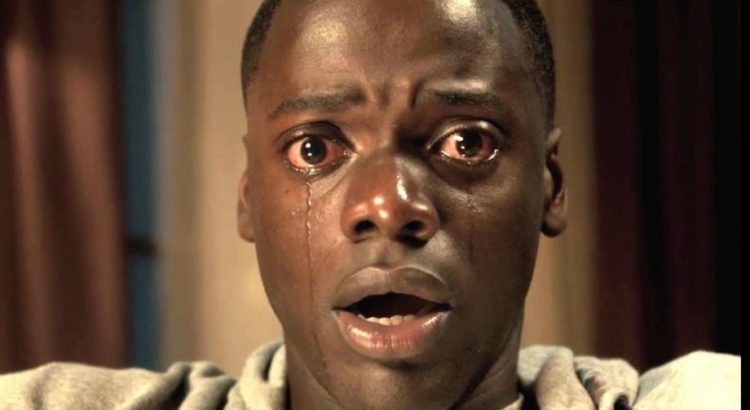
REVIEW: Get Out (2017)
For me, the name Jordan Peele will always be synonymous with clever sketch comedy. In the early stages of my adolescence, Key & Peele (2012-2015), a Comedy Central series created by Jordan and his frequent collaborator, Keegan-Michael Key, was held, amongst the likes
of South Park and Family Guy, in the highest echelon of my pantheon of teenage television. However, in 2017, Peele left behind his comfortable niche in the realm of buddy-comedy shorts and made his directorial debut with Get Out, a psychological thriller neatly wrapped in astute social commentary. The film has been met with a significant amount of positive attention from a diverse pool of critics (98% on Rotten Tomatoes), and for the past two years, I have waited eagerly to see Get Out for myself. Unfortunately, I left the State Theater a bit
disappointed.
From a purely cinematic perspective, Get Out falls flat on a number of fronts, but most glaringly, I found that the film was far too stylistically ambivalent. Over the course of 104 minutes, Get Out oscillates between moments of dramatic tension, over the top slasher violence, sci-fi absurdism, and yes, nostalgic, Peele-esque humor. Independent from one another, the scenes of Get Out are strong, but the way in which the greater project incorporates the footage is detrimental to the emotional gravity of the film. Additionally, the thematic elements of the film are focused mostly on the serious and relevant issue of camouflaged racial tensions between Black and White Americans, and with such a dynamic narrative structure, some of the film’s more nuanced messages are greatly obscured by the spectacle of it all. Again, Get Out was Jordan Peele’s directorial debut, and at times, the film feels like a somewhat disjointed string of shorts – eerily reflective of Key & Peele.
My concerns about the stylistic coherence of Get Out aside, I found that the dramatic climax of the film was set far too early in the story. The first hour of the film is fantastic, but after the second act, the previously riveting tension of the film felt, well, cheapened and manufactured, and as such, the third act of Get Out features far more moments of the stylistic inconsistency that I took issue with in the previous paragraph. From the perspective of the viewer, it almost seems as if Peele directed two entirely separate films: acts one and two of Get Out were bold, chilling, and intellectual, whereas act three felt slightly unbelievable, goofy, and rushed.
All things considered, Get Out is slightly above average, but the film’s narrative structure was somewhat flawed. On a positive note, I thought that the cinematographers and set designers of Get Out made exceptional use of both dark and light landscapes, props, and clothing to highlight and reinforce some of Peele’s more abstract messages. Similarly, I also thought that the audio mixing of Get Out was remarkable, as the occasional interjection of shrill, dissonant violin strokes sent my fellow moviegoers out of their seats in fear.
6.2/10
