REVIEW: The Music of John Williams

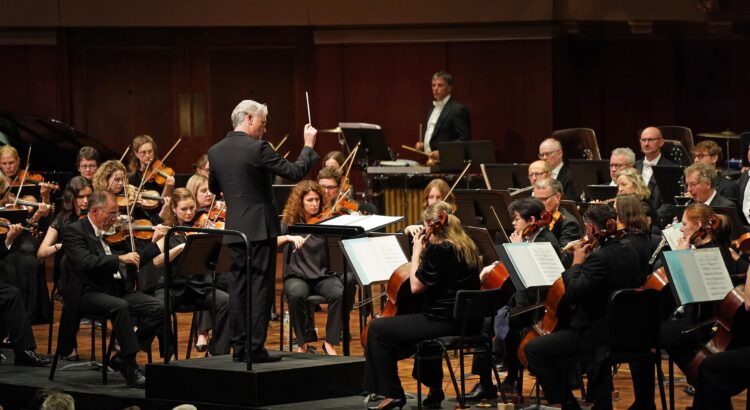
On Saturday, October 19, I attended the Ann Arbor Symphony Orchestra (A2SO) concert celebrating the music of John Williams. As expected, given the popularity of one of cinema’s greatest composers, the line at the Michigan Theatre was incredible—possibly the longest I’ve ever seen for an A2SO concert. The crowd was notably diverse, with attendees of all ages, and I even recognized friends who don’t typically attend orchestra performances.

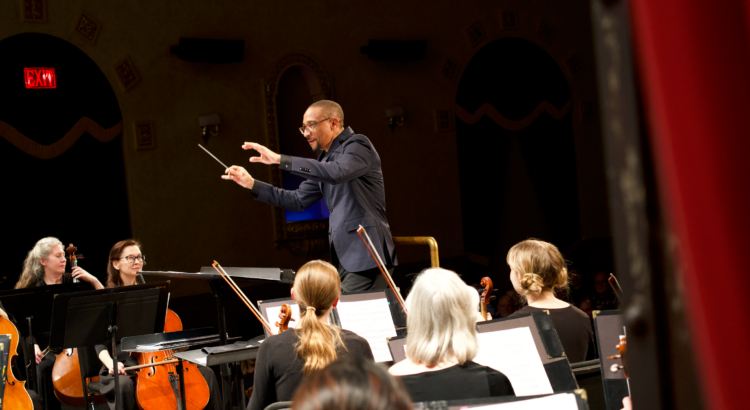
Under the baton of guest conductor Damon Gupton, the program showcased some of John Williams’ most famous works. The first half, in program order, included “Superman March” from Superman, “The Shark Theme” from Jaws, the main themes from Jurassic Park and Schindler’s List, “Devil’s Dance” from The Witches of Eastwick, “Love Theme” from Superman, and the “Throne Room & End Title” from Star Wars: Episode IV – A New Hope.

I loved seeing some musicians—and even some instruments—in costume on stage. Paired with the quick beat and lively brass in “Superman March,” it set high expectations from the start that this would be a fun and exciting concert. Damon Gupton’s theatrical side shone through as he conducted the iconic, suspenseful opening measures of “The Shark Theme.” With each new phrase in the music, he would glance apprehensively behind him, as if watching out for danger lurking—an amusing touch that drew laughter and reflected his background as an actor. 

The order in which the repertoire was performed made me feel as though I were watching a movie, with each piece shifting the tone and taking me in a new direction. After Jaws, the uplifting main theme from Jurassic Park brought excitement, followed by the somber theme from Schindler’s List, which featured a sorrowful violin solo by the concertmaster. “Devil’s Dance” then introduced a thrilling energy that transitioned seamlessly into the sweet melody of “Love Theme,” before the first half concluded with the universally recognizable soundtrack from Star Wars.

The orchestra also performed the Olympic Fanfare and Theme, “Harry’s Wondrous World” from Harry Potter and the Sorcerer’s Stone, “Hymn to the Fallen” from Saving Private Ryan, “March” from 1941, “With Malice Toward None” from Lincoln, and finished the evening with “Adventures on Earth” from E.T. the Extra-Terrestrial. 

Since I haven’t seen the films Olympic Fanfare and Theme, “March,” and “With Malice Toward None” come from, I had never heard them before. This allowed me to fully absorb the emotions conveyed by the music, without the influence of imagery associated with the movies. The catchy rhythms and bright trumpets in Olympic Fanfare and Theme and “March” made it easy to visualize social festivities. Meanwhile, the strings in “With Malice Toward None” evoked a strong bittersweet feeling. 

On the other hand, I’ve already heard “Harry’s Wondrous World,” “Hymn to the Fallen,” and “Adventures on Earth” performed live by the Michigan Pops Orchestra (MPO), who also played the same versions of “The Shark Theme,” themes from Jurassic Park, and Star Wars from the first half of the concert. It was interesting to compare how the A2SO and MPO interpreted these musical scores. The MPO has a much larger string section, which allowed their strings to stand out more, while the winds shined more in the A2SO. Though each had a different dynamic, this experience only deepened my admiration for our school’s student orchestras, as I didn’t find them lacking in musical quality compared to a professional ensemble.

Overall, with its diverse selection of pieces, the Ann Arbor Symphony Orchestra’s performance felt like watching a film without the visuals, beautifully celebrating the genius of John Williams.

Pictures are provided by A2SO

REVIEW: The 5th Annual Pass The Mic

On October 23 2024, “Pass the Mic” invited everyone into a space full of real emotions, honesty, and a bit of magic. Hosted by the Hopwood Program, this yearly event brought students from all over the University of Michigan to share their writing—poems, stories, and essays.

Throughout the night, we heard all kinds of stories, each one reflecting the writer’s unique life and feelings. There were poems about deep loss, struggles with mental health, and even the simple sweetness of peaches and plums. Listening felt like getting a glimpse into each person’s world, as they opened up and shared real pieces of their lives.

From the Dearborn campus, Vincent Intrieri shared a powerful story about his own life experiences. From open-heart surgery, his time in the Navy, and moments in a hospital room with his girlfriend and nephew, he crafted his life into lines that made up his living. His words felt raw and genuine. “Living felt worth it again and I eventually found my voice,” he said. For him, that was his way to heal and reclaim his story. We were right there with him, almost reliving it.

Then, a poet from the Flint campus shared a love story in a different kind of way. Peaches and Plums, it was called. Each stage of the relationship was tied to the stages of eating a peach or a plum—like the sweetness of a peach when you first bite into it to the tartness of a plum halfway—capturing the ups and downs of love. The poem ended on a bittersweet note, capturing love’s simple but complicated beauty. While the author explained they did end up staying friends, a love story is a love story, even if it’s between friends. It was like “unraveling a love story through the sweetness and messiness of fruit.”

Finally, from Ann Arbor, another author shared a piece about loss and nature. Their words felt like a quiet tribute, with landscapes that mirrored their sadness. “I rest my head on the hook of your neck mother.” You could feel the weight of the words the more they spoke. The poem felt dreamy and light, as if they were letting nature carry their grief. Losing someone is a natural process, and the poem was a gentle reminder that it would all be okay. Trees grow back!

By the end of the night, I felt like I’d been part of something special. “Pass the Mic” was more than just an event; it was a space for people to share their stories and connect. Each voice mattered, and each story—no matter how different—was heard. It was a night to remember.

REVIEW: Silver Linings

Spelman College is a historically Black women’s college in Atlanta, Georgia, which holds an art collection spanning over 100 years of African American artwork. “Silver Linings” brings a sampling of this historic collection to the walls of UMMA.

The exhibition includes 40 works from the Spelman Collection, a wide sampling that represents a slice of the history, experiences and aesthetics of Black Americans in the last hundred years. It features a few local connections as well, including several works by Beverly Buchanan, who spent the later years of her life in Ann Arbor.

There are some truly illustrious artists included in the exhibition, both historical and contemporary. I was excited to see a piece by Faith Ringgold, an artist whose work I have studied in depth. She is well known for her “story quilts” and similar pieces combining painting with textiles, often inspired by her childhood in the heart of the Harlem Renaissance. “Groovin’ High,” titled after a track by famous jazz musician Dizzy Gillespie, is a rhythmic and joyous scene of Harlem nightlife. It also serves as a demonstration of the artistic and historical significance of this collection.

The exhibition is largely organized into categories such as photography, portraiture and abstraction, with some works standing alone. I found the effect a bit disjointed, with no clear path to lead me through the gallery and no overarching story connecting different areas of the exhibition. However, a collection as broad as this one is best displayed with a diverse range of works and topics, so it is understandable that curatorial emphasis was placed on several smaller groupings of work around different themes.

Of all the works in “Silver Linings,” I was particularly drawn to the ornate mixed media works of Lina Iris Viktor in the “Portraiture and Subversion” section. Her work combines photographs with ink, paint and pure gold. She captures Black female bodies in lush, dark compositions, filled with deep shadows, with only soft highlights and bright accents of gold to distinguish the figures from their surroundings. These were visually stunning celebrations of the beauty of Blackness, skillfully subverting racist and colorist tropes.

Betty Blayton, “Vibes Penetrated.” 1983, acrylic on canvas. Image via Neil Kagerer and UMMA.

I also enjoyed the works in the “Abstraction” section of the exhibition. Betty Blayton’s “Vibes Penetrated,” the huge circular painting used in marketing materials for the exhibition, is even more stunning in person. The exhibition text references Blayton’s intention to create a “meditative pause,” which I felt as I lingered in front of it—the composition is active yet calm, and I felt that I could have stared at it for hours. Another highlight of this section were the luminous paintings of Michigan alumna Lucille Malkia Roberts (MFA 1939). Her works “Out of the Blues” and “Winter Sun” used beautiful complimentary colors and expressive brushwork that felt joyful and bright.

I did not love every single piece in “Silver Linings,” but I found several that spoke to me. Any exhibition with such a broad variety of work can never be a perfect fit for one individual’s taste. That breadth, however, means there is room for many different kinds of people to find an artwork they connect to. Others may find that their favorite works are very different from mine, but there is something for everyone in “Silver Linings.”

“Silver Linings” is on display at UMMA until January 5th. An exhibition tour by guest curator and History of Art professor julia elizabeth neal will occur on November 10th.

REVIEW: The Wild Robot

Based on Peter Brown’s 2016 middle-grade novel of the same name, Universal Pictures’ The Wild Robot centers around ROZZUM-7134, or “Roz” (Lupita Nyong’o), a robot created by company Universal Dynamics to serve a variety of tasks in their cities. After her delivery ship is shipwrecked on an island, she forms a family of sorts with fox Fink (Pedro Pascal), and goose Brightbill (Kit Connor).


Lupita Nyong’o is fabulous here. Her voice-acting is pristine, and gradually gains emotional range and variation as Roz does, breaking from her pre-programmed expressions and knowledge in order to adapt to an environment which requires – and permits – it. The rest of the cast shines too: the names are generally big, but they don’t feel as if they’ve been cast just because they’re famous. They feel suited to the characters, and deliver engaging performances that feel real, enlivening the generally very good screenplay of Chris Sanders (who is also the film’s director).


Like its cast, the majority of The Wild Robot is excellent. The animation is a gorgeous watercolor-esque style, and almost every still feels like a work of art. The audience is generally trusted to understand information without it being spoon-fed to them. There is humor accessible to kids, humor for any adults watching, and not much toilet humor. Kids can enjoy the goofy possum kids who play dead and their squabbling; adults can enjoy the specificity of one of them explaining that their play-death was so slow because they were dying of meningitis.


The film weakens in its final conflict. Roz has been steadily breaking down – she’s not made for life on a human-free island, and she’s been sacrificing herself in order to raise Brightbill. Her worsening physical condition is shown throughout the film. This is not what the climax of the film is about. Instead, the movie opts for an evil robot attack, led by Vontra (Stephanie Hsu), who is sent to bring Roz back to the humans so that they can study her. The animals fight back, and defeat them, but Roz ultimately chooses to go back to the humans, so that the island isn’t attacked again. Presumably, she manages to get fixed there, as she seems fine the next time we see her. The humans’ motivations for their actions seem vague, and the whole thing just feels a bit as if it comes out of nowhere. It feels like it happened in large part because animals fighting evil robots seems cool. And it is cool. But the rest of the film manages to do cool and interesting things with a really strong focus on character, and this didn’t feel like that to me. It did manage to provide a pseudo-death for Brightbill to bring Roz back from through the power of familial love, but Roz was already falling apart, and he could have just brought her back from that pseudo-death instead – that could even have had more emotional weight, as her dying would have been linked more directly to him.


Final robot battle aside (and even that is quite good given that it happens), The Wild Robot is a witty and warm story with a largely strong script that’s got something for audiences of many ages to enjoy.

REVIEW: London Philharmonic

Photos are provided by Peter Smith Photography

On October 18th, the London Philharmonic returned to Hill Auditorium after 13 years. The concert was especially thrilling for me, as it was my first time experiencing the London Philharmonic live. The repertoire, performed in order, included Britten’s Sinfonia de Requiem, Shostakovich’s Violin Concerto No. 1 in a minor, Tania León’s Raíces (Origins), and Sibelius’s Symphony No. 5 in E-flat Major.

I found it unusual that they chose to open with a requiem, given the somber, darker tones typically associated with such works. Yet Britten’s piece turned out to be grand in its own right, and I was surprised by how much I enjoyed listening to it. The quality of the music drew me in immediately, largely due to Edward Gardner’s conducting—I found my eyes fixed on him from the very beginning.

I consider the conductor to be the heart of an ensemble: the musicians move and breathe to the beat of the baton, and the phrasing of each lyrical line relies on the tiniest of gestures. A captivating conductor is vital to the quality of an orchestra’s performance, and Gardner’s skills truly shone, especially when every instrument joined in a musical passage. The contrasting dynamics filled the auditorium with a depth of sound that made me feel one with the Sinfonia de Requiem, despite being in the audience. 

Although I had never heard Shostakovich’s first violin concerto before, the eerie dissonant intervals and unsettling lack of vibrato in the opening unmistakably evoked his distinctive melancholic style. Once the second movement began, the intensity of the piece immediately shifted my attention to violin soloist Patricia Kopatchinskaja. The clean harmonics and intonation of her double stops were breathtaking. Furthermore, she preserved Shostakovich’s voice by weaving between the lack of vibrato characteristic of the first movement and the vibrato that expressed her own musicality.

London Philharmonic Orchestra performing with Edward Gardner and Patricia Kopatchinskaja in Hill Auditorium, October 18, 2024.

Like the preceding pieces, the introduction of Raíces was quieter and calm. What made it stand out from the rest of the program was the lively beat that picked up in the latter half; in this section, the woodwinds and brass melodies particularly shone, establishing themselves as the main characters of the piece.

Sibelius’s fifth symphony continued the trend of opening with a peaceful first movement, which made me hopeful for a triumphant ending to conclude the night. Instead of achieving an impactful ending by increasing the tempo, the last movement made its mark through the layering of instruments. The full volume of the brass rang beautifully through the hall, yet I could still hear the violins complimenting them with a gorgeous melody rich in luscious notes. The concluding measures were also unexpected; rather than maintaining that full sound, they transitioned into a series of single note chords played by the whole orchestra.

However, I must confess that for me the highlight of the concert was actually the encore: Variation IX, Adagio “Nimrod,” from Edward Elgar’s Enigma Variations. It was another calm piece, but rather than a somber sound, it featured sweet tones and a yearning melody that lingered with me long after the performance. It provided a perfect change of pace accompanied by a bittersweet emotion that proved to be more memorable than a loud and exciting ending.

REVIEW: Saturday Night

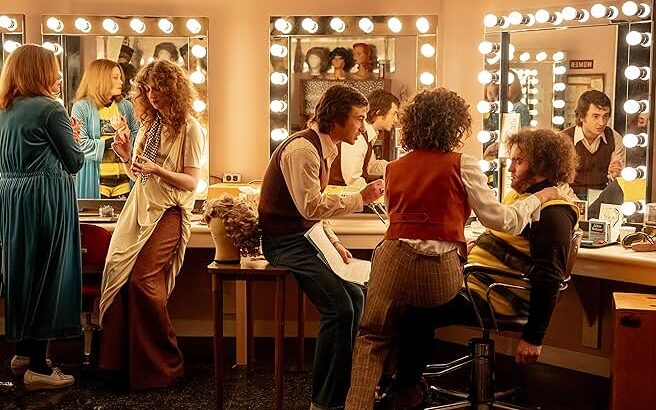
It’s Saturday night in the city that never sleeps, and a frazzled Lorne Michaels (Gabriel LaBelle) is trying to maintain his cool in the 90 minutes before the premiere of his magnum opus, a risque and revolutionary live television show. A head shorter than every musical guest, comedian and NBC executive, Michaels is faced with an angry censorship representative, wildly ballooning expenses, a show that is almost two hours too long and grumpy comedian Jim Belushi who refuses to sign his contract.

Saturday Night is a mythologized and loose retelling of the iconic cultural moment that is the first airing of Saturday Night Live, the NBC sketch comedy show now in its fiftieth season. The characters are real writers and cast from those early seasons, including Cory Michael Smith as Chevy Chase and Matt Wood as Jim Belushi. But the main point of tension, that David Tebet (Willem Dafoe) would switch to a Johnny Carson rerun tape instead, is mostly fiction. 

Just like how Michaels says his show is meant to encapsulate the feeling of being alive in New York City, the film – while not totally accurate – aims to encapsulate the chaotic and unpredictable nature of the earliest seasons of SNL. In the movie, several legendary stories from 30 Rock appeared in the 90 minutes before the show’s premiere, while in reality iconic scenes like Belushi ice skating in a bee costume occurred years later. Michaels did in fact meet legendary comedy writer Alan Zwiebel (Josh Brener) at a bar, but it was not in fact 20 minutes before the premiere began. 

The movie is not meant to be a hyper-realistic documentary about the first time SNL aired. Rather, it is a depiction of the chaotic and unprecedented nature of this new style of live television and how it came about. 

The screen intermittently cuts to a time card ticking away the minutes until 11:30, when the show is supposed to start. While this is meant to add to the tension of time quickly slipping away, it doesn’t fulfill this effect. While ninety minutes is not a lot of time to pull together a live television show, it is a decent amount of time to sit in a theater and watch. This aspect could be cut, and the time pressure would still be felt through the nonstop dialogue and constant flow of problems.

In a bit of awkward exposition that is out-of-place amidst the jumble of conversations and barrage of problems on set, writer Rosie Shuster (Rachel Sennott) details the nature of her relationship with husband Michaels to her boyfriend, Dan Aykroyd (Dylan O’Brien). This is one of the more accurate aspects of the film, as it was widely known at the time that Shuster was both married to Michaels and openly dating Aykroyd. It humanizes Michaels, who is a constant flurry of stress, and part of the iconic web of SNL stories, but its integration was clunky.

There is so much going on in this movie that it would be impossible to recount it all. There’s almost too much, but that’s part of its charm. The film exemplifies the excitement and chaos by being exciting and chaotic, leaving the audience energized and inspired to take a trip to the Big Apple.