

It’s a whole new school year, which means a new year of excellent musical performances. Kick off the 2019-2020 UMS season with Snarky Puppy, a Brooklyn-based funk and jazz collective that explores with improvisation the convergence of black and white American music culture. Don’t miss the three-time Grammy winners season opener at Hill Auditorium on Sunday, September 8, with Alina Engibaryan opening the show at 7:00 PM.
PREVIEW: Gala Mukomolova Poetry Reading and Book Signing
As I’m becoming more familiar and learning to recognize the intersecting pathways of my identity, I have learned to cultivate a deep appreciation for artists of different identities doing the same. Gala Mukomolova is one such artist who I believe may be able to shed light on the landscape of complex, often even opposing, experiences, and using art as a form of synthesis. From the few poems I have read, Mukomolova seems to have a rich sense of voice and a kaleidescopic, evocative representation of the world around her. I look forward to her reading on Thursday, September 5th at 5:30-7 pm in UMMA’s Helmut Sterne auditorium. A book signing will follow with book sales provided by Literati bookstore.
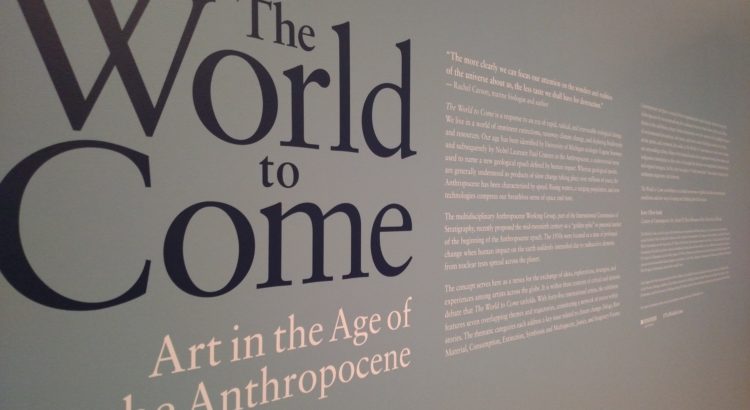
REVIEW: The World to Come: Art in the Age of the Anthropocene
The University of Michigan Museum of Art’s new exhibition Art in the Age of the Anthropocene is a powerful collection that forces museum-goers to grapple with the harsh realities of human impact on the environment, climate change, and our future. Here is a sampling of what I found to be the most impactful pieces:
Chris Jordan: CF000313, unaltered stomach contents of juvenile Laysan albatross (2009) & CF000668, unaltered stomach contents of juvenile Laysan albatross:
These photographs show the half-decomposed carcasses of albatross, the former location of their stomach filled with brightly-colored plastic detritus. According to the placard accompanying the work, their parents would have mistaken the plastic for food and fed it to their young (as well as eating it themselves). As a result, albatross of all ages suffocate and die. The photographs cannot avoid being interpreted through the lens of Samuel Taylor Coleridge’s poem “The Rime of the Ancient Mariner”: “the death of the albatrosses heralds humanity’s impending destruction.” However, I believe that one of the purposes of this exhibition is to work toward a world where the impending destruction doesn’t come to pass. All hope is not lost, if only we would wake up to the reality of what is happening to our world.
Nicole Six & Paul Petritsch: Special Intervention 1 (2002):
You will hear this work long before you see it. A video in a dark room off the main gallery, it shows Petritsch in the middle of an expansive frozen landscape, repeatedly chipping away a circle around himself with a pickaxe. “Regardless of impending disaster, he persists in this futile and ultimately deadly activity” … clearly a commentary on our own inaction regarding climate change. The sound of this pickaxe echoes across the entirety of the exhibition, and it continued to echo in my mind once I left the museum. It drills into your skull, incessant and without letting up, and even now I can hear it in my mind’s ear.
Kimiyo Mishima: Akikan [Empty Can] (2012):
From far away, these appear to be actual crumpled soda and beer cans, but close inspection reveals that they are impeccable ceramic replicas. Sitting in a glass case in a museum, it is impossible not to wonder if this is what the future will see us as. Is the legacy we are leaving behind on the planet one of disposable materialism resulting in environmental destruction? Is this what the archaeologists of the future will find we left behind?
REVIEW: Collection Ensemble
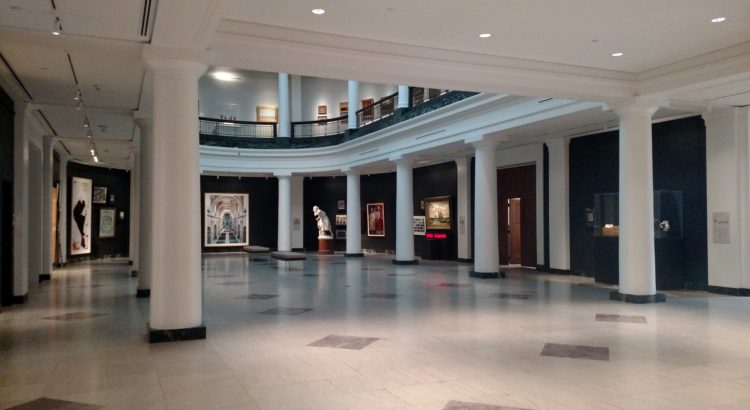
Walk into the University of Michigan Museum of Art, and you will be greeted by Collection Ensemble, the new museum entry way. It is certainly a stark contrast from the previous collection in the apse, which housed only European and American paintings from the 19th and 20th centuries. Where heavy gilded frames once hung on white walls, a diverse collection of art graces the now-black walls in the grand, columned space. Collection Ensemble is a museum entrance fit for the modern world: it feels sleek, modern, and almost minimalist compared to what only just recently hung on the very same walls. The white columns stand out against the black background, and though the frame of the entrance is still very much recognizable, it’s fascinating to me how something as simple as a change in the color of the walls could change the entire feel and light dynamic of the museum’s space.
The first thing I noticed when I walked in the museum’s front doors was Candida Höfer’s photograph Basílica do Palácio Nacional de Mafra. From far away, it appears to be almost a portal through the end of the apse, like you could just keep walking right into it. Walk closer, though, and you will see that it is actually a photograph of a Baroque church. Almost ironically, two marble statues, one by Richard James Wyatt and the other by Randolph Rogers, remain unmoved on either side of the photograph, survivors of the apse’s reimagining.
The exhibition is divided into nine “gatherings,” separated by the apse’s already existing columns. Among the titles of these spaces are “Community Blocks,” “Constructing a Scene,” “Light Details,” “Entrancing,” “The Cosmos + Me,” and “Water Protocols.” I appreciated these carefully thought-out names, as they offered a lens through which to view the artwork in each gathering. Additionally, signs with each gathering title give a “key” of which artwork is which.
Also new is the seating space just inside the doors of the museum. With comfy seating, coffee table books about art, and art hanging over your head, the little area seems as much like someone’s home as it does an art museum. From the vantage point of this seating, it is possible to admire most of Collection Ensemble.
If you haven’t yet had the chance to check out the University of Michigan Museum of Art’s new entry space, stop by for a visit!
REVIEW: Shoplifters
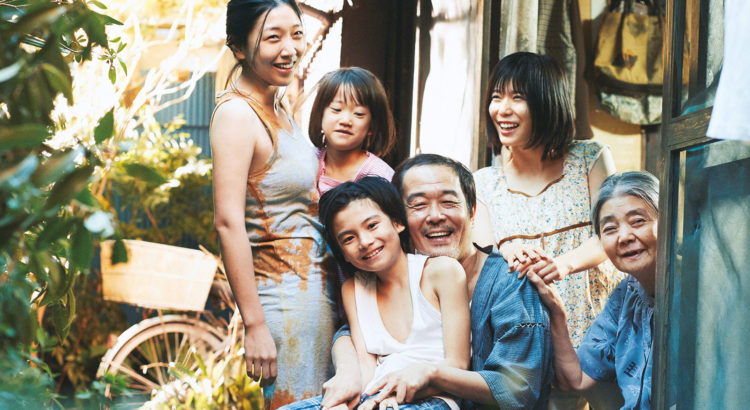
Shoplifters is a quietly touching movie. It neither strives to be a tear-jerker nor is it overly pessimistic. It simply is. It is a story set perfectly in the real world, even though most of its characters are ignored by the rest of society. Constantly, they are told by others that they don’t exist. Most interestingly though, Osamu (Lily Franky) and Nobuyo (Sakura Ando), the central couple of the story, simply don’t care. They benefit from inattention, cultivating an unusual family in the midst of busy Tokyo. They are not married, but they have a child. Hatsue (Kirin Kiki), the older women that lives with them, is not their mother, but they call her ‘mother’ in front of the housing authorities. They are living false lives, but so is everyone around them. Osamu and Nobuyo see their lies as necessities for both their survival and the survival of the family that they have built together.
In addition to Osamu and Nobuyo, the ostensible ‘Dad’ and ‘Mom’ of the household, and Hatsue, the ‘Grandmother’ figure, the household consists of Osamu’s younger ‘sister’, Aki, and their ‘son’ Shota. All of their histories are carefully veiled, the audience only occasionally glimpsing their true pasts. The characters, themselves, seem to avoid their prior selves. They have discarded themselves as easily as the plastic wrappers thrown next to the road. It is freeing and empowering to only live in the present. For them, it doesn’t matter how they have gotten to this moment only what they can do now. It is a life with few regrets, but also little thought for the future. The fragility of their situation is constantly threatened and one of the greatest threats comes in the form of a little girl, Yuri. Yuri’s biological parents are constantly arguing, leaving her to play outside unattended. One night, Osamu and Shota find Yuri who has run away. Instead of returning her, they decide to take her into their own family. Other movies would simply assume that the adoptive family is Yuri’s salvation. But they, too, are dysfunctional.
Shoplifters, admirably, never chooses sides, instead finding the happiness in the messiest, most unorthodox situations.

REVIEW: The Favourite
Sometimes, the best twists do not manifest as supernatural ghosts or as a long-lost relative. Sometimes, the best twists are not external but ones that were within the character all along. The characters of The Favorite think they know each other, inside and out. As members of Queen Anne’s court, Lady Sarah (Rachel Weisz) and Abigail (Emma Stone) vie for her favor and the power that entails. But Queen Anne (Oliva Coleman) is more than a figure to be manipulated. She, too, has a motive. As the three women pull and push each other, though, each one’s goals become more and more unclear. Director Yorgos Lanthimos reveals the characters as much to the audience as to themselves.
18th century England is a land of strict propriety, but Lanthimos finds the farce in it. The wigs and excessive make-up are treated as constant visual jokes. Even the extravagant palace settings are used more to make fun of than to glorify. Certainly, the entire film is visually fabulous, but all the gold veneers only serve to highlight the messiness of the lives within. The humanity of the characters and most of the supporting cast help greatly in grounding the film in emotion. Lanthimos does not want the audience to think of the character merely as plot points but as insecure bundles of nerves and feelings. No matter what Sarah and Abigail might say to themselves, they are vulnerable. And not even their impeccable table manners or frighteningly tight dresses will impede them from demonstrating how they feel.
This movie is a testament to each of the actresses’ choices, too. Stone is physically sloppy while being entirely emotionally composed. Weisz, too, schemes and maintains a careful exterior, but the few times she allows it to slip are the most touching of the entire movie. Together, the two characters engage in combat over who can win Queen Anne’s affections. It is a delicate political dance and a bruising fist fight. It is warfare and a promenade. It is women fighting women in ways only women can. The Favorite is message driven without being pandering. It allows its characters to explore issues without forcing the issues upon them. It is also easily one of my favorite movies of the year.
