REVIEW: Captain Marvel

We hurried to the darkness of the theater even as the sunshine beckoned. We hurried, compulsively, because the newest Marvel movie, Captain Marvel, had finally been released for our eager consumption. We hurried without much contemplation for this was just the latest piece in an expanding narrative. I wonder when I will stop hurrying to MCU movies. I have watched them with my sister, my friends, even dragged my parents along to some. It used to be that such communal experiences would thrill me. Each movie spawned a conversation, one of the few that encompassed my entire community. Yet, I find myself balking now, twenty-one movies later.

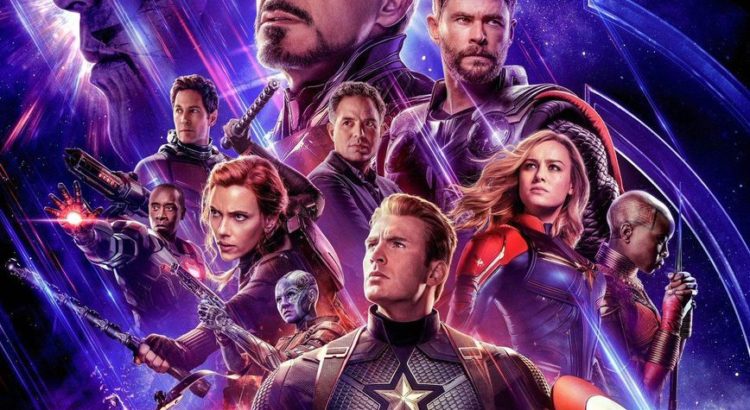
This is, of course, not entirely due to Captain Marvel, itself. It is a perfectly serviceable movie that has a perfectly acceptable mixture of action scenes, inspirational montages, and banter. But Captain Marvel was never going to be judged entirely on its own merit. No Marvel movie can separate itself from the overwhelming pressure of living up to greater expectations. Each must reach outside of its own story to connect to its predecessors as well as serve as infrastructure for future entries into the pantheon. Perhaps it is here, where Captain Marvel stumbles the most. Set in the 90s, the movie is situated in an era far before the one most Marvel films take place in. Due to the difference in time period, it is often tasked with being a prequel to the rest of the cinematic universe. This is most evident in the excessive incorporation of Nick Fury (Samuel Jackson) into a movie that is ostensibly about Carol Danvers (Brie Larson). Instead of being an origin story for one character, it is the origin story for Nick Fury, and for the MCU in general.

With much to accomplish, it is Carol’s story that gets shortchanged. It takes half of the runtime even for her true name to even be revealed. She is instead introduced as Vers, a warrior for the Kree race in their war against the shape-shifting Skrulls. Vers is a dedicated soldier whose quips are as sharp as her blows. But beyond the occasional sarcastic turn-of-phrase, not much of her character is revealed. Brie Larson plays this initial version of Carol with a discomfort that doesn’t quite fit with the character’s brash confidence. It is, indeed, difficult to see her as a cocky, but selfless hero. It is a strange combination that the movie fails to justify with further backstory. Instead, the movie substitutes character development for easy montages and deus ex machinas. It allows Carol to fly before we even see her learn to run. It is a movie out of sync, which is ironic, for one that seems so concerned about continuity.

It is those that are invested in the Marvel Universe that will benefit most from this movie. We will be the ones that ‘get’ the references, the ones that understand the significance of Captain Marvel in a greater narrative. But as a movie unto itself, it does not understand the characters at its heart.
REVIEW: Amazing Grace

“She can sing anything … ANYTHING.”

Amazing Grace will transport you in an instant to New Temple Missionary Baptist Church on two very special evenings in 1972: when the legendary Aretha Franklin recorded live her album of the same title, which would go on to be certified double platinum. The film of this event, recorded by Warner Brothers, has never been released before due to technical difficulties associated with it, and it is a rare window into a monumental performance to be able to view it.

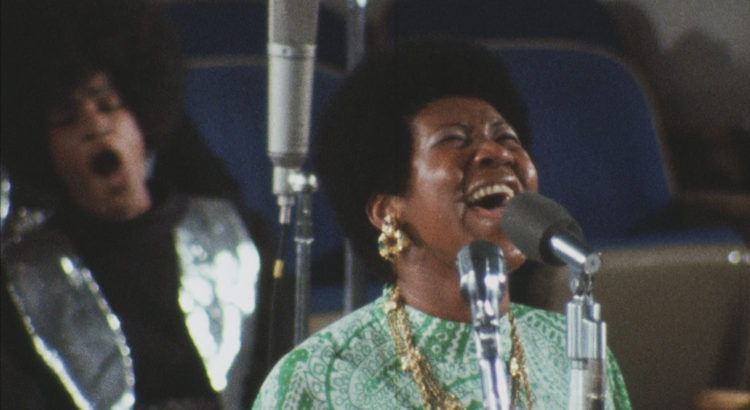
The film quality, which is grainy and blurry, is terrible by today’s standards, but it doesn’t matter. Similarly, the camera work is quite bad: the camera shakes, moves around too quickly, and looks like a home video during some parts. But again, it couldn’t matter less. What viewers see is the awed faces of the audience, the sweat beading on the brow of Ms. Franklin as she sings, and the shining vests of the Southern California Community Choir, the group that provided background vocals. We see the face of Jesus on the wall behind the performers, and we watch when, in the middle of the evening, an audience member breaks out into tap dance. We witness the Reverend James Cleveland, his head in his hands and tears in his eyes during the performance of “Amazing Grace.” We view Ms. Franklin’s entrance on the first night, the camera angle giving her an almost regal appearance as she passes down the church’s aisle. What is most important, though is what we hear: one of the greatest voices of modern American music, unfiltered and in her fullest glory.

I don’t think that I can put into words the energy and electricity that is tangible in the moment, and it is a privilege to be allowed in to see it. It’s pretty much impossible to watch this documentary without feeling the insuppressible urge to clap, sing, stand up, and dance, and it did not bother me in the least when I could hear other audience members doing so. It is an emotional rollercoaster ride that is a miracle to be able to ride, and you will likely laugh, cry, and sway with the music.

In my opinion, it is not possible to give this film a high enough rating – eleven out of ten stars would not even begin to describe it. Experience it for yourself while it is still in theaters!

REVIEW: The Chaperone

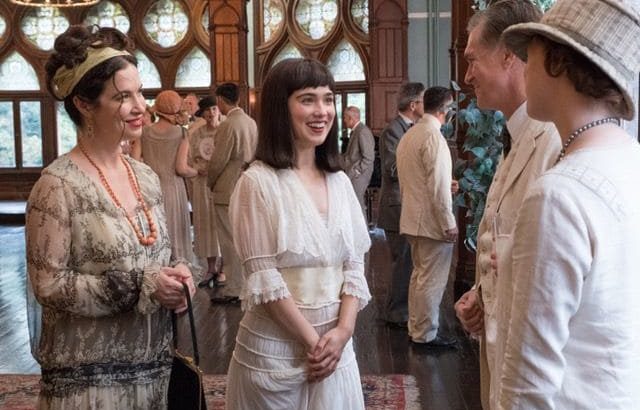
The Chaperone, directed by Michael Engler, was a movie, though flawed in some areas, that was full of delightful details. It tells the story of sixteen-year-old Louise Brooks (played by Haley Lu Richardson, the future film star of the 1920s), and how she travelled from Wichita, Kansas to New York City to study dance at the Denishawn School. There was just one problem: Louise’s father would not allow her to go unless she was accompanied by a chaperone. Luckily for her, Norma Carlisle (played by Elizabeth McGovern) volunteers herself on a whim after seeing Louise, and the two head off to the big city – a stark contrast from small-town Wichita.

Though Louise Brooks is the “star” of the movie in that she is the larger-than-life character, Norma Carlisle is really the person that comes to be the main character. Layer by layer, we learn more about Norma’s past, and the movie deals with difficult themes of identity. Adopted from a New York orphanage by a farming couple in Kansas, Norma married her husband at age sixteen. As the audience, we can sense that Norma isn’t fully happy in her marriage, and Louise sees right through this as well, despite Norma’s insistence that she is perfectly happy. As it turns out, in a flashback scene, we learn that Norma’s husband is in a relationship with a man named Raymond. This is very complicated for the two of them, because they can’t separate under these circumstances, and so they remain together. However, in New York, Norma meets a man named Joseph, and the two of them connect in a way that she has never felt with Mr. Carlisle.

I will say that I found the character development between Norma and Joseph to be somewhat inconsistent. I was never entirely sure whether we were supposed to be seeing a newer, different side of Norma, or if her actions simply did not add up with her character. Particularly when they first met, Norma and Joseph’s interactions felt extremely awkward to me. They stood uncomfortably close to each other for people that were just meeting, and it did not seem like the Norma we knew from the other scenes. With Louise, she espoused moral and proper, lady-like behavior, and frowned upon flirting with boys (particularly a Columbia law student named Floyd), but her own actions with Joseph did not match this.

However, we did see Norma’s character arc develop throughout the movie, largely in part to Louise’s influences. She gains self-confidence, takes risks, and loses her corset. On a side note, having seen Elizabeth McGovern in the TV show Downton Abbey, it was interesting to see her play Norma, who had an entirely different affect.

The Chaperone was an enjoyable movie, but it won’t be added to my list of favorites.


REVIEW: Six Senses of Buddhism

Like all special exhibits in UMMA, this exhibit is a very small exhibit, only taking up part of a hallway and consisting of a few art pieces. It is an interesting exhibit because it is about how Buddhist art and objects invoke our senses; smell, sight, feel (there are lots of things to touch in this exhibit), and most importantly mind (thought), our sixth sense. In fact, I have always thought of Meditation as a release from all six of our senses, we close our eyes, sit still, ideally only smelling one fragrant of incense, hearing only silence, and letting our mind relax, detached from any thought.

The main piece of this exhibit is a painting of a Buddha heaven. This painting is from Pure Land Buddhists, one of the biggest sects of Buddhism in China, and is of someone, probably a monk, being welcomed into heaven. I like that the heaven is on the clouds, it makes me think that heaven is always watching over us. In this painting figures with halos represent Bodhisattvas. Tea is an integral part of Buddhism, and so there were two tea bowls, one from China and one from Japan. The Chinese bowl is a lot older, but it looks more modern because it is symmetrical and completely smooth. The Japanese bowl, on the other hand, seems much more hand crafted,maybe even by an amateur, because it is rugged and asymmetrical. However, in Japanese art this is intentional because Japanese ceramic art considers asymmetry more beautiful and more impressionable.

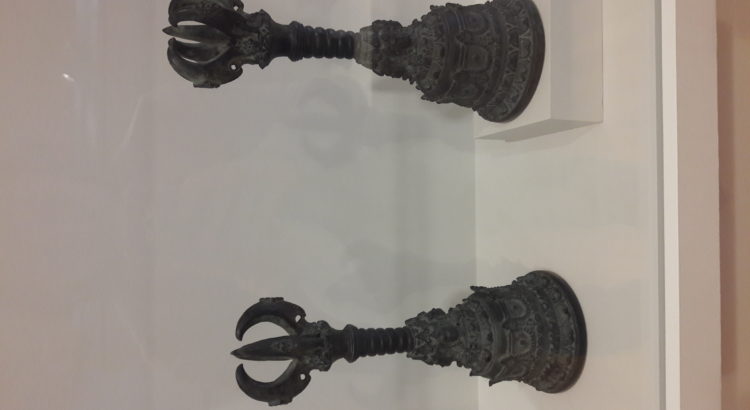
The featured photo is of Bells and Vajra. This bell is very ornate, and was probably used to call monks to the meditation hall. You can touch a 3D printing of the bells at the exhibit. There are beautiful incense holders. Next to them are cards you can take that smell like clove incense. Incense is often used to keep track of time while meditating. When the incense burns out, you are done. No sporadically looking at a clock is necessary. The last piece in this exhibit is a Rakusu, which is the garment monks wear outside their robes. This Rakusu was pretty ornate and had designs, so it was probably of a monk that had a higher status. Monks like to make their own clothes, because it is a tradition from monks who were too poor to afford clothes and would patch together old rags.

The exhibit is small, but there is actually a lot of Buddhist artwork in the Asian Art gallery. If you can’t get enough from the exhibit you can see more paintings, actual scrolls, and shrines that were in temples in the gallery.

REVIEW: NEEDTOBREATHE Acoustic Live Tour

I was familiar with the South Carolina-based soft rock band’s music, but NEEDTOBREATHE’s concert last Monday at the Michigan Theater was not the kind of event that I usually would go to. That said, I enjoyed the performance for that very reason.

I couldn’t help but be excited as I stood in the buzzing line on the sidewalk to get in to the concert, under the marquee sign lit with NEEDTOBREATHE’s name. It was clear that there were many loyal fans in attendance, and so that was surely a good sign!

After an opener by singer-songwriter Trent Dabbs, the concert began with golden lights onstage turning on one by one, like lanterns in the dark. The band then entered, and launched right in to several songs. One thing that was very fascinating to me about this concert was the set: the background consisted of many twinkling lights, like stars in the sky, with a wave of vertical lines of light at the bottom. The color and intensity of the lights changed according to the mood of the song they were playing, and the bars of light would move at times and turn off completely at others. I thought that it was very well-done in that it was interesting and added to, rather than distracting from, the music.

It was quite a long concert (almost 3 hours with the opener and an intermission), and NEEDTOBREATHE played a host of songs, of which a few of my favorites were “Wasteland,” “Difference Maker,” and “Multiplied.” However, the one thing that I didn’t like was that I found that the music was generally too loud. I expected it to be a rather loud concert, but it was their acoustic tour after all, and so I thought that it would be a little more manageable (I can only imagine how loud their non-acoustic tour concerts must be!). The volume was distracting from the actual music, though, I found that to be frustrating.

On that note, the best part of the concert was hands-down the last songs, during which NEEDTOBREATHE disconnected entirely from the sound system and came to the front of the stage. No microphones, and no amps – just human voices, two guitars, and a single drum. I didn’t want it to end, and I wished that they had performed the entire concert like this! It was in this configuration that they concluded the concert with their hit song “Brother,” to wild applause. After what seemed like a long time filled with shouts of appreciation and unabated applause, NEEDTOBREATHE returned to the stage for an encore of their song “More Heart Less Attack.”

I had a great time at this concert, and it showed me that it’s good to get out of your artistic comfort zone every once in a while!


REVIEW: Avengers: Endgame

Mild spoilers alluded to in this review.

It took me a very long time to figure out how to approach this review. I was practically raised on this series— an eleven-year-old baby when the first Marvel installment, Iron Man, came out.

It is a pretty long-running joke/phrase/cultural feeling that people are tired of superhero movies. Some people bone-deep hate them— and that these pictures are difficult to ignore with how huge they are in pop culture. And I empathize. But I am, tragically, overwhelmed with a deep love for these films that it drives out my naturally cynical side. I love these movies.

It is a frustrating genre, absolutely. I don’t completely have rose-tinted glasses but it is still something I kept to my heart. Because I love legacy and expansive lore. I love adaptations. I love an idealistic base and people trying to be the best they can be— and that is what Endgame ultimately encompasses.

Avengers: Endgame is a loving dedication to the superhero world Marvel has created, capping the first arc and juggling a surprising amount of character development for each of its original six heroes. It wanted to make you smile, a big tonal departure from from Infinity War and a necessary one. I don’t mean to say that the nuance of grief is unneeded in a large production— it absolutely is. But Endgame falls back on a Golden-Age feeling, a more classic superhero feel as it says goodbye to the first, long stretch of the series. Most of all, Endgame wanted to remind you where this whole journey started, when things were a little brighter. 

After the alien-induced rapture at the end of Infinity War, our original Avengers are left on a desolate Earth that is dealing with an unbearable loss. Departed friends, children, and loved-ones has left a surprising amount mystery around the central goal of the film. There wasn’t a moment where you would doubt that T’Challa or Peter wouldn’t be back— it was the how they would be back that drives the film, with a fast-paced and snappy momentum.  

Basically, one of these solutions is a time-heist and without getting too much into what that entails, it allows the movie to go back and revisit the Cinematic Universe’s high points (or middle points). With our heroes’ backs to the wall, a desperation turns into craftiness as they debate and bicker over magical science, falling into a cast chemistry that has been the heart of these movies. And it is a surprisingly niche mission for their final hurrah.

Robert Downey Jr.’s Tony Stark has been as natural to the actor as breathing and his love poured into the playboy billionaire with a heart holds the plan together this round. Tony finds a calm that hasn’t been granted to him in over a decade, putting him at surprising odds against the others. His growth, redemption, and new family makes Tony suddenly the most stable Avenger. 

On the flip side, Chris Evans’s Captain America continues to suffer loss and falls back into the muted depression that has been a defining, if often overlooked, characteristic of the hero since the end of his first movie. Scarlett Johansson’s Natasha Romanoff strives to find a type of redemption that puts her at rest. Mark Ruffalo’s Hulk finds an equilibrium, Chris Hemsworth’s Thor falls into despair after the complete bloodshed of his people, Jeremy Renner’s gets bloodthirsty and an interesting haircut.  

There were definitely parts that falter— a lot of the arcs for the characters were shifted to make things lighter or quickly pushed aside to move on to the next thing. Because of the overstuff of content, content, content, the movie forgets to sit down and cry over the shocking thing we just saw. The first half of the film tries to remedy this old Marvel habit but drops it at the latter half for some important scenes. 

Not everyone gets their goodbye— which hurts. As a fan, I need to remember who would reasonably could get their share of screen time. But even then, a line or two more dedicated to beloved relationships would have been just fine. And I definitely have some Thoughts on the send-off for one of the flagship characters.

But I was still smiling through a lot of Endgame. 

Because I saw this movie on Thursday at 12 A.M. Three hours long and running purely on coffee, I let shocked yelps and gasps that was shared across the theater. The final battle was chock-full of these character who only ever thought would stay on the glossy pages of a four dollar single issue. While I believe it is vital that we all view industries with a critical lens, it genuinely is wild that this franchise was able to happen and sustain for for so long. Endgame was built to be the series finale and it did just that.  

Avengers: Endgame is in theaters now— head to State Theater for the closest showing.