PREVIEW: A/PIA Heritage Month Closing Ceremony’s Prism Gala

Deck out in your fanciest gear for A/PIA Heritage Month’s last event of the year. Called the Prism Gala, the ceremony will features dancers, speakers, and awards for the A/PIA community.

There will be a screening of campus organization Uncover: A/PIA’s video “In My Mind: A/PIA’s and Mental Health.” The evening will also feature Seoul Juice and rXn.

The event was possible by the efforts of MESA, United Asian American Organizations, and the A/PIA Heritage Month committee.

The event is at the UMMA on April 20th from 7-10PM. You need to RSVP but it is a free event! The dress code is an encourage black tie or cultural attire. I’ll be the girl in the black shalwar kameez.

PREVIEW: Amazing Grace

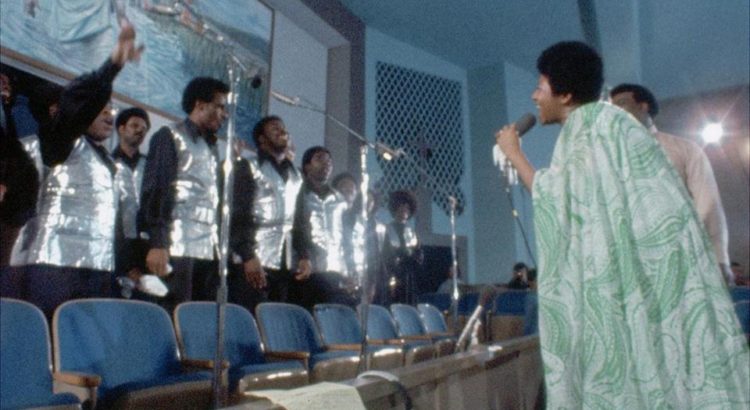
Forty-seven years after the release of Aretha Franklin’s album Amazing Grace, which went on to become certified double platinum, the best-selling disk of her entire career, and the highest selling live gospel album of all time, viewers are offered a window into its recording.

Recorded in January 1972 in Los Angeles at the New Temple Missionary Baptist Church, the footage in this documentary has never before been released. That said, it has been received with critical acclaim, a 99% rating on Rotten Tomatoes, and the Best Documentary (film) award at the 50th NAACP Image Awards, among other award nominations. According to Rolling Stones, “It’s the closest thing to witnessing a miracle — just some cameras, a crowd and a voice touched by God.”

Amazing Grace opened Friday, April 19 at the Michigan Theater. Don’t miss your chance to witness the Queen of Soul in this monumental documentary.


REVIEW: The Lute: Cai BoJie (Chinese Opera)

The grand finale of the Confucius Institute was the best show I have seen in all my four years at Michigan. I appreciate the Confucius Institute for making my experience at U of M much more cultural and special, and congratulate them on all their success on U of M’s campus.

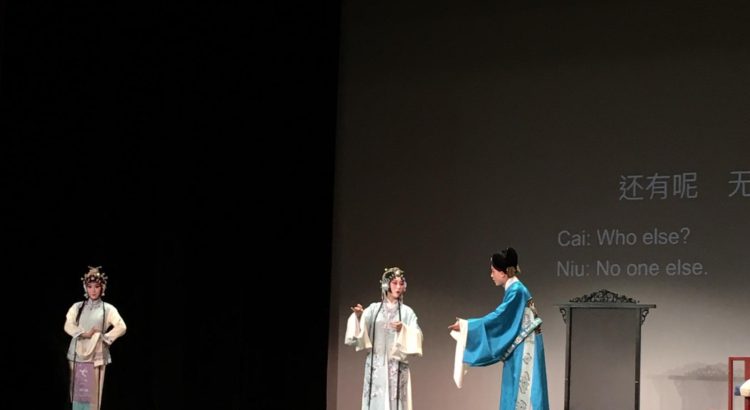
Chinese operas are more comprehensive than western operas because of the emphasis on movement and acting in addition to music and singing. These actors train their whole lives to be able to express subtle but deep emotions in their movements. I love how precise the movements align with the percussion and cymbals. Even when the actors were not moving they would stand in a beautiful pose flaunting their hands by elegantly contorting their fingers. Some other major differences between Western and Chinese opera include: Chinese opera has limited facial and mouth movements when actors sing, most of the singing from both male and female characters is an extremely high pitched falsetto, and the most important part of the clothing/costume is the sleeves. The costumes are extravagant. Dainty, light, silky, colorful dresses and robes combined with beautiful makeup and jewelry lining their hair. The male characters all had a feminine look to them because of the intense makeup and lack of facial hair. Still, sleeves are the most characteristic part of their clothes because of how the actors use their sleeves. Sleeves usually covering their hands would fly inward and outward with precision and control. The actors would twirl the sleeves occasionally allowing a glance at their fingers.

The plot was extremely Chinese because it was all about filial piety. It was a depressing story about a failed son without a happy ending. Still, this play was surprisingly comical. Cai BoJie often had me laughing, especially when he interacted with Lady Niu. Besides the irony and intended comedy in their scene together, something about how respectful and orderly he was to Lady Niu was funny. Maybe it was the juxtaposition of his esteemed attitude and his melancholy feelings. Maybe it was how unnatural their relationship felt having to address each other as “honored lady/husband”. One thing for sure is that the movements in Chinese opera give a sense of comedy vacant in Western operas or American musicals because we don’t have to wait for a joke to laugh, the subtle movements of the actors do the work.

The acting of the characters was truly incredible. Cai Bojie did a great job acting sorrowful and regretful. No matter what he was doing he always seemed conflicted. The scene where he was on his knees mourning his parents death was riveting.  WuNiang was an incredible actress as well. Wuniang had a persistent look of worry the entire play. This showed the hardships she had been through and helped the audience understand the depth of her depression. The most comical character was the monk in the temple. He had a silly face and was constantly laughing. His singing sounded more like a fools chant than a monk reciting a prayer or sutra.  I am curious if this was a commentary on monks? The monk seemed to care more about sucking up to Cai Bojie than actually performing rituals. Seeking money and donation must be his first priority.

Music is a central component of the story. It is through music that characters displayed their true emotions. The most beautiful music was when WuNiang told her tale through the pipa. In fact, this play is named after the pipa, lute means pipa in English. My favorite sounds besides the instruments were when the actors would laugh or cry.

My favorite scene was scene 3. It was interesting that Lady Niu wanted to fervently punish Cai BaoJie when it was WuNiang who had to endure all the hardships because of Cai BaoJie. Yet, WuNiang didn’t want any vengeance on Cai BoJie and was willing to go back and mourn for another twelve years. The best part was when WuNiang revealed the name of Cai BoJie and she and Lady Niu simultaneously shrilled.  All of a sudden they started to mimic each other, even slouching in the same manner.

This was a once in a lifetime treat that I will never forget; being able to see a first-class Chinese opera, in the front row and with English subtitles.

REVIEW: Bookmarks: Speculating the Future of the Library

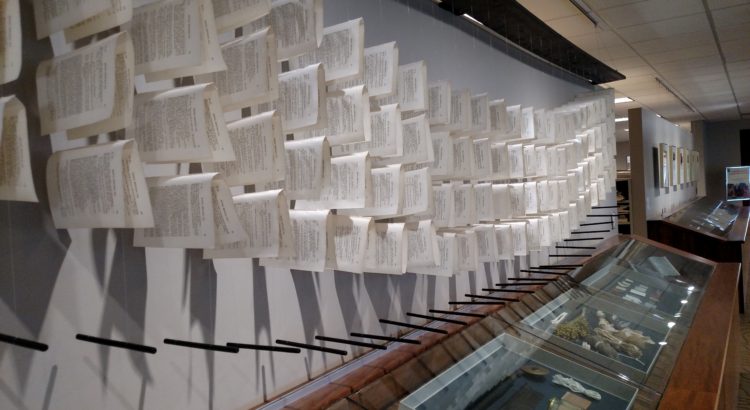
Spread across campus in the Hatcher Graduate Library, Shapiro Undergraduate Library, and the Art, Architecture & Engineering Library, Bookmarks: Speculating the Future of the Library is a mixed media exploration that does just that.

The main installation in the Hatcher Graduate Library, In Search of the Pale Blue Spin, is an audio walk through the library created by Stephanie Rowden & Jennifer Metsker. Visitors may use their own personal device or borrow an mp3 player and headphones from the information desk. The walk is inspired by Jorge Luis Borges’s short story Tlön, Uqbar, Orbis Tertius, and although I found the context of the story confusing, I must believe that that was part of the point.

More than anything, In Search of the Pale Blue Spin encourages “travelers” to stop and notice the details of the library. The calm voices in the recording, along with ethereal string bass and clarinet, usher listeners out of the everyday. You may have spent hours doing homework at the Hatcher Graduate Library, but have you ever stopped to take in the mosaic-like paintings in the North entrance, the arched ceiling of the reference room that is reminiscent of a train station, or the carvings of men in horses on the second floor? As the voice in the recording led me through the stacks in search of a mysterious book about Earth, I was able to be present in the library in a way that studying there doesn’t allow. I had never really stopped to take in the illuminated stained-glass window depicting a boat at sea, and I certainly had never noticed that it includes the letters “U M” at the top. Furthermore, I had never even been to some of the areas that the audio walk took me through.

Along the way, there are other pieces of art that are a part of Bookmarks. One of these works, Sophia Brueckner’s work Captured by an Algorithm, appears to be a set of Victorian-style porcelain plates at first look. However, further scrutiny, and a reading of the artwork’s description, reveals that the plates are printed with images made by applying Photoshop’s Photomerge algorithm to scans of romance novel covers. Each plate also includes a Kindle Popular Highlight from a romance novel. In other words, the set is a juxtaposition between what is old and what is new, and between what appears to be and what is.

Despite my enjoyment of In Search of the Pale Blue Spin, I cannot agree with its view of the library’s future. After heightening listeners’ appreciation of the library, the audio concludes, “Some of us have appointments to get to. Some of us are just tired. We need to say goodbye now. We need to say goodbye to the library, though we hope that it will still exist.” The World Book Encyclopedia may have become obsolete in the age of the Internet, but this does not mean that libraries are dead. They certainly are changing and must continue to, but evolution is the very thing that prevents extinction. In the twenty-first century, libraries have the opportunity to embrace and expand their role as epicenters of community and education, and we should be giving them new life by working to make them as accessible and relevant as possible, not mourning their death. We should not and cannot write off libraries just because the world (inevitably) is changing.

Bookmarks: Speculating the Future of the Library is free and open to the public and will continue through May 26. For more information, visit the exhibition’s webpage.

REVIEW: Shazam

Fun fact: Shazam is technically a Christmas movie.

But it is also an incredibly sweet movie that generates a loving origin story surrounding the main character and his family, creating a narrative that refreshing, humorous, and incredibly, incredibly fun to watch.

Asher Angel pays Billy Batson, a young runaway teen on the lookout for his mother who he was accidentally separated from when he was a child. He is placed in a large— and nice— foster family but is not having any of their sweet dinner rituals and found family antics. This is derailed anyways when a dying wizard bestows Billy with the collective powers of multiple famed godly beings throughout history, turning him into the hero that we know as Shazam.

(Or Captain Marvel in the comics but Marvel Comics snagged the old name from them. Copyright is hilarious sometimes).

Anyways, whenever Billy uses these powers, he turns in Chuck’s Zachary Levi— a man in his late-30s.

Angel is an engaging actor, endearingly sympathetic as a clearly heartbroken child even when Billy is being a bit of a brat. (He is also a near duplicate of Maisie “Arya Stark” Williams.) There was a quick concern that we will loose Billy in Levi’s antics and forget the kid behind the mask (or, ah, adult-man-body). This is the case for a lot of movies— see Big or switched up in 18 Again or any film that partakes in the popular trope of “child gets zapped into something else for a day”, but the film consistently reaffirms Angel into the film during the emotional beats of the film.

Levi has always been a goofy, physical actor and it was a throwback for me to see him back as a fun-loving centerpiece again. He took the pre-teen angle and ran with it— always fun while getting Billy’s own personal hang-ups through his actions. They are definitely two sides of the same coin— while Angel getting more of the dramatic scenes and Levi getting some of the more goofy, maybe a little less cool ones. And the latter makes sense— a rough kid still is going to be kind of silly when you see his actions in a man’s body. (Cue first-taste-of-beer spit take.)

The wizard deemed Billy as “pure of heart”, but it takes a while for our protagonist to get there— he is actively selfish, impulsive, and kind of mean. But he is also fourteen and the natural growth of Billy’s character development was packed well into the high-concept of his powers. There’s something kind of surprising to see your kid-hero actually being kind of terrified by being hunted down by an grown-man-villain with zapping powers.

The supporting cast was fantastic as well— Billy’s fellow foster child Freddy (Jack Dylan Grazer) takes up the other third of the film as a supportive fanboy and rare “friend-in-the-know” who actually participates in the hero scene. Billy’s youngest foster sister Darla was absolutely adorable. Shazam deal with themes of found family in ways that feel jarringly realistic, while keeping an idealistic base that gives it a distinct superhero feel.

And in case you are wondering, Shazam is a little divorced for the larger narrative of the DC Cinematic Universe. (And that’s all I will say about that!)

I liked Shazam the way I liked Spider-Man: Homecoming and Spider-Man: Into the Spider-Verse— a movie that tackles a young adult’s life as they move on to the next stage of their life. Movies that can approach mature, maybe even dark, subjects with a wide-eye type of kindness that is needed for all audiences. The final battle scene of Shazam causes a thrilled gasp throughout the theater and I believe it earned it completely with how it built its story.

If you are the type of person deeply exhausted by the slew of superhero movies (and I sure am glad I am not you, sounds rough), Shazam would probably be the movie for you. The coming-of-age feel and separation from a larger narrative allows it to be a contained story that focuses on the fun, wild growth of its cultivated characters.


REVIEW: FLINT, a play

Award-winning playwright, Jose Casas, wrote FLINT in order to raise awareness about issues residents of Flint, MI still face today. Other plays and movies have been produced about the water crisis, but the timeline of this play extends to present day and the personal stories within it are unique.

One element of FLINT I admire is that the transcript was written from real-life interviews of Flint residents. The narrative included communities within Flint who have been marginalized and rendered invisible; such as undocumented immigrants and people in the deaf/Deaf community. Undocumented immigrants feared/fear going to relief events to obtain donations like bottled water, because the Immigration and Customs Enforcement (ICE) would target and deport them (even though ICE claims not to target individuals during humanitarian relief events). On the other hand, people in the deaf/Deaf community were not notified about the water crisis until 2016, two years after the fact.

Numerous stories and perspectives were featured within the play: the Mother, Father, Fighter, Pediatrician, Sociologist, Gardener, Professor, Demolitionist, etc. The play began with the Father’s story and ended with the Mother’s. The intentionally-elliptical narrative conveyed that there are no clear solutions to the water crisis—within the play itself and in real life.

The Flint water crisis started in 2014 when the city’s drinking water source was changed from Lake Huron and the Detroit River to the Flint River. Residents knew for decades that the Flint River is toxic due to pollution from General Motors. They knew not to swim in it, let alone drink it. But the switch for their source of drinking water still went through in order to lower costs for the city. After the switch, lead from the pipes leached into the water, which exposed thousands of people to high lead levels. In some places, the water that came out of the faucet was brown and undrinkable. Paradoxically, people still had/have to pay their water bills for water they can not drink.  

Frustratingly, America has known the detrimental effects of lead for decades now. Lead is an insidious neurological toxin that can cause cognitive damage. The World Health Organization (WHO) states that lead is stored in the teeth and bones. During pregnancy, lead in the bone is released into the blood and can harm the fetus. Over time, lead can decrease a person’s IQ. No amount of lead exposure is considered safe. That is why the U.S. Environmental Protection Agency (EPA) has spent thousands—and even millions—of dollars in the past few decades to renovate houses with lead paint for families with low incomes.

Ironically, while houses are renovated for lead content, millions of people in the U.S. still drink water with lead in it. A shocking fact I learned from the play is that there are two-thousand cities in America with more lead in their water than Flint. I am dumbfounded by this fact. This is a nation-wide issue.

But the problem isn’t just with the water. One must think about how things got this bad in Flint even before the water source was switched and lead leached into the drinking water: Why was the Flint River polluted to begin with? Why was it not filtered properly before redirected to people’s faucets? Why was the water source switched to the Flint river when people knew it was polluted? Why is the Flint economy so poor?

The water crisis is not an isolated problem. A culmination of factors led to this. Minorities and people who are in poverty traditionally suffer the most from systematic injustice. Our government has failed communities it has pledged to serve and protect. People have fought for their rights for generations, and they are tired.

But despite all the tragedies that Flint has experienced, the play reminds us that Flint is more than the challenges it has overcome and the ones it still faces today. Happy memories are made there. People live there. Some grew up there. The community hosts film festivals and concerts, visual arts events and cultural shows. And there are other wonderful stories about its residents still waiting to be shared.