
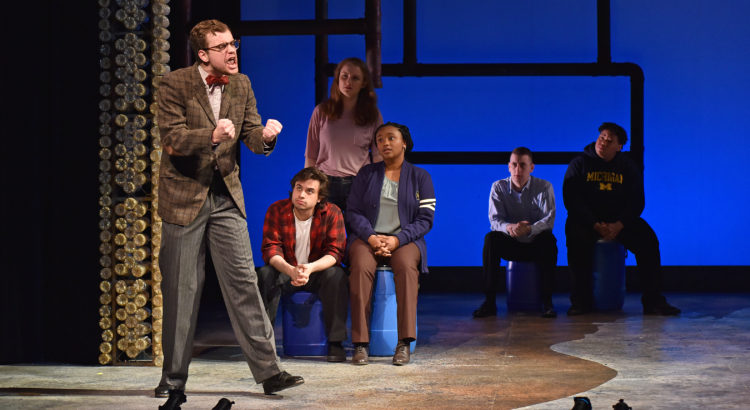
REVIEW: FLINT

It’s not just about the water. It’s about the food, it’s about the health, it’s about the children, it’s about the disabled, it’s about the racism. It’s about human lives.

Five years later, the Flint Water Crisis is still very much ongoing. However, in reality, the Flint crisis has been ongoing long before the news media caught wind of the lead pipes. In José Casas’s newest play FLINT, he chronicles the tales of anger, fear, and betrayal that the people of Flint have endured, and continue to endure. With poignant and powerful vignettes of all types of people who have a connection to Flint, this play honors the community that’s been holding onto their strength and fighting against the system, even when the system is stacked against them.

The play starts with the story of the Father and ends with the Mother, the love of parents and the sense of community permeating every corner of the city. They feel the brunt of the Water Crisis as they watch their children drink contaminated water and watch them leave the city, where the Auntie cares for her nieces who, at such a young age, have developed an alarming distrust of the water and of life. There’s the stories of University of Michigan students in Ann Arbor who come from Flint, reflecting on the reasons why they left and how they felt when they did, and how the city never really leaves them. There’s the old Man and Woman who find love, despite the stigma associated with interracial marriages. There’s the Prom King, keeping the legacy of his high school alive while appreciating the moments of everyday joy that the media glances over while glorifying the crisis. There’s the Catholic who organizes unified relief efforts with people of all skin color, genders, and religions, only to be turned away. There’s the Boxer who fights, both physically and mentally, in his community.

There’s the optimistic Photographer, la aspiring Poeta, and the dreamer Actress, who find solace and hope in their art forms. There’s the Cashier, the Demolition Worker, the Autoworker, the Barber, and the Delivery Guy, who reflect on what makes a place a place, who see the different sides of failure, who wonder what can be made of destruction. There’s the Professor, the Commissioner, the Attorney, the Nurse, the Pediatrician, and the Sociologist, who understand how systematic and intentional the racism is, who see how the government systems in place work to oppress the ones who are already oppressed.

Flint is the home of children, parents, and old couples. It’s the home of the Black and Latinx and Deaf communities. But the government has turned that home into a place of fear and distrust. Governor Snyder failed his constituents. So did President Obama. General Motors never actually considered the city and its workers, while Nestle exploited the city to turn a profit on clean water. There are people and corporations and structures to blame, but the ones answering for these problems and shouldering the weight of it all is the community.

However, Flint and its people is not the water crisis. They are not helpless and they are not weak. They are not defined by this crisis because there is more to this place than the selfish act of the government and corporations. FLINT is the powerful compilation of the tales that have not been told, and Casas and the SMTD cast did a phenomenal job telling these real stories and giving them all a voice. As the ensemble switched between different characters, they weaved together these seemingly-separate narratives into one empowering story about one powerful community. The arch made from empty plastic water bottles was a stunning visual representation, along with the rusted lead pipes that hung from the ceiling and the graphics in the background that played clips of the Flint River, rippling waters, and much more. From the interviewing process all the way to the production, the resilient community has been at the heart of this play, not to exploit or glorify it, but to honor it and to make sure change happens.

Water is a human right. There is nothing more essential to our health and growth. The story of Flint is not an isolated one, as many cities and communities around the world are fighting for clean water, something we — the privileged — often take for granted, and as a result, often forget. Now, it is our job to never forget and always keep fighting for what is right so that our neighbors don’t have to fight alone.

REVIEW: Aldo Leopoldo Pando Girard Poetry Reading

I really enjoyed Aldo Leopoldo Pando Girard’s poetry reading at Literati. He was charismatic and well-spoken, and the audience was very supportive. The reading itself was very interactive: people responded through snaps, claps, and cheers.


Girard read from his book Self Portraits, Mixed Media, published by Red Beard Press. His poetry was vulnerable, political, and skillfully crafted. The poems were often conversational and contained clever linguistic surprises. Some of the themes in his poetry included seasons, college, sadness, identity, race, bilingualism (specifically Spanish and English), queerness, the cosmos, and politics. Girard seemed very comfortable in front of a crowd. His background in slam poetry was evident when he came alive with gestures and facial expressions, and how he manipulated sounds and rhythms in some of his poems. It was a delight to see the performance side of his work.


Some of my favorite lines I heard him read:

“My whole body is woven with stories”

“Fall up into the stars”

“My ribs are an earthquake”


His reading was followed by a Q & A and book signing. During the Q & A, he talked about his role as the 2018-2019 Ann Arbor Youth Poet Laureate, a position I was not familiar with. As a Youth Poet Laureate, he is conducting a social justice project, mentoring teens at the Neutral Zone, leading workshops on poetry performance and editing, and educating people about the diversity and power of poetry. He is also putting together a chapbook featuring works by youths of color in the Ann Arbor-Ypsilanti area. The chapbook will be released at the end of May.

During the Q & A, Girard also talked about his creative process as well as the differences between spoken word and page poetry. He usually determines whether a piece is meant to be spoken or not during his editing process. For his spoken pieces, he utilizes double meanings and wordplay, and he edits them so they can be easily understood when read aloud. Whereas for page poetry, he allows the poems to have more complicated meanings, which may only be deciphered through closer readings.

For poets who are just starting out, he recommends reading a lot because the field of poetry is diverse. Referencing other people’s work can expose you to unique ideas on what is defined as “poetry” and what “poetry” can do. He also says that “editing is most of writing” and that it is crucial to find a community through which you can receive feedback about your work.

You can purchase his book of poetry, Self Portraits, Mixed Media, as well as I Name This Body Mine (which features some of his work) both at Literati for $12. Also, be sure to read the reviews on the backs of the books, several famous writers have great things to say about Girard’s work. 

Upcoming Events featuring Aldo Leopoldo Pando Girard:

  • Ann Arbor Youth Laureate Commencement Performance: https://aadl.org/node/388703
    • Downtown Library
    • 5/23/19, 7-8:30 pm
  • Poetry Workshops: Mondays 4:30-6pm @ the Neutral Zone

REVIEW: Streetcar Named Desire

Last weekend, I had the pleasure of being witness to Rude Mechanicals’ Production of “Streetcar Named Desire” by Tennessee Williams.


What I really enjoyed about this show overall was the emotional vulnerability and raw honesty, that everyone on stage brought to the production. Being unfamiliar with the story, I was blown away by how much justice that this group of performers brought to such a powerful, complicated, and difficult portrayal of human life. This wasn’t the type of show that you leave thinking “wow what a splendid show”, although it was remarkable. It’s the type of show you leave and it sticks to you, weighs on you, keeps you thinking about it long after the bows have been taken.


Juliana Tassos as Blanche Dubois. There never was more perfect casting, from her entrancing voice that transported you to another time and place to her stature that could simultaneously portray proud regality and a desperation as her façade came crumbling down. Quite simply, she shone. You could feel the almost magnetic pull between Mallory Avnet and Jack Alberts as Stella and Stanley Kowalski. You could see Mallory’s distress not only on her face but in the embodiment of her struggle between loyalty and responsibility to her husband and her sister. And Jack. I mean it in the best way when I say that he literally terrified me. As the “villain” of the show, he kept the audience captivated- trying to figure out who was good and who was evil and finally sticking the landing as a master manipulator. You could just love to hate him. Austin D’Ambrosio as Mitch as brought forth a wonderful performance. Making us love him as the one genuine nice guy in the whole show, he was a refreshing breath of fresh air in an otherwise dark plot. That is, of course, until the twist at the end. But in either case, he was wonderful to watch as the angel to so many other devils in the show. The supporting players rounded out the cast beautifully, from the haunting matron carrying flowers, to the Eunice the loud but well-meaning landlady, and the rest of the poker players making a ruckus.


Altogether, this show was a poignant but painful exploration into the lives of these characters. At the same time that you felt that you could know them intimately, you also felt that it was impossible to understand them. The cast and crew was clearly under excellent direction, keeping the audience on their toes through the ebbs and flows of the tempo of this piece. Set against the stark background of a nearly-empty apartment, you could feel the resonance of the events with full effect, bouncing bleakly off the empty walls and leaving us all dumb-founded in their wake.

REVIEW: Handel’s Semele

Somewhere between an opera and an oratorio sits Handel’s dramatic musical work Semele. And for that reason, I will hereafter call it an “operatorio.” A generally well-liked musical retelling of the Greco-Roman myth of Semele, who, at Juno’s urging asked to see Jupiter in his fully divine form, promptly died, and the resultant child became Bacchus. You know. Standard Olympus tabloid fare. Semele was performed last night at Hill Auditorium, by the English Concert, conducted by Harry Bicket, along with the Clarion Choir, and a cast of world-renowned singers.

Semele was an unusual work for Handel in 1744. With one abstract exception, all of his previous oratorios had dealt with biblical subject matter, from the strictly-narrative Esther to the more innovative Messiah. Semele has more clearly defined characters than previous oratorios, and presents more dramatic situations that are explored within aria rather than recitative. Tellingly, it contains an unusually large number of duets, several back-to-back arias where one comprises a response to the previous (in one instance, Semele’s aria following Jupiter’s even picks up his meter and rhyme scheme, completing the last lines of his aria with the first lines of her own) and even a quartet in the first act — almost unheard of in this genre and time period.

Handel makes a lot out of very little. The score is filled with orchestral “effects,” which Handel generally seems more keen to play with in his oratorios than in his operas.This may have something also to do with the fact that the bulk of Handel’s oratorio-writing career happened after his opera-writing career was all but finished, and this change in style reflects a more general maturation as a composer. Whatever the reason, the Handel of Semele is far more playful than the Handel of Alcina, which I reviewed a few weeks ago.

The role of Semele last night was played by soprano Brenda Rae, whose performance was hampered more than anything by the fact that the titular character of this operatorio also happens to be the least compelling. Still, she did ample justice to it, and her rendition of “Myself I Shall Adore” in the third act garnered one of the only instance of mid-scene applause in the performance. And deservedly so. She brought a wonderful comic edge to the nearly eight-minute-long aria, which, through repeating only twenty-six syllables of text, can easily fall into tedium.

Equally comic was Elizabeth DeShong’s performance as Juno. (Her performance as Semele’s sister Ino — the two roles double — was more melancholy.) As Ino in Act I, DeShong enthralled with her voice (she is easily one of the best coloratura mezzos of the present day) but found the character lacking. As Juno in Act II, she made her first entrance with a fierce swagger that evoked the great mezzos of previous generations, such as Marilyn Horne and Christa Ludwig. Her Juno was both a comic and dramatic highlight of the evening. She, along with soprano Ailish Tynan as Iris, milked the first scene of Act II for every piece of laughter they could, and “Hence Iris Hence Away” achieved both riotous laughter and applause.

Bass Solomon Howard also played two roles, and if his first role as Cadmus was lacking in material, he made an impression on the audience with the sheer power of his voice the moment he first opened his mouth. A vocal highlight of Act I, he subsequently became a comic highlight in Act III, when, as Somnus, the god of Sleep, he faced off against the firey Juno. (Ailish Tynan’s Iris also played a crucial part in the comic stylings of this scene.) The lowest notes in Howard’s “Leave, Loathsome Light” got a noticeably impressed reaction from the audience around me, and his subsequent interractions with Juno received more than a few chuckles.

Countertenor Christopher Lowrey made the most of the relatively small part of Athamas, the prince to whom Semele is initially engaged, and he really came into his own in the last act, in which he sings the operatorio’s last full aria, “Despair No More Shall Wound Me,” which evokes some of the more popular excerpts from Handel’s Messiah. Benjamin Hullet had a bit more to do as Jupiter, and his rendition of “Where’er You Walk” (perhaps the operatorio’s most famous aria) was perhaps the most affecting moment of the evening.

The English Concert Orchestra was in top condition, as was the Clarion Choir. If there was one thing to be desired in the performance, it was brevity. The operatorio clocks in at about three hours of music, and the performance, which started at 7:30, did not let out until about 11:00. Still, Semele’s most lethargic moments are in its first act, and with such wonderful moments as Juno’s cheerfully sinister “Above Measure,” and the intensely dramatic “Ah Take Heed” between Jupiter and Semele, all the way through the end of Act III, it was hard not to be engaged, entertained, and at times deeply affected by this truly unique musico-theatrical operatorio.

PREVIEW: The Lute

Have you ever seen Chinese Opera? I certainly haven’t. Saturday’s performance of The Lute is the perfect chance to fix that! The Confucius Institute is hosting the Suzhou Kunqu Opera Theater for this unique opportunity in the Michigan Theater tomorrow for FREE to anyone who RSVPs. This opera is a classic Chinese story about a man named Cai Bojie who must juggle duty to his country, loyalty to his family, and love for two different women. The story was first written Gao Ming in the 1340s but has been constantly discussed and reworked in Chinese culture since its creation. The story traditionally acts as an allegory for Chinese loyalty, responsibility, sacrifice, and familial duty. However, the version which will presented at this performance was premiered in 2018 in Suzhou and offers commentary on life in China today.
I am excited to see how my concept of opera, based on the German and Italian operas I have listened to or seen, will be expanded by seeing a non-Western version of the artform. I expect to see differences between European and Chinese opera in both the performance aspects and the storyline. Instrumentation, singing, and dance styles will surely be different from those featured in pieces like the Marriage of Figaro. I expect that the storytelling aspect will differ as well. European opera follows the rigid lines of comedy and drama fairly well with the classic pyramid shaped plot. I’m curious to see how The Lute shapes its tale without those rigid expectations to follow, creating a different flow.

Image courtesy of the Confucius Institute.

PREVIEW: The Public

I will be reviewing the Public because it struck me as an interesting premise for a film. The movie tells the story of a group of homeless folks occupying a library during a bitter cold front. I can’t think of another movie that I’ve seen which focuses on the homeless population, let alone painting them as protagonists. In the US we have a large homeless population despite the fact that we also have enough homes to house them. Our society has put an emphasis on charity work for the homeless with soup kitchens and shelters, but hasn’t stressed the importance of knowing homeless folk as individuals and valuing them as part of our society. This movie seems like it is trying to move the issue surrounding homelessness into the light and question the way we perceive the community. I am hopeful that it does this goal justice. The Public just opened and will be playing at the Michigan Theater through April 17th so this week is your chance to go see it!