

REVIEW: Xylem Release Party

Xylem, according to the opening letter of the 2018-2019 issue, has existed since 1990. I myself have been a part of the two most recent issues of the magazine, and even in the span of that one year it evolved immensely. I can’t imagine what it must be like to be a part of a publication with that type of history and capacity for growth. This year’s issue presented a unique collection of artists, each expressing their own forms of metamorphosis. While the release event itself was inspiring, the magazine is what I would like to preserve in writing.

One of the pieces that stood out to me during my initial read through of the magazine was Notes on Colors by Christine Mackenzie. Instead of normal stanza breaks, Notes on Colors separates lines with simple dashes. This creates a stream of consciousness feel to the read of the poem, which strengthens its subject matter. Notes on Colors, to me, is about being able to associate other senses with the perception of visual color. The poem utilizes a lot of nature imagery, like the feeling of wind to evoke the blue sky of a summer’s day or cranberry juice drying on your tongue to evoke the heat of redness. All in all, it’s a brilliant poem focusing on multiple forms of perception to solidify its expression of one.

Another piece that was particularly striking was Elizabeth Le’s Out of Many, One. The aspects of the poem that I found the most captivating were in its discussion of “broken language.” This is a theme I’ve discussed many times in past classes, so I’m familiar with its academic discourse and what it can bring to a classroom conversation. Despite that, I haven’t come across that theme a lot in my everyday life, so I thought it was refreshing to know the subject matter in a different context.

Out of Many, One accomplishes a lot in the small space of the poem. The narrative voice contrasts itself with certain aspects of her mother, illustrating how eloquent the mother figure is and how inadequate the narrator feels by comparison. The importance of physical beauty and musical talent are important to the narrator because they are emblematic of her culture. The narrator, however, feels as if she doesn’t belong to neither American culture nor her native one. Most of this internal struggle stems from observations she makes about language. Le ends her poem with “Bless it despite its ugliness. / Bless it / anyway.” It was a powerful poem with an optimistic conclusion.

The cover of the magazine itself is also really cool, with a glossy feel to it and a stark black and white color scheme. Images are printed in color on special paper in the middle of the magazine. While I understand the practicality of that, part of me wishes the images were spread a little more throughout the other works. Overall, however, I’m really glad to be featured in the 2018-2019 issue of Xylem, with my work residing alongside many other incredible pieces of art.
REVIEW: The Aftermath

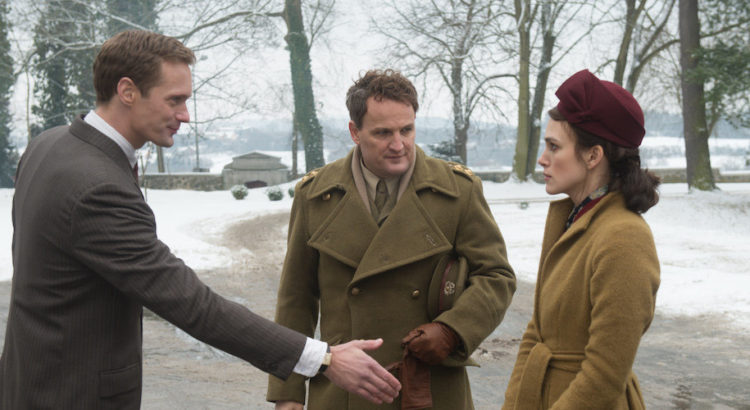
It was a scandalous romance set in post war Germany with Keira Knightly and the couple that I was rooting for didn’t end up together, so it was exactly the movie that I expected. What I didn’t expect was to have the Michigan Theater main auditorium basically to myself when I watched it. It was my first time seeing a movie in the main auditorium (I saw Rocky Horror there but that was a performance so it doesn’t count) and I was pretty excited since that room is gorgeous, but the experience was a little disappointing. The only people in the room were the projector operator who kept wiping the projector lens during the commercials, my friend and I, and a couple halfway back in the theater. While I was originally excited at the concept of having the place to myself, it actually detracted from the experience. With such a large room and so few bodies to absorb the sound it was echoey and made things a bit difficult to understand occasionally.
As for the movie itself, I enjoyed just as much as an romantic drama set in another time period, but it wasn’t fantastic. My main complaint is that it felt abrupt and choppy. The romance between the main characters developed out of nowhere, hatred between the daughter and Keira Knightly’s character turned to friendship in a matter of seconds, an awkward sex scene turned into full-fledged love in the course of a couple days. It just felt like the story did not give these relationships enough time to develop. Also, I hated the ending. I love happy endings, I want everything to go exactly the way that they make you want them to go. Given this fact, its not surprising that I like romantic comedies, but it makes my relationship with dramas fraught. Keira Knightly and her husband have been apart for years during the war and they agree that the death of their son destroyed their relationship. It felt like they were agreeing that separation was for the best. Anyone from the outside could agree. And yet, she chooses to leave the man that is making her happier than she has been in years for the marriage she already decided was over. While I am not condoning cheating or affairs, sometimes people need to leave relationships that aren’t healthy anymore for new ones and that isn’t always an easy thing to navigate. It would be great if dramas could catch up with the times to display romantic relationships as the complex, unique phenomena that they are.

Image courtesy of rogerebert.com.

REVIEW: FLINT

Let me start off by saying that I am from Flint, Michigan. I was born and raised in the city and had lived there my entire life until I came to Ann Arbor. When the water crisis started I was in my junior year of high school and we knew something was wrong but had no idea of the magnitude and the problems to come. I still call Flint home and go there often to visit family and the community I love. First semester freshman year in college is hard enough as it is but my experience was made even more complicated when the water crisis broke international news. Suddenly it was my hometown in the news, spread across my facebook news feed, and as the subject of conversation everywhere. When people found out where I was from they would ask in horror how my family was, as if my city had survived the latest natural disaster. Many people, with both good and not so pure intentions, were focused on producing media around the issue and holding fundraisers. It often felt like my hometown was being sensationalized as a pitiable, suffering place. I have become incredibly cynical about outside activism centered around my city and our crisis due to these experiences; that is why I was very skeptical when I first learned about FLINT being produced on our campus.
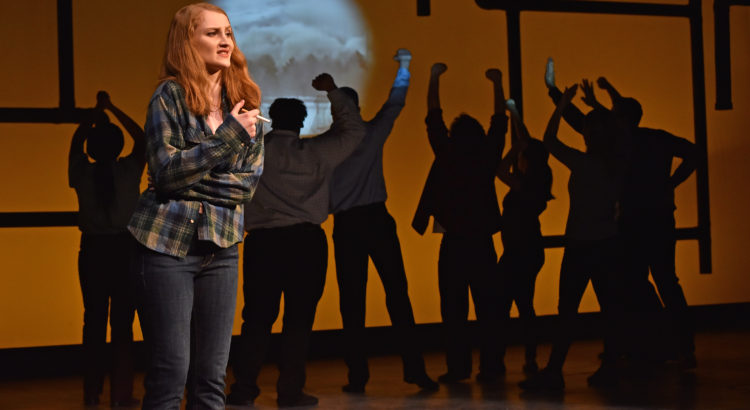
In spite of my skepticism, FLINT blew me away. I am still processing the weight of the production. A couple scenes from the play really stuck with me as they resonated with my experiences or taught me something new. In the first half of the play one scene depicted a conversation of Umich students and faculty from Flint discussing their complicated relationships with the city. They spoke truths that I have been mulling over since I came to Ann Arbor, the fact that we identify as being from Flint, call it our home, but also acknowledge our privilege as members of the Umich community here. Another scene that stuck with me was the nurse character’s perspective as a health professional in this health crisis. While her impressions of the crisis itself were powerful, the part that really got to me was when she said exactly what I’ve been saying and feeling for years; things were bad before the water crisis, and no one cared about us then. Though the water crisis has shook my community, we were struggling long before it due to a government which does not care about poor, rustbelt, communities of color. We were abandoned long ago, making the water crisis almost inevitable. What I was not necessarily expecting was to learn about my city and its experience with this crisis. Flint is home to the Michigan School for the Deaf, but I was completely shocked by the scene detailing the experience of the daughter of deaf parents. I never thought about the role this sub-group plays in my community and the different ways it affected them.
Another unexpected experience that I had watching this play was nostalgia. I did not know any of the characters represented in this play, but they felt familiar. I recognized the traits that Flint instills in a person and the places which they occupied. Pictures taken in everyone’s favorite diner, Starlite; a prom scene set in Northwestern high school the spring before the school closed. I knew it was a play about my hometown when I could single out the places and experiences they described in the most vague of terms. I know better than anything not to go in the Flint River, I remember when they found a dead, frozen body in it one winter. The new, exciting bookstore opened downtown is called Totem Books and I’ve passed it in the car a million times, heard all the buzz surrounding it with little recognition for Black-owned bookstores in other parts of the city. I’m worried about the gentrification I’ve spent my life watching expand through the downtown area, just like that barber. This play didn’t include my narrative, but it was about me, my family, my community, and my hometown.

Picture courtesy of SMTD.

PREVIEW: Abstraction, Color, and Politics in the 1970s

The title for this exhibit is kind of like a word cloud for the words most associated with the 1970s. I think of the era of sex, drugs, and rock n roll, a time full of psychedelics and political protests. I’m curious to see how this exhibit takes those mental images and translates them into a collection of art. However, I think this exhibit may not quite be my favorite art exhibit. I have an appreciation for certain forms of contemporary art, but struggle with many of the early explorations in this art form from the 1960s and 1970s. The flagship piece of this exhibit seems to be a painted tarp artfully draped on the wall. A piece like this seems like it would create for a nice, calming space and good home decor, but I’m not so sure if I think it can represent political thought. I’ll be heading over to the UMMA to decide why I draw the lines in the age-old discussion of “what is art?”. Make sure to catch this exhibit this summer as it will be leaving at the end of September 2019!

PREVIEW: Handel’s Semele

On Friday, April 12th, 7:30pm at Hill Auditorium, the University Musical Society will present a concert of Handel’s Semele, performed by The English Concert, along with the Clarion Choir, and a cast of world-renowned soloists.

Handel’s Semele is a musical drama (originally performed as an oratorio, but has subsequently been performed with staging as an opera) based on the Greek myth of Semele, mother of Dionysos. (Note: William Congreve’s libretto is based on Ovid’s account in The Metamorphoses, and therefore uses the Roman names for the various deities.) Though once considered scandalous, Semele is now one of Handel’s most popular works, and is admired for the richness and variety of its score, with such beautiful arias as “The Morning Lark” and “Where’er You Walk.”

The English Concert, lead by Harry Bicket, is one of the world’s leading Baroque orchestras. With a cast of singers including Brenda Rae as Semele and Elizabeth DeShong as her adversary Juno, this performance of Handel’s Semele is sure to be a must-see at Hill Auditorium this Friday.

REVIEW: Us

Spoilers for the movie will be alluded to. The reviewer highly suggests you watch the movie without reading reviews and essays!

Cheeks stained with tears, the Wilson family is pushed onto the coach and forced to face the intruders that broke into their home.  

When asked who they ask, the leader— Adelaide’s doppelgänger— says in a voice hoarse from apparent disuse, “We are Americans.”

It feels like a bizarre thing to say in the moment, almost out of place in the rest of her story, but the Jordan Peele cultivates a heart-wrenching universe that forces the viewer to evaluate their place within the world and where their empathy (and efforts) are lent.

Us is a beautifully-made film, both in visuals and story. It is crafted with love and laced with horror (both immediately apparent and fridge, the best kind!). It follows Adelaide Wilson, played by the stunning Lupita Nyong’o, and her family during a summer vacation to their beach house. Adelaide is plagued by memories of a short, but traumatic event as a child that hangs over her during the trip. Before she can cut their time in Santa Cruz short, the family is threatened by their almost-exact clones. 

My favorite horror movies tend to make me more sad than scared— personally, this usually chalks up to whether or not the characters where given the chance to be a part of the narrative rather than just becoming the bloody punchline. Adelaide’s motivations and background center this story— Nyong’o switches from the skeptical and vulnerable Adelaide to the menacing and collected doppelgänger Red. Nyong’o adopts difference voices, facial expressions, movement to demonstrate the constrat of these two characters– both equally complex and mysterious.

The rest of the Wilsons are absolutely lovable. Winston Duke (Black Panther) plays the sweet, dorky father— he dabs in front of his daughter and spins his tiny motorboat in efforts to impress his family. Zora (Shahadi Wright Joseph) and Jason (Evan Alex) play Adelaide and Gabe’s children— an apathetic teenage daughter and a strange little brother that capture enough of their own personal uniqueness to keep the character types fresh and likable. The family’s interactions allow them to be the perfect supporting cast for Adelaide and her character arc, which deviates far from expectations. Peele’s natural comedic talent shines through their bickering affection for each other.

What leaves you feeling gutted is the constant question of the motive of your villain. Not the doppelgängers– it is somewhat obvious. It is Red and her seemingly omniscient sense of Adelaide and her family. The climax is raw, orchestrated act between the two players, a switch of roles that shows how the movie played with your perceptions. Your hero is only as good as your villain, etc. 

Everyone and their neighbor already dropped the analytical essays about the movies and its dozens and dozens of references/Easter eggs. I am definitely the type to sit down and read them all (The shirt! Her voice! Pluto! Chemicals in the water!), because it just makes you excited as a viewer. Peele and his cast/crew put so much thought and dedication in framing ever single aspect of this film.

Some of the criticism of the movie I heard seems to take issue with the logic of the movie– an argument I disagree with a bit. I do not think movies and their message need to fit immediately with one, and only one, perfect allegory— and I don’t think movies need to lay out their details in a step-by-step guide. Trying to nitpick the world that Us has created takes away the atmosphere it has shaped to bring Adelaide and Red face-to-face.

After all, what we see in Us feels pretty real.