PREVIEW: Xylem Release Party

Xylem is one of The University of Michigan’s literary magazines. The magazine features University of Michigan undergraduate artwork, including poetry, fiction, creative nonfiction, artwork and photography.

Tomorrow, April 9th, Xylem Literary Magazine is hosting their annual release party to celebrate the newest issue of their magazine. From 7-9pm, the event will be held in the West Conference Room of Rackham Graduate School (on the 4th floor). Published authors and artists will get a chance to grab copies of the magazine, read their work, and celebrate another successful issue of Xylem!

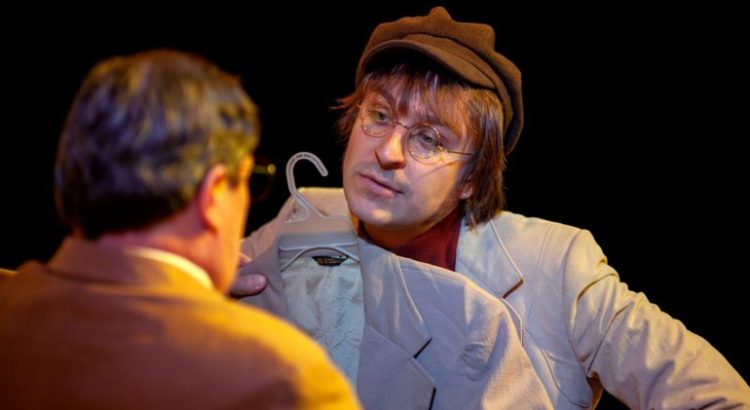
PREVIEW: Mazel Tov, John Lennon

This is the world premiere of the show and you can see it this Thursday thru Saturday (4/11-4/13) at 8pm or on Sunday (4/14) at 2pm.  Beware, the last showing is April 14th, so this is your last week to see the show. The show is taking place at Theatre Nova which is a local Ann Arbor establishment located at 410 W. Huron, Ann Arbor. You can buy tickets in advance for $22, or if you show up right before the play you can purchase a last-second-pay-what-you-want ticket, which is great for anyone trying to save money.

This show takes place during the Vietnam war when the U.S. tried to deport John Lennon over marijuana possession. It is a play that will contrast relaxed, witty, chill personalities with hardline, uptight, angry personalities.

This is the description from Theater Nova’s website: January 1972: Vietnam war protests are at their peak, and newly ex-Beatled John Lennon walks into the office of Leon Wildes, an eminent immigration lawyer. As ultra-laid-back Lennon and straight-laced Wildes navigate Lennon’s stormy immigration case, an unlikely and comical kinship unfolds, and both men gain a greater understanding of friendship, personal values, and patriotism. Based on the true story of the Nixon administration’s attempt to deport John Lennon.

If you’re a Beatles fan, this show is a must see.

REVIEW: Julius Caesar

This was a very experimental play, but Shakespeare plays are so commonly performed that any rendition not beyond experimental or without a famous actor in it won’t get recognition. At first, I was confused by the modern setting, it felt weird hearing about Rome and an emperor from a bunch of guys in suits and joggers, but I quickly got used too it and actually liked the modern relevant feel this play had.

The first interesting plot point to contemplate is whether Brutus should betray his best friend, Julius Caesar, by joining the Senate conspiracy to kill him. It is an interesting dilemma because I think it is heroic to turn on someone you love for what you believe is the best for the general good of your country. This is why Brutus decides to kill Caesar, he believes this is the best solution to maintain the freedom of Rome, there wasn’t any selfish reason attached. However, Brutus is portrayed as the antagonist of the play for killing Caesar. From the play, we don’t know whether Caesar was a good or bad person, and therefore there is no plot that suggests killing him is any worse than not killing him. Still, the stabbing of Caesar is portrayed in such a gruesome and murderous scene, that the moral I took is that murder is never acceptable in any circumstance.

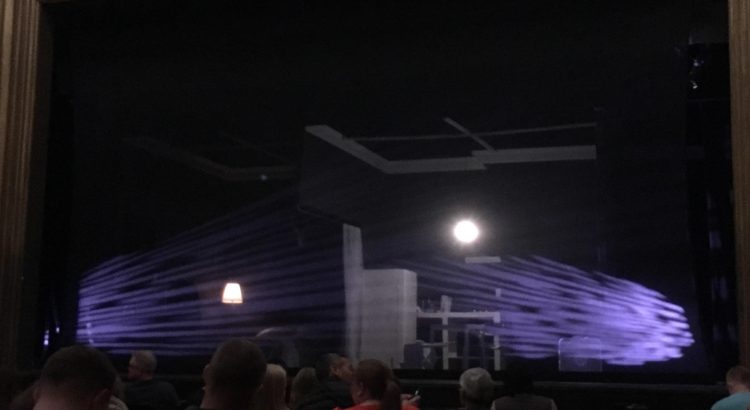
The most important aspect was the lighting. The settings were built so that the feeling could be easily manipulated by the lights, for example, the opening scene had all of the characters standing in front of giant white blocks. The only colors in the whole play were white, black and red. This little color variance made the tone of the color that was set by the lights more prominent. The lighting was often extremely bright or dark to contrast the different emotions and thoughts of the characters. When characters were in disagreement or friction, they would be portrayed with a different level of brightness.  As soon as characters started to agree with each other, all of a suddenly the lighting on them would match as well. The radiant lighting made the play feel factioned and it made events feel more intense. Bad events felt evil, courageous events felt heroic, and gloomy moments felt hopeless and depressing. Lights were even used to cast the audience as part of the play. All the lights in the theater would turn on, so even the back rows were completely lit when the audience would be portrayed as the roman mass of citizens.

Brutus and Marc Anthony speaking at Caesar’s funeral are the two best monologues I have ever heard. I was previously familiar with snippets of these speeches, but I have never heard them in their entirety or seen them performed. Brutus’s rhetoric is all based on ethos and logos, it is extremely logical and he is an honorable man considering he is on the Senate. Marc Anthony speaks with all pathos, contemplating on why he loved Caesar, and it is Marc Anthony’s speech that sways the crowd and starts the civil war. This is so true of life, emotional appeal trumps everything during a speech or debate.

Julius Caesar is the best example of why Shakespeare needs to be performed instead of read. When the characters speak, the syllable emphasis is extremely important. During a dialogue, how the actor stresses “sh” sounds or “t” sounds can make him sound conniving or sympathetic. Cassius was my favorite character mainly because of how great a job he did speaking. He spoke with clarity, like a voice of reason, and had such strong pronunciation and emphases when he spoke that I knew he was a persuasive character who would be able to sway Brutus, who was a lot gentler in his pronunciation and speech. Cassius also had a great straight face throughout the play, he was serious and never smiling. Brutus was a lot more emotional, and his movements would vary from comical to melodramatic. This suprised me, I never imagined Brutus being portrayed in such a weak and malleable manner. It took some of the dignity out of Brutus, which is a necessary trait for Brutus to have to justify the killing of Caesar.

Lucius was by far the most experimental character in this rendition of Julius Caesar. Most of the time he wasn’t a plot character interacting with the rest of the characters. Instead, he would interact with the other characters in a mysterious and surreal way.  It was like he represented the thoughts and conscience of other characters. He would stand next to the other characters while they were talking, mimicking them with interpretive movements. He spoke no words only performing interpretive dances.  Lucius would break out of the plays dimensions to foretell what will happen or to tell what is really happening with his movements. My favorite dance of his was when he acted out Caesars stabbing before it happened.

I liked the subtle touches of this play. The circular language in Julius Caesar is very apparent and this play would add a comical emphasis when reciting these lines. There was often a confusing mixture of “I and you” “here and there” “With and without” and the actors would looked confused when speaking them. Shakespeare loves having blood on characters hands, this play had no shortage of blood on hands and arms. They also incorporated the mysterious babushka lady (look her up), which was very fitting for this play. My favorite touch was the Jazz Trio, who would provide little breaks throughout the play for our minds to rest and relax.




PREVIEW: The Aftermath

The Aftermath follows life after World War II in Germany as an American officer’s wife comes to live with him in a house already occupied by a German man and his young child. This movie takes a look at a part of the war we don’t usually think about and displays the complicated process of transitioning life in Germany when many Nazis were still on the loose and some remnants of the war still remained. The movie stars Kiera Knightley, Alexander Skarsgard, and Jason Clarke in what looks to be a scandalous love triangle.
I haven’t heard fantastic things about the movie. However, I’m a sucker for period dramas – especially when Keira Knightly is in them. And with finals and graduation looming ever nearer, a little scandal and romance are welcome distractions. The Aftermath is playing in the Michigan Theater for a limited time so make sure and get out to see it this week while you can!

REVIEW: A Streetcar Named Desire

A masterpiece of Southern Gothic at its best, Rude Mechanicals put on Tennessee Williams’s iconic play “A Streetcar Named Desire” and executed it with intensity and emotional fervor. Proper and aristocratic-at-heart Blanche DuBois, portrayed wonderfully by Juliana Tassos, travels to New Orleans to stay with her sister after she lost their family plantation, and her lighthearted yet grand arrival soon takes an ominous turn. Stella, played by the talented Stella Kowalski, welcomes her with open arms, yet it is clear that Blanche does not belong in this dilapidated apartment, nor in the life of Stanley, her husband. Jack Alberts executes this intense character with scary yet admirable fortitude, his sudden outbursts captivating our attention with a breathtaking startle. Though Stella and Stanley have an animalistic love and desire for each other, Stanley’s propensity toward violence drives a permanent wedge between him and Blanche while driving the play forward toward its imminent end. Blanche’s Southern mannerism and charms and denouncement of realism directly contrast Stanley’s aggression and manhood and pragmaticism, and this dance between their personalities and views of life lead to an inevitable clash between the two, with Stella caught trying to mediate it in the middle.

The physical and emotional abuse of Stella by Stanley, followed directly by their subsequent embrace, is mirrored by Eunice and Steve, portrayed by Jillian Lee Garner and Jackson Verolini, which shows this unfortunate commonality of brutal marriages within the Southern lifestyle. Though Stella occasionally tries to stand up to Stanley, his loud strength always overpowers her, and she always goes back to him when he calls for her. In the very end, Stella’s fearful and morose isolation in her bedroom and Eunice’s somber reflection on the doorstep while Stanley returns to the next room to play poker shows the distinct separation between the emotionally-scarred women of the play and the misogynistic yet dominant men.

Blanche’s doomed relationship with Mitch, played by Austin D’Ambrosio, reflects her inability to confront her past and face the light. As Blanche’s past is revealed, from her dead husband to her stay in hotels to her forbidden relationship with a student, she slowly withdraws into her fantasies. Stanley’s role in her hysterical breakdown is more than direct, revealing her past to others and furthermore, sexually assaulting her. Blanche’s gradual mental deterioration was painful to watch, yet there was a beauty in Tassos’s performance of it. Her thoughtful and regretful soliloquies throughout the play solidified her tenderness and her talent, even through the pain.

The Southern dialects of the characters, combined with the rapid speed of their delivery, sometimes made it tough to understand their words, but it captured the setting of the place and their frenzy. The lighting and scenery set the mood, as did the foreboding tones that often sounded in between scene transitions. Every character in this play is complex and hypocritical to an extent, and this cast did a phenomenal job bringing these flaws to life and making these characters seem human, however flawed. With Blanche’s unacceptable sexual behavior and Stanley’s abhorrent violence, these characters bring out the best of the Southern Gothic genre, and Tassos, Alberts, and Avnet excelled in putting on this phenomenal production.

REVIEW: Polly Rosenwaike Fiction Reading

I was really excited to see a full house at Polly Rosenwaike’s reading at Literati. She read the first story from her book Look How Happy I’m Making You, titled “Grow Your Eyelashes.” There was a Q & A afterwards hosted by her colleague, followed by a book signing. There were a few speaking points that really stuck with me.

One was Rosenwaike’s description of her writing process and timeline. She said that this book took her twelve years to write—which equates to about twenty pages per year. She is not a fan of outlines; instead, she often starts with an idea or a feeling, or she moves the story forward based on her characters’ motivations. This makes me think of the process for crafting a poem. The birth of most poems, from personal experience, begin with an idea. But because of the nature of poetry—how it is a culmination of linguistic surprises and skill—the poem unfolds itself as it is written. Poets often do not know what the finished product will look like. Once it is on paper, the poem seems to grow separate from the poet. This felt very much true about Rosenwaike’s work. Many of her short stories have been published in various magazines before she released her book. They have grown over time, and she has edited each narrative based on where each one wanted to go and what they wanted to do.

Another talking point that resonated with me was her process of choosing a title. She went through several ideas, some of which were rejected by her editor (such as “Baby Person”). Initially, she read through poems for inspiration. Eventually, she skimmed through her own stories and found the line that she thought was both intriguing and informative on the overarching themes and purpose within the short stories. “Look How Happy I’m Making You” was said by one of her characters who appeared in “Grow Your Eyelashes.”

“Grow Your Eyelashes,” and other stories in the book, interlaces the joys, griefs, and ironies of early motherhood. From wanting a baby, to needing a baby, people often romanticize parenthood. Even from the beginning, they search for answers. Do babies really make people happier? How do you care for this new living being? There are books and articles and poems and essays on how to raise a child. Motherhood propels people toward the search of information and the need for a community. As Rosenwaike said, infants are very much like birds. They flap and chirp and make a mess. They don’t yet communicate (at least well), and it can often feel like a one-sided relationship when you are a mother. It is not until later that the child begins to become “more human.” Motherhood and the domestic role of a woman comes with unforgiving scrutiny. How can one survive it without a supportive community?

Rosenwaike’s book is in conversation with Rachel Cussk’s A Life’s Work: On Becoming a Mother, and Helen Simpson’s Getting a Life.

You can purchase her book at places like Literati, Amazon, and Barnes & Noble.

More info on Polly Rosenwaike can be found here.