REVIEW: BEES the Musical

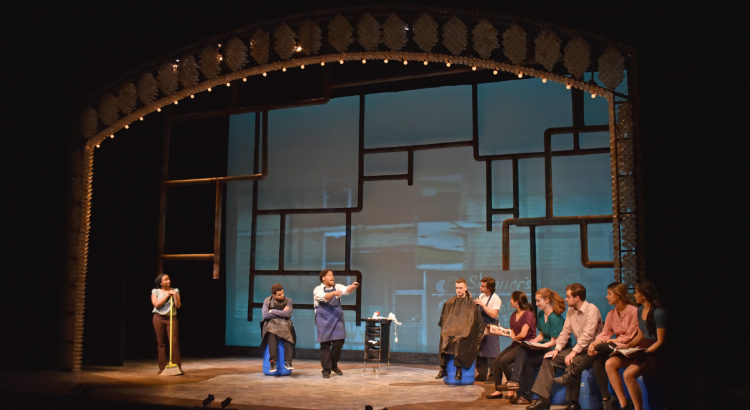
Once again, NERDS has delivered a wonderfully poignant and hilarious musical with this semester’s performance of BEES the Musical.

Avery Fessenden played Charlotte “Charlie” Peppers, the daughter of big-time bee farmers in Honeyville. Her wonderful number “Buzzing On By” shows how she looks forward to moving on with her life by pursuing her dreams of being a detective. Though everyone questions and doubts these dreams, she becomes the newest recruit in the police department, and she’s instantly put on the big case of the missing bees. Her partner, Penelope Wright (Sam Dunlap), is abrasive and direct, a great contrast to Charlie’s gentle and optimistic demeanor. They butt heads when it comes to interrogation techniques, and their different backgrounds — Charlie from the successful agricultural side and Sam from the poorer industrial district — also act as a source of difference and tension.

However, as they are stumped from this crime, they realize that something must change in their partnership. The duets between Dunlap and Fessenden were particularly beautiful, their voices complementing each other’s wonderfully. From their first song together, “My Way or the Highway” to their song closing the first act, “Moving”, the two detectives evolve a long way, recognizing that teamwork and compromise is important when they share the same goal.

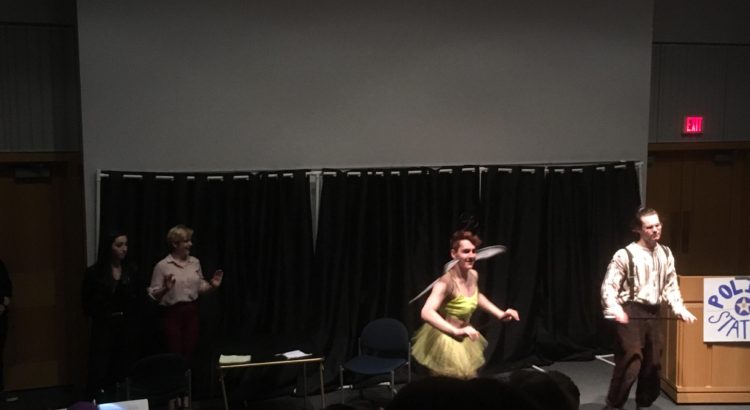
From the very beginning, the audience learns that Frank B. Napper (Perry Fiero) is the obvious criminal bee napper, an enjoyable twist of dramatic irony that made Fiero’s blatant panics when he is interrogated or suspects he’s close to being caught that much better. His “Bee Burglin’” song was catchy and amusing, as he scooped yellow ping pong balls with black stripes into a jar. His motives for stealing all the bees was simply to find his only friend, a black bee with yellow stripes, who ran away. This elicits sympathy from the audience, as well as Charlie and Penelope, who decide to not arrest him, which is unfortunate for womanizer Dustin (Sean Moore), who was framed for the crime.

This musical displayed compassion and friendship in the most humorous ways, from Chief Montana’s incompetence to Mr. Peppers’ fatherly figure. Probably the highlight of the musical was when Frank’s Bee (Dylan Beasley) emerged during “Bee-F-F (The Ballad of Frank B. Napper),” a lovely and heartwarming song that featured a beautiful fluttering and dancing human bee.

The ending romance of Charlie and Penelope was a beautiful cherry on top of overcoming differences and finding companionship. As Frank inherits Peppers Farms and is constantly surrounded by bees, and the two detectives continue to solve crime alongside each other, there’s a happy ending in Honeyville (except for Dustin, who is forgotten behind bars).

REVIEW: Change Our World (Slam Poetry)

Spoken word is a powerful medium for literature. It brings together elements of traditional poetry, the lyrical form and flow of rap music, and the stage presence and movement of dance. The audience is more closely involved in the experience than a reader of Dickinson might be; it is a conversation with the author, a chance to see the emotion on their face when they speak and to react more richly to the writing.

Members of University of Michigan’s Slam Poetry team opened the night with a selection of poems I still feel lodged in the back of my mind, even days later. I will not reveal how many tears I cried, but the number was embarrassingly high.

A self-proclaimed “emotional b*tch,” Bronx native Roya Marsh is sheer inspiration in human form. She has ascended from minor competitions and open mics to performing at Carnegie Hall in front of an audience of thousands. She commands the stage whether in mid-poem or casual conversation with members of the peanut gallery; it is impossible to peel your eyes off of her as she moves through words you know are intentionally selected one by one. Her 15-poem set (all memorized and organized in her head, or what she calls her “rolodex of poems”) felt somewhere between a Sammus concert, a comedy act, and a palm reading session. The crowd was modest, but that made it all the more personal. At one point, she asked just about everyone if they’d been to New York and what their major was.

The poems went hard and fast, their words expressive and moving. I felt a literal, bodily sensation when I was being pushed through such a range of emotions in a short period of time; a sense of that fullness which can only be achieved through a run-on stream of hurt and joy and experience. It was easy to fall into the atmosphere of the place, the fancy theater and the lights of the stage and Roya standing, shining in front of the audience. I was rapt, unable to focus on anything else as I took in what it meant to be in a room of strangers all feeling differently about the same words. The night and the poetry were completely encompassing, ambient. The turmoil within the intersection of race, gender, sexuality, and class had never been so clearly laid out, and in such an undiluted way. Other expressions of such experiences have the tendency to fall flat, whether in traditional poetry, theater, or novel form. Hearing the author speak as loudly, as harshly, as fast or slowly as they choose to is more strongly moving than anything that could be written on a page.

If you are interested in keeping up with what she’s up to, Roya is on Twitter at @ChampagnePoet (right up there in the search results for Drake). She is currently working on an album of spoken word poetry, coming out next year, so keep your eyes peeled for those updates!

REVIEW: Der Kaiser von Atlantis

Considering the circumstances under which Der Kaiser von Atlantis was written — (it was written in the Theresienstadt concentration camp with the musicians available, and was rehearsed but not allowed to be performed because the Nazis thought the title character seemed a bit too much like Hitler) — it seems reasonable to consider it something akin to an unfinished work. The piece starts out with a really interesting idea which it doesn’t really have the space to explore. The libretto is crudely formed, and reads more like the work of a poet than a dramatist. Each individual moment works splendidly as an exploration of its own theme, but the parts fail to gel into a particularly coherent whole. The title character of Kaiser Overall gets a strong starting point, and a strong ending point, but not the development that brings him from point A to point B.

The opera begins with a prologue, which takes the form of a conversation between Death and the clown Harlekin. The characters converse on their melancholy state. A drum-major announces that Kaiser Overall has declared a universal fight to the death. Everyone will take up arms and kill each other. Death feels quite frustrated by this; he feels overworked, and thinks Overall is being disrespectful of him. So Death goes on strike, and in the ensuing bloodbath, no one can die. In the second scene, Overall gets updates on how the murdering is going, and is distressed to find out that no one is dying. In an effort not to be seen as weak, he tries to turn the situation into a positive, by saying that his soldiers have been given a formula which makes them immune to death.

In Scene III, we meet a soldier and a maiden who are unable to kill each other, so they fall in love instead, casting death aside. And in Scene IV, everyone’s pretty upset about this no-one-being-able-to-die thing — not least the people who are stuck with mortal wounds that should have killed them hours ago. Death shows up, and tells Overall that he will get back to work, but Overall must give up his life first. Overall agrees, and promptly dies, followed by everybody else. A quartet sings a hymn to death, and the opera ends.

I’m not really going to dig into a full dramatic analysis of the opera. It’s a very surreal opera, a very philosophical opera, and not a very complete opera. I don’t think it’s really my place to tell you what you’re supposed to get out of it. Peter Kien’s libretto is vague, doesn’t really apply itself as any specific allegory, and very open to interpretation. Ullman’s score employs a good deal of pastiche and reference, and evokes a variety of composers of the era, including Shostakovich, Szymanowski, and even Kurt Weill. On a moment-to-moment basis the opera is most effective.

Der Kaiser von Overall was presented tonight at the McIntosh Theater in the Earl V. Moore School of Music, directed by Matthew Ozawa, and performed by students in the School of Music, Theater, and Dance. It will be presented again tomorrow, April 7th, at 8pm. Admission is free, and the opera runs approximately one hour. Supertitles in English are projected above the stage.

The singers all gave wonderful performances. Louis Ong as Kaiser Overall and Zachary Crowle as Death imbued their characters with immense gravitas, which Lucas Alvarado and Kayleigh Jardine, as the Soldier and the Maiden contrasted with a lovely tenderness. Daniel McGrew, Jenny Cresswell, and Logan Dell’Acqua had the most abstracted roles, as Harlekin, the Drummer, and the Loudspeaker respectively, and though their characters were not very defined, their performances were definitive. The fourteen-piece ensemble, lead by Timothy Cheek, gave out a sound almost twice its size — though I regret to say an electric keyboard is still no substitute for a real harpsichord.

The production is directed by Matthew Ozawa, and though the theater itself is not very conducive to a tightly-focused dramatic treatment of the work, a lot is done with lighting (also by Ozawa) to carry the piece. There was a lot of apparent symbolism which at places I felt bogged the production down, and there were moments where the sheer size of the stage proved distracting, but I cannot count this against the opera. Der Kaiser von Atlantis is of sufficient interest for its history alone, and any production therefore worth an eye or two.

REVIEW: Free Spirit


As I entered the Emagine Theater located in Novi, MI, I wasn’t prepared to experience a visual and musical presentation that would change my attitude and outlook on my life going forward. This experience consisted of watching the short film created by R&B artist, Khalid, called Free Spirit and listening to his newest album titled Free Spirit that played afterwards. With that being said, I would like to comment on the experience as a whole.

As the visual presentation began, the lights dimmed and the screen primarily showed Khalid himself giving an introduction to his show. He welcomed the fans that had attended the event and thanked us all for coming to experience the short film he had made. Ultimately, his comforting presence was consistent throughout the presentation and I felt glad that he was taking the time to connect with the audience in this way.

Shortly after this introduction, the short film, Free Spirit, began. It opened up with a montage of scenes depicting the vast desert-like countryside of an unsaid Southern state, the calm, small-town essence of a neighborhood on the outskirts of a big city, a high school gym with senior prom decorations, and the teenage hangout places of modern suburbia. Meanwhile, one of the songs from his album played in the background, fitting the nostalgic, emotional, and free-spirited essence of the montage perfectly. The film was constructed around these scenes and told the story of a group of teenagers who were on the brink of seizing the freedoms of true adulthood.

The story mainly follows a girl who goes by Ladybug and who joins her group of friends on a road trip after being kicked out of her intoxicated mother’s house. All the while, the group emulates the essence of teenage freedom: feeling the open air while standing outside the sunroof of the van that they stole, drinking alcohol and smoking weed, and proving themselves unstoppable against the world. Eventually, things begin to fall apart as apparent romances between some of the friends divide the group completely, and the film ends with a devastating consequence for one of the friends as a result. The ended proved to be my favorite part of the film because of how emotional it was and how unresolved it was. I believe it portrayed the struggle that young adults have to find themselves and to make it in this world as adults, and how it seems that we will constantly struggle to find ourselves completely even as we get older.

After the short film ended, Khalid played his new album, Free Spirit, before its worldwide release with visuals and commentary accompanying it. Overall, I really enjoyed this experience and felt that visuals accompanied by the music allowed me to enjoy the meaning behind the music in a better way. Ultimately, I very much appreciated how this short film portrayed the lives of young individuals. As the film showed, anyone from any background essentially experiences the same struggles as a young adult and I felt that it validated the truth about how youthful questioning exploration doesn’t quite end with our childhood.

PREVIEW: FLINT

A new play is being put on by the school of music, theater, and dance called FLINT. The play was written by Professor Jose Casas and was the result of a collaboration with Umich students and volunteers from Flint. The play is meant to resemble a documentary and tell the complex story of Flint residents’ experiences with the water crisis. Casas wrote the play based on over 80 interviews with Flint residents, some of which he searched out and others he stumbled upon by happenstance. The project began over a year ago and has involved students interested in what is referred to as social justice theater.
A classmate of mine is one of the actors and shared with me the anxiety he and his colleagues felt about their debut. He shared a worry that comes hand in hand with social justice theater, are we serving the community or exploiting it? For my classmate, this fear culminates on April 16th when the troupe will be performing in the play’s namesake.
I must admit, hearing about this anxiety gave me hope. A group fueled by such good intentions and so concerned with the impact of their work will surely do the story of Flint justice. If you want to see FLINT make your way over the Arthur Miller theater between now and April 14th to see what’s in store.

Image courtesy of university productions.

PREVIEW: BEES the Musical

For NERDS’s winter semester musical, we enter the town of Honeyville, where everything revolves around bees and honey. When the town’s bees disappear, it is up to Charlotte Peppers and Penelope Wright to work together and find out who the bee napper is. BEES the Musical is a story about finding friends, finding similarities in differences, and, of course, finding the bees. The musical is this weekend, April 5 at 6pm and April 6 at 1pm and 6pm, in the Palmer Commons Forum Hall. Bee there or bee square.