PREVIEW: Flint

Many people remember the Flint Water Crisis that occurred now 5 years ago, but it is simply that — a distant memory of the extensive news coverage that has slowly faded from our collective minds. However, though there are no more national news reports about it, the issue has not been resolved, as Flint residents have battled for clean water and answers for five years and counting.

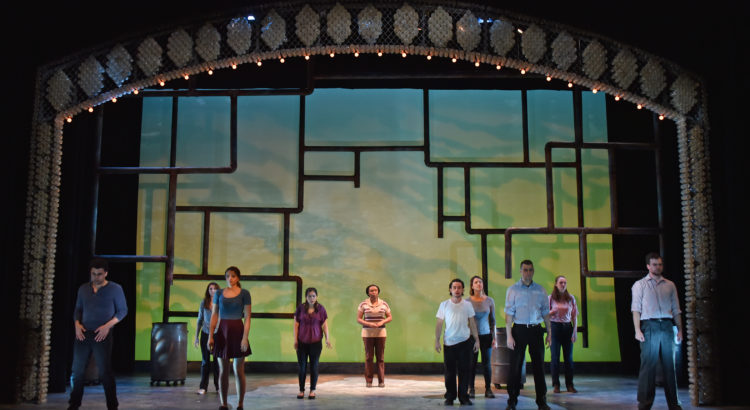
José Casas, playwright and SMTD faculty member, has transformed this tragic event into a powerful play that documents the effects, aftermath, and current state of this once-avoidable crisis. Based on true stories of Flint residents collected personally by Casas, “Flint” gives power and strength to the city and combines the monologues of pain and reality into this educational, documentary play that will hit close to home and open people’s minds and eyes to what our neighbors have dealt with and continue to deal with.

SMTD’s play “Flint” premiers tonight and runs for eight nights. Taking place on the blackbox stage in the Arthur Miller Theatre, general admission is $30 or $12 for students. The showtimes are as follows:

April 4 and 11 at 7:30 PM

April 5, 6, and 8 at 8 PM

April 7 and 14 at 2 PM

PREVIEW: A Streetcar Named Desire

Rude Mechanicals is performing one of the greatest pieces of Southern Gothic literature and modern American theatre. “A Streetcar Named Desire” follows Blanche DuBois, a Southern belle coping with personal losses who goes to stay with her sister Stella in New Orleans. There, she witnesses the volatile relationship between Stella and her husband Stanley, and her involvement can only lead to pain. Tennessee Williams’ brilliant play is taking place in the Lydia Mendelssohn Theatre this weekend at 8 PM on April 5 and 6 and 2 PM on April 7. Tickets can be bought at MUTO in the League Underground, where a Passport to the Arts can be redeemed for a free ticket as well.

REVIEW: Change Our World – Poetry Slam

What I have learned about slam poetry at U of M is that slam poetry is one of those things everyone goes “ah that is so cool” too, but don’t care to participate in or view. The people that like slam poetry, love it, because it consumes their emotions and creativity. Slammers can’t get enough slamming. They perform and watch others perform. If you don’t slam you don’t care to watch others perform. It isn’t like improv comedy, where everyone goes to see the shows whether they perform improv or not. This is an important lesson to learn because Rackham yesterday was mis-booked. Rackham is a big beautiful auditorium, but it feels daunting when only 20 people show up for the slam leaving the auditorium empty. At least Kai made a great decision forcing everyone to come to the first few rows to make the vast space feel smaller.

The show started with readings from the UM slam poem team, who will compete at CUPSI in a few weeks. I’ve seen and reviewed these poems before at previous slams , but of course, I was entertained watching them a second time.  Sorry for any misspelled names and incorrect quotes in this review. Dylan has an awesome voice for reading slam poetry; my favorite lines of hers was “the girls you care enough about to loan to what-if-it were her scenarios.” Lizzie used moon imagery very well in her poem, from marks on a body to something to reach for. My favorite line was ” Manifest love in silence, loving him means I cannot speak.”

Kai’s poems were absolutely phenomenal, I feel like she is ready to get some viral recordings on button poetry. Her first poem creatively used ghosts to symbolize depression, what is wrong with hypocrisy and culture in America, and how these issues have affected herself and her family. I liked Kai’s use of sheet white faces, rituals, exorcism and I liked how I could never tell who Kai was addressing this poem to, whether it was to herself, America, or her parents? I liked the quote “Depression in America is laziness in Asia, and not a disease but a ghost to her father.” Her second poem was also great, I liked the imagery of mechanical humans and her repeated use of three questions.

This was all introduction for the main poet of the night, Roya Marsh, who has the dream job, she travels around reading slam poetry. She is a professional poet featured on frontier poetry and button poetry and has won all these other impressive awards I forgot but you can probably look up. To introduce her, a local poem legend, Ty, read a poem about mint tea that was short but beautiful. My favorite line was ” Mothers will chase, fight, hunt, honey, home to settle and be comfortable.”

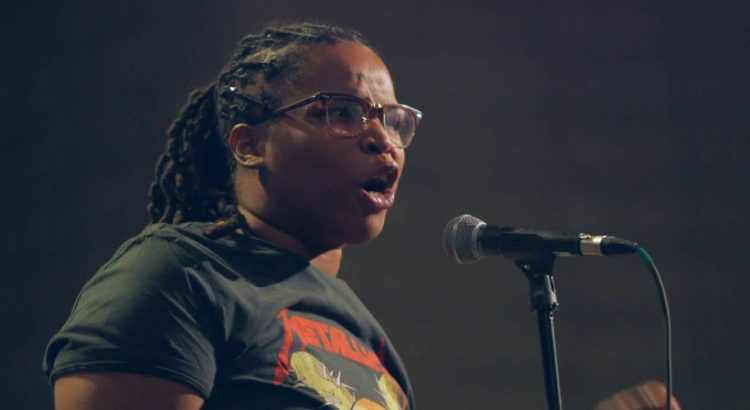
Roya’s poems were all extremely passionate. She showed how important it is to memorize your poems because then poems can come from the heart instead of a sheet of paper. She also cusses a lot in her poems she even had a whole poem about certain curse words. Cussing in slam poetry is like a right of passage, only great poets can use cuss and not have everyone in audience flinch.  Roya said if you’re going to put a curse word in your poem, it should be the strongest word in the poem, otherwise, don’t use it.

Roya read so many poems. that I can’t comment on all of them, but I will say what stood out to me and if you like what you hear, check out her book or check her out online. Most of Roya’s poem were about being gay, a woman, and being black.  My favorite poem was about how uninvited she feels in American churches and how that has empowered her sexuality and body. She had a poem about the mass shooting at a gay bar in Orlando where she recited every single victim’s name. She had a hilarious line about Donald Trump that had me laughing for 5 minutes, but is too profane for me to write about. Her imagery throughout her performance was so strong, my favorite usage was about her pulse. She had a whole verse about acheivements of famous historical black women that rhymed. My three favorite lines of the night: “silence is a cloak draped over a body of lies” , ” pessimism is trying to kill myself, optimism is trying to live in spite of that” ,  “Black joy knows prosperity in the face of white supremacy.”

REVIEW: That Brown Show

I was very excited to see That Brown Show, and so, it seems, was everybody else in the audience, because they were much more boisterous than usual. In most other settings, this would have been somewhat irritating (in some parts, the audience cheered so loudly that I could barely hear the music), but after attending so many Indian student performances, I’ve accepted that this exuberance is simply part of the show.

I think all the ensembles did a very nice job, but I know I’ve seen much better from some. Sahana Music could have been a little more balanced – the vocalists didn’t perform much, while there were several percussion solos – but I loved the harmonium solo. Taal is capable of far more than what the piece they performed let on. The storyline of their dance, Robin Hood, could have been more connected to their choreography. The choreography itself seemed more fit for a nightclub until they started incorporating movements inspired by Indian classical dance, which they performed much more gracefully. It is possible that this was a deliberate juxtaposition between the more graceful Merry Men and the decadent King Richard, but if so, a more obvious difference would have helped. The Michigan Bhangra team had, as always, a very energetic performance, and their movements were crisp and unified, even those of the handkerchiefs they were flicking around. I wish they hadn’t had a video playing in the background, because after I noticed it all it did was distract me. Michigan Manzil had a really cohesive performance, and I was amazed at the unison they displayed despite the throng of people onstage. Their storyline for the dance – 21 Jump Street – worked really well with their performance, and their style and energy remained consistent throughout even when they were blending moves from different genres of dance. Sahana Dance was my favorite: they did a beautiful job of blending the three styles of dance that were represented onstage. Often, they take turns highlighting each dance style, but this time they managed to dance at the same time, and it worked really well. And they had some really unique music choices (that transitioned well) and some beautiful geometric formations. Michigan Izzat, as per usual, had a really tight performance with their hallmark crisp movements and a very well implemented storyline. Someday, though, I’d like to see them do more lyrical movements. I think it would add a lot of range to their repertoire, and I know they’re skilled enough to perform them. Lastly, Wolveraas had some really lovely musicality and very consistent energy, and they didn’t let that slip even despite a couple minor mishaps. This year, TBS was a competition – why I don’t know, and I hope it isn’t actually going to happen annually – and Izzat won the audience’s vote.

Strangely, Hill Auditorium as a venue didn’t seem to help anyone. Somehow the sound seemed muffled, not as bright as usual, and that leeched energy from everybody’s performances. This was not helpful, because these performances require a lot of energy, and I realized then that not all of that can come from the performers. But that couldn’t really be helped. My last note, though, is something that can be fixed: I really wish they would get their tech together. There were some hiccups with videos, sound editing, and sound balance that seem to happen at every show, and I know those are things that are so easily fixed with some minor attention to detail.

PREVIEW: Der Kaiser von Atlantis

This weekend, the School of Music, Theater, and Dance will present two performances of Viktor Ullman’s Der Kaiser von Atlantis. Composed circa 1943 while Ullmann and librettist Peter Kien were both in the concentration camp at Theresienstadt, the darkly surreal opera concerns a bloodthirsty Emperor who orders a nation-wide fight to the death. Death himself, annoyed at being overworked, frustrated at the lack of respect he gets nowadays, and angered that the Emperor seems to feel himself fit to do Death’s job, goes on strike, resulting in no one being quite able to die in the ensuing bloodbath.

The opera will be directed by Matthew Ozawa, with music direction by Timothy Cheek. The cast comprises seven SMTD voice students and a chamber ensemble.

Performances are April 6th and 7th, at 8pm at the McIntosh Theater in the Earl V. Moore School of Music building. Admission is free.

REVIEW: Chamber Jazz Ensemble

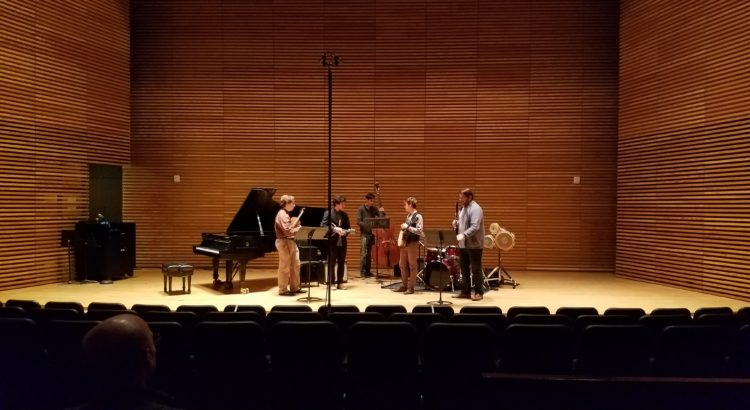
This was my first time going deep into the belly of the school of music theatre and dance for the chamber jazz ensemble performance. I said that I wanted to experience some new jazz and that is definitely what I experienced Monday night. The first ensemble (featured in the picture above) was definitely the furthest stretch from what I consider jazz. It seemed a lot more like a bluegrass group based on instrumentation as there was a violin, mandolin, and banjo in addition to the upright bass, drum set, and clarinet. They called themselves Knit & Wool which only added to their Mumford and Sons vibes. Their first piece was confusing. It featured a lot of clapping and latin vibes making it sound more like flamenco than jazz to my ears. There seemed to be so many pieces trying to fit together and I just couldn’t decide if it was successful in my mind. However, their second piece was amazing. The mandolin player composed the second piece which made it even more exciting and made me wonder if this strange ensemble had been formed as an experiment to test out his composition. The piece was beautiful, very melodic and meandering, successfully pulling together overlapping melodies without sounding chaotic. It felt like summer and adventure to me and I couldn’t help but smile throughout the show.
The second ensemble was very 50s jazz with a big band vibe, featuring sax, trombone, trumpet, guitar, bass, drums, and vocals. I’m generally not super into jazz with vocals, I tend to listen for the instrumental aspect of the music. However, I think the vocalist was my favorite part of this ensemble. She looked the part and her voice was beautifully interesting and jazzy. The two pieces they played were arranged by the performers themselves with the first being arranged by the trombone player and the second by the saxophone player. The trombone and trumpet players were both women and I love it when women play stereotypically masculine instruments. However, I was originally surprised when the trombone didn’t play a solo in the piece which she arranged. It became clearer to me after listening to the second piece when she played an extra long solo. The second piece was Cherokee by Kamasi Washington which I hadn’t heard before but I know Washington which made me feel like quite the jazz fan.
The last ensemble was not as printed on the program but we were all the better for it. They walked on the stage and instantly oozed “cool”. The pianist had an afro, long sideburns, and wore round sunglasses indoors making him look straight out of the 70s. They introduced themselves as the bassist (I couldn’t quite hear his name) and the minorities aka the bassist and the majorities aka, aka, aka… they had many different aliases. This ensemble featured piano, drums, bass, guitar, alto and tenor sax, and trumpet. The first piece that they played was so modern jazz. It was chaotic and dissonant and reminded me that I really do need to expand my jazz horizons. They threw me for a loop in the middle though when it suddenly changed to sounding like a classic jazz combo. I leaned over and asked my boyfriend if they had transitioned into a second piece without pausing because it felt so different. The piece eventually looped back around to its chaos before ending. The second piece really brought it home featuring the great trumpet player and guitarist. You could feel real synergy on the stage and knew that they enjoyed their instruments and playing together.