REVIEW: Tillirnanngittuq

Why is the UMMA so difficult to navigate?? If you aren’t looking at one of the main exhibits it is just a maze of half levels and random staircases. However, if you manage to find your way through and follow the signs for the Buddhism exhibit, you will find the Power family’s Inuit art collection. It is a fairly small collection, filling on room comfortably. Everything is one of two media, prints or sculptures. The first piece I saw entering the exhibit was a sculpture of two intertwined narwals with their bodes carved out of a beautiful, blueish granite and their horns out of ivory. This was probably the largest of the sculptures and certainly held a place of honor. I really like multi media sculptures; Degas’ dancer sculptures have always been favorites of mine as he uses ribbon and tulle to create a more realistic, and textural representation of his subjects. The Inuit sculptures utilized a similar technique by using ivory and horn to represent tusks, teeth, and horns on their sculptures. This added something extra to the art and made it feel connected with the real life animals that they represented.
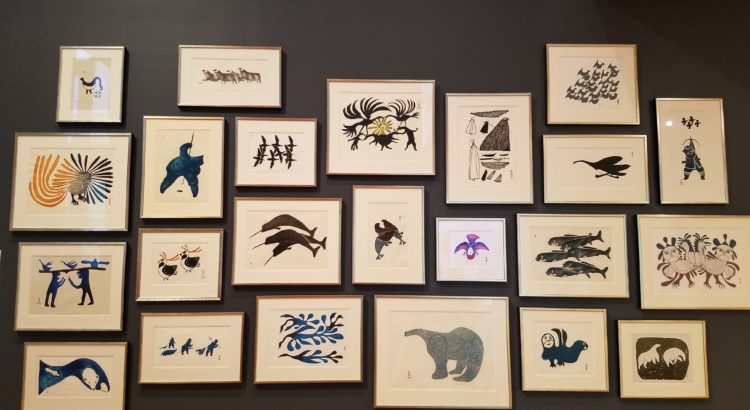
The other art form featured in the exhibit was prints. The gallery wall featured some twenty, framed prints of various hues and subject matter arranged on one wall together. Next to the gallery wall was a stone print block for one of the prints on the wall. I generally think of prints being carved on wooden blocks or maybe a plastic like vinyl but many of these prints were carved into stone or ivory. The prints on the wall mainly featured animals and fed into the general hue of the room as many were printed in black or shades of blue while the sculptures were mainly carved out of stone on the black and blue color spectrums. The prints were interesting individually but also as a collection altogether. Many of the prints featuring birds were at the top while polar bears were at the bottom. To my mind, they were roughly arranged so as to put predators at the bottom and prey at the top. Two prints in particular were placed alongside each other creating a story. One print featured a flock of birds while the print next to it featured a smaller flock of similar birds and a hunter with a bow pointed at the birds above them. This interplay between the prints really displayed the beauty of good curation as those prints did not seem to be made by the same artist or necessarily intended as a pair but added something to the gallery when featured as such.
PREVIEW: The Six Senses of Buddhism

This exhibit is currently in UMMA and will be there until June 30, way past the end of the school year.

What is meant by the sixth sense is the mind, which for those unfamiliar with Buddhism is closely represented as enlightenment. The mind of the Buddha is what Buddhists train so hard to obtain, through sutra’s, meditation, and basically every other practice.

If you want a more involved experience with this exhibit than simply strolling through and looking at the art, UMMA is hosting many events like conversations, demonstrations, and tours in this exhibit. Go to UMMA’s website to check it out.

I know Sat May 11th, 1:30-2:30pm there is a demonstration of a tea ceremony in the exhibit and right afterwards at 3pm-4pm there is a group conversation which will shed some light on the artwork.

PREVIEW: Change Our World (Slam Poetry)

Poetry has long been a medium that puts words to the indescribable. It can be used to explore the feelings that exist amorphously, from the most complete pains to immense elation. It draws together seemingly unrelated pieces of life and brings light to ideas that we may otherwise glaze over in our striving for a normal life. Further still, slam poetry combines this style of writing with a moving, lyrical flow that resonates with a wider audience, adding in a most earnest emotion to the already poignant stanzas.

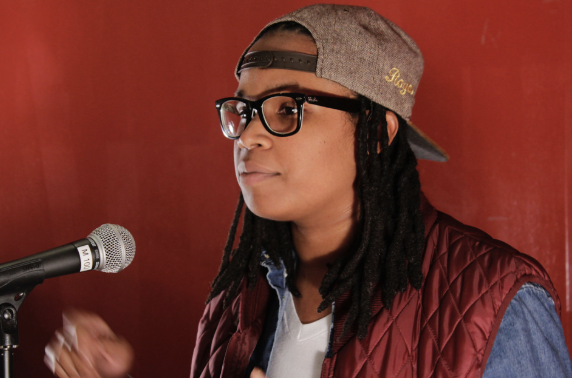
The U of M Slam Poetry Competition group and Roya Marsh are coming together to perform their work Wednesday, April 3rd at Rackham Auditorium. Come snatch a seat at 7 pm and prepare yourself to gain new perspectives on social justice issues that plague our existence. Admission is free for students and faculty, and staff!

Image result for poet

PREVIEW: Aldo Girard Poetry Reading

Aldo Leopoldo Pando Girard is Ann Arbor’s Youth Poet Laureate. He was the feature poet for Poetry Night in Ann Arbor, and a member of the 2018 Ann Arbor slam team. He is currently studying vocal performance and civil engineering at U of M, and he spends a lot of his time at the Neutral Zone performing and engaging other artists.

He is releasing a poetry book that vulnerably explores the intersection of his identities as an Afro-Cuban born and raised in Ann Arbor. At the event, he will read from his collection, answer questions, and sign his books.

I think it will be really inspiring to meet a fellow undergrad who is fulfilling my personal dream of publishing a book. Come out and support him!

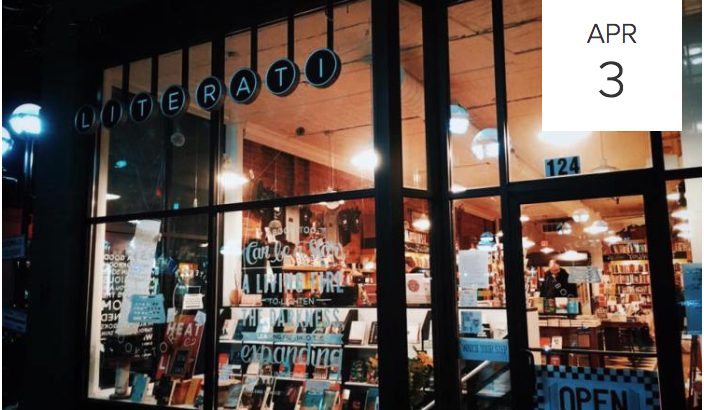
Location: Literati

Date: April 8th, 6pm

Admission: Free

PREVIEW: Polly Rosenwaike Fiction Reading

Polly Rosenwaike (a writer, reviewer, editor, and teacher) is reading her fiction pieces at Literati tomorrow evening. Her pieces are inspired by poems—which is an interesting jumping off point.

She has published a lot of stories in magazines such as the New England Review, Colorado Review, The O. Henry Prize Stories 2013, etc. Her essays and stories have also appeared in the New York Times Book Review, The Brooklyn Rail, and The Millions. Fun fact: she is the partner of Cody Walker, the director of the English Department at U of M. You can find more information about Rosenwaike here: https://www.pollyrosenwaike.com/

Location: Literati

Date: April 3rd, 7pm

Admission: Free


REVIEW: Transit

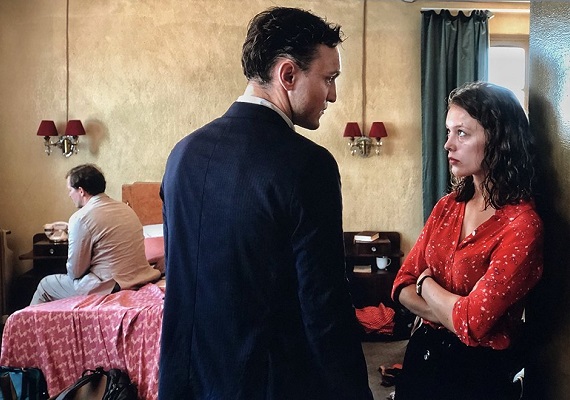
Christian’s Petzold’s Transit is a sprawling, moral adventure that examines questions of loyalty, morality, and the modern global order in the face of fascism. Set primarily in the French seaside town of Marseille, the background to the drama is a façade of gorgeous pastel storefronts that police vans race past in a flurry of sound and light. The setting is noticeably modern; the outfits chosen by the characters, the ships in the harbor, the vehicles in the streets all clearly belong to the modern era, and it’s also clear that Petzold wants it that way. The ambiguity of eras is only one part of the ambiguity that Petzold has carefully constructed for his film, as he places grand amounts of trust in the viewer to think critically about and understand the messages he wants to send.

The ambiguous setting contains both undertones of the Nazi occupation of France, and the modern rise of fascism in Europe. Most of the characters in Marseille trying to flee are German, and although the identity of those occupying the country goes unsaid, references to Jews, “the occupation” and “cleansings” evokes strong similarities to the Nazi occupation of France during WWII. Yet there is also a modern twist. A family of African descent that the protagonist, Georg, befriends is described as “illegal”, living a careful life in avoidance of the authorities. Their entire apartment complex is revealed to be a haven for cautious, illegal families largely of African or Middle Eastern descent, mirroring the current refugee crisis in Europe. Petzold carefully draws the comparison between the historical threats we have learned to fear and the more modern ones we may have not.

The ambiguity stretches into the exposition of the characters and the choices they make. The narrator, who appears partway into the story, goes deliberately unnamed and largely unidentified for much of the saga, but he is identifiable as an outside observer, someone witnessing the events but not privy to the inner thoughts of the main characters themselves. Petzold also avoids the potential easy moralizing of his characters. They act in unpredictable and frequently selfish ways, given opportunities to act in a clear, ethical manner, they abstain for sometimes selfish reasons, and sometimes reasons wholly unclear and never explained. Petzold’s characters are constructed as complex, whole people, with rich, unexplained inner lives. And that is what makes Transitultimately worth seeing. The characters are rich, real people, with real, complex desires, who refuse to fall into the mold of action heroes or love interests. The film artfully touches on serious modern issues while simultaneously immersing the viewer in a carefully constructed world of drama and tension, the one the unexpected ending ultimately topples.