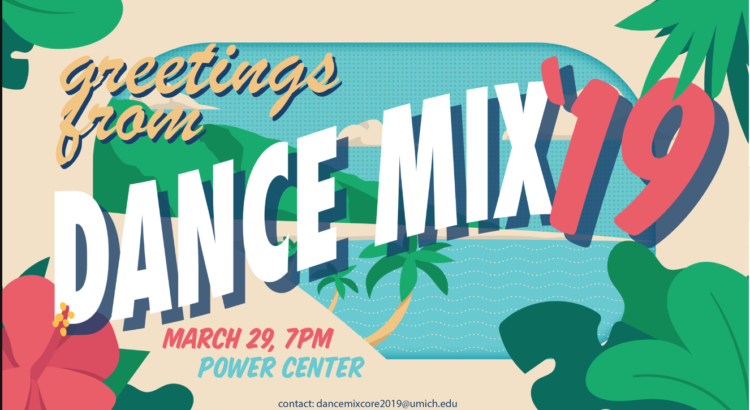
REVIEW: Dance Mix 2019, Tropical Paradise

This was my first time attending Dance Mix, and I was wowed. In many ways, the event felt like Acarush, the a cappella concert in September where 16 different student groups perform. At Dance Mix, fourteen groups performed: 2XS Michigan, Ambiance, Cadence, Element One, Encore, funKtion, Impact, K-Gayo-3, Michigan Ballroom, Michigan Manzil, Photonix, Revolution, Rhythm, and Salto. Each group approached their performance differently. Some used elements of humor, storytelling, Shrek’s movie soundtrack, or even lip-syncing.

It was a great event that showcased the variety of dance styles across campus. There was contemporary ballet, modern, hip hop (including breakdancing, funk, jazz, krump, and house), ballroom, tap, urban, k-pop, contemporary, jazz, bollywood, glowsticking, Chinese yo-yoing, etc. I never fully realized just how many different genres of dance there are.

I appreciated Dance Mix’s inclusivity of groups that might not otherwise be considered “dance” teams—such as Photonix and Revolution. Not everyone would consider glowsticking or Chinese yo-yoing as forms of dance, but I believe that they are. “Dance” means to move your body rhythmically and usually to music. Both performances by Photonix and Revolution exhibited musicality, and the performers achieved a high degree of skill in order to execute the complicated choreography. I have personally tried to twirl glowsticks but kept hitting myself instead of synchronizing my left and right hands. Now I appreciate the difficulty level of Photonix’s routines so much more.

A fun observation that I made was that there was a lot of collaboration across different groups. I often saw dancers appear in multiple performances. There was even one performance where two groups came together, coordinated costumes, and danced together.

One of the most enjoyable parts of the show was the energy in the room. Often, audience members would scream and cheer on their friends who were performing, or whistle when they were impressed by what was happening on stage. I noticed that the energy generally peaked when the performers exhibited striking skill and/or musicality. When a dancer’s sharp movements match the beats in a song, it’s pure magic. One of the performances with the most striking musicality was Cadence’s “Rain Dance.” Dancers’ crisp motion synchronized with the sound of rain drops. It was enchanting to watch.

Other aspects I valued in the performances was how they challenged and reshaped ideas on “masculine” or “feminine” movement and clothes. Dance Mix celebrated self-expression that traversed across both sets of gender norms. It was an encouraging space where performers could show off who they were and convey their emotions and passion to an audience. I loved seeing how each dance group embodied culture, community, and self-expression.

I’ll be back next year.


(Promotional video that gives you a snippet of the performance)
REVIEW: Alcina

This was my first time seeing a full opera performance, and unlike the guy next to me who kept dozing on and off, I loved it. I was captivated from the very beginning which had a very eerie feel, flashing lights, people still like statues, and the orchestra playing fervent music.

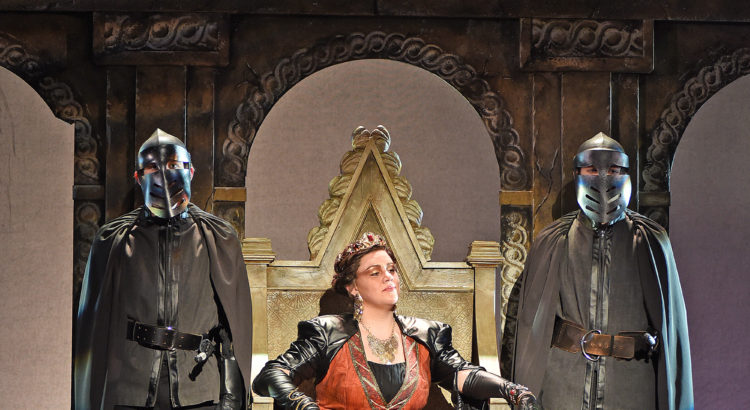
The scenery and outfits were awesome. I got the impression that the island was beautiful, but with an artificial non-natural sense of beauty. The colors felt fluorescent, rocks and landscapes were too symmetrical, and animals had a ghostly-dead look to their face. This was fitting, because the island is supposed to have a false sense of beauty cast by Alcina. The costumes of the characters were very bold. When they first meet Alcina, her court is filled with interesting costumes; people in masquerade masks, Trojan knights, and what looked like a holy Legolas dressed in all white. My favorite scenery design was the purple flowers that would overhang from above because of the different uses they created with these flowers. Depending on the lighting, it would be a beautiful array of purple flowers above, or simply tree overhangs representing the forest, and if the lighting was very dark it would represent a spikey cave or rock formation above.

My favorite character was Ruggerio because of how amazingly feminine his voice sounded, and how well he acted the part of a naive but entitled and faux-macho character. The whole time Ruggerio had this smug sly face that had an air of cockiness to it. In reality, he was kind of a fool, who was so easily tricked by Oronte, and after breaking out of Alcina’s spell still couldn’t recognize Bradamante.  It was fitting he always looked foolish with long blond hair and pure white or gold clothes. When he would beat his chest or put his hand on Bradamante’s shoulder, I would laugh from how ridiculous the actor acted. I am curious about the exact meaning of Ruggerio having such a high pitched voice.

Oronte had a classically beautiful voice. It was soothing and clear, which was interesting because Oronte is a bad character for most of the play. Immediately I could tell Oronte was a bad character, he had a scar above his eye and was dressed in all black, so it felt unfitting that his voice sounded heroic and good-natured. In the end, Oronte goes against Alcina and becomes good, so in this way, his voice was foreshadowing. He is also a true lover, he always deeply loves Morgana no matter how she hurts him, and Oronte’s voice sounded like a true lovers voice. Every actor had an amazing operatic voice, but what also stood out to me was how gracefully Morgana was able to waver her voice and how great Melisso’s bass/baritone voice was.

Thankfully we had English subtitles case above the stage. For a three hour opera, there is actually very little dialogue, because the same word or sentence will be repeated continuously for three minutes. I was confused because it didn’t sound like the exact same sentence was being sung over and over again. Also, when words are being sung in operatic fashion, it takes a lot longer than it would to speak the same words.

I am not an expert on Handel, but I know that his music is known for sounding royal and regal. In this opera, the wavering voice was the main vocal instrument. Especially when a character was in love, every word they sang would have a vibrato, which often gave a richer tone. Again Morgana did a phenomenal job with this. The main instrument was the harpsichord, which is like an organy sounding piano. The harpsichord would play the whole time, often being the lone instrument while actors sang. The orchestra would support the harpsichord or play when there wasn’t any singing going on.

PREVIEW: Julius Caeser

This year I have been transformed into a Shakespeare fan and this will be my first time seeing Julius Caeser. This showing is a 1960’s twist of Julius Caesar, which usually takes place in ancient Rome. It is during the time when Kennady was assassinated, for those familiar with the Julius Caeser you should be able to see the connection. There will also be a live jazz trio for the show.

This show was directed by Arthur Nauzyciel of the Théâtre National de Bretagne in conjunction with the American Repertory Theater. Which basically means it’s going to be a very high-quality show.

See it Friday, April 5 or Saturday, April 6. Both shows at 7:30 pm the Power Center.

REVIEW: 21 Chump Street

I arrived at the Keene Theater at 7:55pm, only to find that the theater was already full and it was standing room only. I found a spot in the back along the wall where I could still mostly see the stage, and after a couple more people trickled in, they announced that the theater had reached max capacity and no more people could enter. One person involved with Room 6 Productions walked past me and exclaimed to her colleague setting up the video camera in the back, “I thought no one was going to come!”

Indeed, many students, and many people from the public as well, wanted to see this one-night only, 15-minute musical, making it a popular and successful hit. Since the musical was so short, there was a narrator who provided important commentary in the beginning and in between songs to set the stage and move the plot along. Bryan Chan played Justin, a high school student that sees this transfer student Naomi, played by Maya Balleste, and instantly tries to win her over, asking what the heck he’s gotta do. She tells him that she wants marijuana, and though Justin doesn’t smoke, he does everything he can to get it for her, in the name of love. Though, Naomi, an undercover cop, eventually turns him in, she reflects on the smart and innocent kids that need to be taught a lesson, yet she can’t get them out of her head, referring to Justin and her care for him. This somber ending to a relatively funny and entertaining musical tried to pinpoint the pains and struggles of drug use in schools.

The music was very characteristically Lin-Manuel Miranda. As Brian Heyman, Ani Keshamouni, and Karthik Ganapathy, who made up the ensemble, played the three cousins who used their networking skills to get Justin his marijuana, they rapped and sang in the style that evoked images of Hamilton and Maui from Moana. Since the musical was so short, there didn’t really seem to be anything substantial, but the music was still great, the characters had their distinct personalities and development, and the acting was on point and made the 15 minutes really entertaining.

PREVIEW: The Lute: Cai BoJie (Chinese Opera)

FREE performance of traditional Chinese Kun Opera. I attached a link with more description and the RSVP to claim free tickets. The show is Saturday, April 13, 2019, 7-9:30pm, at the Michigan Theater. The Suzhou Kunqu Opera Theater of Jiangsu Province, China is coming all the way to Ann Arbor for this performance.

I cannot stress how special this event is. This is probably your only chance to see a traditional Chinese opera show if you don’t actually go to China. Even if you go to China, it is hard and expensive to see a show of this quality. This is the Confucius Institutes last event before they leave U of M, which is why it is so spectacular.

http://www.confucius.umich.edu/event-details/the_lute/ (Link for free tickets)

REVIEW: Exploring the Complexities of Jazz Funk

Have you ever been to the video studio in the Duderstadt? It’s a super cool space. This was my first time seeing a performance in the studio. They have a lot of fancy sound and video equipment.

Exploring the Complexities of Jazz Funk is a behind-the-scenes commercial dance video production put on by Lenard J. Foust for his masters thesis. Audience members experience what it was like to film a dance video with all the camera angles, breaks between different takes, etc. It was a really unique experience that made me think about the differences between a live dance performance and one that is filmed.

For the most part, I enjoy live dance performances a lot more than filmed ones. This is mainly because I get really annoyed when the camera zooms in and out so I can only see one aspect of the performance. For example, when the camera only focuses on the dancers’ faces, I can not see their footwork. Or when the camera only shows one dancer so I miss out on the synchronicity of the ensemble, which is often a crucial element of the performance. I saw a lot of this happening during Exploring the Complexities of Jazz Funk. They also had busy projections in the background during the videos. I thought it was unnecessary, a little too “busy,” and distracted my focus on the dancers.

Even so, I understand why camera movement and somewhat-psychedelic backgrounds are so widely utilized while filming dance performances. With the shortened attention spans of this generation, it takes more and more to keep audience members intrigued. Camera movement makes a scene more “exciting,” even though I personally believe that choreography should be captivating “enough” in and of itself.

Another element I noticed was how dance should appear “effortless.” Clearly, after dancing vigorously for an hour, most people would be exhausted. But to put on a dance performance that is professional, it is important for dancers not to huff and puff, or grimace, or be dripping with sweat from physical exertion unless the choreography calls for it. Of course there are exceptions. But this is something I have noticed from personal experience and also watching competitions such as World of Dance (an international dance competition and tv show where judges evaluate top dancing talent and troupes of all ages). A dancer’s facial expressions are as important, if not more important, than the choreography. If you are bored by the routine and your movement shows it, how can the audience not feel at least a tinge of boredom or lack of energy as well?

The dancers in Exploring the Complexities of Jazz Funk did a great job of exuding confidence, connecting with the camera, as well as coming up with engaging motion on the spot. Often, I feel like I have a limited repertoire so it was helpful to see how each routine showcased different types of movement. Jazz funk is recognized for its sharp movement and syncopated musicality. It often exudes lots of “femininity,” and the genre combines elements from hip hop, jazz, vogue, and waacking. One piece had a lot of back-arching in its choreography, another featured the fluttering of the hands. Paying attention to the choreography introduced new ideas of movement into my vocabulary.

Overall, the performance was thoughtful. It sparked personal reflection, and I am glad I went.