REVIEW: Roulette

This show is like watching a cool dialogue between a couple that easily could be you and your significant other.  There are only two characters in the whole play, a girl and a guy in a relationship. The whole play is in one scene, their apartment, and there is very limited use of props. In fact, the actors themselves did all the scene setting themselves. I enjoyed this because it made two aspects of the play super important, the dialogue and the relationship between the two characters. These were all the substance the play had, so if the dialogue wasn’t clever and well-written, and the relationship between the guy and girl was poorly acted, the play would have been miserable to watch, which it wasn’t. Sometimes cool props and extras running around just make for a pleasant distraction from the intense moments of the play. This play felt intense and that was because the actors did a phenomenal job.

I enjoyed that the male part was loaded with poetic and deep lines. He also had an amazing voice that sounded so genuine when he spoke. After many of his romantic lines I would anticipate the couple to kiss, only to see an intense look and then another question asked. Finally, the kiss did happen after he said the most important lines for the first time “I love you” ironically after a story about puking.  My favorite dialogue during the play was when they were talking about how ” oh uh ya” is more like a no than a yes. This part was funny and made me realize concretely “oh uh ya is not yes”, “yes is yes”. The actor did an awesome job of acting when he was talking about his previous assault as a child. All of a sudden he felt very vulnerable and insecure from the way he held his leg and gave quick one word replies.

I enjoyed relating to this play as I am sure anyone who has ever gone through a relationship or breakup has. The line that really stuck with me was when the guy asked “Do I hurt you more often than I make you happy?” because this is a question I always contemplate when I am dating someone. The female role also reminded me of how I feel my significant others talked. I could tell that the play was co-written by a girl and a guy because the feminine and masculine roles were defined really well. Throughout the play the girl and guy had different ways of presenting information and used different nuanced language that really felt authentic.

The couple was portrayed to be a few years out of college working adults, but the vibe I got was definitely an immature college relationship vibe. The way they joked around with each other and how they would talk at times made me think I was watching a college relationship. However, the actors both being college students definitely biased my opinion.  For the final vodka shot that was taken, the acting was good, but I was confused about why it was drunk. I felt that it was less clear and had less build up than the previous five shots. Unless this was intentional, I think there needed to be more dramatic substance leading to the final shot and more suspense about whether it will be drunk or not. It kind of felt out of the blue and sudden, which took away a lot of potential suspense.

It was interesting how insignificant the play made the fact that the couple shared different religious values. The boyfriend even said he doesn’t believe she will go to heaven because she isn’t Christian. I was expecting this to escalate, but not only did they not take a shot over religion, they didn’t even seem to have any friction over the topic, it just led to some playful joking around. I guess in modern times shared religious values is becoming less and less significant in relationships, and the writers realize that.

The play was very good and well-written, especially for college students. The dialogue was clever, relatable, and realistic. However, a dialogue is really what the play was, there wasn’t much plot or character development or creativity in this sense. In the end, I enjoyed watching it, but it isn’t a play I would want to watch a second time.

REVIEW: Haley Heynderickx

On March 29, 2019, two magnificent women from Portland took over The Ark, capturing the night with their unique sounds and instrumentation for a night of pure and magical music.

Lily Breshears, who usually tours with Haley Heynderickx in her band as the bassist and keyboardist, took the stage first with her synth, a harp (a rental, in replacement of her harp back home named Spreadsheet), and a mic. She opened with a song about the dysfunctional long distance relationship, but later countered it with her hymn about relationships that are so good, it makes you forget all the pain, or be thankful for it because it led to the present. Her song, “Pick Up Game,” combined basketball references and pick-up lines, and she ended with “Wet Plastic,” which should honestly be the anthem for the #MeToo movement. Breshears’s voice and her harp weaved together harmoniously, setting the stage with her stunning musical aura for her good friend to follow.

After a short break, the most charismatic and comedic musician came out to mesmerize her fans with her Portland accent. After some tuning, Haley Heynderickx first performed a song with Breshears to ease into her own solo show, though she summoned Breshears back to the harp for two more songs later in the set. Heynderickx captivated us with her songs from her “I Need To Start a Garden” album. From priest-like praying mantises and successful exes to the wonderful mantra “Oom Sha La La,” Heynderickx’s music combines the emotionally poignant with the humorously absurd, creating music that is both thought-provoking and meaningful. Her guitar techniques were truly mindblowing, and the strumming, plucking, and melodies complemented her voice perfectly. Heynderickx also performed some covers and even threw some impersonations in there. For her encore, she treated us to some new songs in the works, giving us a little teaser to be excited about for the future.

Heynderickx’s music features some of the most underrated, beautiful, and meditative singing and lyrics, and seeing her perform live, with her nerves and all, made for one of the best concerts I’ve been to. The two musicians’ personalities and styles fitted together perfectly, their gentle and soft-spoken manner drawing us in to listen carefully to the stories they are telling, making their musical styles even more compelling.

REVIEW: Alcina

The principal challenge of directing Baroque opera for a modern audience is, I think, the prevelance of the Da Capo aria. Da Capo arias are, in short, arias that take an ABA form. A main A section, followed by a contrasting B section, followed by a repeat of the A section, which some people feel should be ornamented with improvisations by the singer, and others feel should be sung exactly as notated. In a modern music theater mindset, we expect songs to get us from point A to point B, and the fact that so many arias in Baroque operas very specifically end with a return to the beginning seems counterintuitive to making them dramatically compelling. Of course, Handel in the 18th century wasn’t writing for a modern music theater mindset, and audiences in the 1700s approached operas very differently from how we approach them today. Meaning that sitting through contemporary productions of Baroque operas can be a real slog a lot of the time.

Alcina is one of George Frideric Handel’s more popular operas today, and when I heard that the University opera department was going to take a crack at it, my interest was immediately piqued, hopeful that the production would be able to thread the needle that is making Baroque opera compelling to a modern audience without compromising the elements that make it unique.

But first, a summary.

Alcina starts with Bradamante arriving at the island of the sorceress Alcina. She is disguised as her brother, Ricciardo, and has come to rescue her betrothed, Ruggiero, who has fallen under Alcina’s spell. Alcina is in the habit of seducing men who wash up on her island, and when she tires of them, transforming them into local wildlife a la Circe. Bradamante is accompanied the tutor, Melisso. The first person they meet on the island is Alcina’s sister, Morgana, who becomes infatuated with “Ricciardo,” which provokes the jealousy of Morgana’s suitor Oronte. Bradamante and Melisso succeed in finding Ruggiero, but he is so thoroughly under Alcina’s spell that he rebukes them. Meanwhile, a young boy called Oberto is on the island, searching for his missing father, whom Alcina has already transformed. In the rest of the plot, Bradamante and Melisso try to rescue Ruggiero from Alcina, while Morgana and Oronte work out their jealousy, and off on the side Oberto tries to get Alcina to show him his father.

And now, a review.

Right off the bat, this production was gorgeous. Gorgeous sets, gorgeous costumes, gorgeous lighting, even a pretty nifty-looking pre-show curtain. The look was very lush, but very stately, and reminded me of really old-school Jean-Pierre Ponnelle-style productions. It is a good look, a classic look, and one that works really well for this style of opera. I don’t think I can overstate how stunning the look of this production was, and the visual aspect was maybe of all aspects the most appealing.

The musical quality too was top-notch, as one would expect from the School of Music, Theater, and Dance. A phenomenal cast of singers (admittedly, I have only seen one of the two casts), and a wonderful orchestra lead by Stephanie Rhodes Russell. I did note that the orchestra was rather larger than Baroque opera typically calls for. Baroque opera often thrives with lighter voices which can sometimes get drowned out by a too-large orchestra, and it seemed that was sometimes the case here, but on the whole, the musical aspect of the production was excellent.

Unabridged, Alcina can run upwards of four hours. I estimate about an hour of material was cut from this production in an effort to get it down to a manageable length. Usually a three-act opera performed with two intermissions, this production had a single intermission inserted near the end of Act II, with the second half of the performance picking up with the last scene of Act II and going into Act III. It was a lopsided arrangement, with the first half of the evening being nearly twice as long as the second, which did make the first half somewhat fatiguing, especially as it had not only the length of two acts, but the dramatic content of two acts, which needs some time to be digested.

I had expected that the bulk of the abridgement would be in the form of cutting sections of Da Capo arias, and also trimming recitative, which turned out not to be the case. Oberto lost the largest chunk of his material (which had the side effect of making Alcina less villainous, as Oberto’s main function in the plot is to provide a victim for Alcina to antagonize so that the audience knows she’s evil), but I was surprised that as many Da Capo arias were kept entirely intact as there were.

The big problem with Da Capo arias (especially those as long as Handel writes) is how can you stage them such that by the end we feel something has actually happened? Does the aria progress the plot? Reveal something about character? Act as a signpost for an important turning point in the story? And what is the character’s reason for returning to the top of the aria? The very form makes this difficult, and I’m not going to try and be a purist and say all of Handel’s Da Capo arias are always one-hundred percent justified. Handel lived three-hundred years ago and these operas were written for a very different theatrical environment. I really think that, when presenting a baroque opera for a modern audience, there is no shame in trimming down a Da Capo aria if you can’t find a way to make it dramatically compelling.

So, yeah, a lot of the longer arias in this production were pretty stagnant, I might even go so far as to say boring. There was a lot of unmotivated standing and singing, or unmotivated wandering and singing. Sometimes it seemed that characters forgot to whom they were adressing an aria, or why they were even singing it in the first place.

Bradamante’s “jealousy” aria in the first act was one that stood out to me, because that’s one that I think very easily can be incredibly compelling, and reveal something about Bradamante’s character, but here it just wasn’t and didn’t. But most of the arias that I found stagnant were ones that I recognize are difficult to pull off theatrically, so mostly I just wished they had been trimmed down.

On the other hand, there were also arias that really really worked! Oronte and Morgana were the two most engaging characters, probably in no small part because their subplot is arguably more interesting than the main plot with Alcina and Ruggiero. Oronte is a character that I have never really liked, but in this production he was maybe the biggest highlight, and, in a novelty to me, managed to be really funny and shockingly entertaining without compromising the overall serious tone of the opera.

The interpretation of Morgana in this production was also new and interesting to me. I’ve seen her played very innocently, almost childishly sometimes, and, most notably, I have seen her played (and have typically interpreted her myself) as being as much a victim of Alcina as anyone else in the opera. (Which is why I’ve always felt that Morgana getting vanquished along with Alcina at the end is really unwarranted and unfair.) In this production, she was definitely still a more likeable and more fun-loving counterpart to Alcina, but she was also very clearly conscious of her own actions and had agency — she even carried around a sword in the first act, and used it! So this production loaded her with a bit more responsibility for her own actions, which at the same time lessened the villainous aspect of Alcina much in the same way reducing Oberto’s part did, since Alcina didn’t really seem to be excersizing any control over Morgana here.

All this considered, I still found Morgana the most likeable character in the opera, and I still feel her being vanquished at the end is undeserved. And I think it’s great that, between Morgana and Oronte, this production really managed to maintain two complex and morally ambiguous characters who were both still really likeable and fun to watch on stage, again without compromising the overall tone of the opera.

I don’t mean to diminish the other players. Bradamante, Ruggiero, Melisso, Oberto, and, of course, Alcina, as important pieces of this opera, and, considering the difficulties of Baroque opera previously mentioned, were about as well executed here as I’ve ever seen them. It was with Morgana and Oronte, though, that this production really went above and beyond, and I wish that Handel and Riccardo Broschi (the librettist), had given them the ending they deserve. I have said in the past that this opera does not deserve Morgana, and that Morgana deserves a better opera. This production confirms that for me, and adds Oronte to the list as well.

REVIEW: Beth Nielsen Chapman and David Wilcox

After a tough week I was looking forward to a relaxing concert. The ark does quiet-comfortable concerts perfectly. The dark small intimate atmosphere fits slow music very well. The performer’s mics weren’t working for the first 20 minutes or so, which allowed us to hear multiple songs unplugged. This was actually my favorite part of the concert. I could hear everything perfectly without the mics, because the ark is small enough to support unplugged music. I think soft singing and acoustic guitars sound better this way. There was a stillness in the air that disappeared as soon as the mics started working.

David and Beth’s music styles were a lot more similar than I was expecting or hoping for, but the content of their songs, the lyrics, metaphors, themes, and meaning, were drastically different. David was like a philosopher. His songs all had deep, often transformative meanings. He sang songs about the political state of our country and related it to a winter storm. He sang a song about emptying our minds, which made me think of the Buddhism class I am taking. He even quoted Abraham Lincoln in one of his songs. My favorite song of his was a song about how we are only responsible for the things in this world we can change, and that we shouldn’t feel responsible from all the bad news happening around us. He used water and the ocean as a recurring theme throughout this song.

Beth sang songs about love. All her songs seemed to relate to the happiness or sadness or mysteriousness of love. Beth has had a very impactful and emotional love life. She has lost two loved ones to brain cancer. It was remarkable how easily she was able to speak about her past love history. My favorite quote of Beths was when she said that Grief is like a boulder in our path that we can’t go around, under, or over. We just have to wait for the rain to wear it down into sand. The only way through grief is time. Beth had a beautiful voice which I actually thought fit the piano more than the guitar. All my favorite songs of her’s were songs played on the piano.

David and Beth would switch off playing songs, which made me wonder why they were even performing together. They only played two songs together the whole, and these were the best songs. I don’t see the point in them performing together if all they are going to do is take turns performing songs. They should learn eachothers so they can perform them together. Even songs that they wrote together, they would split in half instead of playing it together.

PREVIEW: Lisa Hilton

Hailing from the coast of central California, critically acclaimed jazz pianist and composer, Lisa Hilton, is a performer whose work has transcended among the sounds of various genres and time periods in history. Her work consists of both modern and classical flavors and her ability ranges from orchestral melodies to the vibrant sounds of jazz. Having completed an art degree in college, she describes her work as compositions painted by harmonies and sculpted by textural and rhythmic elements. Hilton has worked with many notable composers and musicians, including George Gershwin and Horace Silver, who all have influenced the emotion and the energy apparent in her pieces.

This Saturday, she will be taking the stage at the Kerrytown Concert House performing songs from her newest album, OASIS, and more. I am beyond excited to attend this performance because I will be able to experience someone perform music of their own that could resemble compositions performed by other high-caliber musicians and orchestras.

As a note, this event is available to all students for no cost through the Passport to the Arts offered by the Arts at Michigan program from the University of Michigan. Without further ado, I hope to see you there!

REVIEW: Ballet Preljocaj

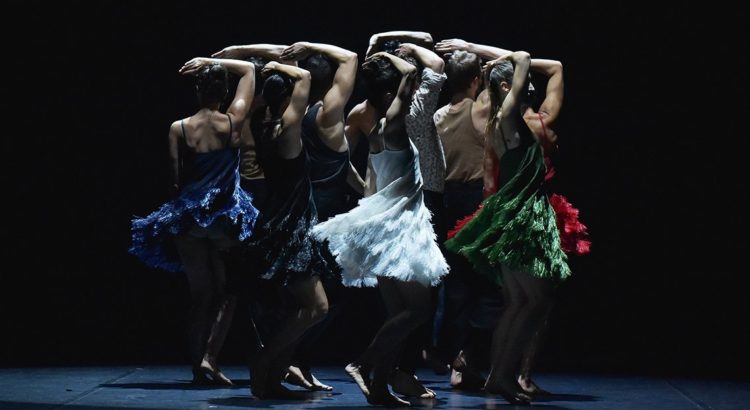
Ballet Preljocaj’s performance of “La Fresque” was a wild experience. At first I wasn’t really sure if I liked it. The first few dances were set to music which I would describe as a mix between ambient and electronic while the dance itself was very abstract (at one point I recognized a series of moves as yoga positions I did during my fitness kick last winter). I found myself feeling like I was watching a caricature of what people would imagine a modern ballet to look and sound like. However, I slowly became more immersed in the performance and really started to enjoy myself.
The ballet did a very good job of presenting the story it was trying to tell of a man in love with a painting come to life and his journey into the painting, through alternate dimensions. The use of curtains and set to create the impression of the painting in its frame was particularly successful. The ballet was supposed to explore juxtaposition and it definitely accomplished this, but it was to a fault. Each dance featured vastly different dance styles and music, going from hard rock to soft ambient music, flowing ballet to frenetic jumping, leaving me with whiplash sometimes. I often felt confused by the abruptness of the changes in tone and felt like it was being extreme for the sake of being extreme. While my overall impression of the ballet was positive, I often felt like the creator was just trying too hard to be edgy. It certainly stretched my idea of what is considered ballet.
A theme developed early in the ballet which was present throughout in various iterations and that was hair. There was so much hair. All the ballerinas had long, beautiful hair. Was that a requirement for auditions? “Ballet Preljocaj seeking female dancers with hair at least two feet long.” And their hair was so shiny and healthy. Are they sponsored by Pantene? I could almost imagine some of the dances being featured in one of those ridiculous shampoo commercials. The focus on hair almost started to feel inappropriate, like we were getting a glimpse of Angelin Preljocaj’s obsession. The first dance performed by the female ballerinas made this theme apparent as they would cover their faces with hair then slowly pull it back or toward the end of the dance when they started furiously flipping their hair to a degree that felt comical. They also used hair to distinguish between the prima ballerina and the crew as she kept her hair down and flowing for much of the performance while the other women tied their hair back in ponytails. Then there were the hair suits. Most of the crew came out in masks and black bodysuits with what looked like long braids of hair attached to them to perform a dance which felt very much like an amalgam of African and South American traditional dances. The hair continued to be included in wilder ways. The dance that really took the cake was toward the end and featured the female dancers with long bungee cords attacked to their buns, meant to look like their hair, attached to the ceiling. The female and male dancers danced in pairs on and around the cords. At first it seemed ridiculous. However, after they started dancing it became beautiful. The women wrapped the cords around their hands, arms, or torsos to support their own weight or the weight of their partners as they suspended each other from the ground and spun in circles. It was truly magnificent. My favorite of the “hair dances” featured the female dancers to a beautiful piece of string music in an intimate and emotional dance. The four dancers each held a portion of the prima ballerina’s hair and danced around her, eventually wrapping her hair into a bun like a human maypole and taking turns to secure the bun with pins. It was a little silly in concept, like the rest of the hair dances, but it felt more sincere than much of the rest of the ballet. The final nod to hair was in the final scene, after the couple fell asleep and the man was taken out of the painting dimension, the roses he had given her were placed in her bun in the painting showing him that their adventure was real.

Image courtesy of the UMS Twitter account.