
Friday night felt like the perfect evening to take in a thoughtful, emotional exhibit like Stories Never Told: Yemen’s Crises and Renaissance. The exhibit was held on the 10th floor of Weiser which is a view in and of itself. The walls were lined with paintings, prints, and photos taken by artists from Yemen and the Yemeni diaspora. At the back of the space was a stand put up by Qahwah House, a Yemeni cafe based in Dearborn, with coffee, tea, and treats such as sabaya (a Yemeni honey cake) drizzled with locally sourced honey. These treats were perfect to keep me company as I made my way over to the screen for the speakers and short films. Before programming began, they had screens playing music videos by Yemeni artists. A short documentary was featured telling the story of Yemeni singer-songwriter Methal and her path to releasing a song featuring the major American band X Ambassadors. They also showed an interview of a Yemeni social media influencer based in South Korea sharing her story in Arabic. I was surprised to find that, after a year and a half without practicing or using my Arabic, I was able to understand a fair amount of the video, which was necessary since there were no subtitles.
After opening remarks from the Arab American National Museum and the curator, Hanan Ali Yahyah, there was a short presentation given by an expert from Michigan State University on the background of the crisis in Yemen. This truly put things in context when watching the eight following short films. Yemen is experiencing the worst humanitarian crisis of our time and this exhibit truly portrayed that. The short film that cut the deepest was about a woman living in Yemen whose heart condition left her dependent on medication which is difficult to find in conflict-torn Yemen. At the end of the film we learned that she died four minutes before her son arrived with the medication to save her life. The audience heaved a collective sigh and we all started to understand why there were boxes of tissue along the aisles. The visual art was equally stunning and emotional. One artist expressed her struggle with identity through photographs with her face edited out. Another piece that caught my attention, as a former cellist, was a painting featuring a young girl playing cello in the wreckage of her city.
REVIEW: The Exonerated
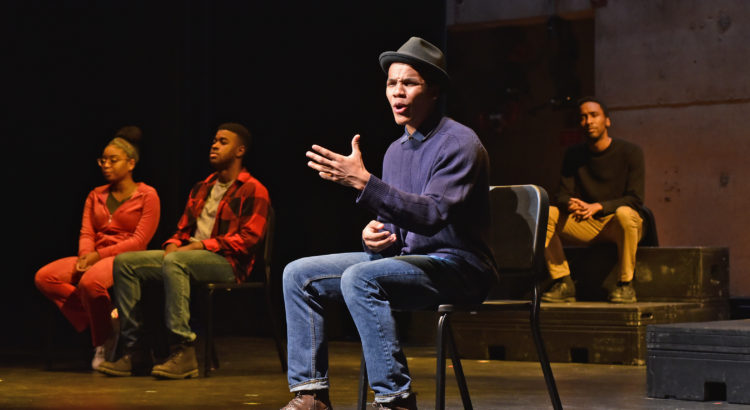
The Exonerated was a well-written and evocative play. The six stories were effectively interwoven with smooth transitions, and the music segwayed well between scenes. The unfolding of events was compelling and heartbreaking. To balance out the anger, grief, and hopelessness, the play also utilized elements of religion or the divine to bring hope. I walked away with so many emotions and was unsure of what to do. What can I do to advocate for people who have been wrongfully accused of a crime and imprisoned? I don’t know.
Each storyline had possible “reasons” for why someone was wrongfully accused (because as an audience, consumer of stories, and general human beings we are inclined to look for reason and logic, and the playwrights acknowledged this). In three of the six stories, it was “because of” the person’s race. Most, if not all, of the stories took place in the 1970s (Not to say that racism no longer exists, but blatant racism was more prevalent during that decade.) Even when there was no evidence—or even more despicably, when there was evidence that indicated that they were innocent—they were tried and convicted.

The other two stories were about white men. One man’s parents were brutally murdered, he was convicted, and years later someone found out the murderer(s) were actually members of a gang. The other man was accused of being a “perverted, bloodthirsty homosexual” who took out his anger by murdering a woman. The play did not go into detail about his sexuality; later on, he married a woman, so he may have been straight or bisexual. But his sexuality was not relevant. What was relevant, was the label of being “gay” was put on him to convince people in the court that he was guilty (Remember that the conversion therapy [a recognized form of torture] trend started in the 1970s. It’s still legal in some states, and gay marriage only became legal in 2015). News of his presumptive sexuality was broadcasted on television and he was raped in prison. His perpetrators carved profanity into his skin, so deep that plastic surgery could not repair the damage. Awful, awful stuff.

The remaining story was about a woman who, even after someone else admitted to committing the murder, was left in prison for another sixteen years. She was the first woman to ever be put on death row.

The “reasons” why the latter three people were falsely convicted were less clear. Perhaps because we do not (I did not) generally think of white people being cheated by the justice system (unless they are a female in the context of sexual assault), and the narrative of the illy treated African American is so disgustingly common.
The most important thing I want to point out is that even now, people are wrongfully convicted all the time. This narrative is not unique to the 1970s. Being a victim of systematic injustice does not just happen to African Americans, or women who are sexually abused, or gay white men. It is not unique to a certain race or social class. Plenty of children of all races and social class are under the guardianship of caregivers who abuse them, sometimes for decades, even when Child Protective Services has already been called numerous times.
Of course, being wrongfully convicted is more common for certain demographics because our justice system favors the economically well off (if you don’t have the means to hire a lawyer, you may be assigned one who is overworked, underpaid, unexperienced, or has no intention of looking out for your best interest. It happens all the time.) Or, being of a privileged social status may decrease your chances of becoming a victim. But it does not prevent it. What I have learned throughout the years, is that the court system is all about connections and social status.
Why, when two people commit murder, one is put on death row and the other is sentenced ten years in prison, and then gets out in three? Where is the logic? What do we do in a society that wrongfully convicts the innocent and acquits the guilty? That’s not to say there aren’t any success stories. But I often wonder, do we have a justice system? Or do we have a system that places blame? Personally, I believe it is the latter.
For the unlucky ones—when you come out of prison, you have to learn how to feel again. If you didn’t have problems with mental health before prison, you most likely will have them after being in that kind of an environment.
I feel compelled into action. But I don’t know what to do. The only bandage I can think of for this enormous wound is compassion. Believe someone. Being wronged by the justice system does not automatically mean you lied or did something wrong. Sometimes, the most damaging experience isn’t the traumatic incident itself, but afterwards, when people don’t believe you. Or when your credibility is scrutinized in court. Or when you have to recount every traumatic moment in excruciating detail while prosecutors cross-examine you and question why your description of the events was not precisely the same as the testimony you gave six months or two years ago. Because yes, court cases do get dragged on for that long, and often much longer.
Be aware of our unjust “justice” system. We may not be able to eradicate the unfair and immoral. But we can listen.
*photos by Peter Smith Photography
PREVIEW: Merrily We Roll Along
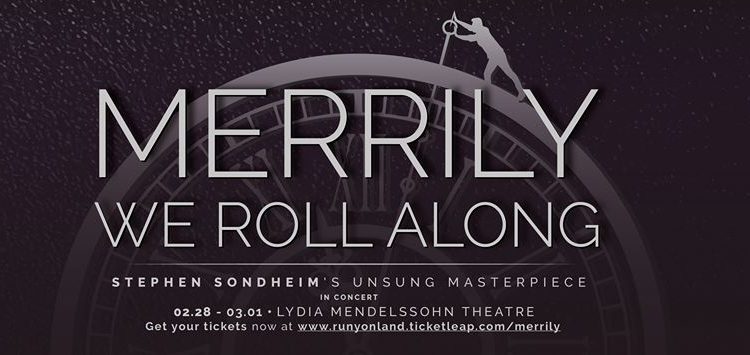
Runyonland Productions, Ann Arbor’s new theater company, is bringing Sondheim’s iconic Merrily We Roll Along to the Lydia Mendelssohn Theater as a staged concert production. The musical revolves around Franklin Shepard, starting with the peak of his songwriting career and moving backwards in time to show the big moments of his life and the choices he and his friends made that led to the present. Showtimes are February 28 and March 1 at 7:30 PM and tickets can be bought online at https://runyonland.ticketleap.com/merrily/.
REVIEW: The Ark’s 32nd Annual Storytelling Festival
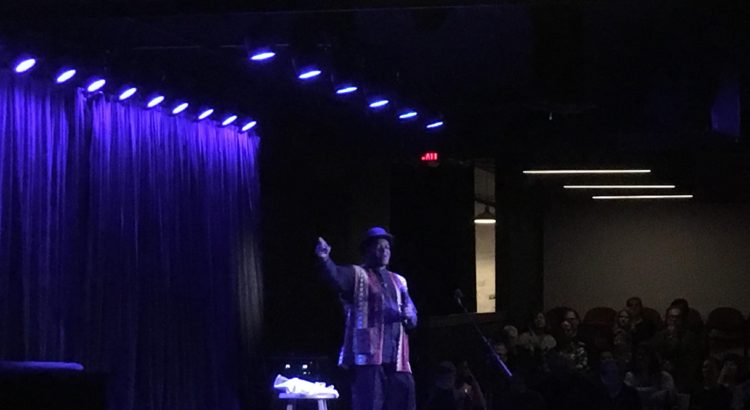
In The Ark’s 32nd year of its storytelling festival, we were graced with a mix of personal and traditional tales from three wonderful performers. Each storyteller had their own style of storytelling, all of which were appealing and intriguing and full of lessons to be learned.
Ivory Williams of Detroit started the night off with his stories that very much involved the audience. He started with a story about God’s creation and dispersal of people, putting the best people in Ann Arbor obviously. His story about a monster blocking the bridge highlighted the meaning behind obstacles, which you don’t always have to fight with force, since they are meant to be embraced. The young girl of the story, who embraced the monster and become successful in life, did the two most important things a successful person must do: she returned to her village to share what she learned, and she told stories. The morals of kindness and love guided Williams’s stories, and his use of repetition tied the story nicely together, making it twice as nice and twice as powerful.
Next was Edgar Oliver, who had a very timid yet enthralling voice, as he performed for us snippets of his shows and some pieces of poetry as well. His vivid imagery and meticulous details of his stories set the stage for some absurd twist in the story that he delivered with such deadpan emotion, the audience loved it. From the albino watermelons trapped under a swimming pool to the trash can goddess and his love for red wine to the trampling pig, Oliver regaled us with his very distinct storytelling. He took us all over the world, telling us stories about his hometown of Savannah, Georgia, his time spent in France, and his life in New York City. His stories were sprinkled with entertaining comedy, though there was a hint of sadness and regret in the last snippet from a show he’s still writing; however, through his words and stories, Victor lives on in his memories and in ours.

Finally, Laura Simms finished the night with her love stories, which took on a variety of forms. She told us about the fairy she met on the New York City subway, and the time she saw Nina Simone perform, which was the first time she fell in love with the world. Then, she told a long and humorous story about a prince’s long and desperate journey looking for true love, emphasizing the importance of true companionship. She ended with the story of her mother’s seal skin coat and the powers it had in transferring good to the world.

Williams, Oliver, and Simms all captivated the audience with their engaging words and stories. Their stories taught us to think about the good in ourselves and in others, and to look for true love in every moment of our lives. This wonderful tradition at The Ark gives the people of Ann Arbor a night of entertainment filled with kindness and love through the simple power of words. As Williams repeated throughout the night, stories must be told.
REVIEW: Las Cafeteras
Having looked forward to this event for the entire week prior, I was thoroughly pleased by the impressive performance given by Las Cafeteras during the middle of last week. What I thought would be essentially another Latin pop performance was much more than that. The group experimented with vibrant, modern sounds while maintaining a traditional essence, and the aspect of their performance that was most meaningful to me was the social commentary that was emotionally striking throughout. After experiencing this performance, I couldn’t wait to write this piece and to explain how Las Cafeteras would give us a reason to listen to their music long after the curtains closed.
The style of their music was a perfect blend of modern sounds and a traditional essence. In other words, many of their songs gave a traditional Latin impression in terms of having upbeat tempos, uniform time counts, and classic instrumentation. In addition to these components, the group instilled some of their own personal flares into their songs that gave a revolutionized impression, such as rapping in some verses, filling up the auditorium with the hard and fast strumming of their guitars or ukuleles, or showcasing the baseline beat given by a full drum set. While these aspects of music composition may be more often seen in the rock genre, the group was able to utilize these techniques in their genre to make their music all the more well-rounded, far-reaching, and complete.
Part of what captivated me the most about the performance by Las Cafeteras were the personas of its members. Aside from being musicians, the three main performers were able to show us just how personable they were, expressing their vulnerability during songs about injustice or hard times and their utmost passion during songs about enjoying life and loving your family. When Hector Flores entered the stage, I immediately felt uplifted and attentive; he was the driving force behind the audience’s involvement in their performance. As Denise Carlos bellowed each song, she seemed to sing in a difficult range with ease, allowing us to feel like she could just be a passerby singing down the street. When Daniel French contributed to verses by rapping, he gave an impression that he could be my cousin or brother, writing and singing to address common social issues among our Latin community.
The most important aspect of their performance were the underlying messages in each of their songs. It was emotionally jarring when they talked about the hardships of immigration, the acceptance of diversified communities, and corruption in our nation’s highest influential powers. I believe that their attempt to bring light upon these issue was successful in the sense that everyone left the performance on the same page and forward in the same direction. In the end, what I left the performance with was a drive to achieve purpose in life. Throughout their songs, they continually asked us, “What would you do? Who are you? What are you here for?” and I will continue to support the idea that whatever we choose to pursue in life, it will only be worth doing if we make it meaningful to us.
REVIEW: Love and Information
What’s the purpose of life if not to find love and learn information? “Love and Information” features many short vignettes of everyday life, showing scenes everyone can relate with to some extent. With the anonymous characters running around onstage, there is a universality of the scenes that makes everything connect. The play explores different variances of love and methods of information as the characters struggle to gain information and connect with others.
The title of each vignette aptly described the main point of a scene. Words such as “secret”, “remote”, “silence”, “dream”, “privacy”, “children”, and “facts” convey the information within that scene in a succinct way, while giving some frame of reference so the audience isn’t completely lost. The reoccurrence of certain themes, such as the child who didn’t know certain emotions, brought an underlying thread between these vignettes that might otherwise be hard to connect.
The 18-person SMTD cast embodied all the characters wonderfully, slipping into one persona only to run offstage and return as someone completely different, though the intrinsic drives of that person remain the same. This show, written in 2012, remains completely contemporary, featuring the latest dance moves and songs and all the current trends. The presence of screens on cell phones and televisions is also prominent, a modern source of constant information, one that can invade our privacy and also steal our attention.
The stark contrasts of some of the scenes leave a stronger resonance. One character has perfect memory and can recall any detail of any date, while another character can no longer recognize his own wife. One character suddenly and happily remembers a vivid memory of his dad during a memory game, while another character is traumatized by a flashback they wish they never remembered. Information is fleeting, and it can also be absolute.
The same can be said of love. Affairs can mean the end of something great, or the start of something better. As one vignette points out, sex is a way of transferring and creating information through an act of love, connecting the title of this play neatly.
The play ponders the question of science, philosophy, religion, mathematics, politics, and humanity — everything that gives us thought, forms our personalities, and makes us human. The characters range from children to elders, and it also touches on mental illnesses, such as schizophrenia and attempted suicides.
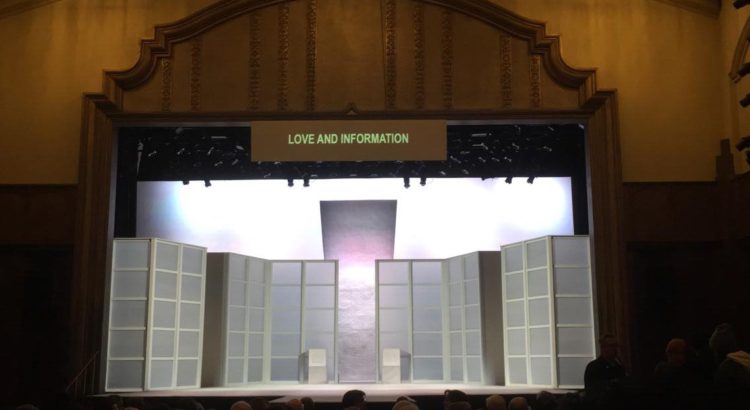
One of the most appealing aspects of the play was the scenery, set designs, and costumes. Each separate scene was distinguished by its color, and all the props and clothing accessories that appeared in the scene emphasized this distinct feature. With a chilling white backdrop surrounded by white boxes and actors in all white clothing to start with, the evolving and uniforming color schemes around this base neutral color brought life to this play.
Love and information can bring great joy and meaning to our lives. However, loss and pain are also facets of love, just as information can be painful and lost just as easily. This play leaves us trying to make sense of the universe, our existence, our relationships, and our daily lives.
