
REVIEW: Shoplifters

I don’t know much about Japanese film and what I do know relates mostly to the world of anime, reminding me of my frightening brush with Spirited Away as a child. So, when I went into the cinema to see Shoplifters, I wasn’t quite sure what to expect. Over the summer, I facilitated English conversation circles through the English Language Institute on campus and found myself talking about foreign film quite a bit. During one conversation with a Japanese graduate student we talked about the difference between American and Japanese film styles. As he pointed out, American movies are often centered around entertainment which they can do with the budgets to support CGI, international sets, and large casts. However, Japanese film, as he described it, is lower budget and often focuses on human relationships. Shoplifters was a prime example of this account.
Shoplifters follows the complicated relationships of this hodge-podge Japanese family and their struggles to survive. As the film unfolded, I learned more about each of the characters and what brought them to this family. This small apartment of misfits was brought together by circumstances often stronger than blood. The complexity of these relationships and the circumstances that brought the family together gave each complexity and depth, however, it also made the story a bit difficult to follow. Between the characters’ many overlapping histories and the barrier of language translation I struggled to ascertain the histories of each character without a little help from a film buff friend. I left the theater questioning the exact nature of the grandmother’s relationship to Aki or the main couple. And who had the couple buried in the past?
Despite these questions and minor confusions, I was still able to fully enjoy the complexity of their interactions and relationships. One of the most enjoyable aspects of the film was the way in which the film slowly unraveled, revealing another aspect of the backstory while simultaneously moving the plot forward. The movie was just a bit long and slow for an American viewer that has seen her fair share of rom-coms and Marvel sequels. However, I still found the film incredibly enjoyable and look forward to seeing how it does once Oscar Sunday comes around.

Image courtesy of the Michigan Theater

REVIEW: Broadway Our Way

Bravo Bravo Bravo! Congratulations to the School of Musical Theatre for putting on this fantastic show. It was so original, unique, talented, and incredible that I went back on Sunday to see it a second time. To sum up this performance it is classic Broadway songs performed in the american musical styles of gospel, jazz, pop, and rhythmic blues. The students got to work with the composer Michael McElroy himself, which explains why it was so good.

I was surprised when what looked like 50 students walked onto the stage to perform the first song “Answer Me” from The Bands Visit. Most Broadway songs are sung by one or a couple of people. Also, the instruments accompanying the singers consisted of one guitarist, one bassist, one pianist, one cellist, and a percussionist, not a full orchestra by any means. I was curious if having so many people sing the Broadway songs would make the music lose it’s Broadway character and the meaning originally intended by the original composer. This did happen with a lot of the songs, but new character and new meaning was put back into the songs with the re-composition, and the students did a great job adding their own flair to every song.  Most of the songs performed throughout the night featured closer to 20 students, which is still a lot for the Broadway songs they were performing.

I most enjoyed the songs where all the students were on stage, I felt these songs were the most powerful. Every song performed was great, but some stood out. “Answer Me” was sung with a hushed whisper sound, but the crescendos were perfect and the buildup ignited what felt like a flame inside of me. “Luck Be A Lady” was performed by a small group of six guys, and was one of my favorites of the night. The harmonizing in the song was stellar, there was a big range of high to low, and the song still accentuated every individual singer’s voice. The two guys who had short solos during this song killed it with their high voices. They weren’t singing in falsetto, but it was still a higher pitch than I could ever achieve. “Silver Lining” was sung wonderfully by a group of five and was the only song to feature a guitar solo, which is important to me as a guitarist. “Defying Gravity” was the strongest song. It wasn’t just loud, it was powerful and got me feeling excited. “You Will be found” was the most gospely song. The girls and guys seemed to face off with two back to back songs, “Love to Me” performed by the guys and “Journey To The Past” performed by the girls. I think the girls did a better job.

There was no stories, props, or scripts, but this didn’t mean it wasn’t a very visual performance. All the students were wearing different outfits and there were choreographed dances. The best dance was during “A Whole New World”this was a ton of fun to watch. There were so many different personalities on stage. Some students were singing with a giant smile while others furrowed their eyebrows. Some students did a lot of acting while they sang with strong facial movements, while others just seemed to sing with a straight face.

Genuinely awesome performance.


REVIEW: Wang QingSong Beijing/Detroit

This art exhibit focuses on an image taken by artist Wang QingSong called The Bloodstained Shirt (2018). It also shows the process Wang went through to create this image. This image is a remake of the famous drawing The Bloodstained Shirt (1959). You can see this exhibit in UMMA until May.
The message of the artwork relates to communities that have been dispossessed. Detroit is a city that has been plagued by gentrification, especially with the New Detroit movement. Physical gentrification is taking place as high rents shove disadvantaged natural residents out of their homes. At the same time cultural gentrification is taking place because of idiopathic empathy. New ventures and businesses are stealing the stories of the Detroit residents by labelling themselves and their businesses as resilient and making a come back from struggle. This is a facade that is denying the voices of the actual victims of Detroit. One person’s opportunity is often another person’s eviction. The New Detroit movement needs to recognize that they are not saving Detroit, they are taking it over it. Bringing privilege into Detroit and forcing out vulnerable people is not fixing the problem. Art exhibits like this promote collaboration instead of gentrification and hopefully will encourage the people of Detroit to rewrite their own cities history.
This artwork captures gentrification by showing neglected ruins of Detroit. It relates it to similar struggles and issues happening in China by impersonating the drawing The Bloodstained Shirt (1959). This photo has been banned in China!
The photo features the artist himself and many Detroit locals. I know some Michigan students and other people involved with the University participated as models for the photo. Shout out to anyone on campus who was involved.
In addition to the photo The Bloodstained Shirt (2018) , I included other photos featured in the exhibit: the clothes Wang QingSong was wearing in the photograph, the bloodstained shirt that is held up in the photograph, some photos of the making of the photograph and the volunteers involved, and lastly words and Chinese expressions that are on the windows of the exhibit. There is also a video of the making of this image playing in the exhibit room.
There are probably a hundred different phrases, I chose to include a couple of my favorites. Most of the Chinese phrases have English translations above them, but some do not. I am not sure why he did for some and not others, but I recommend going with a Chinese friend who can translate some of the phrases that are not in English.

REVIEW: Jazz + Chocolate

It’s official, there is no better combination than jazz and chocolate. It was the Valentine’s Day date to rule them all with Josef Deas’ jazz trio playing classics while chowing down on Zingermann’s triple chocolate cake. The Josef Deas Trio is composed of upright bass, drum set, and trumpet playing pieces by Coltrane and all your favorite classic jazz artists. This was a pleasant surprise for me as more modern jazz is truly a hit-or-miss in my mind. Sorry mom and dad, but I really hate the “smooth jazz” and “watercolors” music channels you made me listen to growing up. The real highlight was the drummer tapping out a complex rhythm with one hand and a different one with the other. He drove the trio through highs and lows. At one point in the performance he started increasing the tempo, over the course of the piece he pushed the trio faster and faster leaving me to wonder if they were ever going to slow down. The bass and trumpet kept in time not missing a single beat. Halfway through the night, our the trio turned into a quartet with the addition of an alto sax. I don’t know the saxophonist’s name but I’ve seen him many times playing sax in a tuxedo outside the Potbelly on State and Liberty. It felt like a special treat to see the busker with such a passion for his craft show up for the performance.
Adding to the general ambiance of the night was an interesting crowd. There were couples slightly dressed up and clearly there to celebrate the holiday, but there were also others just there like it was any other Thursday night. In one corner I watched two women pull out all sorts of pink and red flowers and glittery items as they started to construct what I imagined to be gift bags for a weekend Galentine’s Day party. Meanwhile, the middle-aged couple at the table next to us was friendly and chatty throughout the night. By the end of the show the husband was nodding off at the table as his wife lovingly gazed on and laughed with us at his inability to keep eyes open. My favorite audience member was a little girl probably no older than 3 or 4. She came ambling into the room with her dad trailing along, excited to watch the performance. Her dad informed us that she loves music and just had to watch. I imagine that little girl has a bright musical future ahead of her as I know very few infants with such an appreciation for the jazz classics.

REVIEW: Benjamin Britten’s War Requiem

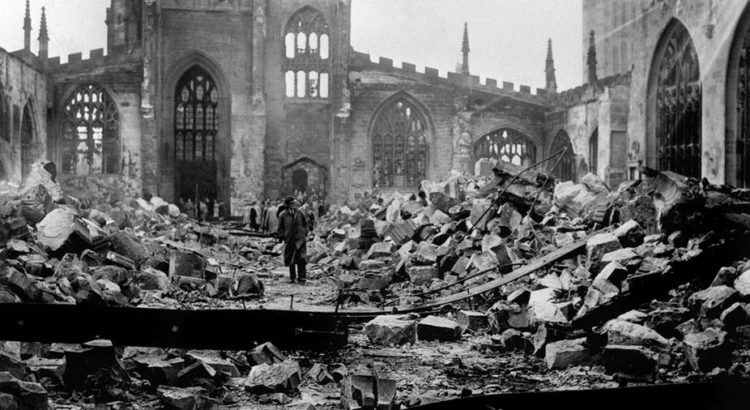
Benjamin Britten’s War Requiem was commissioned for the re-consecration of Britain’s Coventry Cathedral, a beautiful church tragically destroyed in a World War II bombing. Britten himself was a staunch pacifist who had registered as a conscientious objector during the war, and the unique combination of these two elements gave birth to a piece that cuts through the gloss of glorified war stories into the more complex, tragic truth of the raw destruction of war. The text of the 80-minute choral piece is assembled from the Latin Mass for the Dead and the poems of Wilfred Owen, a World War I soldier who was killed just a week before the armistice at the young age of 25. Owen’s poetry is plainly anti-war, and the first of his lines in the piece is the chilling “What passing bells for these who die as cattle?”.


The requiem was presented as the collaboration between the Ann Arbor Symphony Orchestra, the UMS Choral Union, the Ann Arbor Youth Chorale, as well as three vocal soloists. The addition of the children’s chorale as specified by the original work adds a uniquely haunting aspect to the piece, a reminder that war ultimately results in a great deal of innocence lost, and the sacrifice of young lives with full futures ahead. Britten alternates between dissonant chanting mixed with layers of percussion and smooth, lyrical passages as the piece glides from movement to movement. Yet throughout the entire piece, the atmosphere is solemn, almost haunting. Britten refuses to let the audience forget why the piece was conceived, as a response to a tragedy brought about by the senselessness of war. It is impossible to hear the words of Owen echo through the auditorium in the rich tenor of soloist Anthony Dean Griffey without feeling an acute sense of what we have lost to the cruelty of war. Owen himself was a poet who garnered an abundance of post-humous acclaim despite his short career and the few poems he wrote; his career was brought to an abrupt end by a premature death on the battlefield.


Owen is merely one of many young talents, or simply young people, or people in general, whose lives were stolen from them by the merciless combat between sides. War Requiemserves as a haunting reminder that war is not a necessary evil, nor is it one we can afford to distance ourselves from. In the United States, it is perilously easy to turn a blind eye to those suffering from wartime brutality in other countries and in the modern age it is perilously easy to designate war as a “necessary evil”, a tragic yet inevitable byproduct of civilization. Yet as Britten wants us to remember, in a society as advanced as ours, the fact that we have accepted senseless violence over superficial causes as the price of civilization ought to haunt us, and we ought to remember that we have more power over our fates than we like to admit.

REVIEW: If Beale Street Could Talk

If Beale Street Could Talk is a paradox. It is a beautiful movie about ugly realities. It is light enough to take flight and simultaneously weighed down. It should be an ordinary love story of two young people, but it also can’t be because those two people are black. And it is a movie of extraordinary substance, but only sometimes. So, I loved it, but only sometimes.

One of the most significant paradoxes, is how the film can feel incredibly focused and far too broad with its characterization. This is especially true for Tish (KiKi Layne) and Fonny (Stephan Lane), the couple around which the film (and occasionally the camera) revolves. Tish is newly pregnant. Fonny is newly imprisoned. It is a story that feels sadly inevitable. So even as Tish holds out hope for her beloved’s return, we watch with a sense of doom. They are beautiful outlines, walking down the street, hand in hand. Brightly blue and yellow clothing against the concrete sidewalk, you want to follow their silhouettes forever. But that’s all they are. Outlines. They never feel shaded in because so many things, their personalities, their histories, feel like afterthoughts in the narrative. Instead, they are constantly overshadowed by racist, societal forces that refuse to see them as people. And ironically, neither can we.

Though, Barry Jenkins certainly tries. His humanist style is apparent in every shot. When his camera focuses, really focuses, on Tish’s and Fonny’s faces, the lack of explanatory detail is utterly insignificant. Their eyes seem to contain a depth that is voiceless, a meaning that is inexplicable. When the score starts thrumming and the camera sweeps across a brick New York street, the feeling grows until it encompasses everything. Those overwhelming moments don’t by themselves, make the film incredible, but it certainly impresses upon you the importance of every moment. Time slows down, each passing moment agonized over, a memory in movement. For Tish and Fonny, after all, time is of the essence. Separation by prison glass makes every second precious. Seconds before Fonny is led away to a place where even Tish’s love cannot reach. Seconds before their time together is a distant memory.

The film’s greatest accomplishment, though, is forming characters around the Tish and Fonny so their relationship never becomes claustrophobic. In that way, the movie emphasizes familial love as much as romantic much to its advantage. Unlike Tish, her parents have long seen the world as it is. So, their happiness at the imminent birth is both incredibly joyous and a cautious projection. Regina King as Tish’s mom stands unwaveringly in her role, her eyes swimming with hidden vulnerabilities. And as Tish’s father, Coleman Douglas is a pillar of strength, going so far as to sell stolen merchandise to support the increasingly heavy fees for the lawyer. Every moment that the world crumbles, there is a willing hand, reaching out to take on another burden.

A love story above all, If Beale Street Could Talk wanders in a world of color without ever hesitating to explore the dark corners. It is, after all, in the hidden spaces where love blossoms best. In a cramped apartment room where Tish and Fonny finally connect. In a family home, where the celebration for a new member begins with a toast. In these places, there can be no police interference or shady justice systems. In these places, love triumphs.